
Wednesday, October 28, 2026
Nonturn: Repeating Town


A traffic signal changes. Someone crosses the street. An air conditioner hums away with the dedication of a civil servant approaching retirement. Cars pass, footsteps accumulate, machinery grumbles, and conversations dissolve into the general babble of urban existence. Most of us experience this as background noise, occasionally interrupted by a particularly obnoxious motorist. On "Repeating Town", however, these ordinary events become the entire musical vocabulary. Across seven tracks, Nonturn constructs a quietly propulsive electronic work from recordings made in and around Koenji, Tokyo, without using conventional instruments. The city supplies the raw material; editing supplies the composition.
Nonturn is the project of Nozom Yoneda, a Kanazawa-born composer based in Tokyo whose professional work spans film, television and commercial scoring alongside experimental music. He began releasing music in the British drum'n'bass scene in 2004 before gradually developing a sampling-based practice that places environmental recordings at its centre. His earlier Audiobulb releases, "Territory" (2018) and "Jellybeans" (2023), mark different stages in this exploration. "Territory" was constructed from environmental recordings made across Tokyo, while "Jellybeans" drew on extensive sound-library material. The new album returns to the physical city, but approaches it through a more tightly defined compositional framework. Rather than attempting to reproduce the experience of walking through a particular neighbourhood, Yoneda extracts sounds from their original circumstances and gives them new musical responsibilities.
The crucial decision is to organise all seven tracks around a tempo of 96 beats per minute. This provides a common temporal structure without forcing the music into the familiar architecture of dance-floor electronics. There is no obligatory four-on-the-floor kick drum, no synthesised bass line announcing that the weekend has officially begun. Instead, the rhythm emerges from the peculiar properties of recorded reality. A footstep can become a percussive accent; a mechanical hum can supply a sustained tonal layer; a signal or fragment of speech can acquire the function of a repeating motif. Once these sounds are cut, repositioned and layered, their original identities become less important than the relationships they establish.
This is where "Repeating Town" moves beyond the familiar appeal of field recordings. The simple act of capturing interesting noises can certainly produce compelling sound art, but a collection of unusual sounds is not automatically a composition. Yoneda's achievement lies in the grammar he develops from them. His material retains the roughness and irregularity of the environment, yet the fixed pulse gives it a sense of direction. Repetition becomes a means of discovering order without pretending that the world is naturally tidy. The music is neither a documentary soundtrack nor an ambient postcard of Tokyo. It is an alternative version of the city, one assembled according to rules that make its everyday activities audible in a new way.
The opening "Indicate" establishes this approach through the interplay of small sonic events and the album's measured rhythmic flow. The title suggests a signal, an instruction or a prompt to move, and the piece fits a work in which sounds acquire significance through their placement. "Atonement" continues the process, while "Repetition" makes the governing principle explicit. Yet repetition here is not simply the duplication of a sound until everyone involved has lost the will to object. Each recurrence changes the context in which a fragment is heard. What initially registers as a mechanical detail can become a rhythmic anchor; what seems incidental can gradually assume the importance of a musical phrase. Familiarity alters perception, and the repeated sound becomes different without necessarily changing very much at all.
"Stagnant" introduces an especially suggestive title into a record whose underlying pulse never stops. The apparent contradiction is productive: movement and inertia can coexist, just as a person can remain physically stationary while the city carries on around them. A constant tempo does not guarantee forward motion in the conventional dramatic sense. Instead, it establishes a stable reference against which small changes become more noticeable. The album's rhythm resembles the experience of travelling through a familiar district, where the route remains broadly predictable but the details never repeat in precisely the same way. There is a quiet tension between the regularity of the musical grid and the accidental character of the sounds placed upon it.
With "Fathom", the listener is invited to consider how much can be extracted from material that initially seems mundane. Yoneda's process depends on selection, but also on a willingness to let the recordings resist their original meanings. A sound can retain some trace of its source without continuing to function as evidence of a specific event. In this respect, the album occupies an interesting position between musique concrète and post-club electronics. It inherits the former's interest in treating recorded sound as compositional material, while borrowing from club culture an awareness of pulse, repetition and continuity. Neither tradition entirely explains the result. The music has a physical rhythmic presence, but its source material refuses the clean, predictable surfaces usually associated with electronic dance production.
"Disrupt" suggests a disturbance in the established pattern, although the album's deeper interest is not in manufacturing dramatic breakdowns for their own sake. Its organising principle remains consistent, allowing irregularities and changes of density to register against the shared tempo. The music can suggest a city in motion without resorting to a cinematic montage of sirens, horns and exaggerated urban menace. There is no need to make Tokyo sound like a dystopian metropolis whose inhabitants have been sentenced to perpetual overtime. The everyday is strange enough already, provided it receives a little attention.
The closing "Perpetual", the longest track at six minutes and forty-five seconds, gives the album a fitting final perspective. Its title points towards continuation rather than resolution, reinforcing the impression that the seven tracks form parts of a larger process. Each piece can be heard individually, but the common tempo allows them to connect as a continuous environment. This is more than a technical convenience: it suggests a city whose separate locations and activities participate in a shared temporal structure. The listener moves from one arrangement to the next while the pulse persists, much as urban life continues regardless of whether we happen to be paying attention.
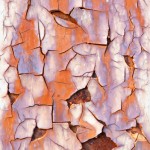
Yoneda's visual work extends this way of thinking beyond sound. The cover uses one of his close-up photographs of Tokyo's surfaces, focusing on details such as walls, textures and peeling paint. Seen from a distance, these belong to a recognisable urban environment; framed tightly enough, they become abstract arrangements of colour and form. The method mirrors the music. In both cases, the city is not simply represented but broken down into components whose relationships can be reconsidered. The photographs suggest that abstraction is not necessarily something imposed on reality from outside. Sometimes it begins by looking, or listening, more closely than ordinary habits encourage.
The accompanying video project takes the idea further. Yoneda recorded footage at the same time as capturing the sounds, then developed a custom Ableton-to-video application, A2MVE, to reconstruct the footage according to the arrangement of the musical session. As sounds overlap, the image divides; when the music repeats, the corresponding visual material repeats too. The footage itself remains real, while artificial intelligence helped design editing rules and extend the process to a level of complexity that would be impractical to assemble manually. This is a thoughtful application of technology: not an attempt to manufacture a synthetic city, but a way of making the relationship between recorded sound, editing and visual perception more explicit. The software effectively turns the arrangement into a set of instructions for looking.
There is something quietly subversive about this project. Contemporary urban life is saturated with sounds that are functional before they are aesthetic. Signals tell us when to cross, machines keep buildings operating, footsteps carry people towards their destinations, and passing conversations vanish before we can make sense of them. We are trained to interpret these events quickly and move on. Yoneda interrupts that process by giving the sounds a different purpose. The signal no longer needs to direct a pedestrian; the machine no longer needs to perform its practical duty. Each becomes part of a composition whose meaning depends on how it relates to everything else.
The result is not necessarily music that makes one long to dance, although its pulse provides a gentle bodily invitation. Nor is it ambient music in the sense of a passive backdrop intended to make a room feel sophisticated while somebody chooses a takeaway. "Repeating Town" asks for active listening, but it does not demand solemn concentration. Its pleasures come from noticing how the pieces fit together, how an apparently unmusical sound can acquire a recognisable role, and how the fixed tempo allows disparate recordings to coexist. The concept is rigorous, yet the music remains approachable because its raw materials belong to experiences most listeners already know.
There are limits to the approach. A consistent tempo and a shared sampling method inevitably impose a degree of uniformity, and listeners looking for strong melodic development or dramatic structural contrasts may find the album's restrained progression too even. The same process that produces coherence can also soften the distinctions between individual tracks. But this tension is intrinsic to the project: Yoneda is not trying to create seven unrelated showcases of technique. He is examining the repetitions that bind a place together, and the continuity of the music is part of the argument.
"Repeating Town" ultimately demonstrates that the boundary between noise and music is less stable than everyday listening assumes. The city does not need to be made beautiful through sentimental orchestration, nor does its sound have to be preserved untouched to retain documentary value. Yoneda takes the middle route, editing reality until its ordinary details reveal another order. The work is precise without feeling sterile, rhythmic without surrendering to conventional club formulas, and experimental without treating obscurity as a badge of honour.
After listening, the most noticeable change may occur outside the album. A crossing signal, the rhythm of someone walking, a ventilation unit rattling above a shop: these sounds may briefly seem less like interruptions and more like parts of an arrangement nobody has quite finished composing. The city has not suddenly become more musical. The listener has simply acquired a different way of hearing it. Given how much noise modern life produces, that is a rather useful skill to take home.
Comments
Stream
Browse by Genre
Industrial Music / Industrial Metal / Aggro Industrial / Electro Metal
Industrial Noise / Power Noise / Harsh Noise
Synth Pop / Electro Pop / Synth-Electronica
Techno / Trance / Goa / Drum'n'Bass / Jungle / Tribal / Trip-Hop
Ambient / Electronica / Ethereal / Dub / Soundscapes / Abstract
Experimental / Avantgarde / Weird & Wired / Glitch / Noise / Field Recording
Dark / Gothic / Wave / New Wave / Dark Wave / Industrial Gothic
New Music / Downtown / Avantgarde Jazz / New Classical / World