
Wednesday, November 4, 2026
Honey Ride Me A Goat: Horns & Hooves
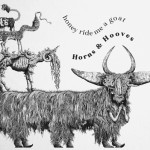
Artist: Honey Ride Me A Goat
Title: Horns & Hooves
Format: 12" + Download
Label: Cuneiform (http://www.cuneiformrecords.com/) (@)
Rated:

Title: Horns & Hooves
Format: 12" + Download
Label: Cuneiform (http://www.cuneiformrecords.com/) (@)
Rated:
Honey Ride Me A Goat have never seemed particularly concerned with making music that behaves itself. Their name sounds like the result of a pub conversation that went badly wrong, and their compositions tend to share that conversation's disregard for conventional manners. Yet there is more to this Kentish trio's peculiar universe than a taste for absurdity and instrumental demolition. "Horns & Hooves", their first full-length album for Cuneiform Records, finds them refining an approach built around the friction between tightly organised structures and spontaneous disruption. The addition of American saxophonist Patrick Shiroishi makes that friction even more productive, giving the band's familiar guitar-bass-drums combination a new dimension without turning it into a conventional jazz-rock outfit.
The history behind the record is a little unusual. Honey Ride Me A Goat were formed by school friends attending college in Canterbury in the early 2000s, united by a shared affection for Captain Beefheart, Black Sabbath and Soft Machine. They began playing live around 2005, releasing a self-titled EP in 2006, followed by a series of tapes and split releases. Much of this early material was gathered on "Udders", issued by Australia's Lexicon Devil in 2010. Their association with Canterbury's musical heritage became more concrete when they recorded an improvised session with Soft Machine bassist Hugh Hopper in 2008. The resulting material eventually appeared as "Goat Hopper" in 2013, after Hopper's death in 2009 had put an end to plans for further collaboration. The band continued to work with American avant-rock group Upsilon Acrux, including joint UK tours and a split release, before eventually entering a lengthy hiatus in 2020.
The new album was recorded in early 2020 and subsequently left unreleased for several years before finding its home at Cuneiform. This delayed arrival gives "Horns & Hooves" the slightly peculiar status of a document from a band that had already moved into a different chapter of its existence by the time the record reached listeners. It also captures a significant change in their sound. The earlier material was often characterised by furious, tightly packed jazz-punk, but here the group allows more direct compositional forms to develop, creating additional room for improvisation. The presence of Shiroishi is central to this evolution. Rather than being invited to provide occasional saxophone decoration, he becomes an integral part of the arrangements, contributing to the music's architecture as well as its more unrestrained passages.
Shiroishi is an especially appropriate collaborator. The Los Angeles-based saxophonist has developed an extensive body of work across free improvisation, experimental music, noise and punk, both as a solo artist and through numerous collaborations. His playing can move between abrasive blasts, lyrical phrases and extended textural explorations, and he has a particularly useful ability to inhabit music without simply taking it over. His experience with Upsilon Acrux also provides a direct link to HRMAG's own history. On "Horns & Hooves", the saxophone does not function as a guest soloist perched above the rhythm section; it becomes another unruly participant in the band's collective argument.
The album opens with "Meatpecker Suite", an eight-minute introduction to the quartet's peculiar sense of order. A jagged guitar figure establishes an angular framework, quickly joined by bass and drums, before the saxophone begins to complicate the arrangement. The music moves between clipped, repeated motifs and freer exchanges, with the instruments repeatedly threatening to pull the piece in different directions. There is a pleasingly physical quality to the performance, but the musicians are not simply chasing speed or volume. Their rhythmic interplay is too considered for that. Even when the arrangement becomes chaotic, one can sense the underlying framework holding everything together, like the structural beams of a building that has been designed by someone with a serious disagreement with right angles.
"Gooseflaps" takes a more compact route, relying on abrupt changes and tightly wound rhythmic gestures. Its short duration makes it feel almost like a concentrated burst of nervous energy, with guitar and saxophone trading sharp-edged phrases over a rhythm section that refuses to settle into predictable patterns. There is a trace of no-wave's confrontational economy here, but also a playful quality that prevents the music from becoming merely aggressive. The title, naturally, offers little assistance in interpreting the composition. One suspects that this is entirely intentional.
"Spacedocker" is one of the album's most immediately engaging pieces, combining a more recognisable rhythmic drive with the quartet's fondness for sudden structural detours. The guitar provides a stronger sense of direction, while the saxophone adds a wiry, restless counterpoint. The piece has something of the muscular precision associated with math rock, but it avoids the genre's more familiar displays of instrumental athleticism. There is no obvious desire to demonstrate how many subdivisions can be squeezed into a bar before the listener requests medical assistance. Instead, the musicians use rhythmic complexity as a means of generating tension and movement. The result is energetic, oddly catchy and just unpredictable enough to keep the floorboards nervous.
"Collyleg" brings the first half of the record to a close with another compact exercise in controlled disruption. Its short form gives the band little opportunity to settle into a single idea, and the music seems to enjoy the resulting instability. Yet the quartet's ability to make these abrupt transitions feel natural is one of its most persuasive qualities. Their compositions are not simply collections of unrelated riffs and improvisations; there is a clear sense of interaction between the different elements, even when the direction changes without warning.
The remaining four pieces on the full digital edition broaden the picture considerably. "Preposterous Proboscis / Tephra" makes the band's Beefheart inheritance particularly apparent, combining an eccentric, almost cartoonish central motif with a more volatile instrumental conversation. The composition moves between playful rhythmic patterns and noisier passages, allowing its absurdity to become part of the musical structure rather than an amusing distraction. "Flambé Gump" pushes further towards the abrasive end of the spectrum, with guitar and saxophone generating a particularly unruly texture. The performance has a rough, almost confrontational energy, but it remains sufficiently alert to dynamics to avoid becoming an undifferentiated wall of sound.
Then comes "Plappy", a welcome change of temperature. Michael Pike's piano introduces a more lyrical dimension, and the composition's comparatively measured pace reveals a side of the band that might otherwise remain concealed beneath the rhythmic commotion. There is a slightly melancholic quality to the piece, and its more direct melodic gestures provide a useful contrast to the album's harsher passages. It is not exactly a ballad, unless one imagines a ballad being performed by musicians who have just discovered that the piano has been left unattended in a room full of strange noises. Still, its presence is important: it demonstrates that the group can create atmosphere and melodic focus without abandoning its distinctive character.
The closing "Bedlams Bottom" returns to more turbulent territory, with discordant guitar work and increasingly free rhythmic activity bringing the record to an appropriately unsettled conclusion. The title suggests a place where things have gone badly wrong, and the music offers little evidence to the contrary. Shiroishi's saxophone is particularly effective in this context, moving between sharply defined gestures and more open-ended bursts of sound. The final impression is not one of resolution, but of a group that has discovered several new ways to make its own musical machinery malfunction.
What distinguishes "Horns & Hooves" from a great deal of contemporary instrumental experimentation is its attitude towards complexity. The band is clearly capable of intricate playing, but it does not confuse technical difficulty with artistic purpose. Its rhythmic frameworks are often built through repetition rather than conventional notation, leaving room for the musicians to alter, extend or destabilise them in performance. This gives the music a flexibility that is different from the tightly scripted intricacies of much math rock. The compositions can be precise without feeling rigid, and improvised without becoming shapeless. That balance is not easy to achieve, particularly when the instruments involved seem to have been selected partly for their ability to disagree with one another.
The production helps preserve this tension. The recordings, made at Big Jelly Studios and Delta Studios, have a raw but clearly defined sound, allowing the instrumental details to remain audible even when the music becomes particularly dense. Guitar, bass and drums retain their physical weight, while the saxophone is given enough space to contribute meaningfully rather than simply decorate the arrangements. The result feels immediate without sacrificing the distinctions between the different musical voices.
There is also a welcome absence of solemnity. Experimental rock can sometimes become so preoccupied with demonstrating its seriousness that it forgets music is supposed to be an enjoyable activity. Honey Ride Me A Goat understand that absurdity and sophistication are not mutually exclusive. Their compositions can be demanding, dissonant and rhythmically intricate, but they also possess a mischievous streak that keeps the whole enterprise from becoming an academic exercise. The band's humour is not merely a matter of ridiculous titles; it is embedded in the way the music continually upsets expectations, as though the musicians are quietly amused by the listener's attempts to anticipate what comes next.
"Horns & Hooves" is therefore more than a belated document of a group with an unusually long and fragmented history. It captures a band finding a new balance between its original instincts and the possibilities offered by an expanded lineup. Patrick Shiroishi's contribution is substantial, but the underlying personality remains unmistakably that of HRMAG: angular, unpredictable, rhythmically mischievous and cheerfully resistant to categorisation. The album may have taken several years to reach the public, but its music sounds anything but archival. It has the restless energy of something that has been waiting patiently for the right moment to cause trouble.
Comments
Stream
Browse by Genre
Industrial Music / Industrial Metal / Aggro Industrial / Electro Metal
Industrial Noise / Power Noise / Harsh Noise
Synth Pop / Electro Pop / Synth-Electronica
Techno / Trance / Goa / Drum'n'Bass / Jungle / Tribal / Trip-Hop
Ambient / Electronica / Ethereal / Dub / Soundscapes / Abstract
Experimental / Avantgarde / Weird & Wired / Glitch / Noise / Field Recording
Dark / Gothic / Wave / New Wave / Dark Wave / Industrial Gothic
New Music / Downtown / Avantgarde Jazz / New Classical / World