
Wednesday, November 18, 2026
Warrington-Runcorn New Town Development Plan: Industrial Growth
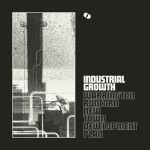
Artist: Warrington-Runcorn New Town Development Plan (@)
Title: Industrial Growth
Format: CD + Download
Label: Castles in Space (@)
Rated:

Title: Industrial Growth
Format: CD + Download
Label: Castles in Space (@)
Rated:
The future was supposed to be carefully planned. There would be modern housing, efficient public transport, pleasant green spaces, convenient shopping facilities and thriving communities, all arranged according to the reassuring geometry of post-war urban planning. Somewhere along the way, however, the brochures became detached from reality, the infrastructure began to deteriorate and the promised social improvements were quietly replaced by the usual assortment of economic calculations and political excuses. Gordon Chapman-Fox has spent several years exploring the distance between those aspirations and their eventual consequences through Warrington-Runcorn New Town Development Plan. With "Industrial Growth", he appears to have decided that the time for politely pointing at the cracks is over. The bulldozers are still running, but something considerably less constructive is happening behind the site fencing.
Since its emergence in 2020, WRNTDP has developed a distinctive musical and conceptual identity, drawing on the modernist ambitions of Britain's post-war new town programme. The project's retro-futurist electronics evoke the promotional films, architectural illustrations and public information broadcasts through which places such as Warrington and Runcorn were presented as models of a more rational, prosperous society. Chapman-Fox, however, has never been interested in uncomplicated nostalgia. The appeal lies in the contradiction between the optimism embedded in those original visions and the subsequent erosion of their promises. His music looks backwards in order to examine the present, rather than offering an imaginary return to an age when everything supposedly worked better. The distinction matters: this is not music for people who collect vintage council brochures because they find concrete car parks emotionally reassuring, although there may well be a market for that somewhere.
Chapman-Fox's personal connection to the subject goes back to childhood memories of television advertisements promoting the new towns. Their combination of idealised urban imagery and electronic music left a lasting impression, eventually becoming the foundation for a project that has grown into a surprisingly substantial body of work. His interest in these places is also rooted in their geographical and cultural position. Rather than concentrating on the familiar mythology of Britain's major cities, WRNTDP gives musical attention to towns that rarely receive much cultural recognition. In interviews, Chapman-Fox has stressed the importance of celebrating places that have been overlooked, while remaining conscious of the broken promises and inadequate investment that shaped their later development. The music's political dimension has consequently become more explicit with each release, without sacrificing its peculiar fascination with the aesthetics of an imagined future.
"Industrial Growth", the project's seventh album, marks a substantial escalation in sonic intensity. Much of the material originated as a suite commissioned by Roadburn Festival for its 2024 edition in Tilburg, a context that makes the record's heavier tendencies particularly understandable. The compositions were subsequently developed in the studio and refined through live performances in the UK. The result is a collection that retains the project's familiar synthesiser vocabulary while introducing considerably more distortion, dissonance and physical aggression. The album's title is deliberately misleading in the most productive sense: the growth in question is not the reassuring upward curve of an economic forecast, but something organic, invasive and difficult to contain. One suspects the planning committee would not have approved the revised proposal.
“This Machine” makes the change immediately apparent. Its pounding rhythms, abrasive electronic surfaces and searing noise establish an atmosphere of industrial hostility that would have seemed excessive on some of the project's earlier records. The track does not so much introduce the album as announce that the public consultation period has ended. Yet beneath its aggression there remains a strong sense of structure. The rhythmic elements are tightly organised, and the distorted textures are deployed with sufficient control to prevent the composition from collapsing into undifferentiated noise. Chapman-Fox understands the difference between sounding angry and simply turning everything up, a distinction that several industrial producers have apparently overlooked since the invention of the volume control.
“The Wire” follows with a more recognisable melodic framework, its repeating synthesiser figures recalling the cyclical constructions of Kraftwerk, particularly the hypnotic propulsion of "Trans-Europe Express". But where that classic album often suggested a technological future characterised by movement and possibility, Chapman-Fox's version seems to travel through an infrastructure that has begun to malfunction. The recurring patterns are both reassuring and faintly ominous, as though a familiar public announcement were being repeated long after the service it describes had ceased to operate.
“Warrington Bank Quay” brings the conceptual geography closer to the surface. The station is a real place, but its appearance here is less an invitation to travel than a reminder of the importance of transport infrastructure to the original new town vision. The track's gloomy electronic atmosphere suggests a location caught between activity and abandonment, its musical details gradually obscured by a sense of urban fatigue. “Heavy Industry” offers a striking contrast. Despite its title, it is one of the album's more luminous moments, with a stirring melodic construction that briefly allows the synthesizers to recover some of their earlier optimism. Chapman-Fox has described it as an unusual moment of light within the record, and its effect is all the more powerful because the surrounding material is so relentlessly dark. The track could almost accompany a public information film from an alternate 1980s, one in which John Carpenter had been commissioned to explain the benefits of regional employment schemes.
“Parkside” returns to a more unsettling electronic vocabulary. Its compact duration and eerie textures give it the character of an industrial warning signal, while “Post Industrial Policy” develops a more expansive, kosmische orientation. The synthesiser patterns are hypnotic, but their melodic beauty is complicated by a persistent sense of unease. There are moments when the music seems to occupy the territory between Chris & Cosey and Klaus Schulze, although the comparison should not obscure Chapman-Fox's own compositional identity. His electronic arrangements have always possessed a distinctive civic quality, as if they were documenting the psychological atmosphere of an entire region rather than the private concerns of an individual musician.
“Post Industrial Policy” is particularly effective because it does not treat industrial decline as a purely visual or documentary subject. Its repeated patterns suggest processes that continue long after their original purpose has disappeared. The track's title also carries an uncomfortable political implication: what happens when the industrial future has been dismantled, but no convincing alternative has been provided? The answer, at least musically, is a strangely compelling combination of rhythmic persistence and melodic uncertainty.
“Astmoor” moves into darker ambient territory, its murky textures suggesting a landscape in which the distinction between industrial residue and natural environment has become increasingly difficult to establish. The track offers a more restrained passage before the album's final confrontation. “Industrial Unrest” then brings everything to a suitably abrasive conclusion, with distortion and dissonant percussion replacing much of the melodic clarity that has characterised the record's more accessible passages. It is a formidable closing statement, although not an entirely comfortable one. The noise feels less like an ornamental climax than the accumulated consequence of everything that has preceded it.
The album's artwork, designed by Chapman-Fox with illustrations by Michael Cooke, reinforces the relationship between the music and the actual experience of living in these towns. Cooke grew up in Runcorn, and his contribution draws on first-hand familiarity with the area. This gives the visual presentation an additional dimension: the places being examined are not merely abstract examples of failed modernist planning, but lived environments with their own histories, memories and communities. That distinction is essential to the project's political perspective. It is easy to romanticise architectural utopianism from a distance; it is considerably harder to ignore the people left dealing with its unfinished business.
The bonus TVAM remix of “This Machine”, available through Bandcamp, provides another perspective on the album's central material, although the original version already makes its intentions abundantly clear. More broadly, "Industrial Growth" demonstrates how successfully Chapman-Fox has expanded the project's musical vocabulary without abandoning its conceptual foundations. The increased aggression does not feel like an attempt to follow contemporary industrial trends, but a response to the increasingly hostile social and political conditions that inform the work. There is still plenty of the shimmering, melodic electronic writing that made earlier WRNTDP releases so distinctive, but here it is frequently surrounded by sounds that seem intent on dismantling it.
The risk, of course, is that such a consistently dark approach might reduce the album to a single emotional register. A little more contrast would occasionally have made the heavier passages even more effective. Yet the moments of melodic brightness, particularly “Heavy Industry” and “The Wire”, provide enough variation to prevent the record from becoming a prolonged exercise in sonic pessimism. Chapman-Fox has also avoided the temptation to turn his political concerns into a series of musical slogans. The compositions remain compelling as electronic works in their own right, even when their titles and conceptual background give them a more specific meaning.
"Industrial Growth" is arguably the most uncompromising entry in the Warrington-Runcorn New Town Development Plan catalogue so far. It takes the project's fascination with post-war optimism and its subsequent disillusionment into harsher territory, replacing some of the earlier records' wistful melodic qualities with a more direct expression of anger. The result is both musically satisfying and politically pointed. The original new towns were designed around the belief that better planning could produce better lives. Chapman-Fox's latest work asks what happens when those ambitions are abandoned, and when the language of progress continues to be used long after its substance has disappeared. The answer is not especially comforting, but it makes for a compelling record. Somewhere, a municipal architect is probably reconsidering the soundtrack for the next public consultation.
Comments
Stream
Browse by Genre
Industrial Music / Industrial Metal / Aggro Industrial / Electro Metal
Industrial Noise / Power Noise / Harsh Noise
Synth Pop / Electro Pop / Synth-Electronica
Techno / Trance / Goa / Drum'n'Bass / Jungle / Tribal / Trip-Hop
Ambient / Electronica / Ethereal / Dub / Soundscapes / Abstract
Experimental / Avantgarde / Weird & Wired / Glitch / Noise / Field Recording
Dark / Gothic / Wave / New Wave / Dark Wave / Industrial Gothic
New Music / Downtown / Avantgarde Jazz / New Classical / World