
Thursday, November 19, 2026
Tobia Poltronieri: La voce della padrona
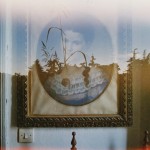
Artist: Tobia Poltronieri (http://www.tobjah.it/) (@)
Title: La voce della padrona
Format: LP
Label: Torto Editions/Esicasmio/Ramble Records (@)
Rated:

Title: La voce della padrona
Format: LP
Label: Torto Editions/Esicasmio/Ramble Records (@)
Rated:
There is something rather wonderful about the idea of spending fifteen years collecting sounds without knowing quite what to do with them, then eventually deciding that they deserve to leave the house. Not every recording needs to become a song, not every musical thought has to justify its existence with a chorus, and not every fragment needs to be rescued from the cutting-room floor. "La voce della padrona" grows out of this freedom. Tobia Poltronieri has assembled material accumulated between 2009 and 2025, captured on dictaphones, four-track cassette recorders and digital devices during journeys, concert tours, sleepless nights and those peculiar intervals when the mind is awake but not entirely committed to the responsibilities of consciousness. The result is a twelve-part instrumental work that feels personal without becoming confessional, and exploratory without turning into an exercise in sound-design self-importance.
Poltronieri is perhaps best known as a co-founder of C+C=Maxigross, the restless collective that emerged from Verona's Lessinia hills in 2008, but his musical history extends well beyond that project. Under the name Tobjah he has pursued a more individual path, moving between songwriting, improvisation and production, while collaborating with musicians as varied as Lino Capra Vaccina, Gabriele Mitelli, Marco Giudici and the late Miles Cooper Seaton. His experience with Seaton, particularly through the Miles Cooper Seaton Trio, is relevant here: the willingness to let a composition remain open, to welcome accidents and to regard musical identity as something that can change through contact with other people. Yet "La voce della padrona" is not simply an archive of collaborations. Its central voice is Poltronieri's guitar, acoustic or electric, treated less as a vehicle for conventional melody than as a means of tracing, interrupting and connecting impressions. Tapes, loops, small keyboards and occasional voices expand the vocabulary, but the guitar remains the album's most recognisable presence.
The opening sequence establishes the record's peculiar sense of proportion. “Labirinto Armonico” and “Cascata Gallurese” are brief, suggestive pieces, followed by the even shorter “Cantico del Saval” and “Ascesa al Corno D’Aquilio”. These titles might suggest a carefully plotted geographical itinerary, but the music is less interested in providing directions than in preserving the sensation of having been somewhere. A few minutes are enough to establish a particular colour or atmosphere before the next recollection takes over. “Rena Majore” gives the guitar more room to unfold, while “Veliero” passes almost like a fleeting thought, its brevity making it feel less like an incomplete composition than a glimpse caught before it disappears. The sequence is deliberately uneven in scale, and that is part of its charm: Poltronieri doesn't seem particularly concerned with the modern album's obligation to make every track look equally important on paper.
The seven-minute “Tropic of Dalston” is the record's most extended episode, and its London reference offers an interesting counterweight to the rural and domestic geography suggested elsewhere. The album moves between the Lessini Prealps, Gallura, southern Sardinia and Verona's Veronetta neighbourhood, but it also carries traces of places encountered through touring and musical friendships. These locations are not presented as postcards, and the music rarely behaves like a literal illustration of landscape. Instead, they become entangled with the imperfect ways in which memory works: a place returns through a particular resonance, a fragment of conversation, a guitar figure or an acoustic detail whose original context may already have vanished. “Carbonassi” introduces Zeno Merlini's clarinet and tapes, while the presence of Alessandro Cau's drums and Luigi Pinarel's voice on the opening track, and Miles Cooper Seaton's electric guitar on “Tropic of Dalston”, gives the material occasional human points of contact. Their contributions feel integrated into the record's long gestation rather than added as prestigious names for the sleeve. Seaton's participation is especially poignant, given his importance in Poltronieri's musical life and his death in 2021.
There is a quiet tension between the album's apparently spontaneous origins and the considerable editorial work required to turn hundreds of fragments into a coherent twelve-track sequence. A sound diary is not automatically an interesting record; private memories can become rather tedious when presented without selection, rather like being trapped at a dinner party with someone who insists on showing every photograph from a holiday. Poltronieri avoids that trap by allowing the pieces to retain their different degrees of finish and immediacy, while giving the whole a recognisable musical character. The short “Ballu del San Francesco”, the more substantial “Mulinu Becciu” and the six-minute “Cieco Pozza” offer successive shifts in pace and texture without forcing an artificial narrative onto the material. The mastering by Giuseppe Ielasi also deserves mention in a record whose identity depends so much on the relationship between recorded detail, texture and space.
The title inevitably invites a comparison with Franco Battiato's "La voce del padrone", although Poltronieri's record inhabits a very different territory from that landmark of Italian pop. Here the voice is largely absent, or at least displaced: it survives as a memory, a suggestion, a distant presence. The album's final miniature, also titled “La voce della padrona”, was recorded on a Yamaha DX7 that Poltronieri had recently bought from a neighbour. Its chosen preset, rather wonderfully, was called “Ladyvox”. It is a small coincidence, but one that seems to have given the entire collection its final clue. The cover offers another connection to the past: a double-exposure photograph incorporating a portrait of Luigina Anselmi, painted by Alcide Allevi in 1869, an image that had been watching over Poltronieri since childhood in his grandmother's home. The record is dedicated to Diana Presutti, who died in 2023, adding another personal dimension to its meditation on what remains.
Ultimately, "La voce della padrona" is less an album about nostalgia than an attempt to understand how the past continues to inhabit ordinary experience, often without announcing itself. Its fragments have survived changes of location, equipment, relationships and circumstance, but they have not been polished into a falsely seamless retrospective. Some passages feel like notes left in the margins of a much larger composition; others acquire an unexpected weight precisely because they are allowed to remain brief. There is a certain generosity in this approach, and also a useful reminder that not everything we make has to be immediately understood, categorised or turned into something productive. Sometimes a sound can simply stay with us for years, waiting for the right moment to become audible again. Apparently, even forgotten recordings have better patience than most of us.
Comments
Stream
Browse by Genre
Industrial Music / Industrial Metal / Aggro Industrial / Electro Metal
Industrial Noise / Power Noise / Harsh Noise
Synth Pop / Electro Pop / Synth-Electronica
Techno / Trance / Goa / Drum'n'Bass / Jungle / Tribal / Trip-Hop
Ambient / Electronica / Ethereal / Dub / Soundscapes / Abstract
Experimental / Avantgarde / Weird & Wired / Glitch / Noise / Field Recording
Dark / Gothic / Wave / New Wave / Dark Wave / Industrial Gothic
New Music / Downtown / Avantgarde Jazz / New Classical / World