
Tuesday, September 15, 2026
Maps and Diagrams: In Circles
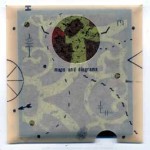


"In Circles" is the second release for Alameda-based Time Released Sound, whose strictly limited editions combine very finely hand crafted packaging and likewise refined mostly ambient and folk music, and the fifth one in 2013 by one of the most appreciated stretcher of frequencies within the packed ambient scene, the brilliant sound alchemist Tim Martin, mainly known in the guise of Maps and Diagrams. There are seemingly many similarities between "In Circles" and "Get Lost", its previous album on TRS, due to the instantaneous emotional impact of each track, the dilution of any sonic appearances into lengthened frequency, a vague sense of bygone nostalgia and an all-absorbing vibrant nimbus, but apart from the refiniment of Martin's way of blending and layering sounds, which usually characterizes his stuff, a careful listening reveals a more meticulous attention to details on dynamics. All the tracks of "In Circles" sounds like transmissions from somehow blurred and mostly celestial places which gves just some tanglible clues in the "real" one and can only be explored in a dream state: the aural breeze on the initial "Talavera" sounds like springing its sonic emissions (including a distant airy piano melody) up and pouring them into the following "Bosque" where what seems to be an elongated church organ swathes the whole track by a kind of holy effulgence, the vaguely bucolic escape in slow motion of "Valargo" and the sweet lapse of "Ten Black Cards", which precedes the heavenly transmissions of the breathtaking "Kimura (Cadiz)". One of the better chiseled moment of the album comes with "A Bump In The Night", where the initial guitar phrasing seems to slide into a fictional dimension by tunefully weaving together a beaming sound before its fade-out and similar dynamics where an instrumental element got fully imbibed by aural sonorities or aural transfigurations of exogenous stimulations occur on "Batika (Rust)" or the enchanting "Madrid (Orion)", which could be considered as necessary sonic steps towards totally ethereal episodes like "Locus (AB)" or "1895 (Moth Evolution)". Even if there some connections with Spain, including the voice by Spanish guests I am Dive on the lovely final song "Yesterday" and the antique ornate silkscreened Spanish cork wallpapers for the artwork of the deluxe version (only 70 copies), each "physical" entity got always mirrored by a sort of sidereal twin.
Comments
Browse by Genre
Industrial Music / Industrial Metal / Aggro Industrial / Electro Metal
Industrial Noise / Power Noise / Harsh Noise
Synth Pop / Electro Pop / Synth-Electronica
Techno / Trance / Goa / Drum'n'Bass / Jungle / Tribal / Trip-Hop
Ambient / Electronica / Ethereal / Dub / Soundscapes / Abstract
Experimental / Avantgarde / Weird & Wired / Glitch / Noise / Field Recording
Dark / Gothic / Wave / New Wave / Dark Wave / Industrial Gothic
New Music / Downtown / Avantgarde Jazz / New Classical / World