
Erik Friedlander: Illuminations
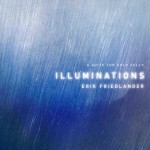


Many works of brilliant cello player and composer Erik Friedlander seems to look for a symbiotic connection or take a linking to the environment where he performs or to specific events that deeply signs a community or a place. This aspect was clear on his soundtrack for Nothing on Earth, that I recently introduced on Chain DLK, and is also particularly relevant on "Illuminations", his latest solo release that combines a double source for inspiration. The first one was the environment where he performed this suite, that was originally commissioned by the Jewish Museum in New York City, which hosted an exhibit of ancient books and manuscripts from Oxford University's Bodleian Collection: "I found myself in this darkened room surrounded by these gorgeous books and manuscripts that seemed to be talking to me. They were telling me a story of patience and craft, ritual and dedication that was inspiring". The second one is merely compositional and is mainly related to Erik's life-long studies on Bach's cello suites, which seem to have been one of the starting point for his scores on "Illuminations": "I was inspired by Bach's Preludes which are technically challenging and musically formidable. Scriptorium is a serious place where work gets done. Scribes sometimes spent their entire lives working in this room". Unlike Bach, who mainly used French dances for his sublime cello suites such as Courante and Bouree, Friedlander preferred to adapt Renaissance vocal forms, ritual dance movements (such as "Cham", named after the trance-inducing mystical Tibetan dance and "Tarantella", the notorious Apulian dance which was supposedly caused by the bite of tarantula), Chants and Madrigals (the tonal counterpoints at the end of each phrases on Erik's amazing "Madrigale - The Virgin and The Unicorn" or the remarkable work on the harmonic textures of "Siddur", the other madrigal which was named after the collection of Jewish daily prayers, are just a couple of tricks to let these definitively old-fashioned styles more contemporary). Wisely opened by an invocation to Seshat, the Egyptian Goddess of writing and science, who got invocated during the ancient religious ceremony of the stretching of the rope (a clear reference to the strings of cello), this release shows the ability of Erik in turning the sound of cello in a way that could cheat listeners by letting them believe he's playing a lute or a gamba as well.
Comments
Browse by Genre
Industrial Music / Industrial Metal / Aggro Industrial / Electro Metal
Industrial Noise / Power Noise / Harsh Noise
Synth Pop / Electro Pop / Synth-Electronica
Techno / Trance / Goa / Drum'n'Bass / Jungle / Tribal / Trip-Hop
Ambient / Electronica / Ethereal / Dub / Soundscapes / Abstract
Experimental / Avantgarde / Weird & Wired / Glitch / Noise / Field Recording
Dark / Gothic / Wave / New Wave / Dark Wave / Industrial Gothic
New Music / Downtown / Avantgarde Jazz / New Classical / World