
Browse by Genre
Industrial Music / Industrial Metal / Aggro Industrial / Electro Metal
Industrial Noise / Power Noise / Harsh Noise
Synth Pop / Electro Pop / Synth-Electronica
Techno / Trance / Goa / Drum'n'Bass / Jungle / Tribal / Trip-Hop
Ambient / Electronica / Ethereal / Dub / Soundscapes / Abstract
Experimental / Avantgarde / Weird & Wired / Glitch / Noise / Field Recording
Dark / Gothic / Wave / New Wave / Dark Wave / Industrial Gothic
New Music / Downtown / Avantgarde Jazz / New Classical / World
Search Reviews
Music Reviews
Julien Gasc: Perles, coraux & requins
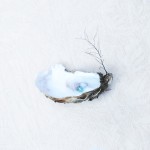
Artist: Julien Gasc
Title: Perles, coraux & requins
Format: CD + Download
Label: Prohibited Records (@)
Rated:

Title: Perles, coraux & requins
Format: CD + Download
Label: Prohibited Records (@)
Rated:
Julien Gasc has always seemed slightly suspicious of the idea that a song should behave itself. On "Perles, coraux & requins", his fifth solo album, he gives that suspicion an aquatic setting: beneath the turbulence of ordinary life, somewhere between romantic fantasy, private melancholy and mildly surreal observation, he goes diving. The result is an album that treats French chanson less as a tradition to be preserved than as a strange little animal that can still be taught some new tricks.
Gasc’s background makes the record’s peculiar balance easier to understand. A founding member of Aquaserge, he has also worked with Stereolab, while his solo catalogue has gradually moved between psychedelic pop, intimate songwriting, experimental arrangements and the more eccentric corners of French song. He is a multi-instrumentalist in the literal sense rather than the promotional sense: here he handles voice, guitar, bass, organ, synthesizers, Mellotron and drum machine, constructing a remarkably detailed environment around songs that often sound deceptively simple. His musical vocabulary draws on Brazilian songwriters such as João Gilberto and Chico Buarque, but also on the more elusive tradition of French pop in which melody, verbal absurdity and arrangement can coexist without asking permission from one another.
The Berlin circumstances add another layer of intrigue. Anton Newcombe recorded the album over three sessions between 2023 and 2024, contributing synthesizers, Mellotron and percussion, while Tim Gane adds guitar and Leo Blomov provides arrangements. It is an unusually convincing meeting because Newcombe’s psychedelic sensibility does not turn Gasc into another BJM satellite, nor does Gane merely arrive to provide an instantly recognisable Stereolab signature. Instead, the production gives the songs a slightly skewed depth, allowing apparently modest gestures to acquire strange afterimages. There is plenty of studio detail here, but very little of the modern obsession with polishing every surface until the music looks frightened of being touched.
“Rosen montag” immediately establishes Gasc’s peculiar relationship with rhythm and melody. His singing can sound languid without being passive, as though the words are arriving a fraction later than the music and have decided not to apologise. “Chez Martine” takes that quality further, with Tim Gane’s guitar adding a subtle foreign body to the chanson framework. The song seems simultaneously domestic and elsewhere, which is one of Gasc’s more useful tricks: he can make an ordinary name, place or gesture feel as though it has been lifted from a half-remembered film whose plot nobody bothered to explain.
The album becomes more bodily as it proceeds. “Le goût de tes lèvres” and “C’est dans le corps” bring desire closer to the skin, but Gasc avoids the usual vocabulary of grand romantic declaration. His sensuality is less polished than curious, interested in the awkwardness of inhabiting a body that keeps producing inconvenient emotions. “Plongeon de haut vol” pushes this further by shifting perspective beyond the solitary male narrator. The song’s emotional weight comes partly from this attempt to inhabit another person’s experience, turning the underwater metaphor into something more serious than an attractive bit of album decoration.
Then there is “16”, where the arrangements become especially important. Blomov’s contribution gives the piece a carefully constructed harmonic architecture, but Gasc never lets the arrangement become pompous. This is perhaps the central achievement of "Perles, coraux & requins": sophistication is everywhere, yet sophistication rarely announces itself wearing a name badge. Even the more elaborate passages retain the slightly crooked charm of someone making pop music while refusing to forget that pop music can be wonderfully strange.
“Patrick”, the album’s sole composition not written by Gasc, fits surprisingly well into this universe. Rather than functioning as an obvious detour, it becomes another piece in the album’s collection of romantic and absurdist fragments. “Je t’aime bel et bien” is more direct, but its brevity prevents the declaration from becoming monumental. Love is allowed to be sincere without being sentenced to orchestral grandeur. Livvy O’Hagan’s contribution to this and “Déguste” adds another vocal presence, and the contrast helps make the record’s interpersonal dimension more tangible.
The title track is where the underwater imagery finally becomes fully convincing. At more than five minutes, “Perles, coraux & requins” has room to let its colours accumulate: soft psychedelic electronics, melodic details, rhythmic insinuations and Gasc’s voice moving through the arrangement with an almost weightless authority. Yet the sharks are important. They prevent the album from becoming an entirely benevolent aquarium. Beauty here has teeth, desire has consequences, and introspection is not necessarily a peaceful activity. One can dive beneath the surface and still discover that the ocean contains predators. This is presumably why swimming pools have chlorine.
There is also a subtle tension between Gasc’s apparent nonchalance and the emotional material underneath it. The voice rarely sounds desperate even when the songs deal with longing, vulnerability, love or unease. That distance is not emotional coldness. It is closer to the French tradition of disguising intensity through elegance, allowing a phrase to smile while something considerably less comfortable happens underneath. The effect is particularly effective because the arrangements refuse to settle into a single mood: Mellotron haze can sit beside a drum machine, a guitar line can suddenly sharpen the texture, and the songs can drift from chanson intimacy toward psychedelic pop without announcing a change of government.
What makes "Perles, coraux & requins" ultimately more interesting than its aquatic imagery might suggest is that the sea is never really the subject. It is a way of thinking about consciousness. Above the surface there is noise, pressure, social machinery and all the ridiculous arrangements through which modern life keeps pretending to be rational. Beneath it, Gasc finds another kind of order: slower, stranger, more sensual, but certainly not free of danger. His songs inhabit that contradiction rather beautifully.
The final “Déguste” leaves the album with one last taste of its peculiar mixture of tenderness and mischief. By then, the pearls, corals and sharks have stopped functioning as symbols that need decoding. They have become inhabitants of Gasc’s private aquarium, swimming around the songs as naturally as guitars, Mellotrons and improbable French sentences.
"Perles, coraux & requins" is therefore not really an escape from the world. It is an alternative method of looking at it: from below, sideways, occasionally upside down. Gasc does not make the chaos disappear. He simply discovers that there is enough oxygen beneath it to sing.
Gasc’s background makes the record’s peculiar balance easier to understand. A founding member of Aquaserge, he has also worked with Stereolab, while his solo catalogue has gradually moved between psychedelic pop, intimate songwriting, experimental arrangements and the more eccentric corners of French song. He is a multi-instrumentalist in the literal sense rather than the promotional sense: here he handles voice, guitar, bass, organ, synthesizers, Mellotron and drum machine, constructing a remarkably detailed environment around songs that often sound deceptively simple. His musical vocabulary draws on Brazilian songwriters such as João Gilberto and Chico Buarque, but also on the more elusive tradition of French pop in which melody, verbal absurdity and arrangement can coexist without asking permission from one another.
The Berlin circumstances add another layer of intrigue. Anton Newcombe recorded the album over three sessions between 2023 and 2024, contributing synthesizers, Mellotron and percussion, while Tim Gane adds guitar and Leo Blomov provides arrangements. It is an unusually convincing meeting because Newcombe’s psychedelic sensibility does not turn Gasc into another BJM satellite, nor does Gane merely arrive to provide an instantly recognisable Stereolab signature. Instead, the production gives the songs a slightly skewed depth, allowing apparently modest gestures to acquire strange afterimages. There is plenty of studio detail here, but very little of the modern obsession with polishing every surface until the music looks frightened of being touched.
“Rosen montag” immediately establishes Gasc’s peculiar relationship with rhythm and melody. His singing can sound languid without being passive, as though the words are arriving a fraction later than the music and have decided not to apologise. “Chez Martine” takes that quality further, with Tim Gane’s guitar adding a subtle foreign body to the chanson framework. The song seems simultaneously domestic and elsewhere, which is one of Gasc’s more useful tricks: he can make an ordinary name, place or gesture feel as though it has been lifted from a half-remembered film whose plot nobody bothered to explain.
The album becomes more bodily as it proceeds. “Le goût de tes lèvres” and “C’est dans le corps” bring desire closer to the skin, but Gasc avoids the usual vocabulary of grand romantic declaration. His sensuality is less polished than curious, interested in the awkwardness of inhabiting a body that keeps producing inconvenient emotions. “Plongeon de haut vol” pushes this further by shifting perspective beyond the solitary male narrator. The song’s emotional weight comes partly from this attempt to inhabit another person’s experience, turning the underwater metaphor into something more serious than an attractive bit of album decoration.
Then there is “16”, where the arrangements become especially important. Blomov’s contribution gives the piece a carefully constructed harmonic architecture, but Gasc never lets the arrangement become pompous. This is perhaps the central achievement of "Perles, coraux & requins": sophistication is everywhere, yet sophistication rarely announces itself wearing a name badge. Even the more elaborate passages retain the slightly crooked charm of someone making pop music while refusing to forget that pop music can be wonderfully strange.
“Patrick”, the album’s sole composition not written by Gasc, fits surprisingly well into this universe. Rather than functioning as an obvious detour, it becomes another piece in the album’s collection of romantic and absurdist fragments. “Je t’aime bel et bien” is more direct, but its brevity prevents the declaration from becoming monumental. Love is allowed to be sincere without being sentenced to orchestral grandeur. Livvy O’Hagan’s contribution to this and “Déguste” adds another vocal presence, and the contrast helps make the record’s interpersonal dimension more tangible.
The title track is where the underwater imagery finally becomes fully convincing. At more than five minutes, “Perles, coraux & requins” has room to let its colours accumulate: soft psychedelic electronics, melodic details, rhythmic insinuations and Gasc’s voice moving through the arrangement with an almost weightless authority. Yet the sharks are important. They prevent the album from becoming an entirely benevolent aquarium. Beauty here has teeth, desire has consequences, and introspection is not necessarily a peaceful activity. One can dive beneath the surface and still discover that the ocean contains predators. This is presumably why swimming pools have chlorine.
There is also a subtle tension between Gasc’s apparent nonchalance and the emotional material underneath it. The voice rarely sounds desperate even when the songs deal with longing, vulnerability, love or unease. That distance is not emotional coldness. It is closer to the French tradition of disguising intensity through elegance, allowing a phrase to smile while something considerably less comfortable happens underneath. The effect is particularly effective because the arrangements refuse to settle into a single mood: Mellotron haze can sit beside a drum machine, a guitar line can suddenly sharpen the texture, and the songs can drift from chanson intimacy toward psychedelic pop without announcing a change of government.
What makes "Perles, coraux & requins" ultimately more interesting than its aquatic imagery might suggest is that the sea is never really the subject. It is a way of thinking about consciousness. Above the surface there is noise, pressure, social machinery and all the ridiculous arrangements through which modern life keeps pretending to be rational. Beneath it, Gasc finds another kind of order: slower, stranger, more sensual, but certainly not free of danger. His songs inhabit that contradiction rather beautifully.
The final “Déguste” leaves the album with one last taste of its peculiar mixture of tenderness and mischief. By then, the pearls, corals and sharks have stopped functioning as symbols that need decoding. They have become inhabitants of Gasc’s private aquarium, swimming around the songs as naturally as guitars, Mellotrons and improbable French sentences.
"Perles, coraux & requins" is therefore not really an escape from the world. It is an alternative method of looking at it: from below, sideways, occasionally upside down. Gasc does not make the chaos disappear. He simply discovers that there is enough oxygen beneath it to sing.
Andrea Taeggi: I Alone

Artist: Andrea Taeggi (@)
Title: I Alone
Format: Download Only (MP3 + Lossless)
Label: Adventurous Music (@)
Rated:

Title: I Alone
Format: Download Only (MP3 + Lossless)
Label: Adventurous Music (@)
Rated:
There is a small joke hidden inside "I Alone", and it is not really hidden at all. Andrea Taeggi gives all six pieces titles beginning with “I alone”, then proceeds to make an album fundamentally concerned with relationships: between frequencies, harmonics, instruments, consciousness and the listener. Solitude, in other words, turns out to be rather sociable. It is perhaps the oldest contradiction in the book of contemplative music: one retreats from the world in order to hear how thoroughly one remains connected to it.
"I Alone" is Taeggi’s latest exploration of Just Intonation, a tuning system based on simple frequency ratios rather than the compromises of equal temperament. The technical choice is important, but what makes the album more interesting is the way he refuses to leave it in the laboratory. For Taeggi, “just” becomes both an acoustic principle and an ethical metaphor, a way of imagining relationships without the distortions produced by hierarchy and domination. That could easily have resulted in music wearing a very serious philosophical beard. Instead, "I Alone" remains surprisingly light on its feet. Its ideas are present, but they vibrate rather than lecture.
Taeggi has been investigating the relationship between technology, acoustic phenomena and musical convention for years. An Amsterdam Conservatoire graduate in piano and electronic music, he has worked under his own name as well as 5HT2 and Gondwana, moving through electro-acoustic composition, musique concrète, experimental electronics and bass music. His catalogue includes releases on Mille Plateaux, Type, Opal Tapes and Hands in the Dark, while his work has taken him from CTM and MUTEK to Moers and numerous venues across Europe, North America, South America and Asia. Earlier projects have frequently involved obsolete measuring equipment, analogue synthesisers and unconventional approaches to rhythm and timbre. "I Alone" represents a noticeable change of emphasis: less concerned with rhythmic machinery, more interested in harmony, resonance and sustained attention.
The prepared-piano samples are particularly important here. Recorded at EMS in Stockholm and Luxus Platte in Berlin, they do not simply provide an acoustic counterweight to the electronics. They bring physical imperfections into a system that could otherwise become almost mathematically pristine. The piano becomes a collection of resonances, attacks, overtones and little disturbances, while the synthesised material supplies slowly changing harmonic fields around it. The distinction between “instrument” and “electronic sound” consequently starts to lose its usefulness. You hear objects, but you also hear the relationships between them.
"I alone drift about" establishes this peculiar equilibrium immediately. The title suggests someone who has misplaced the map, but the music does not sound lost. Its movement is patient, almost gravitational, with sounds appearing to lean toward one another without quite arriving. The melody is understated, yet there is a strong sense of direction in the harmonic changes. This is not ambient music in the conventional sense of asking you to stop paying attention. It asks for the opposite: notice the tiny alteration, the interval that has shifted, the tone whose colour seems to change because another tone has entered the room.
That sensitivity to interval becomes even more revealing in "I alone possess nothing". The phrase could be interpreted as spiritual humility, existential complaint or merely an unusually elegant way of announcing that the rent is due. Taeggi wisely allows all three possibilities to coexist. The music is sparse enough for individual tones to acquire weight, but never so austere that the piece becomes a demonstration of how little sound a person can tolerate before checking their phone.
The six titles draw on Taoist thought, particularly ideas surrounding emptiness, stillness, darkness and not-knowing. Yet the album does not attempt to illustrate those concepts literally. Instead, the titles function almost like small philosophical traps. "I alone am dull", for example, is anything but dull. Its harmonic language keeps the ear slightly unsettled, because the tuning prevents the familiar equal-tempered grid from functioning as an invisible safety net. "I alone am dark" moves toward greater density and shadow, but darkness here is not simply low frequency or melancholy. It is a condition of perception, a reminder that not everything needs to be immediately clarified.
This is where Taeggi's use of Just Intonation becomes musically convincing. He has previously explored the system in works such as "Tableaux Vivant", where a re-tuned piano and closely related frequencies generated beating, friction and unusually vivid overtones. His own writings on tuning show that he is interested not merely in alternative pitches but in the physical consequences of their relationships. On "I Alone", that research becomes less overtly experimental and more compositional. The ear is invited to inhabit the consequences rather than inspect the machinery.
"I alone don't know" may be the album's most telling title because uncertainty is precisely what Taeggi preserves. Electronic music often gives the impression that everything has been controlled down to the last parameter. Here, control and ambiguity coexist. Arpeggiated figures emerge without becoming conventional sequences; prepared-piano sounds suggest recognisable gestures before dissolving into texture; harmonic changes seem both deliberate and strangely organic. Recent criticism has similarly noted the record's movement away from the rhythmic density of "Nattdett" and "Biomimetics toward a more melodic, minimal and harmonically focused language.
The closing "I alone am aimless" brings the paradox full circle. Aimlessness does not mean inactivity. It means movement without the obligation to justify a destination. The piece stretches toward seven minutes, allowing the album's tuning system to reveal itself gradually rather than announcing its credentials at the door. This is perhaps the most persuasive aspect of "I Alone": the music does not demand that its ethical premise be accepted before the listening can begin. It simply creates conditions in which attentiveness becomes possible.
There is something quietly radical about that approach. Taeggi's starting point is the inadequacy of music to repair war, injustice and systemic violence, and he makes no grand promise that six electronic compositions will somehow reorganise society. Sensibly, he aims at something smaller: presence, connection, a change in the way we listen. Whether such changes can migrate from perception into collective life is another question, and the album wisely leaves it unanswered. Political history has never been particularly good at taking instructions from synthesizers anyway.
What remains is a record about tuning in the fullest sense of the expression. Its frequencies are adjusted, but so is the listener's attention. Its apparent solitude is populated by resonances. Its spiritual references are balanced by a dry sense of humour. And its idea of justice begins not with a manifesto but with the simple observation that sounds behave differently when they are allowed to relate to one another without being forced into an artificial uniformity.
"I Alone" therefore feels less like an escape from a damaged world than a modest experiment in hearing it differently. Taeggi does not offer harmony as an answer to disorder. He offers harmony as a question: what might things sound like if their relationships were allowed to become more exact, more patient, and less coercive? It is a rather ambitious question for a digital album. Fortunately, the music has the good manners not to shout it.
"I Alone" is Taeggi’s latest exploration of Just Intonation, a tuning system based on simple frequency ratios rather than the compromises of equal temperament. The technical choice is important, but what makes the album more interesting is the way he refuses to leave it in the laboratory. For Taeggi, “just” becomes both an acoustic principle and an ethical metaphor, a way of imagining relationships without the distortions produced by hierarchy and domination. That could easily have resulted in music wearing a very serious philosophical beard. Instead, "I Alone" remains surprisingly light on its feet. Its ideas are present, but they vibrate rather than lecture.
Taeggi has been investigating the relationship between technology, acoustic phenomena and musical convention for years. An Amsterdam Conservatoire graduate in piano and electronic music, he has worked under his own name as well as 5HT2 and Gondwana, moving through electro-acoustic composition, musique concrète, experimental electronics and bass music. His catalogue includes releases on Mille Plateaux, Type, Opal Tapes and Hands in the Dark, while his work has taken him from CTM and MUTEK to Moers and numerous venues across Europe, North America, South America and Asia. Earlier projects have frequently involved obsolete measuring equipment, analogue synthesisers and unconventional approaches to rhythm and timbre. "I Alone" represents a noticeable change of emphasis: less concerned with rhythmic machinery, more interested in harmony, resonance and sustained attention.
The prepared-piano samples are particularly important here. Recorded at EMS in Stockholm and Luxus Platte in Berlin, they do not simply provide an acoustic counterweight to the electronics. They bring physical imperfections into a system that could otherwise become almost mathematically pristine. The piano becomes a collection of resonances, attacks, overtones and little disturbances, while the synthesised material supplies slowly changing harmonic fields around it. The distinction between “instrument” and “electronic sound” consequently starts to lose its usefulness. You hear objects, but you also hear the relationships between them.
"I alone drift about" establishes this peculiar equilibrium immediately. The title suggests someone who has misplaced the map, but the music does not sound lost. Its movement is patient, almost gravitational, with sounds appearing to lean toward one another without quite arriving. The melody is understated, yet there is a strong sense of direction in the harmonic changes. This is not ambient music in the conventional sense of asking you to stop paying attention. It asks for the opposite: notice the tiny alteration, the interval that has shifted, the tone whose colour seems to change because another tone has entered the room.
That sensitivity to interval becomes even more revealing in "I alone possess nothing". The phrase could be interpreted as spiritual humility, existential complaint or merely an unusually elegant way of announcing that the rent is due. Taeggi wisely allows all three possibilities to coexist. The music is sparse enough for individual tones to acquire weight, but never so austere that the piece becomes a demonstration of how little sound a person can tolerate before checking their phone.
The six titles draw on Taoist thought, particularly ideas surrounding emptiness, stillness, darkness and not-knowing. Yet the album does not attempt to illustrate those concepts literally. Instead, the titles function almost like small philosophical traps. "I alone am dull", for example, is anything but dull. Its harmonic language keeps the ear slightly unsettled, because the tuning prevents the familiar equal-tempered grid from functioning as an invisible safety net. "I alone am dark" moves toward greater density and shadow, but darkness here is not simply low frequency or melancholy. It is a condition of perception, a reminder that not everything needs to be immediately clarified.
This is where Taeggi's use of Just Intonation becomes musically convincing. He has previously explored the system in works such as "Tableaux Vivant", where a re-tuned piano and closely related frequencies generated beating, friction and unusually vivid overtones. His own writings on tuning show that he is interested not merely in alternative pitches but in the physical consequences of their relationships. On "I Alone", that research becomes less overtly experimental and more compositional. The ear is invited to inhabit the consequences rather than inspect the machinery.
"I alone don't know" may be the album's most telling title because uncertainty is precisely what Taeggi preserves. Electronic music often gives the impression that everything has been controlled down to the last parameter. Here, control and ambiguity coexist. Arpeggiated figures emerge without becoming conventional sequences; prepared-piano sounds suggest recognisable gestures before dissolving into texture; harmonic changes seem both deliberate and strangely organic. Recent criticism has similarly noted the record's movement away from the rhythmic density of "Nattdett" and "Biomimetics toward a more melodic, minimal and harmonically focused language.
The closing "I alone am aimless" brings the paradox full circle. Aimlessness does not mean inactivity. It means movement without the obligation to justify a destination. The piece stretches toward seven minutes, allowing the album's tuning system to reveal itself gradually rather than announcing its credentials at the door. This is perhaps the most persuasive aspect of "I Alone": the music does not demand that its ethical premise be accepted before the listening can begin. It simply creates conditions in which attentiveness becomes possible.
There is something quietly radical about that approach. Taeggi's starting point is the inadequacy of music to repair war, injustice and systemic violence, and he makes no grand promise that six electronic compositions will somehow reorganise society. Sensibly, he aims at something smaller: presence, connection, a change in the way we listen. Whether such changes can migrate from perception into collective life is another question, and the album wisely leaves it unanswered. Political history has never been particularly good at taking instructions from synthesizers anyway.
What remains is a record about tuning in the fullest sense of the expression. Its frequencies are adjusted, but so is the listener's attention. Its apparent solitude is populated by resonances. Its spiritual references are balanced by a dry sense of humour. And its idea of justice begins not with a manifesto but with the simple observation that sounds behave differently when they are allowed to relate to one another without being forced into an artificial uniformity.
"I Alone" therefore feels less like an escape from a damaged world than a modest experiment in hearing it differently. Taeggi does not offer harmony as an answer to disorder. He offers harmony as a question: what might things sound like if their relationships were allowed to become more exact, more patient, and less coercive? It is a rather ambitious question for a digital album. Fortunately, the music has the good manners not to shout it.
Peter Gall: Drum Seeds

Artist: Peter Gall (@)
Title: Drum Seeds
Format: CD & 12" + Download
Label: Compost Records (@)
Rated:
Title: Drum Seeds
Format: CD & 12" + Download
Label: Compost Records (@)
Rated:
There is a small but important trap hidden inside the title "Drum Seeds". It makes you expect percussion. Lots of percussion. Perhaps an hour of Peter Gall hitting things with the increasingly alarming conviction of a man who has just discovered that furniture can produce resonance. There are certainly plenty of drums here. But "Drum Seeds" is not really an album about drums. It is an album about what happens when rhythm is allowed to grow roots.
Peter Gall arrives at this record from a rather inconvenient position for anyone attempting to write a conventional career narrative. His previous solo album, "Love Avatar", won the German Jazz Prize for Album of the Year in 2025, while his work as drummer, composer and producer has taken him through contemporary jazz, improvisation, pop and electronic projects, including the spiritual-jazz collective WEB WEB. He could therefore have made the sensible decision to repeat the formula, assemble another impressive ensemble and enjoy the pleasant afterglow of an award-winning record. Instead, he decided to lock himself in the studio and make an album almost entirely by himself. Humanity occasionally does produce evidence that curiosity is not completely extinct.
The original idea was apparently much simpler: a drum album. Gall and Compost founder Michael Reinboth began with that premise, working at Jan Krause's studio and generating a considerable amount of rhythmic material, from grooves and layered kits to larger percussion arrangements. Then Gall's affection for vintage analogue synthesizers interfered with the plan, as good obsessions tend to do. The drums remained the gravitational centre, but suddenly there were synthesizers, harmonic structures, melodies and electronic textures competing for admission. The result is considerably more interesting than the proposed concept.
"Groove Receiver" opens with the sort of rhythmic insistence that immediately makes the word “groove” sound less like a marketing category and more like a physical phenomenon. Two drum kits occupy the stereo field while Mellotron colours float above them, creating a strange collision between Krautrock propulsion and the slightly mystical atmosphere of a forgotten 1970s studio. It is muscular without being macho, which is more difficult to achieve than drummers would probably admit.
Gall's greatest strength throughout the album is that he does not confuse complexity with intelligence. His playing can be extraordinarily intricate, but "Drum Seeds" is rarely interested in the athletic spectacle of percussion. The groove is the protagonist, not the drummer's ego. This distinction is explicitly important to Gall's approach: the simple groove, rather than virtuoso display, is where feeling and narrative reside.
That philosophy becomes clearer with "Super Truth", a short, turbulent burst that feels less like a complete composition than a launch sequence. Then "Prophet Juno" takes the idea somewhere more mischievous, placing a polyrhythmic Afro-derived groove against the synthetic pulse of a Juno-style arpeggiator. The track eventually erupts into a synthesizer solo, as though the machines have finally decided they have tolerated enough discipline from the drummer. This is one of the album's most appealing characteristics: Gall allows acoustic and electronic rhythm to behave as equals. The synthesizers do not merely decorate the drums, and the drums do not merely provide a human counterweight to the machines. They constantly modify each other's behaviour.
"You And Me" is where the record starts flirting openly with the dancefloor, but without surrendering its compositional intelligence. The title might suggest a conventional love song, yet Gall's romance is conducted through pulse, repetition and timbral friction. The track feels intimate without becoming sentimental, which is probably the closest a drum machine and a jazz drummer are ever going to get to couples therapy.
Then comes "It Is Happening Again", whose title could belong to a David Lynch film, and whose musical atmosphere does little to discourage the comparison. A dreamlike surface sits over a distinctly jazz-informed triplet pulse, recalling the elastic propulsion associated with Elvin Jones without simply imitating it. The past is not reproduced here; it is placed inside a contemporary electronic frame and allowed to mutate.
This relationship between memory and technology runs through the whole album. Gall has absorbed a formidable amount of musical history, but he does not seem particularly interested in displaying his record collection as a series of references. Jazz of the 1960s and '70s, Krautrock, hip-hop, ambient electronics, R&B, breakbeats and club music appear less as quotations than as materials that have been metabolised. The album's stylistic vocabulary is broad, but its syntax is surprisingly coherent.
"Core" is perhaps the clearest example. Its melody has a wistful quality while the rhythm leans towards Dilla-inspired R&B, producing that curious sensation of something simultaneously familiar and slightly displaced. Gall understands that groove does not necessarily mean simplicity. A rhythm can be sophisticated without announcing its sophistication every thirty seconds.
"Hello Future Us" pushes the physicality further. Jungle-inflected drumming meets the raw bass presence of an MS-20, and the track acquires the nervous energy of a machine that has been given far too much coffee. Yet again, the complexity remains functional. The rhythm does not exist to demonstrate that Gall can play fast. It exists to create momentum.
The miniature "Seeds" is almost comically concise by comparison. At under two minutes, it returns to the album's original premise and concentrates on percussion itself. It feels less like an interlude than a reminder of the root system beneath everything else: before the synths, before the harmonic ideas, before the cinematic associations, there was the beat.
And then "Glow" does something unexpectedly beautiful. The drums and percussion settle into an interlocking pattern while electronic layers gather above them, creating one of the album's most emotionally open moments. Rather than building towards a conventional climax, the track seems to illuminate itself gradually. It is a rare example of electronic music achieving warmth without coating everything in sentimental fog. The track's slow-burning quality has already attracted attention as one of the record's more atmospheric pieces.
"Zombie Satellite" is shorter and stranger, with analogue synthesizer brutality meeting Gall's lineage of drum heroes. The title alone sounds like something that should be orbiting Earth under a NASA classification nobody wants to discuss. Musically, however, the track is less interested in science fiction than in friction: organic percussion and electronic timbre occupying the same unstable territory.
"Disco Orbit" compresses that idea even further, becoming a brief excursion into club territory before "Love Lost Bits" closes the album with a considerably softer emotional register. Dreamy, funky and touched by trip-hop, it feels like the lights coming back on after a long night, except that some of the furniture has moved and nobody is entirely sure whether the sun is actually rising or whether the synthesizer is merely pretending.
What makes the album work as a whole is precisely this refusal to remain in one rhythmic state. Gall is clearly fascinated by repetition, but he understands that repetition becomes interesting only when something inside it changes. A groove can be looped endlessly, yet its emotional meaning shifts according to what is placed around it. That is the fundamental compositional idea of "Drum Seeds": rhythm is not a fixed object but an ecosystem.
The album's title therefore becomes increasingly apt. These are not drum tracks in the narrow sense. They are rhythmic seeds planted into different musical soils. Some grow into jazz, some into electronics, some into club music, some into ambient territories, and some seem to have wandered into the soundtrack department of a particularly intelligent science-fiction film. The remarkable thing is that they still belong to the same garden.
Gall's decision to record all instruments himself also changes the character of the music. There is no ensemble negotiation in the conventional sense, no spontaneous argument between five musicians whose egos must be accommodated before lunch. Instead, the interaction happens between Gall's different musical identities: drummer, composer, producer, programmer and synthesizer enthusiast. The album becomes a conversation between versions of the same musician.
That solitary method could easily have produced something hermetic. It does not. "Drum Seeds" remains remarkably communicative because Gall builds the music around movement rather than technical display. The grooves invite the listener in before the arrangements begin revealing their architecture.
There is also a subtle tension between its organic title and its technological sound. Seeds imply patience, growth, soil, seasons. Synthesizers imply circuits, electricity, buttons that somebody eventually has to label. Gall brings the two together without trying to make them philosophically reconcile. The analogue machines sound almost tactile, while the percussion repeatedly acquires electronic qualities through processing and layering.
In that sense, "Drum Seeds" belongs to a long tradition of musicians using technology not to escape physicality but to exaggerate it. The machine becomes another percussionist, another resonant body, another surface against which the human gesture can bounce. And perhaps that is why the album avoids becoming a mere showcase for an exceptionally accomplished drummer. Gall has nothing left to prove in that department. His biography already contains enough prestigious collaborators, international touring and awards to make another demonstration of technical competence rather redundant.
Instead, "Drum Seeds" asks a more interesting question: what can a drummer do when nobody tells him where the rhythm is supposed to belong?
The answer is twelve tracks that move between jazz, electronics, groove, ambient music, breakbeats and club culture without behaving like a stylistic catalogue. There are echoes of Aphex Twin, Boards of Canada, Caribou, The Streets and cinematic electronics, but the references never quite become destinations. They are passing signals picked up by Gall's rhythmic radar. That makes the album feel less like a genre exercise than a private laboratory whose doors have accidentally been left open.
The final impression is surprisingly simple. "Drum Seeds" is about rhythm as memory, rhythm as movement, rhythm as atmosphere, rhythm as a form of thought. Gall starts with drums and discovers that drums are capable of growing almost anything if you give them enough time, electronics and slightly unreasonable curiosity.
The beat is only the seed. Everything else is what happens when you let it grow.
Peter Gall arrives at this record from a rather inconvenient position for anyone attempting to write a conventional career narrative. His previous solo album, "Love Avatar", won the German Jazz Prize for Album of the Year in 2025, while his work as drummer, composer and producer has taken him through contemporary jazz, improvisation, pop and electronic projects, including the spiritual-jazz collective WEB WEB. He could therefore have made the sensible decision to repeat the formula, assemble another impressive ensemble and enjoy the pleasant afterglow of an award-winning record. Instead, he decided to lock himself in the studio and make an album almost entirely by himself. Humanity occasionally does produce evidence that curiosity is not completely extinct.
The original idea was apparently much simpler: a drum album. Gall and Compost founder Michael Reinboth began with that premise, working at Jan Krause's studio and generating a considerable amount of rhythmic material, from grooves and layered kits to larger percussion arrangements. Then Gall's affection for vintage analogue synthesizers interfered with the plan, as good obsessions tend to do. The drums remained the gravitational centre, but suddenly there were synthesizers, harmonic structures, melodies and electronic textures competing for admission. The result is considerably more interesting than the proposed concept.
"Groove Receiver" opens with the sort of rhythmic insistence that immediately makes the word “groove” sound less like a marketing category and more like a physical phenomenon. Two drum kits occupy the stereo field while Mellotron colours float above them, creating a strange collision between Krautrock propulsion and the slightly mystical atmosphere of a forgotten 1970s studio. It is muscular without being macho, which is more difficult to achieve than drummers would probably admit.
Gall's greatest strength throughout the album is that he does not confuse complexity with intelligence. His playing can be extraordinarily intricate, but "Drum Seeds" is rarely interested in the athletic spectacle of percussion. The groove is the protagonist, not the drummer's ego. This distinction is explicitly important to Gall's approach: the simple groove, rather than virtuoso display, is where feeling and narrative reside.
That philosophy becomes clearer with "Super Truth", a short, turbulent burst that feels less like a complete composition than a launch sequence. Then "Prophet Juno" takes the idea somewhere more mischievous, placing a polyrhythmic Afro-derived groove against the synthetic pulse of a Juno-style arpeggiator. The track eventually erupts into a synthesizer solo, as though the machines have finally decided they have tolerated enough discipline from the drummer. This is one of the album's most appealing characteristics: Gall allows acoustic and electronic rhythm to behave as equals. The synthesizers do not merely decorate the drums, and the drums do not merely provide a human counterweight to the machines. They constantly modify each other's behaviour.
"You And Me" is where the record starts flirting openly with the dancefloor, but without surrendering its compositional intelligence. The title might suggest a conventional love song, yet Gall's romance is conducted through pulse, repetition and timbral friction. The track feels intimate without becoming sentimental, which is probably the closest a drum machine and a jazz drummer are ever going to get to couples therapy.
Then comes "It Is Happening Again", whose title could belong to a David Lynch film, and whose musical atmosphere does little to discourage the comparison. A dreamlike surface sits over a distinctly jazz-informed triplet pulse, recalling the elastic propulsion associated with Elvin Jones without simply imitating it. The past is not reproduced here; it is placed inside a contemporary electronic frame and allowed to mutate.
This relationship between memory and technology runs through the whole album. Gall has absorbed a formidable amount of musical history, but he does not seem particularly interested in displaying his record collection as a series of references. Jazz of the 1960s and '70s, Krautrock, hip-hop, ambient electronics, R&B, breakbeats and club music appear less as quotations than as materials that have been metabolised. The album's stylistic vocabulary is broad, but its syntax is surprisingly coherent.
"Core" is perhaps the clearest example. Its melody has a wistful quality while the rhythm leans towards Dilla-inspired R&B, producing that curious sensation of something simultaneously familiar and slightly displaced. Gall understands that groove does not necessarily mean simplicity. A rhythm can be sophisticated without announcing its sophistication every thirty seconds.
"Hello Future Us" pushes the physicality further. Jungle-inflected drumming meets the raw bass presence of an MS-20, and the track acquires the nervous energy of a machine that has been given far too much coffee. Yet again, the complexity remains functional. The rhythm does not exist to demonstrate that Gall can play fast. It exists to create momentum.
The miniature "Seeds" is almost comically concise by comparison. At under two minutes, it returns to the album's original premise and concentrates on percussion itself. It feels less like an interlude than a reminder of the root system beneath everything else: before the synths, before the harmonic ideas, before the cinematic associations, there was the beat.
And then "Glow" does something unexpectedly beautiful. The drums and percussion settle into an interlocking pattern while electronic layers gather above them, creating one of the album's most emotionally open moments. Rather than building towards a conventional climax, the track seems to illuminate itself gradually. It is a rare example of electronic music achieving warmth without coating everything in sentimental fog. The track's slow-burning quality has already attracted attention as one of the record's more atmospheric pieces.
"Zombie Satellite" is shorter and stranger, with analogue synthesizer brutality meeting Gall's lineage of drum heroes. The title alone sounds like something that should be orbiting Earth under a NASA classification nobody wants to discuss. Musically, however, the track is less interested in science fiction than in friction: organic percussion and electronic timbre occupying the same unstable territory.
"Disco Orbit" compresses that idea even further, becoming a brief excursion into club territory before "Love Lost Bits" closes the album with a considerably softer emotional register. Dreamy, funky and touched by trip-hop, it feels like the lights coming back on after a long night, except that some of the furniture has moved and nobody is entirely sure whether the sun is actually rising or whether the synthesizer is merely pretending.
What makes the album work as a whole is precisely this refusal to remain in one rhythmic state. Gall is clearly fascinated by repetition, but he understands that repetition becomes interesting only when something inside it changes. A groove can be looped endlessly, yet its emotional meaning shifts according to what is placed around it. That is the fundamental compositional idea of "Drum Seeds": rhythm is not a fixed object but an ecosystem.
The album's title therefore becomes increasingly apt. These are not drum tracks in the narrow sense. They are rhythmic seeds planted into different musical soils. Some grow into jazz, some into electronics, some into club music, some into ambient territories, and some seem to have wandered into the soundtrack department of a particularly intelligent science-fiction film. The remarkable thing is that they still belong to the same garden.
Gall's decision to record all instruments himself also changes the character of the music. There is no ensemble negotiation in the conventional sense, no spontaneous argument between five musicians whose egos must be accommodated before lunch. Instead, the interaction happens between Gall's different musical identities: drummer, composer, producer, programmer and synthesizer enthusiast. The album becomes a conversation between versions of the same musician.
That solitary method could easily have produced something hermetic. It does not. "Drum Seeds" remains remarkably communicative because Gall builds the music around movement rather than technical display. The grooves invite the listener in before the arrangements begin revealing their architecture.
There is also a subtle tension between its organic title and its technological sound. Seeds imply patience, growth, soil, seasons. Synthesizers imply circuits, electricity, buttons that somebody eventually has to label. Gall brings the two together without trying to make them philosophically reconcile. The analogue machines sound almost tactile, while the percussion repeatedly acquires electronic qualities through processing and layering.
In that sense, "Drum Seeds" belongs to a long tradition of musicians using technology not to escape physicality but to exaggerate it. The machine becomes another percussionist, another resonant body, another surface against which the human gesture can bounce. And perhaps that is why the album avoids becoming a mere showcase for an exceptionally accomplished drummer. Gall has nothing left to prove in that department. His biography already contains enough prestigious collaborators, international touring and awards to make another demonstration of technical competence rather redundant.
Instead, "Drum Seeds" asks a more interesting question: what can a drummer do when nobody tells him where the rhythm is supposed to belong?
The answer is twelve tracks that move between jazz, electronics, groove, ambient music, breakbeats and club culture without behaving like a stylistic catalogue. There are echoes of Aphex Twin, Boards of Canada, Caribou, The Streets and cinematic electronics, but the references never quite become destinations. They are passing signals picked up by Gall's rhythmic radar. That makes the album feel less like a genre exercise than a private laboratory whose doors have accidentally been left open.
The final impression is surprisingly simple. "Drum Seeds" is about rhythm as memory, rhythm as movement, rhythm as atmosphere, rhythm as a form of thought. Gall starts with drums and discovers that drums are capable of growing almost anything if you give them enough time, electronics and slightly unreasonable curiosity.
The beat is only the seed. Everything else is what happens when you let it grow.
hackedpicciotto: Lichtung

There is something almost suspicious about an album called "Lichtung" arriving after fourteen years of wandering. A clearing, after all, is not simply a piece of land where the trees happen to be missing. It is a place made visible by an interruption: the forest opens, the horizon returns, and for once nobody has to keep walking. For hackedepicciotto, that distinction matters. Danielle de Picciotto and Alexander Hacke have spent much of their shared artistic life in motion, allowing churches, cities, recording studios and temporary homes to become part of their music. Now they have returned to Berlin, settled on its outer edge, and apparently discovered the radical avant-garde potential of having an address.
"Lichtung" is therefore a homecoming record, but not a cosy one. The forest has been cleared, not domesticated.
The title track establishes this beautifully. Piano, violin, electronics and Hacke's low-frequency presence create an atmosphere that feels neither ambient nor traditionally song-based. There is an almost ritual quality to it, but without the usual incense-and-new-age baggage. The German lyrics move through amethyst, opal, berries, pomegranates, animals, flowers and fire before arriving at the album's central opposition: outside, storms; inside, a place where fear temporarily loses its jurisdiction. The imagery is elemental without becoming decorative. It feels less like a description of nature than an attempt to construct a small protective mythology around it.
That distinction becomes important because "Lichtung" is not really an album about tranquillity. It is an album about what makes tranquillity possible.
"Vogelfrei" introduces a more restless side of the record, its title suggesting freedom from social or legal constraint, but the lyrics are considerably more complicated than a simple liberation anthem. Rivers have to dry up, bars have to be broken, the crowd has to be abandoned, desire and greed have to be escaped. Freedom here is not a picturesque meadow waiting at the end of the road. It requires severance. One has to leave something behind before one can discover what remains.
That idea leads naturally into "Wiederbelebung", perhaps the album's most revealing title. The word means resurrection or revival, but the song is less interested in miraculous rebirth than in the friction involved in becoming alive again. “You want visibility / I want opposition” is the basic tension, and it is a remarkably good description of hackedepicciotto themselves: two radically different artistic temperaments negotiating a common language without sanding down their differences. The lyrics eventually move from solitude into togetherness, which could almost serve as a manifesto for the entire project.
Musically, this is where the album starts to reveal its real development. hackedepicciotto have always been capable of creating vast, dark atmospheres, but "Lichtung" is less content to let repetition do all the heavy lifting. Electronics are no longer merely an atmospheric coating. They become active participants, sometimes mechanical, sometimes spectral, sometimes surprisingly physical. Hacke's bass provides weight and propulsion while de Picciotto's piano, violin and hurdy-gurdy introduce textures that seem to have wandered into the studio from several centuries at once. The resulting collision is neither folk nor industrial, neither chamber music nor electronica, but a peculiar third territory where those categories become increasingly unhelpful.
"Erntedank" pushes this synthesis further. Its imagery of roots, horses, planets, stars and tides makes existence itself sound like some enormous agricultural ceremony conducted by a slightly distracted cosmos. The title, literally connected to harvest thanksgiving, turns the natural cycle into something almost metaphysical: roots grow, stars cast shadows, tides harvest us. Humanity is not harvesting the world here. The world is harvesting humanity.
Then comes "Zeitenwende", and the record stops pretending that the outside world can be kept outside forever. The German word has become particularly loaded in recent years, describing a historical turning point, and the song approaches that idea without resorting to the usual grandstanding. Time, finitude, wars, fate, fire: the vocabulary is stark. Most strikingly, the past follows like a cat dragging tin cans behind its tail. It is a wonderfully strange image because it turns historical trauma into something both absurd and unavoidable. We do not simply remember the past; we hear it rattling behind us whenever we move.
The music responds accordingly. What might have become an obvious political statement instead develops into something more ambiguous and emotionally durable. There is melancholy, tension and a sense of irreversible movement, but also a strange tenderness. The album's turning point is not the discovery of an answer. It is the acceptance that nothing will return exactly to what it was.
That is perhaps where hackedepicciotto's long nomadic history becomes most relevant. After fourteen years of movement, settling down is itself a radical gesture. Not because staying put is inherently virtuous, but because stopping changes one's relationship with time. A traveller accumulates places; a resident accumulates layers. "Lichtung" sounds like a record made at the moment those two forms of memory collide.
The instrumental "Draussen" consequently feels like the album's great paradox. “Outside” should be the expansive counterpart to the protected clearing, yet the music makes the exterior world feel unstable, immense and physically present. Bass, strings, electronics and percussion gradually gather into something more insistent, almost threatening, before the tension begins to dissolve. The clearing is not a bunker. Its walls are imaginary.
"Einig" offers a different possibility. Conflict does not disappear; it transforms. The lyrics describe the stubborn spark of disagreement becoming something lighter when the force of unity creates a bond stronger than discord. It is an unusually mature proposition because it does not demand harmony at all costs. Difference remains. What changes is its function.
And then "Der Marschall" closes the record instrumentally, leaving the listener with no lyrical conclusion, no neatly packaged wisdom, no musical equivalent of a therapist handing over a certificate saying Congratulations, You Have Processed Your Feelings. Instead, there is atmosphere, repetition and an unresolved sense of watchfulness.
The decision to write the album entirely in German is crucial. For de Picciotto, an American who has spent decades in Berlin, this is more than a linguistic experiment. It is an act of belonging, but also of confronting the cultural and historical weight carried by the language. English had offered a certain freedom; German imposes different contours. Rather than disguising that constraint, "Lichtung" uses it as a compositional tool. The words become denser, stranger and more physical. Even without understanding every syllable, their cadence becomes part of the architecture.
That makes "Lichtung" feel less like a departure from hackedepicciotto's previous work than like a reorganisation of it. The nomadic years are still here. So are the darkness, the experimental instincts, the ritual atmosphere, the cinematic scale and the fascination with the border between acoustic and electronic sound. What has changed is the centre of gravity. The duo no longer seems compelled to search for somewhere else.
Perhaps that is the quiet achievement of the record. "Lichtung" does not celebrate arrival as the end of movement. It treats arrival as a new form of movement, one that happens inwardly rather than geographically. The clearing is temporary, the storms are still there, history keeps rattling its absurd tin cans, and the world outside remains perfectly capable of losing its mind. But for a while there is a garden, a piano, a few strange electronic noises, two voices negotiating the same piece of darkness, and enough light to see where the trees end.
After fourteen years on the road, that may be as close to a revolution as one reasonably gets: staying somewhere long enough to hear it change.
"Lichtung" is therefore a homecoming record, but not a cosy one. The forest has been cleared, not domesticated.
The title track establishes this beautifully. Piano, violin, electronics and Hacke's low-frequency presence create an atmosphere that feels neither ambient nor traditionally song-based. There is an almost ritual quality to it, but without the usual incense-and-new-age baggage. The German lyrics move through amethyst, opal, berries, pomegranates, animals, flowers and fire before arriving at the album's central opposition: outside, storms; inside, a place where fear temporarily loses its jurisdiction. The imagery is elemental without becoming decorative. It feels less like a description of nature than an attempt to construct a small protective mythology around it.
That distinction becomes important because "Lichtung" is not really an album about tranquillity. It is an album about what makes tranquillity possible.
"Vogelfrei" introduces a more restless side of the record, its title suggesting freedom from social or legal constraint, but the lyrics are considerably more complicated than a simple liberation anthem. Rivers have to dry up, bars have to be broken, the crowd has to be abandoned, desire and greed have to be escaped. Freedom here is not a picturesque meadow waiting at the end of the road. It requires severance. One has to leave something behind before one can discover what remains.
That idea leads naturally into "Wiederbelebung", perhaps the album's most revealing title. The word means resurrection or revival, but the song is less interested in miraculous rebirth than in the friction involved in becoming alive again. “You want visibility / I want opposition” is the basic tension, and it is a remarkably good description of hackedepicciotto themselves: two radically different artistic temperaments negotiating a common language without sanding down their differences. The lyrics eventually move from solitude into togetherness, which could almost serve as a manifesto for the entire project.
Musically, this is where the album starts to reveal its real development. hackedepicciotto have always been capable of creating vast, dark atmospheres, but "Lichtung" is less content to let repetition do all the heavy lifting. Electronics are no longer merely an atmospheric coating. They become active participants, sometimes mechanical, sometimes spectral, sometimes surprisingly physical. Hacke's bass provides weight and propulsion while de Picciotto's piano, violin and hurdy-gurdy introduce textures that seem to have wandered into the studio from several centuries at once. The resulting collision is neither folk nor industrial, neither chamber music nor electronica, but a peculiar third territory where those categories become increasingly unhelpful.
"Erntedank" pushes this synthesis further. Its imagery of roots, horses, planets, stars and tides makes existence itself sound like some enormous agricultural ceremony conducted by a slightly distracted cosmos. The title, literally connected to harvest thanksgiving, turns the natural cycle into something almost metaphysical: roots grow, stars cast shadows, tides harvest us. Humanity is not harvesting the world here. The world is harvesting humanity.
Then comes "Zeitenwende", and the record stops pretending that the outside world can be kept outside forever. The German word has become particularly loaded in recent years, describing a historical turning point, and the song approaches that idea without resorting to the usual grandstanding. Time, finitude, wars, fate, fire: the vocabulary is stark. Most strikingly, the past follows like a cat dragging tin cans behind its tail. It is a wonderfully strange image because it turns historical trauma into something both absurd and unavoidable. We do not simply remember the past; we hear it rattling behind us whenever we move.
The music responds accordingly. What might have become an obvious political statement instead develops into something more ambiguous and emotionally durable. There is melancholy, tension and a sense of irreversible movement, but also a strange tenderness. The album's turning point is not the discovery of an answer. It is the acceptance that nothing will return exactly to what it was.
That is perhaps where hackedepicciotto's long nomadic history becomes most relevant. After fourteen years of movement, settling down is itself a radical gesture. Not because staying put is inherently virtuous, but because stopping changes one's relationship with time. A traveller accumulates places; a resident accumulates layers. "Lichtung" sounds like a record made at the moment those two forms of memory collide.
The instrumental "Draussen" consequently feels like the album's great paradox. “Outside” should be the expansive counterpart to the protected clearing, yet the music makes the exterior world feel unstable, immense and physically present. Bass, strings, electronics and percussion gradually gather into something more insistent, almost threatening, before the tension begins to dissolve. The clearing is not a bunker. Its walls are imaginary.
"Einig" offers a different possibility. Conflict does not disappear; it transforms. The lyrics describe the stubborn spark of disagreement becoming something lighter when the force of unity creates a bond stronger than discord. It is an unusually mature proposition because it does not demand harmony at all costs. Difference remains. What changes is its function.
And then "Der Marschall" closes the record instrumentally, leaving the listener with no lyrical conclusion, no neatly packaged wisdom, no musical equivalent of a therapist handing over a certificate saying Congratulations, You Have Processed Your Feelings. Instead, there is atmosphere, repetition and an unresolved sense of watchfulness.
The decision to write the album entirely in German is crucial. For de Picciotto, an American who has spent decades in Berlin, this is more than a linguistic experiment. It is an act of belonging, but also of confronting the cultural and historical weight carried by the language. English had offered a certain freedom; German imposes different contours. Rather than disguising that constraint, "Lichtung" uses it as a compositional tool. The words become denser, stranger and more physical. Even without understanding every syllable, their cadence becomes part of the architecture.
That makes "Lichtung" feel less like a departure from hackedepicciotto's previous work than like a reorganisation of it. The nomadic years are still here. So are the darkness, the experimental instincts, the ritual atmosphere, the cinematic scale and the fascination with the border between acoustic and electronic sound. What has changed is the centre of gravity. The duo no longer seems compelled to search for somewhere else.
Perhaps that is the quiet achievement of the record. "Lichtung" does not celebrate arrival as the end of movement. It treats arrival as a new form of movement, one that happens inwardly rather than geographically. The clearing is temporary, the storms are still there, history keeps rattling its absurd tin cans, and the world outside remains perfectly capable of losing its mind. But for a while there is a garden, a piano, a few strange electronic noises, two voices negotiating the same piece of darkness, and enough light to see where the trees end.
After fourteen years on the road, that may be as close to a revolution as one reasonably gets: staying somewhere long enough to hear it change.
Morten Qvenild: Lokalt Piano

Artist: Morten Qvenild (@)
Title: Lokalt Piano
Format: 12" + Download
Label: SusannaSonata (@)
Rated:
Title: Lokalt Piano
Format: 12" + Download
Label: SusannaSonata (@)
Rated:
There is something faintly suspicious about an album called "Lokalt Piano" by a musician who has spent roughly a quarter of a century travelling around the world making music. After years of Kongsberg, Japan and countless intermediate destinations, Morten Qvenild has apparently discovered the radical proposition that home is also somewhere. This time, the somewhere is Nesodden, where he recorded the album in Ugla Lyd, the green studio in his garden. The title sounds modest. The music is considerably less so.
Qvenild has been one of the more difficult Norwegian musicians to put in a single box. His work has crossed jazz, improvisation, electronics and pop, from In the Country and Susanna and the Magical Orchestra to collaborations with Susanne Sundfør, Arve Henriksen, Nils Petter Molvær and, rather unexpectedly for anyone who insists on keeping musical genres in separate drawers, A-ha. His 2015 "Personal Piano" explored what happens when the acoustic piano is technologically altered and treated almost as a compositional instrument in its own right. "Lokalt Piano" continues that fascination, but turns its attention from what the piano can become to what it means to make music from one particular patch of the world.
The result is an album of eight songs that sounds intimate without becoming cosy. Piano, electronics, programming and Qvenild's deliberately processed voice coexist in arrangements that are often spare but rarely plain. The opening "The Flame" establishes the contradiction immediately: personal responsibility, domestic life and environmental anxiety are placed alongside the image of fire, with the warmth of home increasingly difficult to separate from the consequences of what surrounds it. The song does not need to turn into an ecological sermon. Its unease is already embedded in the music.
That unease becomes more complicated on "Være Lære". The Norwegian title plays on the relationship between “being” and “learning”, and the song circles around the difficulty of remaining present when remaining can itself become a burden. Qvenild's voice is not conventionally polished, and that works in its favour. It sounds like somebody thinking aloud rather than somebody delivering a perfectly rehearsed emotional statement. The electronics give the piano a slightly unstable halo, keeping the supposedly familiar instrument from becoming reassuring furniture.
Then comes "Out of Blue Comes Green", Qvenild's highly personal reworking of the song by Paul Waaktaar-Savoy. Given his history with A-ha, the choice is more than a curious cover. The original belongs to a very different musical universe, yet Qvenild slows its emotional machinery down until its melody seems to have been left outside in the Norwegian climate for several years. His relationship with A-ha is hardly incidental: he joined the group's live band for the 2017 MTV Unplugged concerts and later tours, making this one of those rare covers in which biography actually changes what you hear.
"Stay Alive" moves further into ambiguity. Love, responsibility, fear and the urge to withdraw keep colliding, while the song's understated arrangement refuses to provide the kind of cathartic release pop music normally owes us. Qvenild seems more interested in the uncomfortable middle ground where conflicting impulses simply continue to coexist. It is a recurring quality throughout the album: things are rarely resolved because real life has the irritating habit of continuing after the chorus.
The most obvious emotional centre arrives with "Boys of Summer", where Solveig Slettahjell takes the vocal. The Don Henley cover could easily have become an exercise in tasteful Scandinavian melancholy, a genre with enough practitioners to require its own municipal authority. Instead, Qvenild strips away much of the original's polished nostalgia and lets Slettahjell bring a worn, reflective quality to the song. In this setting, its themes of ageing, absence and the inability to return to an earlier version of oneself acquire a strangely local gravity.
"Ghettoblaster" disrupts the introspection with something much more primitive and insistent. Its repeated central image turns the portable speaker into a kind of unwanted local monument, simultaneously banal and threatening. Qvenild understands that the environment is not merely trees, rain and picturesque oak forests. It also contains noise, technology, neighbours, human intrusion and the various ways we insist on announcing our existence to everyone within earshot.
That tension is central to the album's idea of locality. "Lokalt Piano" was developed alongside the Nesodden art collective Lang Omvei, with visual artist Jon Benjamin Tallerås photographing nearby natural areas and writer Lars Mørch Finborud contributing a text about Nesodden. The project has also been presented through small concerts in churches, forests, museums, mines and other local sites before arriving at the Nesodden Jazz Festival. The music therefore belongs to a broader artistic experiment about attachment to place, rather than simply providing an attractive soundtrack to somebody's garden.
"Relativisme" and "After the Rain" bring that argument towards its quieter conclusions. Things disappear, people change, everything remains provisional. Rain becomes less a picturesque Norwegian accessory than an event capable of changing how the world looks afterwards. Qvenild's music has enough electronic intervention to prevent these songs from becoming straightforward singer-songwriter fare, yet enough melodic instinct to keep the experimentation human-sized.
What makes "Lokalt Piano" particularly interesting is its refusal to romanticise staying put. The album is about locality, but it is also about the complications of belonging to somewhere. A place can nourish you, constrain you, irritate you and become part of your identity without ever becoming entirely yours. Nature can be cherished while simultaneously being altered by the people doing the cherishing. Even the idea of “home” turns out to be less stable than the word suggests.
For a musician whose career has involved so much movement, Qvenild's decision to look nearby is therefore not a retreat. It is another experiment. The piano remains recognisably his, but the scale has changed: fewer airports, more trees; less elsewhere, more here. And perhaps the most convincing thing about "Lokalt Piano" is that “here” proves to be anything but simple.
Sometimes you have to travel for twenty-five years to discover that the interesting material was sitting in the garden all along.
Qvenild has been one of the more difficult Norwegian musicians to put in a single box. His work has crossed jazz, improvisation, electronics and pop, from In the Country and Susanna and the Magical Orchestra to collaborations with Susanne Sundfør, Arve Henriksen, Nils Petter Molvær and, rather unexpectedly for anyone who insists on keeping musical genres in separate drawers, A-ha. His 2015 "Personal Piano" explored what happens when the acoustic piano is technologically altered and treated almost as a compositional instrument in its own right. "Lokalt Piano" continues that fascination, but turns its attention from what the piano can become to what it means to make music from one particular patch of the world.
The result is an album of eight songs that sounds intimate without becoming cosy. Piano, electronics, programming and Qvenild's deliberately processed voice coexist in arrangements that are often spare but rarely plain. The opening "The Flame" establishes the contradiction immediately: personal responsibility, domestic life and environmental anxiety are placed alongside the image of fire, with the warmth of home increasingly difficult to separate from the consequences of what surrounds it. The song does not need to turn into an ecological sermon. Its unease is already embedded in the music.
That unease becomes more complicated on "Være Lære". The Norwegian title plays on the relationship between “being” and “learning”, and the song circles around the difficulty of remaining present when remaining can itself become a burden. Qvenild's voice is not conventionally polished, and that works in its favour. It sounds like somebody thinking aloud rather than somebody delivering a perfectly rehearsed emotional statement. The electronics give the piano a slightly unstable halo, keeping the supposedly familiar instrument from becoming reassuring furniture.
Then comes "Out of Blue Comes Green", Qvenild's highly personal reworking of the song by Paul Waaktaar-Savoy. Given his history with A-ha, the choice is more than a curious cover. The original belongs to a very different musical universe, yet Qvenild slows its emotional machinery down until its melody seems to have been left outside in the Norwegian climate for several years. His relationship with A-ha is hardly incidental: he joined the group's live band for the 2017 MTV Unplugged concerts and later tours, making this one of those rare covers in which biography actually changes what you hear.
"Stay Alive" moves further into ambiguity. Love, responsibility, fear and the urge to withdraw keep colliding, while the song's understated arrangement refuses to provide the kind of cathartic release pop music normally owes us. Qvenild seems more interested in the uncomfortable middle ground where conflicting impulses simply continue to coexist. It is a recurring quality throughout the album: things are rarely resolved because real life has the irritating habit of continuing after the chorus.
The most obvious emotional centre arrives with "Boys of Summer", where Solveig Slettahjell takes the vocal. The Don Henley cover could easily have become an exercise in tasteful Scandinavian melancholy, a genre with enough practitioners to require its own municipal authority. Instead, Qvenild strips away much of the original's polished nostalgia and lets Slettahjell bring a worn, reflective quality to the song. In this setting, its themes of ageing, absence and the inability to return to an earlier version of oneself acquire a strangely local gravity.
"Ghettoblaster" disrupts the introspection with something much more primitive and insistent. Its repeated central image turns the portable speaker into a kind of unwanted local monument, simultaneously banal and threatening. Qvenild understands that the environment is not merely trees, rain and picturesque oak forests. It also contains noise, technology, neighbours, human intrusion and the various ways we insist on announcing our existence to everyone within earshot.
That tension is central to the album's idea of locality. "Lokalt Piano" was developed alongside the Nesodden art collective Lang Omvei, with visual artist Jon Benjamin Tallerås photographing nearby natural areas and writer Lars Mørch Finborud contributing a text about Nesodden. The project has also been presented through small concerts in churches, forests, museums, mines and other local sites before arriving at the Nesodden Jazz Festival. The music therefore belongs to a broader artistic experiment about attachment to place, rather than simply providing an attractive soundtrack to somebody's garden.
"Relativisme" and "After the Rain" bring that argument towards its quieter conclusions. Things disappear, people change, everything remains provisional. Rain becomes less a picturesque Norwegian accessory than an event capable of changing how the world looks afterwards. Qvenild's music has enough electronic intervention to prevent these songs from becoming straightforward singer-songwriter fare, yet enough melodic instinct to keep the experimentation human-sized.
What makes "Lokalt Piano" particularly interesting is its refusal to romanticise staying put. The album is about locality, but it is also about the complications of belonging to somewhere. A place can nourish you, constrain you, irritate you and become part of your identity without ever becoming entirely yours. Nature can be cherished while simultaneously being altered by the people doing the cherishing. Even the idea of “home” turns out to be less stable than the word suggests.
For a musician whose career has involved so much movement, Qvenild's decision to look nearby is therefore not a retreat. It is another experiment. The piano remains recognisably his, but the scale has changed: fewer airports, more trees; less elsewhere, more here. And perhaps the most convincing thing about "Lokalt Piano" is that “here” proves to be anything but simple.
Sometimes you have to travel for twenty-five years to discover that the interesting material was sitting in the garden all along.