
Browse by Genre
Industrial Music / Industrial Metal / Aggro Industrial / Electro Metal
Industrial Noise / Power Noise / Harsh Noise
Synth Pop / Electro Pop / Synth-Electronica
Techno / Trance / Goa / Drum'n'Bass / Jungle / Tribal / Trip-Hop
Ambient / Electronica / Ethereal / Dub / Soundscapes / Abstract
Experimental / Avantgarde / Weird & Wired / Glitch / Noise / Field Recording
Dark / Gothic / Wave / New Wave / Dark Wave / Industrial Gothic
New Music / Downtown / Avantgarde Jazz / New Classical / World
Search Reviews
Music Reviews
Deaf Center: Through Time

Time is a notoriously difficult collaborator. It ignores deadlines, refuses creative input, and continues moving whether anyone has approved the arrangement or not. Entire philosophical traditions have exhausted themselves trying to understand it. Deaf Center, thankfully, choose a more practical approach on "Through Time": they listen to it.
The Norwegian duo of Erik K Skodvin and Otto A Totland have spent nearly two decades refining a language that occupies the territory between modern classical composition, ambient music, electroacoustic experimentation, and something more elusive that resists easy categorisation. Since landmark releases such as "Pale Ravine" and "Owl Splinters", Deaf Center have become one of the most distinctive voices in contemporary atmospheric music, creating works that seem less concerned with melody or narrative than with the architecture of perception itself.
Their fourth studio album arrives seven years after "Low Distance", and the intervening silence appears to have altered their relationship with sound. Rather than returning with a collection of miniature piano meditations framed by environmental textures, "Through Time" embraces duration as a compositional tool. The pieces unfold with unusual patience, allowing ideas to emerge gradually, as if the music were discovering itself while being played.
From its opening moments, "Open Upon" establishes an atmosphere of suspended motion. Totland's piano, long one of Deaf Center's defining signatures, appears less frequently than in earlier works, yet every note carries greater weight. It functions almost like a distant lighthouse emerging through fog: not constantly visible, but deeply reassuring when it appears. Around it, Skodvin constructs vast fields of drones, resonances, and subtle electroacoustic currents that seem to stretch far beyond the speakers.
The album's centrepiece, divided into the two parts of the title track, reveals the duo's increasing fascination with scale. These compositions do not progress in conventional terms. They accumulate. Textures gather slowly, densities shift almost imperceptibly, and tiny sonic events acquire disproportionate emotional significance. Listening becomes less about following musical development and more about inhabiting an environment whose contours gradually reveal themselves.
This quality has often distinguished Deaf Center from many of their ambient contemporaries. Their music rarely functions as background. It demands attention, though never through force. Instead, it creates situations where attention becomes inevitable. A distant harmonic bloom, a low-frequency tremor, the sudden appearance of a piano figure after minutes of abstraction: these moments feel less like compositional techniques than discoveries.
There is also a notable sense of physicality running throughout "Through Time". Despite its abstract nature, the album never drifts into weightless ambience. The sounds possess grain, texture, and mass. One can almost feel surfaces being brushed, strings vibrating in dark rooms, air moving through unseen spaces. The recordings made at Morphine Raum and Funkhaus contribute to this tactile quality, allowing acoustics to become active participants in the music.
The latter half of the album introduces a subtle but significant transformation. Rhythmic pulses begin to surface beneath the drones, creating a tension between movement and stasis. "I Myst" in particular generates a curious sensation of travelling without leaving one's position, as if standing still while landscapes quietly rearrange themselves around you. It is both unsettling and strangely comforting, rather like discovering that the train station was moving all along.
The closing piece, "Further", marks another first for Deaf Center through the inclusion of guest musician Simon Goff on violin and viola. His contribution expands the emotional vocabulary of the record without disturbing its coherence. Layers of strings emerge from the surrounding drones like shifting weather fronts, creating a finale that feels simultaneously intimate and immense. The piece never reaches a traditional climax. Instead, it widens, opening new horizons until the distinction between foreground and background dissolves entirely.
What makes "Through Time" particularly affecting is its refusal to dramatise its central theme. Many artists approaching a subject as vast as time might be tempted toward grand conceptual gestures. Deaf Center remain remarkably restrained. Their achievement lies in recognising that time is experienced not through abstractions but through accumulation: moments becoming memories, sounds becoming spaces, silences becoming meaning.
The album often feels like an exercise in attentive observation. Not observation of external events, but of internal shifts that usually pass unnoticed. The listener becomes aware of duration itself, of waiting, of anticipation, of the subtle emotional changes that occur when one remains present long enough. This may not sound thrilling in a culture increasingly designed to eliminate every spare second, but perhaps that is precisely the point.
"Through Time" is not concerned with novelty. It is concerned with depth. Rather than constantly introducing new ideas, it excavates existing ones, digging patiently until unexpected dimensions emerge. In doing so, Deaf Center have created one of their most immersive and mature works to date: an album that understands that the most profound transformations are often the slowest.
By the time "Further" fades into silence, one is left with the curious impression that nothing dramatic has happened and yet everything has subtly changed. Time, after all, tends to work that way. It rarely announces itself. It simply leaves traces. Deaf Center have transformed those traces into music of remarkable grace, patience, and quiet wonder.
The Norwegian duo of Erik K Skodvin and Otto A Totland have spent nearly two decades refining a language that occupies the territory between modern classical composition, ambient music, electroacoustic experimentation, and something more elusive that resists easy categorisation. Since landmark releases such as "Pale Ravine" and "Owl Splinters", Deaf Center have become one of the most distinctive voices in contemporary atmospheric music, creating works that seem less concerned with melody or narrative than with the architecture of perception itself.
Their fourth studio album arrives seven years after "Low Distance", and the intervening silence appears to have altered their relationship with sound. Rather than returning with a collection of miniature piano meditations framed by environmental textures, "Through Time" embraces duration as a compositional tool. The pieces unfold with unusual patience, allowing ideas to emerge gradually, as if the music were discovering itself while being played.
From its opening moments, "Open Upon" establishes an atmosphere of suspended motion. Totland's piano, long one of Deaf Center's defining signatures, appears less frequently than in earlier works, yet every note carries greater weight. It functions almost like a distant lighthouse emerging through fog: not constantly visible, but deeply reassuring when it appears. Around it, Skodvin constructs vast fields of drones, resonances, and subtle electroacoustic currents that seem to stretch far beyond the speakers.
The album's centrepiece, divided into the two parts of the title track, reveals the duo's increasing fascination with scale. These compositions do not progress in conventional terms. They accumulate. Textures gather slowly, densities shift almost imperceptibly, and tiny sonic events acquire disproportionate emotional significance. Listening becomes less about following musical development and more about inhabiting an environment whose contours gradually reveal themselves.
This quality has often distinguished Deaf Center from many of their ambient contemporaries. Their music rarely functions as background. It demands attention, though never through force. Instead, it creates situations where attention becomes inevitable. A distant harmonic bloom, a low-frequency tremor, the sudden appearance of a piano figure after minutes of abstraction: these moments feel less like compositional techniques than discoveries.
There is also a notable sense of physicality running throughout "Through Time". Despite its abstract nature, the album never drifts into weightless ambience. The sounds possess grain, texture, and mass. One can almost feel surfaces being brushed, strings vibrating in dark rooms, air moving through unseen spaces. The recordings made at Morphine Raum and Funkhaus contribute to this tactile quality, allowing acoustics to become active participants in the music.
The latter half of the album introduces a subtle but significant transformation. Rhythmic pulses begin to surface beneath the drones, creating a tension between movement and stasis. "I Myst" in particular generates a curious sensation of travelling without leaving one's position, as if standing still while landscapes quietly rearrange themselves around you. It is both unsettling and strangely comforting, rather like discovering that the train station was moving all along.
The closing piece, "Further", marks another first for Deaf Center through the inclusion of guest musician Simon Goff on violin and viola. His contribution expands the emotional vocabulary of the record without disturbing its coherence. Layers of strings emerge from the surrounding drones like shifting weather fronts, creating a finale that feels simultaneously intimate and immense. The piece never reaches a traditional climax. Instead, it widens, opening new horizons until the distinction between foreground and background dissolves entirely.
What makes "Through Time" particularly affecting is its refusal to dramatise its central theme. Many artists approaching a subject as vast as time might be tempted toward grand conceptual gestures. Deaf Center remain remarkably restrained. Their achievement lies in recognising that time is experienced not through abstractions but through accumulation: moments becoming memories, sounds becoming spaces, silences becoming meaning.
The album often feels like an exercise in attentive observation. Not observation of external events, but of internal shifts that usually pass unnoticed. The listener becomes aware of duration itself, of waiting, of anticipation, of the subtle emotional changes that occur when one remains present long enough. This may not sound thrilling in a culture increasingly designed to eliminate every spare second, but perhaps that is precisely the point.
"Through Time" is not concerned with novelty. It is concerned with depth. Rather than constantly introducing new ideas, it excavates existing ones, digging patiently until unexpected dimensions emerge. In doing so, Deaf Center have created one of their most immersive and mature works to date: an album that understands that the most profound transformations are often the slowest.
By the time "Further" fades into silence, one is left with the curious impression that nothing dramatic has happened and yet everything has subtly changed. Time, after all, tends to work that way. It rarely announces itself. It simply leaves traces. Deaf Center have transformed those traces into music of remarkable grace, patience, and quiet wonder.
Margareth Kammerer: The Garden

Some records arrive with the confidence of a manifesto. Others enter the room quietly, carrying a small lamp and a notebook full of observations. "The Garden", the third solo album by Margareth Kammerer, belongs firmly to the second category. It does not demand attention through spectacle. Instead, it earns it through patience, nuance, and an unusual trust in the expressive power of understatement, a quality that has become almost radical in an age where every cultural object seems obliged to shout its existence from the nearest rooftop.
Born in South Tyrol and based in Berlin since the mid-1990s, Kammerer has spent decades cultivating a musical language that exists somewhere between songwriting, contemporary composition, improvisation, and sound art. Her collaborations with figures from the European experimental scene, as well as her work with The Magic I.D., have established her as an artist largely uninterested in the borders separating genres. "The Garden" feels like a culmination of that philosophy. Although the recordings span more than a decade, from 2007 to 2019, the album possesses a remarkable coherence, as if these songs had been quietly growing underground for years before emerging together.
The title proves fitting. Gardens are places where order and wildness negotiate a fragile truce, and that same balance animates these nine compositions. The songs are structured, certainly, but never rigid. They breathe. They leave room for uncertainty. Instruments enter and disappear like passing weather systems. Silence is treated not as absence but as a participant.
Kammerer's voice remains the album's gravitational centre. It does not perform emotions so much as inhabit them. Her singing often feels conversational, yet every phrase carries the weight of careful placement. There is an intimacy here that avoids confession, a rare achievement. Many singer-songwriters invite listeners into their private worlds; Kammerer instead opens a window and allows us to observe shifting landscapes from a respectful distance.
The material's cinematic origins are evident throughout. Several tracks were originally composed for films, and the music frequently carries the peculiar quality of scenes unfolding just beyond view. "Gift" opens the album with a restrained elegance, while "Circus" and "Ombre" drift through atmospheres that feel simultaneously fragile and unresolved. Elsewhere, pieces such as "Paola" and "Amor" reveal the influence of the improvisers surrounding Kammerer, with trumpet, electronics, double bass, and percussion interacting less like accompaniment and more like secondary characters in a carefully written drama.
What is particularly striking is the album's relationship with language. Kammerer has long worked with poetry and literature, and the texts here, drawn from multiple authors and languages, contribute to a feeling of cultural and emotional permeability. Italian, German, and other literary voices coexist naturally. Nothing feels curated for exoticism. Instead, the songs suggest a world where identities overlap, migrate, and transform, much like the artist herself.
The musicians involved form an impressive ensemble, including Chris Abrahams, Axel Dörner, Werner Dafeldecker, Valerio Tricoli, and others whose contributions enrich the sonic palette without ever crowding the compositions. Their presence resembles careful brushwork rather than grand gestures. Every sound seems chosen for its ability to reveal space rather than fill it.
Among the album's many strengths is its resistance to easy nostalgia. Since the recordings span twelve years, one might expect "The Garden" to function as a retrospective collection. Instead, it feels remarkably present. Time does not separate these tracks; it deepens them. The songs share a common sensibility, one rooted in attentiveness. Listening becomes an exercise in noticing small transformations: a harmonic shift, a breath, a distant electronic texture, a cello line appearing briefly before dissolving again.
"Sleepless City" stands among the album's most evocative moments, unfolding with the quiet tension of nocturnal wandering. The closing "Abschied" offers no dramatic farewell, only a gentle acceptance that departures are part of every landscape worth inhabiting. Gardens bloom, wither, regenerate. Songs do much the same.
In many ways, "The Garden" feels like an antidote to acceleration. It asks listeners to slow down and inhabit ambiguity rather than resolve it. This is not music that seeks immediate gratification. It prefers lingering questions to definitive answers. Some may find that frustrating. Humans have spent centuries inventing systems to avoid uncertainty, only to discover that uncertainty remains stubbornly employed full-time.
Yet that very openness is what makes the album so rewarding. Kammerer creates spaces rather than statements, environments rather than declarations. "The Garden" is a collection of songs, certainly, but it is also an invitation to dwell inside moments that resist simplification. Like any worthwhile garden, it rewards repeated visits. Different details emerge each time. Different paths become visible. And somewhere between voice, memory, poetry, and sound, one begins to understand that the most enduring beauty often grows quietly, almost unnoticed, until it has already taken root.
A record of subtle shadows and patient illumination, "The Garden" demonstrates that experimental songwriting need not sacrifice emotional resonance to complexity. It simply chooses a different route through the landscape, one where every step matters and every silence has something to say.
Born in South Tyrol and based in Berlin since the mid-1990s, Kammerer has spent decades cultivating a musical language that exists somewhere between songwriting, contemporary composition, improvisation, and sound art. Her collaborations with figures from the European experimental scene, as well as her work with The Magic I.D., have established her as an artist largely uninterested in the borders separating genres. "The Garden" feels like a culmination of that philosophy. Although the recordings span more than a decade, from 2007 to 2019, the album possesses a remarkable coherence, as if these songs had been quietly growing underground for years before emerging together.
The title proves fitting. Gardens are places where order and wildness negotiate a fragile truce, and that same balance animates these nine compositions. The songs are structured, certainly, but never rigid. They breathe. They leave room for uncertainty. Instruments enter and disappear like passing weather systems. Silence is treated not as absence but as a participant.
Kammerer's voice remains the album's gravitational centre. It does not perform emotions so much as inhabit them. Her singing often feels conversational, yet every phrase carries the weight of careful placement. There is an intimacy here that avoids confession, a rare achievement. Many singer-songwriters invite listeners into their private worlds; Kammerer instead opens a window and allows us to observe shifting landscapes from a respectful distance.
The material's cinematic origins are evident throughout. Several tracks were originally composed for films, and the music frequently carries the peculiar quality of scenes unfolding just beyond view. "Gift" opens the album with a restrained elegance, while "Circus" and "Ombre" drift through atmospheres that feel simultaneously fragile and unresolved. Elsewhere, pieces such as "Paola" and "Amor" reveal the influence of the improvisers surrounding Kammerer, with trumpet, electronics, double bass, and percussion interacting less like accompaniment and more like secondary characters in a carefully written drama.
What is particularly striking is the album's relationship with language. Kammerer has long worked with poetry and literature, and the texts here, drawn from multiple authors and languages, contribute to a feeling of cultural and emotional permeability. Italian, German, and other literary voices coexist naturally. Nothing feels curated for exoticism. Instead, the songs suggest a world where identities overlap, migrate, and transform, much like the artist herself.
The musicians involved form an impressive ensemble, including Chris Abrahams, Axel Dörner, Werner Dafeldecker, Valerio Tricoli, and others whose contributions enrich the sonic palette without ever crowding the compositions. Their presence resembles careful brushwork rather than grand gestures. Every sound seems chosen for its ability to reveal space rather than fill it.
Among the album's many strengths is its resistance to easy nostalgia. Since the recordings span twelve years, one might expect "The Garden" to function as a retrospective collection. Instead, it feels remarkably present. Time does not separate these tracks; it deepens them. The songs share a common sensibility, one rooted in attentiveness. Listening becomes an exercise in noticing small transformations: a harmonic shift, a breath, a distant electronic texture, a cello line appearing briefly before dissolving again.
"Sleepless City" stands among the album's most evocative moments, unfolding with the quiet tension of nocturnal wandering. The closing "Abschied" offers no dramatic farewell, only a gentle acceptance that departures are part of every landscape worth inhabiting. Gardens bloom, wither, regenerate. Songs do much the same.
In many ways, "The Garden" feels like an antidote to acceleration. It asks listeners to slow down and inhabit ambiguity rather than resolve it. This is not music that seeks immediate gratification. It prefers lingering questions to definitive answers. Some may find that frustrating. Humans have spent centuries inventing systems to avoid uncertainty, only to discover that uncertainty remains stubbornly employed full-time.
Yet that very openness is what makes the album so rewarding. Kammerer creates spaces rather than statements, environments rather than declarations. "The Garden" is a collection of songs, certainly, but it is also an invitation to dwell inside moments that resist simplification. Like any worthwhile garden, it rewards repeated visits. Different details emerge each time. Different paths become visible. And somewhere between voice, memory, poetry, and sound, one begins to understand that the most enduring beauty often grows quietly, almost unnoticed, until it has already taken root.
A record of subtle shadows and patient illumination, "The Garden" demonstrates that experimental songwriting need not sacrifice emotional resonance to complexity. It simply chooses a different route through the landscape, one where every step matters and every silence has something to say.
Monocube & Troum: Contemplation Caeli

Artist: Monocube & Troum
Title: Contemplation Caeli
Format: CD + Download
Label: Zoharum (http://zoharum.com/) (@)
Rated:

Title: Contemplation Caeli
Format: CD + Download
Label: Zoharum (http://zoharum.com/) (@)
Rated:
There are records that ask for attention, records that ask for patience, and then there are records like "Contemplator Caeli", which seem to ask something altogether stranger: that the listener temporarily abandon the comforting illusion of being at the center of things. Not an easy request in an age where every device insists that we are the protagonist of every story. Monocube and Troum, thankfully, have other priorities.
The collaboration between these two respected names in the drone and dark ambient underground always seemed less like a meeting of musicians and more like the convergence of two weather systems. On one side stands Monocube, the long-running project of Ukrainian artist Oleg Kolyada, whose work has often explored themes of spirituality, memory, and metaphysical inquiry through vast sonic landscapes. On the other is Troum, the German duo formed by Stefan Knappe and Martin Gitschel following the dissolution of the influential industrial-ambient project Maeror Tri, a group whose shadow still stretches across much of contemporary drone music. Together, they create something that feels both monumental and elusive.
Originally released only on vinyl, "Contemplator Caeli" now receives a deserved wider edition on CD and cassette, complete with remastering by James Plotkin and a previously unreleased bonus composition. The title itself, roughly translating as "Observer of the Heavens," offers an important clue. This is not an album concerned with earthly narratives or emotional confession. It gazes upward, outward, and inward simultaneously, tracing invisible geometries between stars, silence, and consciousness.
The opening piece, "Circularis Et Perpetua", unfolds with the patience of celestial mechanics. Layers of drone emerge slowly from the darkness, not as melodies but as gravitational fields. Sounds drift, intersect, and recede according to a logic that feels older than composition itself. One is reminded that the universe conducts its affairs without consulting our schedules.
Throughout the album, Monocube and Troum demonstrate a remarkable command of scale. "Precessio Aequinoctiorum", named after the gradual shift of Earth's rotational axis, mirrors its subject matter through subtle, almost imperceptible transformations. Nothing dramatic happens, yet everything changes. It is a composition that rewards surrender rather than analysis, though naturally critics will attempt analysis anyway. Humans have an admirable inability to leave mysteries alone.
What distinguishes "Contemplator Caeli" from many contemporary drone releases is its sense of depth. Too often, drone music becomes a contest of endurance, where sustained tones are mistaken for profundity. Here, however, every layer appears carefully positioned within a three-dimensional space. Sounds seem to arrive from impossible distances, as though transmitted from forgotten observatories orbiting abandoned planets. The result is immersive without becoming overwhelming, expansive without collapsing into formlessness.
"Stellae Errantis" perhaps best captures the album's peculiar beauty. The title refers to wandering stars, an ancient term for planets, and the music itself feels similarly nomadic. Textures drift through one another with a quiet elegance, generating a sense of movement without destination. This is not music about arrival. It is music about the act of travelling through uncertainty.
The influence of both projects remains audible throughout. Monocube contributes a contemplative, almost mystical dimension, while Troum's long experience with drone architectures provides structural weight and textural richness. Yet neither dominates. Instead, the collaboration achieves something increasingly rare: genuine synthesis. The individual identities dissolve into a shared language.
The remastering by James Plotkin serves the material exceptionally well. Known for his ability to preserve detail within immense sonic masses, Plotkin enhances the album's spatial qualities without sacrificing its organic character. The music breathes more deeply, revealing subtle harmonics and hidden currents that might otherwise remain unnoticed.
The bonus track, "Via Astorum", proves more than a mere archival appendage. Rather than feeling tacked on, it functions as a final chapter, extending the album's cosmological meditation with understated grace. It leaves the listener not with closure but with continuation, as if the journey extends beyond the final audible frequencies.
I particularly appreciated the fat that "Contemplator Caeli" doesn't dramatize transcendence. There are no grand crescendos announcing revelation, no cinematic gestures insisting upon significance. Instead, Monocube and Troum understand something fundamental: genuine wonder rarely shouts. It whispers. It lingers. It emerges in the spaces between certainty and doubt.
Listening to this album feels less like hearing music and more like standing beneath a clear night sky far from artificial light, confronted by the uncomfortable realization that the cosmos is simultaneously indifferent to your existence and unimaginably beautiful. Curiously, these two facts do not cancel each other out.
Years after its original appearance, "Contemplator Caeli" remains a remarkable achievement within the drone and dark ambient canon. Not because it seeks to overwhelm the listener, but because it invites them into a state of attentive stillness. Few records ask so little and offer so much in return.
Some albums fill a room. This one expands it.
The collaboration between these two respected names in the drone and dark ambient underground always seemed less like a meeting of musicians and more like the convergence of two weather systems. On one side stands Monocube, the long-running project of Ukrainian artist Oleg Kolyada, whose work has often explored themes of spirituality, memory, and metaphysical inquiry through vast sonic landscapes. On the other is Troum, the German duo formed by Stefan Knappe and Martin Gitschel following the dissolution of the influential industrial-ambient project Maeror Tri, a group whose shadow still stretches across much of contemporary drone music. Together, they create something that feels both monumental and elusive.
Originally released only on vinyl, "Contemplator Caeli" now receives a deserved wider edition on CD and cassette, complete with remastering by James Plotkin and a previously unreleased bonus composition. The title itself, roughly translating as "Observer of the Heavens," offers an important clue. This is not an album concerned with earthly narratives or emotional confession. It gazes upward, outward, and inward simultaneously, tracing invisible geometries between stars, silence, and consciousness.
The opening piece, "Circularis Et Perpetua", unfolds with the patience of celestial mechanics. Layers of drone emerge slowly from the darkness, not as melodies but as gravitational fields. Sounds drift, intersect, and recede according to a logic that feels older than composition itself. One is reminded that the universe conducts its affairs without consulting our schedules.
Throughout the album, Monocube and Troum demonstrate a remarkable command of scale. "Precessio Aequinoctiorum", named after the gradual shift of Earth's rotational axis, mirrors its subject matter through subtle, almost imperceptible transformations. Nothing dramatic happens, yet everything changes. It is a composition that rewards surrender rather than analysis, though naturally critics will attempt analysis anyway. Humans have an admirable inability to leave mysteries alone.
What distinguishes "Contemplator Caeli" from many contemporary drone releases is its sense of depth. Too often, drone music becomes a contest of endurance, where sustained tones are mistaken for profundity. Here, however, every layer appears carefully positioned within a three-dimensional space. Sounds seem to arrive from impossible distances, as though transmitted from forgotten observatories orbiting abandoned planets. The result is immersive without becoming overwhelming, expansive without collapsing into formlessness.
"Stellae Errantis" perhaps best captures the album's peculiar beauty. The title refers to wandering stars, an ancient term for planets, and the music itself feels similarly nomadic. Textures drift through one another with a quiet elegance, generating a sense of movement without destination. This is not music about arrival. It is music about the act of travelling through uncertainty.
The influence of both projects remains audible throughout. Monocube contributes a contemplative, almost mystical dimension, while Troum's long experience with drone architectures provides structural weight and textural richness. Yet neither dominates. Instead, the collaboration achieves something increasingly rare: genuine synthesis. The individual identities dissolve into a shared language.
The remastering by James Plotkin serves the material exceptionally well. Known for his ability to preserve detail within immense sonic masses, Plotkin enhances the album's spatial qualities without sacrificing its organic character. The music breathes more deeply, revealing subtle harmonics and hidden currents that might otherwise remain unnoticed.
The bonus track, "Via Astorum", proves more than a mere archival appendage. Rather than feeling tacked on, it functions as a final chapter, extending the album's cosmological meditation with understated grace. It leaves the listener not with closure but with continuation, as if the journey extends beyond the final audible frequencies.
I particularly appreciated the fat that "Contemplator Caeli" doesn't dramatize transcendence. There are no grand crescendos announcing revelation, no cinematic gestures insisting upon significance. Instead, Monocube and Troum understand something fundamental: genuine wonder rarely shouts. It whispers. It lingers. It emerges in the spaces between certainty and doubt.
Listening to this album feels less like hearing music and more like standing beneath a clear night sky far from artificial light, confronted by the uncomfortable realization that the cosmos is simultaneously indifferent to your existence and unimaginably beautiful. Curiously, these two facts do not cancel each other out.
Years after its original appearance, "Contemplator Caeli" remains a remarkable achievement within the drone and dark ambient canon. Not because it seeks to overwhelm the listener, but because it invites them into a state of attentive stillness. Few records ask so little and offer so much in return.
Some albums fill a room. This one expands it.
Vidna Obmana: Twilight of Perception Redux: Volume Three 1996-2006
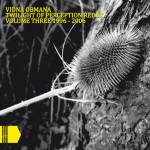
Artist: Vidna Obmana
Title: Twilight of Perception Redux: Volume Three 1996-2006
Format: CD x 3 (triple CD)
Label: Zoharum (http://zoharum.com/) (@)
Rated:
Title: Twilight of Perception Redux: Volume Three 1996-2006
Format: CD x 3 (triple CD)
Label: Zoharum (http://zoharum.com/) (@)
Rated:
Some artists release archives because history demands organization. Others release archives because there are still treasures hidden in the attic. Dirk Serries, operating under the enduring banner of Vidna Obmana, belongs firmly to the latter category. Listening to "Twilight of Perception Redux: Volume Three 1996-2006" feels less like opening a box of leftovers and more like discovering an entire wing of a museum that somehow escaped public attention for two decades.
For those familiar with ambient music's deeper currents, Serries requires little introduction. Since the 1980s, the Belgian composer has occupied a singular position within experimental music, moving effortlessly between dark ambient, drone, electro-acoustic improvisation, minimalist abstraction, and countless collaborative ventures. While many artists spend a career refining a recognizable signature, Serries has often behaved more like an explorer mapping unknown territories, abandoning established routes as soon as they become comfortable.
This third volume in the "Twilight of Perception Redux" series gathers material created between 1996 and 2006, a particularly fertile period in the Vidna Obmana chronology. Eighteen tracks spread across three discs offer not merely a collection of rarities but an alternative history of an artist constantly refining his relationship with atmosphere, texture, and sonic architecture. Thirteen of these pieces were previously unreleased, while the remaining works originally appeared on obscure compilations or limited releases long since absorbed into the collector's marketplace, that peculiar ecosystem where CDs occasionally become more expensive than the equipment needed to play them.
What immediately emerges is the remarkable coherence of the material. Collections of archival recordings often reveal why certain tracks remained unreleased. Here, the opposite occurs. One repeatedly wonders how pieces of this quality managed to remain hidden for so long.
The opening sequence establishes many of the characteristics that made Vidna Obmana such a distinctive voice within ambient music. "Majestic Trip" unfolds with patient grandeur, while "Mechanical Blow" introduces subtle tensions between organic resonance and technological presence. Throughout the compilation, Serries demonstrates an uncommon ability to create environments that feel simultaneously earthly and extraterrestrial. These are not simply ambient backdrops. They are inhabited spaces, alive with movement, memory, and suggestion.
What distinguished Vidna Obmana from many of his contemporaries was his refusal to rely exclusively on synthesizers. Across these recordings, one encounters overtone flutes, fujara, percussion, processed voices, rhythmic fragments, and countless abstract mutations woven into the fabric of the compositions. The result often resembles an imagined anthropology of impossible civilizations. One can almost picture archaeologists from another galaxy carefully excavating evidence of rituals humanity never actually performed.
Long-form pieces such as "Intersection" and "Threshold Of Obstruction" demonstrate Serries' mastery of duration. Rather than moving toward obvious climaxes, these works evolve through gradual transformations, allowing tiny shifts in timbre and density to become meaningful events. Time behaves differently inside these compositions. Minutes cease functioning as measurements and instead become landscapes through which the listener slowly travels.
The period covered by this compilation was also one during which ambient music was undergoing significant transformation. The genre was expanding beyond its early definitions, absorbing influences from industrial music, world music, field recordings, and experimental electronics. Vidna Obmana stood at the crossroads of these developments without ever appearing eager to join any particular movement. There is an independence to these recordings that remains striking today. They neither chase trends nor react against them. They simply exist according to their own internal logic.
Tracks such as "Travelworld", "Totems", and "Temple" reveal another dimension of Serries' artistry: his ability to evoke spiritual resonance without resorting to easy mysticism. These compositions possess a ceremonial quality, yet they avoid the clichés that often plague music attempting to sound transcendent. Nothing here feels decorative. The atmosphere emerges naturally from the interaction of sound, space, and silence.
Perhaps the most fascinating aspect of "Twilight of Perception Redux: Volume Three" is how contemporary it feels. Despite originating from recordings made between 1996 and 2006, the material remains astonishingly fresh. Modern drone, ambient, and sound-art practitioners continue exploring territories that Serries was already navigating decades ago. Listening to these tracks today is a reminder that innovation often occurs quietly, without demanding attention, patiently waiting for future generations to catch up.
The remastering undertaken by Serries himself enhances the collection without sacrificing its original character. The sound remains immersive, detailed, and spacious, allowing the subtle complexities of the recordings to fully emerge. Combined with the extensive commentary and elegant presentation from Zoharum, this release functions both as an archival document and as a rewarding standalone experience.
Ultimately, "Twilight of Perception Redux: Volume Three 1996-2006" succeeds because it transcends the limitations often associated with retrospective collections. Rather than merely preserving the past, it reactivates it. These recordings do not feel like historical artifacts sealed behind glass. They breathe. They wander. They continue asking questions.
And perhaps that is the enduring achievement of Vidna Obmana. While much ambient music seeks to calm the mind, Serries has always seemed more interested in expanding it, opening small doorways into unfamiliar territories and inviting us to step through. Some doors lead to beautiful places. Others lead somewhere stranger. The wisest response is probably the same in either case: keep listening.
For those familiar with ambient music's deeper currents, Serries requires little introduction. Since the 1980s, the Belgian composer has occupied a singular position within experimental music, moving effortlessly between dark ambient, drone, electro-acoustic improvisation, minimalist abstraction, and countless collaborative ventures. While many artists spend a career refining a recognizable signature, Serries has often behaved more like an explorer mapping unknown territories, abandoning established routes as soon as they become comfortable.
This third volume in the "Twilight of Perception Redux" series gathers material created between 1996 and 2006, a particularly fertile period in the Vidna Obmana chronology. Eighteen tracks spread across three discs offer not merely a collection of rarities but an alternative history of an artist constantly refining his relationship with atmosphere, texture, and sonic architecture. Thirteen of these pieces were previously unreleased, while the remaining works originally appeared on obscure compilations or limited releases long since absorbed into the collector's marketplace, that peculiar ecosystem where CDs occasionally become more expensive than the equipment needed to play them.
What immediately emerges is the remarkable coherence of the material. Collections of archival recordings often reveal why certain tracks remained unreleased. Here, the opposite occurs. One repeatedly wonders how pieces of this quality managed to remain hidden for so long.
The opening sequence establishes many of the characteristics that made Vidna Obmana such a distinctive voice within ambient music. "Majestic Trip" unfolds with patient grandeur, while "Mechanical Blow" introduces subtle tensions between organic resonance and technological presence. Throughout the compilation, Serries demonstrates an uncommon ability to create environments that feel simultaneously earthly and extraterrestrial. These are not simply ambient backdrops. They are inhabited spaces, alive with movement, memory, and suggestion.
What distinguished Vidna Obmana from many of his contemporaries was his refusal to rely exclusively on synthesizers. Across these recordings, one encounters overtone flutes, fujara, percussion, processed voices, rhythmic fragments, and countless abstract mutations woven into the fabric of the compositions. The result often resembles an imagined anthropology of impossible civilizations. One can almost picture archaeologists from another galaxy carefully excavating evidence of rituals humanity never actually performed.
Long-form pieces such as "Intersection" and "Threshold Of Obstruction" demonstrate Serries' mastery of duration. Rather than moving toward obvious climaxes, these works evolve through gradual transformations, allowing tiny shifts in timbre and density to become meaningful events. Time behaves differently inside these compositions. Minutes cease functioning as measurements and instead become landscapes through which the listener slowly travels.
The period covered by this compilation was also one during which ambient music was undergoing significant transformation. The genre was expanding beyond its early definitions, absorbing influences from industrial music, world music, field recordings, and experimental electronics. Vidna Obmana stood at the crossroads of these developments without ever appearing eager to join any particular movement. There is an independence to these recordings that remains striking today. They neither chase trends nor react against them. They simply exist according to their own internal logic.
Tracks such as "Travelworld", "Totems", and "Temple" reveal another dimension of Serries' artistry: his ability to evoke spiritual resonance without resorting to easy mysticism. These compositions possess a ceremonial quality, yet they avoid the clichés that often plague music attempting to sound transcendent. Nothing here feels decorative. The atmosphere emerges naturally from the interaction of sound, space, and silence.
Perhaps the most fascinating aspect of "Twilight of Perception Redux: Volume Three" is how contemporary it feels. Despite originating from recordings made between 1996 and 2006, the material remains astonishingly fresh. Modern drone, ambient, and sound-art practitioners continue exploring territories that Serries was already navigating decades ago. Listening to these tracks today is a reminder that innovation often occurs quietly, without demanding attention, patiently waiting for future generations to catch up.
The remastering undertaken by Serries himself enhances the collection without sacrificing its original character. The sound remains immersive, detailed, and spacious, allowing the subtle complexities of the recordings to fully emerge. Combined with the extensive commentary and elegant presentation from Zoharum, this release functions both as an archival document and as a rewarding standalone experience.
Ultimately, "Twilight of Perception Redux: Volume Three 1996-2006" succeeds because it transcends the limitations often associated with retrospective collections. Rather than merely preserving the past, it reactivates it. These recordings do not feel like historical artifacts sealed behind glass. They breathe. They wander. They continue asking questions.
And perhaps that is the enduring achievement of Vidna Obmana. While much ambient music seeks to calm the mind, Serries has always seemed more interested in expanding it, opening small doorways into unfamiliar territories and inviting us to step through. Some doors lead to beautiful places. Others lead somewhere stranger. The wisest response is probably the same in either case: keep listening.
Jude: Zakaz


There are albums that politely invite the listener inside. "Zakaz" is not one of them. It kicks the door open, drags a concrete block across the floor, and then stares at you as if you are somehow responsible for the state of the world.
For more than two decades, the Polish collective JUDE has occupied a peculiar and stubborn corner of underground culture, operating as much as a multimedia organism as a band. Their work has long resisted neat classification, drawing from industrial, hardcore, post-punk, sludge, noise, and experimental art practices while maintaining a fierce independence from both commercial expectations and underground orthodoxies. JUDE's history is littered with records, visual works, films, activism, controversies, and the sort of legends that tend to accumulate around artists who seem fundamentally uninterested in behaving themselves.
"Zakaz" ("Prohibition" in Polish) feels like the culmination of that attitude. Not because it abandons the group's past, but because it sharpens it. The seven tracks gathered here sound less like songs than pressure systems colliding. The production by Kamil azikowski deserves particular mention: every element arrives with startling physicality. The guitars grind and scrape like industrial machinery operating beyond safety regulations, the drums hit with the certainty of demolition equipment, and Wiktor Skok's vocals emerge from the turbulence like urgent transmissions from a collapsing communications network. The result is an album whose aggression is not chaotic but meticulously engineered.
What makes "Zakaz" compelling is that its heaviness never feels ornamental. Many contemporary industrial and noise-adjacent releases mistake volume for intensity, as if distortion alone could substitute for conviction. JUDE understand a more difficult truth: genuine force comes from tension. Throughout the album, moments of suffocating density coexist with carefully constructed spaces, allowing the listener to feel the weight of each impact rather than merely endure an endless barrage.
Tracks such as "Ignition. Szron" and "Misery Within" establish a landscape of friction and resistance, while the title piece stands like a monument built from rusted steel and unresolved anxieties. Elsewhere, the sprawling "Beton Blok. Methodology" unfolds with the grim patience of urban decay itself, transforming repetition into a kind of architectural statement. The music often feels less composed than excavated, as though JUDE have uncovered these sounds buried beneath layers of concrete and social debris.
There is also something distinctly physical about this record. Listening to "Zakaz" evokes textures rather than melodies: cold metal, cracked asphalt, damp walls, electrical interference. One is reminded that industrial music, at its best, is not merely about machines. It is about what machines do to people, how environments shape emotions, and how modern life leaves its marks on both bodies and landscapes.
Yet beneath the abrasion lurks an unexpected humanity. For all its hostility, "Zakaz" is not nihilistic. The album carries the emotional charge of individuals still wrestling with the world rather than surrendering to it. Anger remains present because disappointment remains present; disappointment remains present because some part of the artist still believes things could be otherwise. That fragile thread of hope, hidden beneath layers of noise and distortion, gives the record much of its emotional weight.
The decision by Zoharum to finally issue the album on vinyl feels particularly appropriate. This is music that benefits from physical presence. A limited 180-gram pressing, accompanied by the band's characteristic visual aesthetic, transforms "Zakaz" from a collection of tracks into an object with mass, texture, and permanence. In an age where songs often pass through our lives with the lifespan of a social media post, there is something quietly defiant about a record that insists on occupying actual space.
"Zakaz" does not seek comfort, accessibility, or fashionable relevance. It seeks impact. And it achieves it with remarkable precision. If this is indeed the strongest entry in JUDE's discography, as some have suggested, it is because the band has learned how to transform raw aggression into something larger: a language of resistance, frustration, endurance, and dark beauty.
Like a factory chimney silhouetted against a winter sky, "Zakaz" is harsh, imposing, and strangely magnificent.
For more than two decades, the Polish collective JUDE has occupied a peculiar and stubborn corner of underground culture, operating as much as a multimedia organism as a band. Their work has long resisted neat classification, drawing from industrial, hardcore, post-punk, sludge, noise, and experimental art practices while maintaining a fierce independence from both commercial expectations and underground orthodoxies. JUDE's history is littered with records, visual works, films, activism, controversies, and the sort of legends that tend to accumulate around artists who seem fundamentally uninterested in behaving themselves.
"Zakaz" ("Prohibition" in Polish) feels like the culmination of that attitude. Not because it abandons the group's past, but because it sharpens it. The seven tracks gathered here sound less like songs than pressure systems colliding. The production by Kamil azikowski deserves particular mention: every element arrives with startling physicality. The guitars grind and scrape like industrial machinery operating beyond safety regulations, the drums hit with the certainty of demolition equipment, and Wiktor Skok's vocals emerge from the turbulence like urgent transmissions from a collapsing communications network. The result is an album whose aggression is not chaotic but meticulously engineered.
What makes "Zakaz" compelling is that its heaviness never feels ornamental. Many contemporary industrial and noise-adjacent releases mistake volume for intensity, as if distortion alone could substitute for conviction. JUDE understand a more difficult truth: genuine force comes from tension. Throughout the album, moments of suffocating density coexist with carefully constructed spaces, allowing the listener to feel the weight of each impact rather than merely endure an endless barrage.
Tracks such as "Ignition. Szron" and "Misery Within" establish a landscape of friction and resistance, while the title piece stands like a monument built from rusted steel and unresolved anxieties. Elsewhere, the sprawling "Beton Blok. Methodology" unfolds with the grim patience of urban decay itself, transforming repetition into a kind of architectural statement. The music often feels less composed than excavated, as though JUDE have uncovered these sounds buried beneath layers of concrete and social debris.
There is also something distinctly physical about this record. Listening to "Zakaz" evokes textures rather than melodies: cold metal, cracked asphalt, damp walls, electrical interference. One is reminded that industrial music, at its best, is not merely about machines. It is about what machines do to people, how environments shape emotions, and how modern life leaves its marks on both bodies and landscapes.
Yet beneath the abrasion lurks an unexpected humanity. For all its hostility, "Zakaz" is not nihilistic. The album carries the emotional charge of individuals still wrestling with the world rather than surrendering to it. Anger remains present because disappointment remains present; disappointment remains present because some part of the artist still believes things could be otherwise. That fragile thread of hope, hidden beneath layers of noise and distortion, gives the record much of its emotional weight.
The decision by Zoharum to finally issue the album on vinyl feels particularly appropriate. This is music that benefits from physical presence. A limited 180-gram pressing, accompanied by the band's characteristic visual aesthetic, transforms "Zakaz" from a collection of tracks into an object with mass, texture, and permanence. In an age where songs often pass through our lives with the lifespan of a social media post, there is something quietly defiant about a record that insists on occupying actual space.
"Zakaz" does not seek comfort, accessibility, or fashionable relevance. It seeks impact. And it achieves it with remarkable precision. If this is indeed the strongest entry in JUDE's discography, as some have suggested, it is because the band has learned how to transform raw aggression into something larger: a language of resistance, frustration, endurance, and dark beauty.
Like a factory chimney silhouetted against a winter sky, "Zakaz" is harsh, imposing, and strangely magnificent.