
Thursday, November 5, 2026
Browse by Genre
Industrial Music / Industrial Metal / Aggro Industrial / Electro Metal
Industrial Noise / Power Noise / Harsh Noise
Synth Pop / Electro Pop / Synth-Electronica
Techno / Trance / Goa / Drum'n'Bass / Jungle / Tribal / Trip-Hop
Ambient / Electronica / Ethereal / Dub / Soundscapes / Abstract
Experimental / Avantgarde / Weird & Wired / Glitch / Noise / Field Recording
Dark / Gothic / Wave / New Wave / Dark Wave / Industrial Gothic
New Music / Downtown / Avantgarde Jazz / New Classical / World
Search Reviews
Music Reviews
Mats Erlandsson & Gus Loxbo: Minnets Långa Kedjor

Artist: Mats Erlandsson & Gus Loxbo (@)
Title: Minnets Långa Kedjor
Format: CD + Download
Label: XKatedral (@)
Rated:
Title: Minnets Långa Kedjor
Format: CD + Download
Label: XKatedral (@)
Rated:
There is something quietly unsettling about returning to a place that has not changed nearly as much as the person remembering it. The landscape may still be there, the hills and industrial scars apparently holding their ground, but the past has meanwhile been busy rearranging the furniture inside one's head. "Minnets Långa Kedjor" (roughly, "The Long Chains of Memory") takes this discrepancy as its point of departure, turning a shared geographical and personal history into an hour-long exercise in electroacoustic recollection. For Mats Erlandsson and Gus Loxbo, this is not merely a first recorded collaboration, but the public emergence of a musical relationship that has been developing for more than 25 years. Some friendships produce photographs, others produce music that sounds as though it has been unearthed from beneath an abandoned mine.
Both musicians have deep roots in Sweden's experimental and improvised music scenes. Erlandsson is a composer and sound artist associated with Stockholm's drone community, working with sustained tones, synthesis, field recordings and extensive tape processing. His catalogue includes "Gyttjans Topografi" (2023), while his wider practice moves between solo work and collaborations, often exploring the unstable border between acoustic material and its electronic mutation. Loxbo, meanwhile, is an experienced double bassist whose work includes the groups Pombo and Silence Blossoms. His solo album "Trådknaster" (2021), recorded by Erlandsson, offered a concentrated study of the instrument's less conventional possibilities, exposing the grain, friction and physical peculiarities of the double bass without relying on overdubs. Their familiarity is therefore not simply biographical: each has spent years helping the other reconsider what music can be, and what it might become when conventional instrumental roles are left at the door.
The album draws on their shared upbringing in Bergslagen, a historical mining region in central Sweden. This background is not used as a picturesque postcard or an invitation to indulge in nostalgic folklore. Rather, it supplies a loose network of associations: geographical memories, imagined histories, fragments of atmosphere and the peculiar emotional residue of places inhabited long ago. The original musical impulses were captured in a two-day session at Stockholm's Elektronmusikstudion, with Erlandsson on guitars and electronics and Loxbo on double bass. What emerged was then subjected to a substantial process of editing, arrangement, amplification and transformation, involving digital processing and analogue tape. The result is neither a straightforward document of improvisation nor a conventional studio composition. It occupies an intriguing middle ground, where spontaneous gestures are treated as raw matter and memory itself becomes a kind of editing tool.
That distinction matters. The music often feels as if it is being recalled rather than performed in the present tense. Sustained guitar tones and zither figures hover above the bass, which can sound like an enormous subterranean mechanism operating at a speed entirely indifferent to human urgency. Sometimes Loxbo's playing is recognisably instrumental; elsewhere, the double bass becomes a source of abrasive textures, granular scrapes and distorted low-frequency pressure. Erlandsson's processing does not simply decorate these sounds. It changes their apparent scale, distance and material identity, making it difficult to tell where an instrument ends and the surrounding acoustic environment begins. The listener is left with a landscape whose features keep shifting whenever one tries to identify them.
The opening "Dom gick upp på berget" establishes the album's measured approach, while "Trollkarlsklint" expands the vocabulary into something more imposing. Its extended duration allows the bass to move from scratchy, almost tactile gestures towards a much heavier presence, with the music gradually approaching the weight and slow-motion intensity of doom metal. The comparison is not merely a matter of volume or distortion. There is a similar fascination with duration, with the physical sensation of sound being held in place until it begins to exert pressure. Yet the piece does not settle into a recognisable metal structure. Its mass seems to emerge organically from the interaction, as though a geological formation had decided to make itself heard.
Elsewhere, the atmosphere becomes more elusive. "I Kopparkammaren" and "Flor" offer shorter episodes within the album's broader temporal architecture, while "HÄng blommor om halsen" moves towards a more subdued and suspended register. Erlandsson's sustained guitar tones and Loxbo's distant bass resonances create a strange intimacy, one that is less concerned with melodic development than with the gradual alteration of perspective. The music seems to withdraw from the listener, although its low frequencies remain stubbornly present. It is a useful reminder that quietness in drone music is not necessarily the absence of intensity. Sometimes the most unsettling thing in a room is the sound coming from the next one.
The title track brings the album's contrasting materials into particularly vivid contact. Delicate zither tones coexist with massive electric-guitar weight, a combination that might look absurd on paper but feels entirely natural within this musical environment. There is no attempt to reconcile fragility and heaviness; they are allowed to occupy the same space, like two incompatible memories that have somehow survived in the same mind. "Fallens dag" continues the slow, immersive approach, while "Hur långt har du kvar att gå?" introduces bells and additional accents from Daniel M Karlsson. Their delicate interventions add a further layer of detail before the bass returns with considerable force. The contrast is striking without becoming theatrical: the music has no need to wave its arms around to make its point.
Maria W Horn's narration adds another human dimension to the record. Rather than turning the pieces into conventional songs or supplying a literal narrative, her presence contributes to the sense of recollection and distance that runs throughout the album. The titles themselves suggest fragments of a larger, inaccessible story: climbing a hill, entering a copper chamber, hanging flowers around one's neck, asking how far one has left to walk. These are evocative images, but they resist being assembled into a neat sequence. The album is not a soundtrack to a journey with a clearly marked destination. It is closer to the experience of remembering a dream in which every location seems familiar, although none can be placed with certainty.
The final pair, "I askan" and "I symmetrisk skymning", brings the collection towards its conclusion without offering anything resembling a definitive resolution. The music retains its capacity to hover between recognisable instrumental gestures and transformed sound, between the intimate and the monumental. Even when the textures become more imposing, there is an underlying sense of restraint. Erlandsson's studio work is particularly effective in this respect: the transformations are extensive, but rarely feel like demonstrations of technical cleverness. They serve the material rather than demanding applause for themselves. This is a welcome attitude in experimental music, where the temptation to make every processing decision sound like a major philosophical discovery can occasionally become exhausting.
The production also highlights the unusual balance between the two musicians. Erlandsson's guitars, zither, percussion and analogue and digital synthesis provide a broad range of tonal environments, but Loxbo's double bass remains the album's physical anchor. Its low register can be ominous, its upper textures abrasive, and its occasional distortions almost unrecognisable. Yet the instrument never becomes a mere provider of cinematic menace. There is a sense of listening and response beneath the processing, a shared musical instinct that no amount of studio manipulation could manufacture from scratch. The additional contributions from Karlsson and Horn enrich the picture without disturbing the central relationship.
"Minnets Långa Kedjor" is a patient, carefully assembled work, and its 68-minute duration is part of its character rather than an endurance test imposed for experimental credibility. It asks for attention, certainly, but does not demand that every minute be treated as a revelation. Its strongest passages emerge through accumulation: a sustained note acquiring weight, a rough bass texture becoming almost environmental, a fragile detail suddenly illuminating an otherwise opaque stretch of sound. The combination of free improvisation, electroacoustic drone and doom-metal gravity is compelling precisely because none of these elements is allowed to dominate the others.
Ultimately, the album's most affecting quality lies in the way it treats memory as something active and imperfect. Erlandsson and Loxbo do not attempt to reconstruct their shared past in musical form, nor do they offer a nostalgic portrait of the place that shaped them. Instead, they take the impressions left behind and subject them to a process of distortion, magnification and reconsideration. The past becomes neither a safe refuge nor a reliable archive, but a substance that can still be handled, altered and heard from different angles. These long chains may bind the two musicians to a common origin, but they also provide enough slack for the music to wander somewhere unexpected. A fine achievement, and proof that sometimes the most productive way to revisit home is to make it sound like a place you have never quite been before.
Billy Gomberg: capacity
The word "capacity" can suggest a container, a limit, or the amount of something a person is able to hold. Billy Gomberg’s new album seems interested in all three meanings, though its nine pieces are less concerned with filling space than with discovering what space can contain. Sound is treated as a material with edges, weight and a certain capacity for surprise: tones emerge, flicker, break apart and settle into unexpected relationships. The music is abstract, but not remote; delicate, but not timid. It has the curious quality of a landscape seen through a window that has been cracked in just the right place.
Gomberg has spent more than two decades developing a practice that brings together synthesis, digital processing, acoustic recordings and improvisation. His work has appeared on labels including Students of Decay and Dinzu Artefacts, while his self-released recordings have documented a continuing exploration of modular synthesis and electroacoustic composition. He is also active in the collaborative project Fraufraulein with Anne Guthrie, whose work similarly considers how manipulated sound can retain a sense of physical origin. Gomberg’s musical activity has long been accompanied by photography, and his 2025 exhibition "Several Paths Together" at Indexical Gallery in Santa Cruz made that parallel practice especially visible.
"capacity" is his first proper album in four years, although the interval has hardly been a period of inactivity. Recent releases and performances have continued to explore long-form improvisation, recording and sound as a means of relating to places and experiences. Here, however, Gomberg chooses a more concise format. The nine tracks occupy just over thirty-four minutes, with most pieces lasting between three and five minutes. This is a meaningful shift for a musician whose work has often allowed sounds to develop at considerable length. Instead of asking the listener to settle into a single expansive environment, the album presents a sequence of small sonic situations, each with its own internal weather.
The opening "zero of" establishes the album’s delicate balance between movement and suspension. Its electronic textures possess a faintly unstable quality, as though the sound were being assembled from particles that have not quite agreed to remain in the same place. There is a gentle luminosity to the piece, but it is not the polished, frictionless glow sometimes associated with ambient electronics. Small irregularities keep appearing at the edges, interrupting the apparent calm. The result feels less like a pristine digital environment than a room illuminated by shifting light, where the furniture seems to change shape whenever one looks away.
"rose and nameless" moves through a more subdued register, its title suggesting a relationship between something recognisable and something that has resisted identification. The music seems to occupy that same uncertain space. Its tones are intimate, yet their origins remain difficult to pin down; the listener can sense the presence of a gesture without being able to say exactly what produced it. Gomberg’s approach to synthesis is particularly effective here because the technology never becomes the subject. The sounds do not announce their modular credentials, nor do they demand admiration for the machinery behind them. They simply behave in ways that feel emotionally and physically suggestive.
That distinction matters. Experimental electronic music can sometimes become fascinated with the devices that produce it, turning the studio into a kind of sonic showroom where every strange effect must be accompanied by a demonstration of the equipment responsible. Gomberg seems more interested in the expressive consequences of those sounds. The electronic details are present, but they are not presented as trophies. Instead, they function like marks on a surface: traces of activity that acquire meaning through their placement and relation to everything around them.
"sky in buckets version" offers one of the album’s more intriguing titles, evoking an image that is both absurd and oddly tangible. Its music seems to work through a similar tension between the expansive and the contained. The sounds have an open, airy quality, yet the composition remains compact, allowing fleeting gestures to appear and disappear without being stretched into extended demonstrations of atmosphere. There is a sense of motion, but not necessarily of travel. The piece seems to move by changing its perspective rather than its location.
"use thousand waves" introduces another variation on the album’s central concerns. Its title suggests multiplicity, but Gomberg avoids turning the music into a grand illustration of water or movement. Instead, the piece feels like an accumulation of small changes, each one altering the perception of what came before. This is one of the record’s most appealing qualities: it encourages close attention without making a spectacle of its own intricacy. The listener is not asked to solve a puzzle. There is no hidden message waiting to be uncovered by someone with a notebook, a magnifying glass and an alarming amount of free time. The pleasure lies in noticing how the sound changes while remaining recognisably itself.
"locals" brings the album’s interest in physical geography into sharper focus. Gomberg’s recordings draw on locations in San Francisco and Tokyo, while the work also acknowledges the Indigenous territories associated with the places where the material was gathered. The music does not function as a conventional field-recording document, however. Rather than offering a recognisable sound postcard, it absorbs environmental material into an abstract language. Place becomes less a subject to be represented than a set of conditions that shape the recording: distance, texture, movement, and the particular way sound occupies a space.
The shorter "dusk at the center" seems to turn inward. Its duration gives it the quality of a passing moment, a small pause within the album’s sequence. Gomberg’s music often works through the interplay of detail and stillness, and this piece is a particularly effective example of how little needs to happen for a sound to become compelling. The music does not need to swell or resolve in order to establish a sense of presence. It simply allows its materials to remain exposed long enough for their subtleties to become apparent.
"one from october" has the feeling of a fragment preserved from a particular time, though its title does not insist on a specific narrative. The piece seems to suggest memory without turning it into sentimentality. There is no attempt to recreate a past moment in full, only to retain something of its texture. This is where Gomberg’s photographic practice becomes especially relevant. His images and his music share an interest in what can be revealed by looking or listening closely, and in the possibility that a fragment may carry more emotional information than a complete account. The accompanying eight-page booklet of black-and-white photographs is therefore not merely an attractive extra for the vinyl edition. It extends the album’s visual and sonic inquiry into landscape, detail and the experience of noticing.
The title track, "overflows", appears near the end of the sequence, and its name offers a useful counterpoint to the album’s generally restrained scale. Capacity is not simply a matter of holding more; it can also involve reaching the point at which a container no longer contains what has been placed inside it. Gomberg’s music seems to understand that excess need not mean volume or density. Sometimes it is the accumulation of small gestures, each one adding a little more emotional or spatial information until the composition begins to feel larger than its duration. The closing "group buy tong" then brings the record to an end without making a grand announcement of completion. Its compact form leaves the listener with the impression of a thought that has been allowed to stop rather than forced to conclude.
Taylor Deupree’s mastering is an apt fit for this material. His work at 12k has long been associated with an attentive approach to detail and spatial definition, and "capacity" benefits from that sensitivity. The album’s textures retain their fine edges without becoming brittle, while the quieter elements are given enough presence to register as more than background decoration. The sound is intimate, but not artificially close; the music feels as though it occupies a space that the listener can approach without being invited to dominate.
There are echoes of artists such as Microstoria and Josh Mason in Gomberg’s use of glitch, fractured electronic gestures and unstable textures, but the album does not rely on those associations to establish its identity. Its strongest moments emerge from a more personal relationship between sound and place. The music seems to understand geography not as a collection of coordinates, but as an accumulation of experiences: the physical environment, the memory of being somewhere, the emotional associations attached to a particular moment. That gives "capacity" a quiet human quality, even when its sounds are abstract enough to resist conventional description.
The record is also refreshingly uninterested in making ambient music synonymous with relaxation. Its beauty is not always smooth, and its stillness is rarely absolute. Small disturbances remain present throughout, like the faint crackle of a thought that refuses to disappear. The music can be soothing, but it does not promise to make the listener more efficient, more serene or better prepared for the next round of administrative nonsense. It asks for attention rather than offering escape.
In the end, "capacity" is an album about the amount of meaning that can reside in a small gesture. Gomberg’s nine pieces do not attempt to overwhelm the listener with scale or duration. They work through suggestion, detail and the careful placement of sound, allowing the smallest shifts to acquire a surprising weight. It is a record that rewards patience without demanding solemnity, and one whose beauty comes not from an absence of disturbance but from the way disturbance becomes part of the whole. A modest container, perhaps, but one with a rather remarkable ability to hold the world.
Superføkk!: s/t

Artist: Superføkk! (@)
Title: s/t
Format: Download Only (MP3 + Lossless)
Label: Fysisk Format (@)
Rated:

Title: s/t
Format: Download Only (MP3 + Lossless)
Label: Fysisk Format (@)
Rated:
There are bands that spend years trying to find their sound, and then there are bands that seem to have decided, almost immediately, that finding one would be a rather restrictive use of their time. Superføkk! belong firmly to the latter category. Their self-titled debut is a compact demonstration of musical restlessness, a three-track collision between free jazz, no-wave, noise rock, krautrock, electronics and whatever else happens to be within reach when the instruments start misbehaving. It is energetic, abrasive, frequently funny in its sheer disregard for decorum, and considerably more disciplined than its apparent lack of discipline might suggest.
The Norwegian quartet emerged in Bergen in autumn 2024, initially taking shape in a small studio at the Bergen Kjøtt cultural centre. The lineup brings together Victor Skullerud on drums, Eik Stavem on electric bass, Ole-Hellik Lobben-Seth on guitar and synthesizer, and August Ramstad on tenor and baritone saxophones, electronics and percussion. Within a remarkably short time, they developed a substantial live repertoire, played extensively around Bergen and won the 2025 Eggstock Festival, also receiving recognition from the Vill Vill Vest festival. Their debut was recorded at Duper Studio in November 2025, with Jørgen Træen responsible for mixing and mastering, Iver Sandøy producing, and artwork by Aksel Thorbjørnsen.
The band's name is unlikely to be mistaken for a delicate invitation to afternoon tea. In Norwegian, it carries a suitably irreverent punch, and the music follows through on the promise. Yet Superføkk! are not simply interested in making a racket for the pleasure of watching musical furniture collapse. Their approach is more curious than that: they take recognisable elements from different traditions and subject them to abrupt changes of direction, sudden accelerations and unexpected encounters. The result has something of the nervous intelligence of Black Midi, the rhythmic sophistication associated with Jaga Jazzist, the confrontational attitude of James Chance and the angular theatricality of no-wave. These comparisons provide useful coordinates, but the quartet's identity is less about assembling a convincing family tree than about making the branches collide.
The album's three compositions occupy almost exactly half an hour, which is enough time for the group to establish its methods without allowing the exercise to become an endurance test. "Grønn" opens proceedings with a restless interplay between saxophone, guitar and rhythm section. Rather than establishing a groove and then decorating it, the musicians seem to negotiate the rhythmic ground in real time, with accents appearing and disappearing as the instruments exchange ideas. The saxophone brings a sharp, sometimes almost abrasive melodic presence, while the guitar moves between jagged riffing and more fragmented gestures. Skullerud's drumming and Stavem's bass provide the necessary propulsion, although the rhythm never feels like a fixed platform. It behaves more like a moving target.
There is a distinctly physical quality to this music. Even when the arrangements become intricate, the quartet avoids the impression of musicians demonstrating their technical abilities to an imaginary examination board. The playing is tight, but it retains the nervous energy of something liable to go off course at any moment. That tension is central to the album's appeal. Superføkk! can sound almost danceable, then suddenly pull the floor away from beneath the listener's feet. The body is encouraged to move; the brain is advised not to become too attached to any particular time signature.
At twelve minutes, "River Igjennom" provides the album's most substantial opportunity for the group to explore its shifting dynamics. The longer duration allows ideas to develop, mutate and occasionally undermine themselves. The interplay between the saxophones and guitar becomes especially important here, with the electronic elements adding further instability to the ensemble's sound. The music moves through passages of concentrated rhythmic activity and more open, exploratory exchanges, avoiding the conventional progression from quiet introduction to explosive climax. Instead, its energy seems to circulate, gathering intensity and then redirecting it elsewhere. The result is less a journey with a clearly marked destination than a series of diversions undertaken by four people who have collectively misplaced the map and decided that this is probably an improvement.
The title "River Igjennom" suggests movement through something, and the composition has an appropriately fluid character, although its flow is anything but smooth. The musicians continually disturb the surface, producing a mixture of muscular rock energy and improvisational freedom. There are moments when the group approaches the jagged precision of experimental math rock, only to veer towards the more unruly territory of free jazz. The synthesizer and electronics prevent the music from settling into a purely instrumental rock format, while the saxophone avoids becoming a conventional jazz lead instrument. Every component seems willing to change its function whenever the opportunity arises.
"Piggeple" closes the record with another extended burst of activity, and it is arguably the track that brings the band's various tendencies into the sharpest focus. Its combination of driving rhythm, noisy textures and saxophone-led intensity creates an exhilarating sense of collective momentum. There is a strong punk sensibility beneath the musical complexity: not necessarily in the form of familiar chord structures or straightforward aggression, but in the conviction that music should be allowed to sound excessive, awkward and alive. The composition's energy is cathartic without becoming simplistic, and its danceable qualities are particularly striking. This is music that could easily turn a crowded room into a rather unconventional exercise in cardiovascular health.
The production deserves credit for preserving the rawness of the performances without allowing the individual instruments to disappear into a single indistinct mass. Jørgen Træen's work gives the record enough definition to make its rhythmic exchanges and instrumental details audible, while retaining the rough edges that are essential to the group's character. The three compositions also benefit from their contrasting proportions and internal development. There is no sense of a band padding out a debut with interchangeable material; each piece has a distinct role in the overall sequence, and the album's brevity makes its intensity all the more effective.
What makes Superføkk! particularly interesting is that their genre-hopping does not feel like an attempt to collect fashionable reference points. Free improvisation, krautrock, no-wave, jazz-rock and electronic experimentation are not presented as separate ingredients waiting to be mixed according to a recipe. They are treated as different ways of approaching rhythm, texture and collective interaction. The quartet's music is therefore eclectic without being indiscriminate. Its unpredictability comes from the way the musicians respond to one another, not from a desperate need to introduce a new stylistic surprise every thirty seconds.
There is also something refreshing about the decision to make a debut consisting of just three substantial pieces. In an era when albums can sometimes resemble playlists assembled by an indecisive committee, Superføkk! offer a coherent statement without insisting on unnecessary duration. The title is appropriately self-contained, too: no elaborate conceptual apparatus, no grandiose mythology, just the band's name and a record that gets on with the business of being itself.
Superføkk! are still a young group, and this first album captures the particular excitement of musicians discovering how far they can push a shared language. Its roughness is not a defect to be apologised for, but neither is it an excuse for careless playing. Beneath the racket there is considerable attention to detail, and beneath the technical dexterity there is a direct, almost mischievous desire to make people move. The quartet may not be especially interested in conventional genre boundaries, but they clearly understand the value of a good physical reaction. Sometimes the most persuasive argument for musical freedom is not a manifesto or a carefully constructed theoretical position. It is four musicians making an almighty noise, finding a groove where none was supposed to exist, and daring the audience to stand still.
Honey Ride Me A Goat: Horns & Hooves
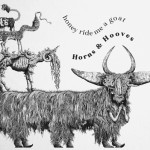
Artist: Honey Ride Me A Goat
Title: Horns & Hooves
Format: 12" + Download
Label: Cuneiform (http://www.cuneiformrecords.com/) (@)
Rated:

Title: Horns & Hooves
Format: 12" + Download
Label: Cuneiform (http://www.cuneiformrecords.com/) (@)
Rated:
Honey Ride Me A Goat have never seemed particularly concerned with making music that behaves itself. Their name sounds like the result of a pub conversation that went badly wrong, and their compositions tend to share that conversation's disregard for conventional manners. Yet there is more to this Kentish trio's peculiar universe than a taste for absurdity and instrumental demolition. "Horns & Hooves", their first full-length album for Cuneiform Records, finds them refining an approach built around the friction between tightly organised structures and spontaneous disruption. The addition of American saxophonist Patrick Shiroishi makes that friction even more productive, giving the band's familiar guitar-bass-drums combination a new dimension without turning it into a conventional jazz-rock outfit.
The history behind the record is a little unusual. Honey Ride Me A Goat were formed by school friends attending college in Canterbury in the early 2000s, united by a shared affection for Captain Beefheart, Black Sabbath and Soft Machine. They began playing live around 2005, releasing a self-titled EP in 2006, followed by a series of tapes and split releases. Much of this early material was gathered on "Udders", issued by Australia's Lexicon Devil in 2010. Their association with Canterbury's musical heritage became more concrete when they recorded an improvised session with Soft Machine bassist Hugh Hopper in 2008. The resulting material eventually appeared as "Goat Hopper" in 2013, after Hopper's death in 2009 had put an end to plans for further collaboration. The band continued to work with American avant-rock group Upsilon Acrux, including joint UK tours and a split release, before eventually entering a lengthy hiatus in 2020.
The new album was recorded in early 2020 and subsequently left unreleased for several years before finding its home at Cuneiform. This delayed arrival gives "Horns & Hooves" the slightly peculiar status of a document from a band that had already moved into a different chapter of its existence by the time the record reached listeners. It also captures a significant change in their sound. The earlier material was often characterised by furious, tightly packed jazz-punk, but here the group allows more direct compositional forms to develop, creating additional room for improvisation. The presence of Shiroishi is central to this evolution. Rather than being invited to provide occasional saxophone decoration, he becomes an integral part of the arrangements, contributing to the music's architecture as well as its more unrestrained passages.
Shiroishi is an especially appropriate collaborator. The Los Angeles-based saxophonist has developed an extensive body of work across free improvisation, experimental music, noise and punk, both as a solo artist and through numerous collaborations. His playing can move between abrasive blasts, lyrical phrases and extended textural explorations, and he has a particularly useful ability to inhabit music without simply taking it over. His experience with Upsilon Acrux also provides a direct link to HRMAG's own history. On "Horns & Hooves", the saxophone does not function as a guest soloist perched above the rhythm section; it becomes another unruly participant in the band's collective argument.
The album opens with "Meatpecker Suite", an eight-minute introduction to the quartet's peculiar sense of order. A jagged guitar figure establishes an angular framework, quickly joined by bass and drums, before the saxophone begins to complicate the arrangement. The music moves between clipped, repeated motifs and freer exchanges, with the instruments repeatedly threatening to pull the piece in different directions. There is a pleasingly physical quality to the performance, but the musicians are not simply chasing speed or volume. Their rhythmic interplay is too considered for that. Even when the arrangement becomes chaotic, one can sense the underlying framework holding everything together, like the structural beams of a building that has been designed by someone with a serious disagreement with right angles.
"Gooseflaps" takes a more compact route, relying on abrupt changes and tightly wound rhythmic gestures. Its short duration makes it feel almost like a concentrated burst of nervous energy, with guitar and saxophone trading sharp-edged phrases over a rhythm section that refuses to settle into predictable patterns. There is a trace of no-wave's confrontational economy here, but also a playful quality that prevents the music from becoming merely aggressive. The title, naturally, offers little assistance in interpreting the composition. One suspects that this is entirely intentional.
"Spacedocker" is one of the album's most immediately engaging pieces, combining a more recognisable rhythmic drive with the quartet's fondness for sudden structural detours. The guitar provides a stronger sense of direction, while the saxophone adds a wiry, restless counterpoint. The piece has something of the muscular precision associated with math rock, but it avoids the genre's more familiar displays of instrumental athleticism. There is no obvious desire to demonstrate how many subdivisions can be squeezed into a bar before the listener requests medical assistance. Instead, the musicians use rhythmic complexity as a means of generating tension and movement. The result is energetic, oddly catchy and just unpredictable enough to keep the floorboards nervous.
"Collyleg" brings the first half of the record to a close with another compact exercise in controlled disruption. Its short form gives the band little opportunity to settle into a single idea, and the music seems to enjoy the resulting instability. Yet the quartet's ability to make these abrupt transitions feel natural is one of its most persuasive qualities. Their compositions are not simply collections of unrelated riffs and improvisations; there is a clear sense of interaction between the different elements, even when the direction changes without warning.
The remaining four pieces on the full digital edition broaden the picture considerably. "Preposterous Proboscis / Tephra" makes the band's Beefheart inheritance particularly apparent, combining an eccentric, almost cartoonish central motif with a more volatile instrumental conversation. The composition moves between playful rhythmic patterns and noisier passages, allowing its absurdity to become part of the musical structure rather than an amusing distraction. "Flambé Gump" pushes further towards the abrasive end of the spectrum, with guitar and saxophone generating a particularly unruly texture. The performance has a rough, almost confrontational energy, but it remains sufficiently alert to dynamics to avoid becoming an undifferentiated wall of sound.
Then comes "Plappy", a welcome change of temperature. Michael Pike's piano introduces a more lyrical dimension, and the composition's comparatively measured pace reveals a side of the band that might otherwise remain concealed beneath the rhythmic commotion. There is a slightly melancholic quality to the piece, and its more direct melodic gestures provide a useful contrast to the album's harsher passages. It is not exactly a ballad, unless one imagines a ballad being performed by musicians who have just discovered that the piano has been left unattended in a room full of strange noises. Still, its presence is important: it demonstrates that the group can create atmosphere and melodic focus without abandoning its distinctive character.
The closing "Bedlams Bottom" returns to more turbulent territory, with discordant guitar work and increasingly free rhythmic activity bringing the record to an appropriately unsettled conclusion. The title suggests a place where things have gone badly wrong, and the music offers little evidence to the contrary. Shiroishi's saxophone is particularly effective in this context, moving between sharply defined gestures and more open-ended bursts of sound. The final impression is not one of resolution, but of a group that has discovered several new ways to make its own musical machinery malfunction.
What distinguishes "Horns & Hooves" from a great deal of contemporary instrumental experimentation is its attitude towards complexity. The band is clearly capable of intricate playing, but it does not confuse technical difficulty with artistic purpose. Its rhythmic frameworks are often built through repetition rather than conventional notation, leaving room for the musicians to alter, extend or destabilise them in performance. This gives the music a flexibility that is different from the tightly scripted intricacies of much math rock. The compositions can be precise without feeling rigid, and improvised without becoming shapeless. That balance is not easy to achieve, particularly when the instruments involved seem to have been selected partly for their ability to disagree with one another.
The production helps preserve this tension. The recordings, made at Big Jelly Studios and Delta Studios, have a raw but clearly defined sound, allowing the instrumental details to remain audible even when the music becomes particularly dense. Guitar, bass and drums retain their physical weight, while the saxophone is given enough space to contribute meaningfully rather than simply decorate the arrangements. The result feels immediate without sacrificing the distinctions between the different musical voices.
There is also a welcome absence of solemnity. Experimental rock can sometimes become so preoccupied with demonstrating its seriousness that it forgets music is supposed to be an enjoyable activity. Honey Ride Me A Goat understand that absurdity and sophistication are not mutually exclusive. Their compositions can be demanding, dissonant and rhythmically intricate, but they also possess a mischievous streak that keeps the whole enterprise from becoming an academic exercise. The band's humour is not merely a matter of ridiculous titles; it is embedded in the way the music continually upsets expectations, as though the musicians are quietly amused by the listener's attempts to anticipate what comes next.
"Horns & Hooves" is therefore more than a belated document of a group with an unusually long and fragmented history. It captures a band finding a new balance between its original instincts and the possibilities offered by an expanded lineup. Patrick Shiroishi's contribution is substantial, but the underlying personality remains unmistakably that of HRMAG: angular, unpredictable, rhythmically mischievous and cheerfully resistant to categorisation. The album may have taken several years to reach the public, but its music sounds anything but archival. It has the restless energy of something that has been waiting patiently for the right moment to cause trouble.
Rhins: The Invisible

Artist: Rhins
Title: The Invisible
Format: Download Only (MP3 + Lossless)
Label: Dragon's Eye Recordings (@)
Rated:
Title: The Invisible
Format: Download Only (MP3 + Lossless)
Label: Dragon's Eye Recordings (@)
Rated:
Being misunderstood is exhausting. Being misunderstood repeatedly, while also having to explain why you are being misunderstood, can become an almost full-time occupation. J. Quimby’s "The Invisible", the latest release under the Rhins name, approaches this predicament without attempting to translate it into a reassuringly legible musical narrative. Instead, it makes a virtue of the very things that conventional communication tends to reject: repetition, overload, interruption, disorientation and the refusal to settle into a recognisable pattern. This is not ambient music designed to help the listener find their happy place. In fact, the happy place appears to have been evacuated, its furniture thrown out of the window and the windows themselves replaced with malfunctioning synthesizers.
The album was conceived during a period of upheaval, as Quimby was moving house and navigating other changes in life. That instability is reflected in the music's construction, but the significance of "The Invisible" reaches beyond the familiar association between personal turmoil and noisy electronics. Its central concern is the frustration of trying to communicate in a neurotypical world, where the expectations and conventions of interaction can make one's own experience difficult to express. Quimby describes the music as a form of communication in itself, one that does not depend on verbal explanation. The distinction is important: this is not simply an album about distress, nor is its intensity offered as a spectacle for curious outsiders. It is an attempt to establish a language on its own terms, even when that language is abrasive, fragmented or difficult to follow.
Rhins is the project of Scottish sound artist and composer J. Quimby, whose earlier releases have appeared through labels including Tombed Visions and Aurora Borealis. The new project also reconnects with a more aggressive musical past, particularly Quimby's involvement in Take A Worm For A Walk Week and Remember Remember, as well as the collaborative performance work with artist Iona Kewney under the Knights of the Invisible name. Those experiences help explain the unusual combination of force and ethereality found here. The music draws on the physical impact of noise and distortion, but also on the more delicate vocal and string-based sensibilities developed through theatrical and performance contexts. The result is not a compromise between two approaches so much as an attempt to make them coexist without smoothing away their differences. Quimby's previous Rhins release, "The Burnout", had already explored suffocating electronic textures; "The Invisible" pushes that vocabulary into a more personal and deliberately unstable territory.
The method is as significant as the subject. Rather than beginning with finished compositions and gradually dismantling them, Quimby starts from improvisation, allowing analogue synthesizers to develop into extended passages before subjecting the material to a process of destruction, subtraction and reconstruction. It is a compositional approach that resembles the repeated application and removal of paint, except that the canvas is sound and the paint occasionally appears to be industrial waste. The resulting pieces retain traces of their original gestures, but those gestures are buried beneath layers of distortion, overlapping tones and recurring patterns. What might initially seem chaotic gradually acquires an internal organisation. Not necessarily a comfortable one, admittedly, but comfort is hardly the album's principal concern.
"Iona" establishes the terms with considerable force. Thick, overlapping synthesizer tones accumulate into a dense mass, with distortion giving the sustained notes a rough, almost physical surface. There is a sense of something attempting to emerge through the pressure, although the music never provides a clean passage out. Its title gives the opening a personal dimension, particularly given the album's dedication to Iona Jane Kewney, whose artwork also accompanies the release. The connection between the dedication and the sound is not something that needs to be decoded; the piece is sufficiently affecting without turning into a puzzle about biography.
"Knights of the Invisible" introduces a different kind of presence. The additional vocals of Emily Quimby bring a human element into the electronic turbulence, but these are not conventional vocal performances in search of a melody or a lyrical message. The voice appears as texture, gesture and atmosphere, at times suggesting a ritual whose words have been deliberately withheld. A more discernible rhythmic movement eventually takes shape, giving the piece a sense of forward motion without making it any less uncanny. There are echoes of the slow-building dread associated with older horror cinema, particularly the synthetic unease of 1970s and 1980s soundtracks, but the music avoids becoming a nostalgic exercise in analogue spookiness. No haunted house has ever sounded quite so poorly equipped to deal with its own electrical system.
The subsequent "Black Regent" and "Self Interrupted" maintain the album's uneasy momentum. The former works through layered drones and shifting electronic pressure, allowing its darker textures to develop without resorting to obvious climactic gestures. The latter feels more abrupt and fractured, its title almost functioning as a description of the listening experience: just as one begins to follow a particular sonic direction, something intervenes. This is not accidental awkwardness. Interruption is part of the album's grammar, and the repeated disruption of expectation becomes one of its most effective compositional tools.
"Electric Woods" offers a more spacious environment, though its apparent openness should not be mistaken for tranquillity. The synth textures have a more enveloping quality, creating an atmosphere that is simultaneously inviting and suspicious. There is something almost organic in the way the layers develop, but the sense of nature suggested by the title is far removed from the pastoral conventions of ambient music. These woods are electrically charged, and the trees probably have a better grasp of circuit diagrams than the average visitor. "Spectrum Collectors", meanwhile, introduces more restless movement through repeating electronic figures and shifting layers. Its patterns seem to gather momentum, only to become absorbed into the surrounding density. The effect is less that of a conventional build-up than of an unstable system repeatedly trying to establish equilibrium.
The closing "Waiting for the Sea Eagle" is particularly revealing. Its softer passages and more open melodic contours suggest the possibility of release, perhaps even the calm that the album has repeatedly seemed to seek. Yet the tension does not disappear. As the piece develops, the more abrasive elements return, disrupting the apparent resolution. The title evokes an act of waiting, but the music offers no guarantee that the awaited arrival will make anything better. The sea eagle may be magnificent, but it is apparently running late.
Across these seven compositions, Quimby works with a strikingly physical understanding of electronic sound. The synthesizers are not merely instruments for creating atmospheric backgrounds; they become extensions of bodily and emotional gestures, repeating, swelling, colliding and withdrawing. The wordless voices are equally important. They suggest the presence of communication without submitting to the assumption that communication must always take the form of intelligible speech. This is where the album's relationship with neurodivergent experience becomes most meaningful. Its refusal to conform to conventional structures is not presented as a decorative aesthetic choice, but as part of a broader struggle over whose modes of expression are recognised and whose are routinely treated as inconvenient noise.
That said, "The Invisible" does not require the listener to approach it as a document or an explanatory statement. Its musical language has enough substance to withstand repeated listening independently of the context provided by the artist. Indeed, the album's most interesting quality is the tension between its raw origins and the considerable care involved in shaping the final result. The improvisations may begin without a predetermined architecture, but the reconstruction is anything but careless. Lawrence English's mastering preserves the density and force of the material while giving its overlapping layers a coherent presence. The music remains difficult, but it is not indiscriminate.
There is also something quietly radical in the decision to make an album whose title refers to invisibility and whose contents insist on being heard. The invisible is not necessarily absent; sometimes it is simply overlooked, misread or denied the space required to become perceptible. Quimby responds by turning that condition into sound, not by making it easier to consume, but by refusing to dilute its contradictions. "The Invisible" can be oppressive, disorienting and occasionally exhausting, yet its intensity is never empty. It gives form to an experience that resists easy explanation, and it does so without pretending that music can magically solve the problems of communication.
Perhaps that is the album's most affecting achievement. It does not ask to be understood through the usual channels, nor does it offer a reassuring conclusion in which all the noise eventually makes sense. It simply insists on its own presence. In a world that often mistakes unfamiliar expression for an absence of meaning, that insistence is worth hearing.