
Wednesday, August 19, 2026
Browse by Genre
Industrial Music / Industrial Metal / Aggro Industrial / Electro Metal
Industrial Noise / Power Noise / Harsh Noise
Synth Pop / Electro Pop / Synth-Electronica
Techno / Trance / Goa / Drum'n'Bass / Jungle / Tribal / Trip-Hop
Ambient / Electronica / Ethereal / Dub / Soundscapes / Abstract
Experimental / Avantgarde / Weird & Wired / Glitch / Noise / Field Recording
Dark / Gothic / Wave / New Wave / Dark Wave / Industrial Gothic
New Music / Downtown / Avantgarde Jazz / New Classical / World
Search Reviews
Music Reviews
Ian Williams: Soundtracks For Weaving
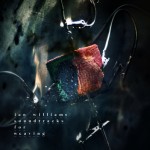
Artist: Ian Williams
Title: Soundtracks For Weaving
Format: Download Only (MP3 + Lossless)
Label: Slaughterback
Rated:

Title: Soundtracks For Weaving
Format: Download Only (MP3 + Lossless)
Label: Slaughterback
Rated:
Some music is made because somebody has a deadline. Some is made because somebody has a record contract. And occasionally, apparently, somebody makes five electronic improvisations to help a group of art students weave tapestries, only to discover that the weavers would rather listen to Radio 1. Thirty-nine years later, the tapes have escaped.
"Soundtracks For Weaving" is one of those releases whose backstory is almost too charmingly modest for the music it contains. Recorded by Ian Williams in Edinburgh in 1986 as an improvised accompaniment for friends studying tapestry at the city's art college, these five pieces were never really intended to become an album. They were practical music, or at least music aspiring to practical usefulness. The practical part failed. The music survived.
Williams has now recovered the original four-track cassette masters, digitised them and carefully reconstructed the recordings without adding contemporary production. The result is therefore not a modern musician attempting to recreate an imaginary 1986, but something much more valuable: 1986 itself, cleaned up just enough to let it breathe.
The equipment tells much of the story. A Roland SH-101 supplies the synthesizers, a Roland TR-707 handles the programmed percussion, and guitar appears here and there, with basic digital delay helping the elements occupy their slightly blurred, suspended spaces. There is nothing extravagant about the ingredients. The remarkable thing is what Williams manages to suggest with them.
The opening “The Vase” immediately reveals an artist already fascinated by the meeting point between melody and atmosphere. Its sequenced elements do not insist on becoming a conventional electronic composition. Instead, they seem to hover between soundtrack, song fragment and private experiment. This is particularly appropriate given that the piece eventually became the backing track for a Beautiful Pea Green Boat song, first appearing on Third Mind's "Future Tense" compilation in 1986 before being reworked for the band's "Get Religion".
That connection is useful because Beautiful Pea Green Boat was an important part of Williams' early trajectory. Founded in Edinburgh in the mid-1980s, the group combined electronic textures, ethereal vocals and melodic material in ways that anticipated some of the later dream-pop vocabulary. Their recordings occupied an appealingly ambiguous territory between synth music, gothic melancholy and something much softer and stranger. Contemporary retrospectives still struggle to put a clean label on them, which is probably a sign that the band was doing something right.
But "Soundtracks For Weaving" is less concerned with songs than with duration. “The Wee Red” and “The Horse” stretch patiently across ten and thirteen minutes, respectively, allowing Williams' primitive electronic machinery to reveal its character through repetition. The programmed drums are unmistakably products of their period, but their mechanical regularity gives the softer synthesizer tones something to push against. Rather than sounding dated in the pejorative sense, the technology becomes part of the emotional identity of the music. There is something wonderfully honest about that. The SH-101 does not pretend to be an orchestra. The TR-707 does not pretend to be a human drummer. The four-track does not pretend to be a pristine digital workstation. Everything sounds like what it is, and precisely because of that, the recordings develop an unusual warmth. Their limitations become compositional parameters.
“The Horse” is perhaps the clearest example. Its long-form development allows Williams to explore the tension between programmed rhythm and slowly shifting harmonic material without needing to manufacture a climax. The piece seems to move by accumulation rather than destination. A pattern settles into place, another element appears, the texture changes almost imperceptibly, and suddenly several minutes have disappeared.
This is music that understands that a loop does not have to be a prison. It can be a room. And perhaps the weaving connection is less accidental than it initially seems. Tapestry is fundamentally an art of repetition, incremental variation and accumulated detail. A thread passes through a structure again and again, apparently doing the same thing, until enough repetitions have occurred for an image to emerge. Williams' electronic constructions operate according to a surprisingly similar principle. Small sonic units recur, overlap and gradually acquire meaning through their relationships.
The students may have ignored the soundtrack, but the soundtrack was quietly learning from the activity around it. “The Etruscans” introduces a slightly more enigmatic character. The title alone suggests archaeology, fragments and buried histories, and the music has an appropriately distant quality. Williams does not attempt literal antiquity, of course. Instead, the piece creates the sensation of something half-remembered, with synthetic tones and programmed movement occupying a space that feels strangely detached from its technological origins.
Then comes “Flight”, the shortest piece at just over four minutes, and its brevity changes the perspective of the entire record. After the patient development of the preceding works, this final miniature feels almost like a departure scene. The album does not resolve so much as lift away. That lack of conventional resolution is one reason the record remains compelling as a contemporary listen.
It would be easy to treat "Soundtracks For Weaving" as an archaeological curiosity: here are some Roland instruments, here is a cassette from 1986, here is a forgotten branch of the electronic family tree. But that would undersell it considerably. Archival music becomes interesting when it stops behaving like evidence and starts behaving like music. These pieces do. They also reveal an early version of qualities that would become increasingly prominent in Williams' later work. His subsequent solo releases have moved through dark electronic compositions, cinematic soundtracks and minimalist ambient music, while his work for contemporary dance and documentary film has further developed his instinct for atmosphere and visual suggestion. His 2021 "All Becomes Desert", for example, returned to older analogue improvisations and used gradual change to evoke vast, inhospitable spaces. The connection is striking. Even when the scale changes, Williams seems drawn to music that creates environments without needing to describe them.
"Soundtracks For Weaving" is therefore an early document of a sensibility rather than merely an early document of technology. There is also an appealing absence of ambition here. These recordings were not apparently conceived as statements about electronic music, nor as attempts to predict the future. They were made for a practical purpose that nobody actually used them for. Williams kept the cassette because he liked what he heard. Decades later, he returned to it, repaired the technical problems and resisted the temptation to make it more contemporary. That decision matters. There is always a peculiar danger in revisiting old recordings with modern technology. Restoration can easily become revision. A musician can polish away the very imperfections that made the original material distinctive. Williams instead seems to have treated the old four-track like an archaeological object that deserved cleaning but not reconstruction according to present-day standards.
The music still sounds like 1986. It simply sounds like 1986 without a layer of dust over the speakers. And that gives the album an unexpected emotional quality. There is nostalgia here, certainly, but it is not the aggressively curated nostalgia of synthwave or retro culture. There are no neon signs, no artificial VHS haze, no desperate attempts to convince us that the past was cooler than the present. These recordings belong to their time because they were actually made then.
That distinction makes them strangely moving. The synthesizers have no idea that they will one day become historical objects. The drum machine has no idea that people will eventually find its sound charming. The guitarist certainly did not know that somebody would be listening to these tracks nearly forty years later while contemplating the absurd fate of music intended to accompany tapestry.
That is perhaps the quiet beauty of the record. We often imagine music history as a procession of major works, influential scenes and important names. In reality, there are countless little experiments happening in bedrooms, studios, art schools and borrowed rooms, most of which disappear. "Soundtracks For Weaving" is one of the fortunate survivors. Its original purpose has vanished, its context has changed, and its intended audience never showed up. Yet the music remains. The tapestries were never woven to it. That is almost beside the point now. Williams' five pieces have acquired their own pattern, one made not from wool and coloured thread but from analogue oscillators, primitive drum programming, delay, repetition and time. Nearly forty years later, they have finally found a listener.
Perhaps the weavers were wrong. Or perhaps they were simply listening to Radio 1 while Williams was quietly making something they would need much longer to catch up with.
"Soundtracks For Weaving" is one of those releases whose backstory is almost too charmingly modest for the music it contains. Recorded by Ian Williams in Edinburgh in 1986 as an improvised accompaniment for friends studying tapestry at the city's art college, these five pieces were never really intended to become an album. They were practical music, or at least music aspiring to practical usefulness. The practical part failed. The music survived.
Williams has now recovered the original four-track cassette masters, digitised them and carefully reconstructed the recordings without adding contemporary production. The result is therefore not a modern musician attempting to recreate an imaginary 1986, but something much more valuable: 1986 itself, cleaned up just enough to let it breathe.
The equipment tells much of the story. A Roland SH-101 supplies the synthesizers, a Roland TR-707 handles the programmed percussion, and guitar appears here and there, with basic digital delay helping the elements occupy their slightly blurred, suspended spaces. There is nothing extravagant about the ingredients. The remarkable thing is what Williams manages to suggest with them.
The opening “The Vase” immediately reveals an artist already fascinated by the meeting point between melody and atmosphere. Its sequenced elements do not insist on becoming a conventional electronic composition. Instead, they seem to hover between soundtrack, song fragment and private experiment. This is particularly appropriate given that the piece eventually became the backing track for a Beautiful Pea Green Boat song, first appearing on Third Mind's "Future Tense" compilation in 1986 before being reworked for the band's "Get Religion".
That connection is useful because Beautiful Pea Green Boat was an important part of Williams' early trajectory. Founded in Edinburgh in the mid-1980s, the group combined electronic textures, ethereal vocals and melodic material in ways that anticipated some of the later dream-pop vocabulary. Their recordings occupied an appealingly ambiguous territory between synth music, gothic melancholy and something much softer and stranger. Contemporary retrospectives still struggle to put a clean label on them, which is probably a sign that the band was doing something right.
But "Soundtracks For Weaving" is less concerned with songs than with duration. “The Wee Red” and “The Horse” stretch patiently across ten and thirteen minutes, respectively, allowing Williams' primitive electronic machinery to reveal its character through repetition. The programmed drums are unmistakably products of their period, but their mechanical regularity gives the softer synthesizer tones something to push against. Rather than sounding dated in the pejorative sense, the technology becomes part of the emotional identity of the music. There is something wonderfully honest about that. The SH-101 does not pretend to be an orchestra. The TR-707 does not pretend to be a human drummer. The four-track does not pretend to be a pristine digital workstation. Everything sounds like what it is, and precisely because of that, the recordings develop an unusual warmth. Their limitations become compositional parameters.
“The Horse” is perhaps the clearest example. Its long-form development allows Williams to explore the tension between programmed rhythm and slowly shifting harmonic material without needing to manufacture a climax. The piece seems to move by accumulation rather than destination. A pattern settles into place, another element appears, the texture changes almost imperceptibly, and suddenly several minutes have disappeared.
This is music that understands that a loop does not have to be a prison. It can be a room. And perhaps the weaving connection is less accidental than it initially seems. Tapestry is fundamentally an art of repetition, incremental variation and accumulated detail. A thread passes through a structure again and again, apparently doing the same thing, until enough repetitions have occurred for an image to emerge. Williams' electronic constructions operate according to a surprisingly similar principle. Small sonic units recur, overlap and gradually acquire meaning through their relationships.
The students may have ignored the soundtrack, but the soundtrack was quietly learning from the activity around it. “The Etruscans” introduces a slightly more enigmatic character. The title alone suggests archaeology, fragments and buried histories, and the music has an appropriately distant quality. Williams does not attempt literal antiquity, of course. Instead, the piece creates the sensation of something half-remembered, with synthetic tones and programmed movement occupying a space that feels strangely detached from its technological origins.
Then comes “Flight”, the shortest piece at just over four minutes, and its brevity changes the perspective of the entire record. After the patient development of the preceding works, this final miniature feels almost like a departure scene. The album does not resolve so much as lift away. That lack of conventional resolution is one reason the record remains compelling as a contemporary listen.
It would be easy to treat "Soundtracks For Weaving" as an archaeological curiosity: here are some Roland instruments, here is a cassette from 1986, here is a forgotten branch of the electronic family tree. But that would undersell it considerably. Archival music becomes interesting when it stops behaving like evidence and starts behaving like music. These pieces do. They also reveal an early version of qualities that would become increasingly prominent in Williams' later work. His subsequent solo releases have moved through dark electronic compositions, cinematic soundtracks and minimalist ambient music, while his work for contemporary dance and documentary film has further developed his instinct for atmosphere and visual suggestion. His 2021 "All Becomes Desert", for example, returned to older analogue improvisations and used gradual change to evoke vast, inhospitable spaces. The connection is striking. Even when the scale changes, Williams seems drawn to music that creates environments without needing to describe them.
"Soundtracks For Weaving" is therefore an early document of a sensibility rather than merely an early document of technology. There is also an appealing absence of ambition here. These recordings were not apparently conceived as statements about electronic music, nor as attempts to predict the future. They were made for a practical purpose that nobody actually used them for. Williams kept the cassette because he liked what he heard. Decades later, he returned to it, repaired the technical problems and resisted the temptation to make it more contemporary. That decision matters. There is always a peculiar danger in revisiting old recordings with modern technology. Restoration can easily become revision. A musician can polish away the very imperfections that made the original material distinctive. Williams instead seems to have treated the old four-track like an archaeological object that deserved cleaning but not reconstruction according to present-day standards.
The music still sounds like 1986. It simply sounds like 1986 without a layer of dust over the speakers. And that gives the album an unexpected emotional quality. There is nostalgia here, certainly, but it is not the aggressively curated nostalgia of synthwave or retro culture. There are no neon signs, no artificial VHS haze, no desperate attempts to convince us that the past was cooler than the present. These recordings belong to their time because they were actually made then.
That distinction makes them strangely moving. The synthesizers have no idea that they will one day become historical objects. The drum machine has no idea that people will eventually find its sound charming. The guitarist certainly did not know that somebody would be listening to these tracks nearly forty years later while contemplating the absurd fate of music intended to accompany tapestry.
That is perhaps the quiet beauty of the record. We often imagine music history as a procession of major works, influential scenes and important names. In reality, there are countless little experiments happening in bedrooms, studios, art schools and borrowed rooms, most of which disappear. "Soundtracks For Weaving" is one of the fortunate survivors. Its original purpose has vanished, its context has changed, and its intended audience never showed up. Yet the music remains. The tapestries were never woven to it. That is almost beside the point now. Williams' five pieces have acquired their own pattern, one made not from wool and coloured thread but from analogue oscillators, primitive drum programming, delay, repetition and time. Nearly forty years later, they have finally found a listener.
Perhaps the weavers were wrong. Or perhaps they were simply listening to Radio 1 while Williams was quietly making something they would need much longer to catch up with.
Lawrence English: The Rest Is My Ghost


Nostalgia usually arrives wearing flattering clothes. It brings old photographs, familiar songs, warm lighting and the reassuring suggestion that things were somehow more coherent before we came along and ruined them. "The Rest Is My Ghost", Lawrence English's latest album, is considerably less polite. It looks at nostalgia and finds something corrosive underneath the sepia.
That idea, which English calls “Acid Nostalgia”, provides the conceptual trigger for the record, but the music is too restless and physically detailed to function as a mere soundtrack to a theory. Instead, "The Rest Is My Ghost" turns memory into unstable material. Things shimmer, buckle, recur in altered forms and occasionally seem to be disappearing while they are still being heard.
This is fitting territory for an artist who has spent more than two decades investigating the politics of perception. Brisbane-based English is a composer, sound artist, curator and the founder of Room40, the Australian label that has become one of the important international homes for experimental sound. His practice has repeatedly explored the relationship between listening, place, memory and embodiment, whether through field recordings, electronic composition, installation or collaboration.
On "The Rest Is My Ghost", however, the outside world does not simply enter through recordings of distant environments. English constructs an unusually crowded acoustic environment from musicians whose individual identities are already associated with very different corners of experimental music.
Mats Gustafsson brings saxophone; Tony Buck contributes drums, percussion and gongs; Thor Harris supplies hammer dulcimer, vibes and gongs; Chuck Johnson adds pedal steel; Peter Knight trumpet; Norman Westberg guitar; Rully Shabara and Madeleine Cocolas voice; The Australian Voices choir; Lena Ito and Vanessa Tomlinson gamelan. There are trombones, piano, electronics and further guitar. It is less an ensemble than a small municipal infrastructure project.
The remarkable thing is how coherent the result remains.
A track titled as the pinyin character for 'da' (meaning "great", "wide", "huge") opens the record with a brief, enigmatic gesture before “Acid Nostalgia” arrives with considerably greater force. Low frequencies churn beneath distorted brass and percussion while Gustafsson's saxophone seems to inhabit the upper atmosphere of a building whose foundations are already giving way. The music is ominous, but not in the simplistic cinematic sense. It does not tell us that something terrible is about to happen. It creates the uncomfortable impression that something has already happened and that we have arrived slightly too late to understand it. This distinction matters throughout the album.
English has often worked with density and distortion, but here heaviness is repeatedly interrupted by details that refuse to settle into a single emotional register. A metallic resonance appears inside the drone. A brass tone bends unexpectedly. A voice seems to emerge from behind the instrumentation only to dissolve again. The effect is closer to archaeological excavation than conventional composition: layers are uncovered, but none can be trusted to remain intact.
“Eclosion” changes the temperature without abandoning the album's central unease. Its title suggests emergence, and the music indeed feels as though something is attempting to break through a compressed surface. The movement is not towards resolution, however. It is towards greater permeability. Electronic and acoustic elements begin to bleed into one another until distinctions between instrument, texture and atmosphere become increasingly difficult to maintain.
Then “Sodium Vapour Halo” offers one of the record's most evocative images. The title refers to the orange-yellow street lighting once characteristic of many cities, a technology now displaced in countless places by more efficient forms of illumination. English turns that vanished urban colour into sound. The piece glows rather than shines, with a bruised warmth that carries a strange mixture of beauty and decay. This is where the album's treatment of nostalgia becomes particularly convincing.
English is not nostalgic for sodium-vapour lamps. He is interested in what happens when a technological object becomes a memory and that memory subsequently gets simplified into an aesthetic. The old streetlight can become an image of a supposedly better city, stripped of everything inconvenient that actually surrounded it. Nostalgia turns history into décor. The music refuses to do that. Its memories remain noisy.
“Grey's Shadow”, featuring gamelan, creates another kind of temporal ambiguity. The metallic resonance of the instruments introduces a sense of ritual, but the surrounding textures prevent the music from settling into any picturesque idea of “tradition”. The past is not being displayed behind glass. It is colliding with the present.
That collision becomes more pronounced in “One Line Sky”, whose title references the compressed horizon of Hong Kong's urban environment. Here English's fascination with architecture becomes almost palpable. The music feels vertical, crowded and pressurised, as though the listener were looking upwards through a canyon of buildings rather than across an open landscape.
It is one of the album's strongest qualities that its architectural references remain sonic rather than illustrative. English does not attempt to imitate a city. He extracts a sensation from it: density, acceleration, obstruction, scale.
“Metabolic City”, at under two minutes, is almost a fragment of a larger thought. Its brevity is useful. After several pieces of substantial duration, the sudden contraction feels like a cut in film stock. The Japanese Metabolist movement, which imagined cities as structures capable of growth and transformation, provides another of the album's reference points. English's music seems to take that idea and turn it inside out: what happens when the infrastructure designed to accommodate the future becomes itself a ruin? The answer is not necessarily despair.
That is what makes "The Rest Is My Ghost" more interesting than a dystopian album. It does not simply say that the future has been destroyed. It asks why we have become so willing to imagine it as destroyed in the first place.
“Aerial Cable” and “Hack” continue to play with this tension. The former has an almost suspended quality, its sounds stretched between weight and lift, while the latter is more abrupt and fractured. The sequence feels deliberately unstable. English keeps changing the scale at which we are expected to listen. And then comes “GhostType”. The title is almost too perfect for an album concerned with memories that survive after their original contexts have vanished. The music itself seems to behave like a residue. Piano, electronics and voice occupy a space that is intimate but strangely impersonal, as though we were hearing somebody's recollection without knowing whose memory it was.
This is where Chris Abrahams' piano and Madeleine Cocolas' voice become particularly important. Their presence introduces something vulnerable into a record otherwise dominated by larger forces. The human element does not sentimentalise the music; it makes its abstractions more difficult to dismiss.
The final two pieces, “One Line Sky (alone)” and “Sodium Vapour Halo (alone)”, are especially revealing. By presenting stripped versions of earlier material, English effectively turns memory against itself. We hear something we already know, but without the same surrounding density. Familiarity becomes difference.
That gesture provides a quiet answer to the album's central concern.
If weaponised nostalgia flattens history into a single image, then "The Rest Is My Ghost" does the opposite. It keeps reopening the image. It shows us several versions of the same thing, with different textures, different contexts and different emotional temperatures. Nothing is allowed to become definitive.
This is also why the album's extensive list of intellectual and cultural references never feels entirely academic. English draws inspiration from writers and thinkers including J.G. Ballard, Mark Fisher, Franco Berardi, Kate Crawford, Katsuhiro Otomo and Alexei Yurchak, alongside architectural and civic phenomena ranging from Japanese Metabolism to Hong Kong's urban skyline and Los Angeles' obsolete street lighting. These references might sound formidable on paper, but the music does not require the listener to complete a reading list before pressing play. Thankfully. Nobody needs another album that comes with homework.
Instead, the ideas become pressure points.
Memory becomes density. Architecture becomes rhythm. Technological obsolescence becomes timbre. Political anxiety becomes low-frequency vibration. The future is not represented as a shiny destination but as a space whose shape is still uncertain.
English's earlier work has frequently explored bleakness, isolation and the physical impact of sound, from "Kiri No Oto" through "Wilderness of Mirrors", "Cruel Optimism" and his more recent projects. "The Rest Is My Ghost" continues that lineage but seems less interested in portraying catastrophe than in examining the mental habits that make catastrophe feel inevitable. That is a subtle but significant difference.
The album is dark, certainly. “Acid Nostalgia” alone could probably make an abandoned shopping centre feel emotionally inadequate. Yet darkness here is not the final destination. English repeatedly leaves cracks in it. The gamelan, piano, voices, pedal steel and brass introduce possibilities that the drones never entirely manage to suppress. Failure, consequently, becomes productive.
A structure can collapse and still leave materials behind. A city can disappear and leave traces. A technology can become obsolete and acquire another life in memory. A failed future does not necessarily prove that futures are impossible.
Perhaps that is what the ghost in the title represents. Not simply something dead haunting the present, but something unfinished.
"The Rest Is My Ghost" is therefore an album about ruins that refuses to romanticise ruins. It understands that decay can be beautiful without becoming desirable, that memories can be powerful without being reliable, and that looking backwards can either illuminate the road ahead or cover it in fog. Its most valuable gesture is ultimately an act of resistance against simplification.
The past remains complicated. The present remains unstable. The future remains irritatingly unavailable for advance review. Good. That uncertainty is where imagination begins.
That idea, which English calls “Acid Nostalgia”, provides the conceptual trigger for the record, but the music is too restless and physically detailed to function as a mere soundtrack to a theory. Instead, "The Rest Is My Ghost" turns memory into unstable material. Things shimmer, buckle, recur in altered forms and occasionally seem to be disappearing while they are still being heard.
This is fitting territory for an artist who has spent more than two decades investigating the politics of perception. Brisbane-based English is a composer, sound artist, curator and the founder of Room40, the Australian label that has become one of the important international homes for experimental sound. His practice has repeatedly explored the relationship between listening, place, memory and embodiment, whether through field recordings, electronic composition, installation or collaboration.
On "The Rest Is My Ghost", however, the outside world does not simply enter through recordings of distant environments. English constructs an unusually crowded acoustic environment from musicians whose individual identities are already associated with very different corners of experimental music.
Mats Gustafsson brings saxophone; Tony Buck contributes drums, percussion and gongs; Thor Harris supplies hammer dulcimer, vibes and gongs; Chuck Johnson adds pedal steel; Peter Knight trumpet; Norman Westberg guitar; Rully Shabara and Madeleine Cocolas voice; The Australian Voices choir; Lena Ito and Vanessa Tomlinson gamelan. There are trombones, piano, electronics and further guitar. It is less an ensemble than a small municipal infrastructure project.
The remarkable thing is how coherent the result remains.
A track titled as the pinyin character for 'da' (meaning "great", "wide", "huge") opens the record with a brief, enigmatic gesture before “Acid Nostalgia” arrives with considerably greater force. Low frequencies churn beneath distorted brass and percussion while Gustafsson's saxophone seems to inhabit the upper atmosphere of a building whose foundations are already giving way. The music is ominous, but not in the simplistic cinematic sense. It does not tell us that something terrible is about to happen. It creates the uncomfortable impression that something has already happened and that we have arrived slightly too late to understand it. This distinction matters throughout the album.
English has often worked with density and distortion, but here heaviness is repeatedly interrupted by details that refuse to settle into a single emotional register. A metallic resonance appears inside the drone. A brass tone bends unexpectedly. A voice seems to emerge from behind the instrumentation only to dissolve again. The effect is closer to archaeological excavation than conventional composition: layers are uncovered, but none can be trusted to remain intact.
“Eclosion” changes the temperature without abandoning the album's central unease. Its title suggests emergence, and the music indeed feels as though something is attempting to break through a compressed surface. The movement is not towards resolution, however. It is towards greater permeability. Electronic and acoustic elements begin to bleed into one another until distinctions between instrument, texture and atmosphere become increasingly difficult to maintain.
Then “Sodium Vapour Halo” offers one of the record's most evocative images. The title refers to the orange-yellow street lighting once characteristic of many cities, a technology now displaced in countless places by more efficient forms of illumination. English turns that vanished urban colour into sound. The piece glows rather than shines, with a bruised warmth that carries a strange mixture of beauty and decay. This is where the album's treatment of nostalgia becomes particularly convincing.
English is not nostalgic for sodium-vapour lamps. He is interested in what happens when a technological object becomes a memory and that memory subsequently gets simplified into an aesthetic. The old streetlight can become an image of a supposedly better city, stripped of everything inconvenient that actually surrounded it. Nostalgia turns history into décor. The music refuses to do that. Its memories remain noisy.
“Grey's Shadow”, featuring gamelan, creates another kind of temporal ambiguity. The metallic resonance of the instruments introduces a sense of ritual, but the surrounding textures prevent the music from settling into any picturesque idea of “tradition”. The past is not being displayed behind glass. It is colliding with the present.
That collision becomes more pronounced in “One Line Sky”, whose title references the compressed horizon of Hong Kong's urban environment. Here English's fascination with architecture becomes almost palpable. The music feels vertical, crowded and pressurised, as though the listener were looking upwards through a canyon of buildings rather than across an open landscape.
It is one of the album's strongest qualities that its architectural references remain sonic rather than illustrative. English does not attempt to imitate a city. He extracts a sensation from it: density, acceleration, obstruction, scale.
“Metabolic City”, at under two minutes, is almost a fragment of a larger thought. Its brevity is useful. After several pieces of substantial duration, the sudden contraction feels like a cut in film stock. The Japanese Metabolist movement, which imagined cities as structures capable of growth and transformation, provides another of the album's reference points. English's music seems to take that idea and turn it inside out: what happens when the infrastructure designed to accommodate the future becomes itself a ruin? The answer is not necessarily despair.
That is what makes "The Rest Is My Ghost" more interesting than a dystopian album. It does not simply say that the future has been destroyed. It asks why we have become so willing to imagine it as destroyed in the first place.
“Aerial Cable” and “Hack” continue to play with this tension. The former has an almost suspended quality, its sounds stretched between weight and lift, while the latter is more abrupt and fractured. The sequence feels deliberately unstable. English keeps changing the scale at which we are expected to listen. And then comes “GhostType”. The title is almost too perfect for an album concerned with memories that survive after their original contexts have vanished. The music itself seems to behave like a residue. Piano, electronics and voice occupy a space that is intimate but strangely impersonal, as though we were hearing somebody's recollection without knowing whose memory it was.
This is where Chris Abrahams' piano and Madeleine Cocolas' voice become particularly important. Their presence introduces something vulnerable into a record otherwise dominated by larger forces. The human element does not sentimentalise the music; it makes its abstractions more difficult to dismiss.
The final two pieces, “One Line Sky (alone)” and “Sodium Vapour Halo (alone)”, are especially revealing. By presenting stripped versions of earlier material, English effectively turns memory against itself. We hear something we already know, but without the same surrounding density. Familiarity becomes difference.
That gesture provides a quiet answer to the album's central concern.
If weaponised nostalgia flattens history into a single image, then "The Rest Is My Ghost" does the opposite. It keeps reopening the image. It shows us several versions of the same thing, with different textures, different contexts and different emotional temperatures. Nothing is allowed to become definitive.
This is also why the album's extensive list of intellectual and cultural references never feels entirely academic. English draws inspiration from writers and thinkers including J.G. Ballard, Mark Fisher, Franco Berardi, Kate Crawford, Katsuhiro Otomo and Alexei Yurchak, alongside architectural and civic phenomena ranging from Japanese Metabolism to Hong Kong's urban skyline and Los Angeles' obsolete street lighting. These references might sound formidable on paper, but the music does not require the listener to complete a reading list before pressing play. Thankfully. Nobody needs another album that comes with homework.
Instead, the ideas become pressure points.
Memory becomes density. Architecture becomes rhythm. Technological obsolescence becomes timbre. Political anxiety becomes low-frequency vibration. The future is not represented as a shiny destination but as a space whose shape is still uncertain.
English's earlier work has frequently explored bleakness, isolation and the physical impact of sound, from "Kiri No Oto" through "Wilderness of Mirrors", "Cruel Optimism" and his more recent projects. "The Rest Is My Ghost" continues that lineage but seems less interested in portraying catastrophe than in examining the mental habits that make catastrophe feel inevitable. That is a subtle but significant difference.
The album is dark, certainly. “Acid Nostalgia” alone could probably make an abandoned shopping centre feel emotionally inadequate. Yet darkness here is not the final destination. English repeatedly leaves cracks in it. The gamelan, piano, voices, pedal steel and brass introduce possibilities that the drones never entirely manage to suppress. Failure, consequently, becomes productive.
A structure can collapse and still leave materials behind. A city can disappear and leave traces. A technology can become obsolete and acquire another life in memory. A failed future does not necessarily prove that futures are impossible.
Perhaps that is what the ghost in the title represents. Not simply something dead haunting the present, but something unfinished.
"The Rest Is My Ghost" is therefore an album about ruins that refuses to romanticise ruins. It understands that decay can be beautiful without becoming desirable, that memories can be powerful without being reliable, and that looking backwards can either illuminate the road ahead or cover it in fog. Its most valuable gesture is ultimately an act of resistance against simplification.
The past remains complicated. The present remains unstable. The future remains irritatingly unavailable for advance review. Good. That uncertainty is where imagination begins.
Christof Migone: oo

There are records that ask you to listen carefully. There are records that ask you to listen differently. Then there is "oo", which first asks you to reconsider the alphabet and eventually makes you wonder whether the letter “o” has been quietly plotting against you.
Christof Migone's latest release consists of five pieces, all built around the obsessive doubling of that most rounded of vowels. The titles progressively accumulate "o"s, the sounds move insistently across the stereo field, and language begins to wobble under the pressure of its own repetition. It sounds like a simple premise. It isn't. Migone has spent much of his career discovering just how unstable the apparently simple things are: the voice, the body, a word, a recording, a gesture, a noise.
Born in Geneva in 1964 and based in Canada, Migone occupies an unusual territory between sound art, performance, writing and experimental music. His work has repeatedly investigated voice and language not as transparent vehicles for meaning but as physical phenomena, complete with saliva, breath, hesitation, rhythm, failure and all the other inconvenient evidence that there is an actual body attached to the mouth producing them. His extensive work as an artist, writer, curator and teacher has included collaborations, installations, performances and recordings, as well as the influential writings collected in "Sonic Somatic". He also co-founded Squint Press with Alexandre St-Onge, making this release part of an artistic ecosystem in which sounds, words and concepts are allowed to contaminate one another. With "oo", the contamination is delightfully literal.
The five pieces inhabit a stereo field divided almost absurdly cleanly between left and right. One “oo” occupies one side, another answers from the other. Gradually, the distinction between call and response, original and reflection, utterance and echo begins to become unstable. The repeated vowel stops behaving like language and starts behaving like an object. This is where the record becomes considerably more interesting than a clever formal exercise.
Migone's "o" is not merely pronounced. It is stretched, interrupted, multiplied, displaced and made to stumble. The electronic apparatus does not construct some grand synthetic environment around the voice. Instead, it behaves more like an extension of the vocal tract, a prosthesis that allows the mouth to occupy more than one place at once. Technology becomes bodily rather than monumental. There is no electronic cathedral here, no grand architecture waiting for the listener to admire it from a respectful distance. The machine is practically sticking its fingers into the mouth. The result is strangely intimate.
The sounds have an almost cartoonish quality at times, but the humour is never detached from the physicality of the performance. Repetition makes the vowel increasingly strange. Say “oo” once and it is simply a sound. Say it enough times and it begins to lose its linguistic identity. Keep going and eventually you are left with something closer to breath, pulse and resonance. Meaning does not disappear so much as become embarrassed and leave the room.
This is a recurring concern in Migone's practice. His long engagement with stuttering, vocalisation, sonic writing and the body has consistently challenged the assumption that speech exists primarily to transmit information. In "oo", the problem is approached through an almost comically minimal means. There is barely anything to work with, and therefore nowhere for the sound to hide.
The first piece establishes the basic mechanism, but the subsequent tracks complicate it through accumulation. As the number of "o"s increases in the titles, the listener becomes increasingly aware of the difference between visual language and audible language. The written word promises an expanding sequence; the ear encounters repetition. The eye counts. The body listens. That tension is central to the album.
The relationship with Migone's Stéréoophonie project, developed with Simon Brown and Julie Doucet, gives "oo" a larger conceptual background. That earlier project similarly played with doubled vowels, stereo space, polyphony and the destabilisation of textual meaning. A related book, Stéréoophonie, was also published in 2026. Yet "oo" does not require knowledge of that lineage to function. The conceptual scaffolding is there, but it does not need to be assembled before the music can begin. This is important because conceptual art can sometimes behave like an entrance exam: understand the theory first, then you may be permitted to enjoy the object. Migone is considerably more generous.
You can simply listen to two vowels bouncing around the room. And, eventually, you will probably start hearing much more.
There is a peculiar rhythmic quality to the pieces, too. Migone describes them as songs, and although they have almost nothing to do with conventional songwriting, the description makes sense. Each piece establishes its own peculiar groove through repetition and interruption. The voice becomes percussion without quite becoming speech; the stereo movements become choreography without requiring any visible dancer. It is dance music for the organs. The hips are largely irrelevant. The mouth, lungs and gut are where the beat is happening.
This bodily quality also keeps "oo" from becoming merely cerebral. The record is undeniably conceptual, but the concept is continually subjected to physical reality. Breath gets in the way. Pronunciation becomes texture. Repetition becomes exertion. The human voice refuses to remain a clean symbol. It insists on being flesh.
That may be why the apparent silliness of the project gradually acquires something almost poignant. The repeated "o" starts as a typographical joke and ends up exposing one of the oldest peculiarities of human communication: we have invented elaborate systems of language, then spend our lives rediscovering that underneath the words there is only breath making shapes.
Migone's electronic manipulation intensifies this contradiction. The voice is multiplied but never becomes anonymous. Its doubling produces an uncanny sensation of companionship, as if one mouth had somehow split into two. Left and right become psychological as well as spatial positions. The sound travels, returns, hesitates, mirrors itself. The stereo field becomes a small theatre in which identity is repeatedly doubled and displaced.
There is also something quietly absurd about the precision of it all. An entire CD has been constructed around one vowel, yet the more carefully you listen, the less trivial the vowel becomes. This is the great trap of "oo": it makes the listener laugh at the premise and then catches them taking the premise seriously.
By the final piece, the accumulation of "o"s feels almost architectural. Not because the music has become enormous, but because the smallest possible material has acquired enough repetition to develop its own internal geography. The vowel is no longer a letter. It is a place.
And perhaps that is what Migone does best. He takes things we normally pass through without noticing and makes them impossible to ignore. A word becomes a sound. A sound becomes a body. A body becomes a stereo image. A stereo image becomes a conceptual problem. Then, just when you think you've figured it out, the whole thing makes another stupid little noise and starts again.
"oo" is therefore playful without being frivolous, conceptual without becoming explanatory, and bodily without indulging in the usual theatre of transgression. Its real subject is not the vowel itself but the instability of perception: how repetition alters recognition, how placement alters identity, how language becomes music once meaning is made to wait.
It is a small record with an unusually large appetite for mischief.
And somewhere between the first “oo” and the fifth, the alphabet begins to look less like a system and more like a box of strange little creatures that we have foolishly assumed were under control.
Christof Migone's latest release consists of five pieces, all built around the obsessive doubling of that most rounded of vowels. The titles progressively accumulate "o"s, the sounds move insistently across the stereo field, and language begins to wobble under the pressure of its own repetition. It sounds like a simple premise. It isn't. Migone has spent much of his career discovering just how unstable the apparently simple things are: the voice, the body, a word, a recording, a gesture, a noise.
Born in Geneva in 1964 and based in Canada, Migone occupies an unusual territory between sound art, performance, writing and experimental music. His work has repeatedly investigated voice and language not as transparent vehicles for meaning but as physical phenomena, complete with saliva, breath, hesitation, rhythm, failure and all the other inconvenient evidence that there is an actual body attached to the mouth producing them. His extensive work as an artist, writer, curator and teacher has included collaborations, installations, performances and recordings, as well as the influential writings collected in "Sonic Somatic". He also co-founded Squint Press with Alexandre St-Onge, making this release part of an artistic ecosystem in which sounds, words and concepts are allowed to contaminate one another. With "oo", the contamination is delightfully literal.
The five pieces inhabit a stereo field divided almost absurdly cleanly between left and right. One “oo” occupies one side, another answers from the other. Gradually, the distinction between call and response, original and reflection, utterance and echo begins to become unstable. The repeated vowel stops behaving like language and starts behaving like an object. This is where the record becomes considerably more interesting than a clever formal exercise.
Migone's "o" is not merely pronounced. It is stretched, interrupted, multiplied, displaced and made to stumble. The electronic apparatus does not construct some grand synthetic environment around the voice. Instead, it behaves more like an extension of the vocal tract, a prosthesis that allows the mouth to occupy more than one place at once. Technology becomes bodily rather than monumental. There is no electronic cathedral here, no grand architecture waiting for the listener to admire it from a respectful distance. The machine is practically sticking its fingers into the mouth. The result is strangely intimate.
The sounds have an almost cartoonish quality at times, but the humour is never detached from the physicality of the performance. Repetition makes the vowel increasingly strange. Say “oo” once and it is simply a sound. Say it enough times and it begins to lose its linguistic identity. Keep going and eventually you are left with something closer to breath, pulse and resonance. Meaning does not disappear so much as become embarrassed and leave the room.
This is a recurring concern in Migone's practice. His long engagement with stuttering, vocalisation, sonic writing and the body has consistently challenged the assumption that speech exists primarily to transmit information. In "oo", the problem is approached through an almost comically minimal means. There is barely anything to work with, and therefore nowhere for the sound to hide.
The first piece establishes the basic mechanism, but the subsequent tracks complicate it through accumulation. As the number of "o"s increases in the titles, the listener becomes increasingly aware of the difference between visual language and audible language. The written word promises an expanding sequence; the ear encounters repetition. The eye counts. The body listens. That tension is central to the album.
The relationship with Migone's Stéréoophonie project, developed with Simon Brown and Julie Doucet, gives "oo" a larger conceptual background. That earlier project similarly played with doubled vowels, stereo space, polyphony and the destabilisation of textual meaning. A related book, Stéréoophonie, was also published in 2026. Yet "oo" does not require knowledge of that lineage to function. The conceptual scaffolding is there, but it does not need to be assembled before the music can begin. This is important because conceptual art can sometimes behave like an entrance exam: understand the theory first, then you may be permitted to enjoy the object. Migone is considerably more generous.
You can simply listen to two vowels bouncing around the room. And, eventually, you will probably start hearing much more.
There is a peculiar rhythmic quality to the pieces, too. Migone describes them as songs, and although they have almost nothing to do with conventional songwriting, the description makes sense. Each piece establishes its own peculiar groove through repetition and interruption. The voice becomes percussion without quite becoming speech; the stereo movements become choreography without requiring any visible dancer. It is dance music for the organs. The hips are largely irrelevant. The mouth, lungs and gut are where the beat is happening.
This bodily quality also keeps "oo" from becoming merely cerebral. The record is undeniably conceptual, but the concept is continually subjected to physical reality. Breath gets in the way. Pronunciation becomes texture. Repetition becomes exertion. The human voice refuses to remain a clean symbol. It insists on being flesh.
That may be why the apparent silliness of the project gradually acquires something almost poignant. The repeated "o" starts as a typographical joke and ends up exposing one of the oldest peculiarities of human communication: we have invented elaborate systems of language, then spend our lives rediscovering that underneath the words there is only breath making shapes.
Migone's electronic manipulation intensifies this contradiction. The voice is multiplied but never becomes anonymous. Its doubling produces an uncanny sensation of companionship, as if one mouth had somehow split into two. Left and right become psychological as well as spatial positions. The sound travels, returns, hesitates, mirrors itself. The stereo field becomes a small theatre in which identity is repeatedly doubled and displaced.
There is also something quietly absurd about the precision of it all. An entire CD has been constructed around one vowel, yet the more carefully you listen, the less trivial the vowel becomes. This is the great trap of "oo": it makes the listener laugh at the premise and then catches them taking the premise seriously.
By the final piece, the accumulation of "o"s feels almost architectural. Not because the music has become enormous, but because the smallest possible material has acquired enough repetition to develop its own internal geography. The vowel is no longer a letter. It is a place.
And perhaps that is what Migone does best. He takes things we normally pass through without noticing and makes them impossible to ignore. A word becomes a sound. A sound becomes a body. A body becomes a stereo image. A stereo image becomes a conceptual problem. Then, just when you think you've figured it out, the whole thing makes another stupid little noise and starts again.
"oo" is therefore playful without being frivolous, conceptual without becoming explanatory, and bodily without indulging in the usual theatre of transgression. Its real subject is not the vowel itself but the instability of perception: how repetition alters recognition, how placement alters identity, how language becomes music once meaning is made to wait.
It is a small record with an unusually large appetite for mischief.
And somewhere between the first “oo” and the fifth, the alphabet begins to look less like a system and more like a box of strange little creatures that we have foolishly assumed were under control.
Matthias Muche’s BONECRUSHER: Densities - for 12 trombones & percussion
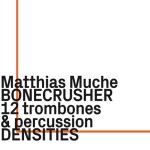
Artist: Matthias Muche’s BONECRUSHER (@)
Title: Densities - for 12 trombones & percussion
Format: Download Only (MP3 + Lossless)
Label: Hat Hut Records (@)
Rated:
Title: Densities - for 12 trombones & percussion
Format: Download Only (MP3 + Lossless)
Label: Hat Hut Records (@)
Rated:
There are twelve trombones on "Densities". This is the sort of information that ought to be stated early, partly because it is impressive, and partly because twelve trombones sound like the beginning of either a magnificent musical experiment or an exceptionally elaborate way of upsetting the neighbours.
Matthias Muche’s BONECRUSHER belongs firmly to the first category. Since its formation, the ensemble has treated the trombone less as a brass instrument in the conventional sense than as a complicated physical apparatus: a column of air, a collection of vibrating surfaces, a system of valves, slides, breath and resonance capable of producing sounds that seem to belong to several musical families at once. On "Densities", this idea has matured into something remarkably cohesive. The thirteen musicians do not merely produce a large sound. They create a body.
Muche, a Cologne-based composer and trombonist, has spent much of his career investigating precisely this territory, where instrumental technique becomes inseparable from the physical behaviour of sound. His work has earned him recognition including the WDR Jazz Prize for improvisation, but "Densities" makes little interest in credentials. The music is too busy examining the molecular structure of a trombone to worry about its résumé.
The album begins with “Butter”, and the title is almost perversely gentle considering what follows. The trombones accumulate in layers, initially suggesting a low-frequency weather system before gradually revealing the extraordinary number of events occurring inside it. Air becomes grain; tones become pressure; individual attacks dissolve into a thickened acoustic surface. The impression is not of twelve players standing next to one another but of one enormous instrument discovering that it has twelve mouths.
That distinction is crucial. Much of the fascination here comes from the way BONECRUSHER constantly shifts the listener’s perception of scale. A sound that initially seems monumental can suddenly disclose a tiny tremor inside it. A seemingly continuous drone turns out to be composed of subtly moving pitches and timbral variations. The music therefore possesses an unusual kind of depth: not the depth produced by reverberation or electronics, but one created entirely by the internal friction of acoustic material.
“Quater” pushes this principle further. Microtonal movements, abrupt articulations and overlapping gestures create a situation in which apparent disorder gradually reveals a remarkably precise organisation. The trombones seem to smear themselves across one another, yet small harmonic relationships keep emerging from the confusion. There is something almost tactile about it, as though the composition were being kneaded into shape rather than conventionally played.
This is where Muche’s compositional thinking becomes particularly compelling. The large ensemble is not used simply to amplify an idea. It changes the nature of the idea itself. Music written for one trombone can contain ambiguity, breath and physical instability; multiplied by twelve, those properties become architecture. A gesture is no longer merely a gesture. It becomes a surface, a pressure field, a mass with edges.
Matthias Müller’s “Up & Down” approaches the same problem from another direction. Its sustained harmonies and carefully controlled internal movement make the ensemble appear almost static at first, although the apparent stillness is constantly being modified. The trombones breathe into one another, generating small shifts in colour and pitch that gradually alter the whole structure. It is an excellent demonstration of how much movement can be hidden inside a sound that, from a distance, appears motionless.
Then comes Johannes Bauer’s “Brass / Breath / Brisk”, originally conceived in the late 1990s and here transformed from its solo/tape origins into an ensemble piece through the work of Jeb Bishop, Matthias Müller and Muche. The historical dimension matters. Bauer, who died in 2016, was one of the great European trombonists of free improvisation, and his presence is felt not through nostalgia but through the physical unruliness of the material. The piece has a rougher grain than the preceding works, with blocks of brass colliding, separating and reforming while Etienne Nillesen’s prepared snare provides a wonderfully economical counterweight.
Nillesen deserves particular attention because his percussion does not behave like percussion in any ordinary orchestral sense. The snare becomes another resonating object, sometimes sharply articulated, sometimes almost suspended within the brass. Its presence prevents the twelve trombones from becoming an entirely self-contained organism. It punctures the mass, gives it a skeleton, occasionally reminds us that rhythm has not been abolished, merely buried somewhere under several tonnes of brass.
And that is perhaps the central achievement of "Densities": it manages to be massive without becoming blunt.
There is plenty here that could easily have collapsed into undifferentiated heaviness. Twelve trombones offer a frighteningly efficient route towards sonic obesity. Instead, BONECRUSHER repeatedly finds cracks inside the density. Breaths, overtones, unstable pitches, tiny articulations and differences in attack remain audible. The music can be abrasive, even physically imposing, but it is rarely merely loud. Its power comes from the complexity packed inside the weight.
The title consequently works on several levels. These are densities of sound, certainly, but also densities of bodies, air, time and attention. The album asks what happens when an instrument normally associated with a single voice is multiplied until individuality begins to disappear. What remains is neither anonymity nor uniformity. It is a collective identity in which the smallest discrepancies become part of the composition.
There is something quietly philosophical about that. The ensemble does not erase the individual players; it makes their differences useful. Twelve trombones can approximate a single organism precisely because no twelve human beings will ever produce exactly the same sound. The imperfections are not defects to be corrected but the material from which the larger form emerges.
Muche's fascination with the trombone therefore reaches beyond extended technique. He is interested in what happens when an instrument is treated as a physical proposition rather than a predetermined vocabulary. The trombone is allowed to be metallic, breathy, granular, vocal, mechanical, spectral and occasionally almost orchestral. It can growl like machinery one moment and become astonishingly fragile the next.
That fragility is what saves "Densities" from becoming a mere demonstration of force. Beneath the muscular title and the intimidating personnel list there is a surprisingly delicate record, one that pays attention to the smallest variations in pressure and resonance. The brute and the microscopic coexist without cancelling one another.
Listening to it is consequently less like hearing a brass ensemble and more like standing inside a machine that has developed an unexpectedly sophisticated inner life.
Which is a fairly good reason to forgive it for having twelve trombones.
"Densities" is an imposing, meticulous and occasionally beautiful piece of contemporary acoustic music. It demonstrates how much can still be extracted from an instrument whose conventional identity seems almost too familiar to surprise us anymore. Muche and BONECRUSHER do not reinvent the trombone by disguising it. They do something more interesting: they expose the strange thing that was already hiding inside it.
The result is music of considerable physical presence, but also of patience and precision. It crushes bones only metaphorically. The ears, however, are invited to undergo a rather more elaborate treatment.
Matthias Muche’s BONECRUSHER belongs firmly to the first category. Since its formation, the ensemble has treated the trombone less as a brass instrument in the conventional sense than as a complicated physical apparatus: a column of air, a collection of vibrating surfaces, a system of valves, slides, breath and resonance capable of producing sounds that seem to belong to several musical families at once. On "Densities", this idea has matured into something remarkably cohesive. The thirteen musicians do not merely produce a large sound. They create a body.
Muche, a Cologne-based composer and trombonist, has spent much of his career investigating precisely this territory, where instrumental technique becomes inseparable from the physical behaviour of sound. His work has earned him recognition including the WDR Jazz Prize for improvisation, but "Densities" makes little interest in credentials. The music is too busy examining the molecular structure of a trombone to worry about its résumé.
The album begins with “Butter”, and the title is almost perversely gentle considering what follows. The trombones accumulate in layers, initially suggesting a low-frequency weather system before gradually revealing the extraordinary number of events occurring inside it. Air becomes grain; tones become pressure; individual attacks dissolve into a thickened acoustic surface. The impression is not of twelve players standing next to one another but of one enormous instrument discovering that it has twelve mouths.
That distinction is crucial. Much of the fascination here comes from the way BONECRUSHER constantly shifts the listener’s perception of scale. A sound that initially seems monumental can suddenly disclose a tiny tremor inside it. A seemingly continuous drone turns out to be composed of subtly moving pitches and timbral variations. The music therefore possesses an unusual kind of depth: not the depth produced by reverberation or electronics, but one created entirely by the internal friction of acoustic material.
“Quater” pushes this principle further. Microtonal movements, abrupt articulations and overlapping gestures create a situation in which apparent disorder gradually reveals a remarkably precise organisation. The trombones seem to smear themselves across one another, yet small harmonic relationships keep emerging from the confusion. There is something almost tactile about it, as though the composition were being kneaded into shape rather than conventionally played.
This is where Muche’s compositional thinking becomes particularly compelling. The large ensemble is not used simply to amplify an idea. It changes the nature of the idea itself. Music written for one trombone can contain ambiguity, breath and physical instability; multiplied by twelve, those properties become architecture. A gesture is no longer merely a gesture. It becomes a surface, a pressure field, a mass with edges.
Matthias Müller’s “Up & Down” approaches the same problem from another direction. Its sustained harmonies and carefully controlled internal movement make the ensemble appear almost static at first, although the apparent stillness is constantly being modified. The trombones breathe into one another, generating small shifts in colour and pitch that gradually alter the whole structure. It is an excellent demonstration of how much movement can be hidden inside a sound that, from a distance, appears motionless.
Then comes Johannes Bauer’s “Brass / Breath / Brisk”, originally conceived in the late 1990s and here transformed from its solo/tape origins into an ensemble piece through the work of Jeb Bishop, Matthias Müller and Muche. The historical dimension matters. Bauer, who died in 2016, was one of the great European trombonists of free improvisation, and his presence is felt not through nostalgia but through the physical unruliness of the material. The piece has a rougher grain than the preceding works, with blocks of brass colliding, separating and reforming while Etienne Nillesen’s prepared snare provides a wonderfully economical counterweight.
Nillesen deserves particular attention because his percussion does not behave like percussion in any ordinary orchestral sense. The snare becomes another resonating object, sometimes sharply articulated, sometimes almost suspended within the brass. Its presence prevents the twelve trombones from becoming an entirely self-contained organism. It punctures the mass, gives it a skeleton, occasionally reminds us that rhythm has not been abolished, merely buried somewhere under several tonnes of brass.
And that is perhaps the central achievement of "Densities": it manages to be massive without becoming blunt.
There is plenty here that could easily have collapsed into undifferentiated heaviness. Twelve trombones offer a frighteningly efficient route towards sonic obesity. Instead, BONECRUSHER repeatedly finds cracks inside the density. Breaths, overtones, unstable pitches, tiny articulations and differences in attack remain audible. The music can be abrasive, even physically imposing, but it is rarely merely loud. Its power comes from the complexity packed inside the weight.
The title consequently works on several levels. These are densities of sound, certainly, but also densities of bodies, air, time and attention. The album asks what happens when an instrument normally associated with a single voice is multiplied until individuality begins to disappear. What remains is neither anonymity nor uniformity. It is a collective identity in which the smallest discrepancies become part of the composition.
There is something quietly philosophical about that. The ensemble does not erase the individual players; it makes their differences useful. Twelve trombones can approximate a single organism precisely because no twelve human beings will ever produce exactly the same sound. The imperfections are not defects to be corrected but the material from which the larger form emerges.
Muche's fascination with the trombone therefore reaches beyond extended technique. He is interested in what happens when an instrument is treated as a physical proposition rather than a predetermined vocabulary. The trombone is allowed to be metallic, breathy, granular, vocal, mechanical, spectral and occasionally almost orchestral. It can growl like machinery one moment and become astonishingly fragile the next.
That fragility is what saves "Densities" from becoming a mere demonstration of force. Beneath the muscular title and the intimidating personnel list there is a surprisingly delicate record, one that pays attention to the smallest variations in pressure and resonance. The brute and the microscopic coexist without cancelling one another.
Listening to it is consequently less like hearing a brass ensemble and more like standing inside a machine that has developed an unexpectedly sophisticated inner life.
Which is a fairly good reason to forgive it for having twelve trombones.
"Densities" is an imposing, meticulous and occasionally beautiful piece of contemporary acoustic music. It demonstrates how much can still be extracted from an instrument whose conventional identity seems almost too familiar to surprise us anymore. Muche and BONECRUSHER do not reinvent the trombone by disguising it. They do something more interesting: they expose the strange thing that was already hiding inside it.
The result is music of considerable physical presence, but also of patience and precision. It crushes bones only metaphorically. The ears, however, are invited to undergo a rather more elaborate treatment.
Emra Grid: Eleven Finns
There is something oddly reassuring about broken electronics. They have already failed at being what they were designed to be, so they no longer have to pretend. A damaged synthesizer can stop obeying its manual and start behaving like an instrument with opinions.
"Eleven Finns", the latest release from Sean Piñeiro under the Emra Grid name, seems to understand this instinctively. Built from slow-moving bass frequencies, carefully shaped percussion and the peculiar behaviour of malfunctioning machines, it is an ambient record that does not so much surround the listener as gradually become part of the room. Its five pieces, composed in Barcelona in 2025, unfold with a patience that makes conventional notions of development feel almost unnecessarily busy.
Piñeiro has been cultivating this particular territory for years. His Emra Grid work has consistently occupied the murkier regions between drone, ambient electronics and industrial sound design, balancing harmonic density against silence and using bass not simply as a low-frequency foundation but as something almost architectural. His previous LINE releases, "Five Cycles Through an Empty Chamber" and "Threatening Omens in the Clouds", established a vocabulary in which menace could emerge from very little: a pressure in the low end, a distorted resonance, a texture slowly changing shape.
"Eleven Finns" retains that vocabulary but changes its weather.
Where "Threatening Omens in the Clouds" suggested something gathering overhead, the new record feels closer to humidity. Nothing is necessarily approaching. Nothing needs to happen. The air simply becomes different.
The title track takes more than thirteen minutes to demonstrate how effective this approach can be. Its rhythmic material is never quite presented as a beat. Percussive sounds appear, recede and mutate, gradually becoming indistinguishable from the surrounding electronic textures. What might initially register as rhythm turns into surface; what seems like background noise acquires a pulse. The piece keeps moving without giving the listener the reassuring landmarks normally associated with movement. This is one of Piñeiro's strengths. He understands that repetition becomes interesting when it is allowed to deteriorate. The bass does not simply return. It shifts. Percussion does not merely repeat. It acquires different weights and edges. Small deviations accumulate until the listener realises that the original pattern has quietly disappeared. There is no dramatic announcement of change because the changes are too patient for that sort of theatre.
“Fact + True” extends the process. Here the relationship between percussion and sustained electronic material becomes even more elusive, with rhythmic fragments emerging from a thickened atmosphere before being swallowed back into it. The effect is strangely physical. One can almost imagine the sounds as objects moving through a dark room, although the room itself keeps changing dimensions.
That visual quality is important to Emra Grid's music. Piñeiro has long been interested in the relationship between sound and empty space, and "Eleven Finns" makes that relationship unusually tangible. Silence is not necessarily an absence between events. It is part of the material. The sounds need somewhere to exist, and the surrounding emptiness gives their low frequencies room to breathe.
Then there is the wonderful perversity of “Alway Season”, composed entirely with a broken MEGAfm MKII. The machine's damaged state is not treated as an unfortunate technical obstacle but as compositional material. This is very much in keeping with Piñeiro's broader fascination with unstable sound sources, but it also reveals something fundamental about the album: "Eleven Finns" is interested in processes that cannot be completely controlled.
The same is true of the circuit-bent Yamaha PortaSound PS-400 used for the title track. A consumer keyboard, once subjected to the usual indignities of circuit bending, becomes something considerably less innocent. The familiar promise of the instrument has been dismantled and replaced by unpredictable electronic behaviour. It is almost a metaphor for ambient music itself. Take an ordinary sound, slow it down, remove its obvious function, place it in enough empty space, and eventually nobody knows what it was supposed to be.
The shorter “The Vision” provides a useful change of scale. At just over three minutes, it does not attempt the prolonged transformations of the longer pieces. Instead, it feels like a fleeting glimpse into the same environment. The record briefly contracts before “The Fame” expands its vocabulary again, bringing the release to a conclusion that feels more like evaporation than resolution.
This structure is one of the album's quiet virtues. Piñeiro does not mistake duration for profundity. The longer pieces allow processes to become perceptible, while the shorter tracks interrupt the accumulation before it turns into a predictable formula. There is enough variation to keep the record alive, but not so much that its internal logic becomes obscured.
The most striking thing about "Eleven Finns", however, is how little it demands from the listener. That does not mean it is easy. There is a difference between music that requires concentration and music that makes concentration unnecessary. Piñeiro's work belongs to the second category. It can be listened to attentively, in which case tiny fluctuations in timbre and rhythm become increasingly apparent, but it can also occupy the peripheral zones of consciousness without collapsing into decorative wallpaper.
That balance is notoriously difficult to achieve. Ambient music has always lived dangerously close to the furniture department, where an attractive texture can be mistaken for a composition. "Eleven Finns" avoids that fate because its sounds are constantly doing something, even when that something is almost imperceptible. The music is not static. It is simply operating at a scale where change has to be noticed rather than announced.
There is also a subtle emotional transformation taking place. The darkness of Piñeiro's earlier LINE work has not disappeared. It has become less theatrical. Instead of menace, there is uncertainty. Instead of something ominous looming in the distance, there is a feeling that the familiar world has become slightly less solid than it was a few minutes ago. That makes "Eleven Finns" a surprisingly intimate record. Its electronic materials may originate in machines, but the music never feels particularly technological. The equipment is merely the means through which Piñeiro investigates resonance, deterioration, repetition and space. A broken synthesizer is no more important than the room in which it is heard. The machine generates the material; the composer decides how long we remain with it.
And patience is perhaps the real instrument being played here. "Eleven Finns" does not chase climaxes, nor does it construct grand emotional arcs. It allows sounds to accumulate their own histories. A percussion hit heard early in a piece may have become almost unrecognisable by the time the piece ends. A bass tone can begin as a presence and eventually feel like part of the architecture. The music's narrative is written in gradual deviation rather than dramatic event.
This gives the album a peculiar kind of poetry. Not the poetry of beautiful images, but of things changing when nobody is looking.
The title "Eleven Finns" remains suitably mysterious, and perhaps it is better that way. The record itself does not explain its names. It simply offers five slightly different ways of inhabiting the same unstable atmosphere. In Piñeiro's hands, ambient music becomes less a genre than a method of paying attention to marginal phenomena: the hum behind the hum, the rhythm beneath the rhythm, the sound that remains after the recognisable sound has gone.
The machines may be broken, but the music is not.
Quite the opposite. "Eleven Finns" finds considerable freedom in malfunction, uncertainty and gradual transformation. It is an understated but deeply tactile work, one that replaces the ominous skies of Piñeiro's earlier LINE releases with something softer and arguably more unsettling: weather that has no intention of leaving.
"Eleven Finns", the latest release from Sean Piñeiro under the Emra Grid name, seems to understand this instinctively. Built from slow-moving bass frequencies, carefully shaped percussion and the peculiar behaviour of malfunctioning machines, it is an ambient record that does not so much surround the listener as gradually become part of the room. Its five pieces, composed in Barcelona in 2025, unfold with a patience that makes conventional notions of development feel almost unnecessarily busy.
Piñeiro has been cultivating this particular territory for years. His Emra Grid work has consistently occupied the murkier regions between drone, ambient electronics and industrial sound design, balancing harmonic density against silence and using bass not simply as a low-frequency foundation but as something almost architectural. His previous LINE releases, "Five Cycles Through an Empty Chamber" and "Threatening Omens in the Clouds", established a vocabulary in which menace could emerge from very little: a pressure in the low end, a distorted resonance, a texture slowly changing shape.
"Eleven Finns" retains that vocabulary but changes its weather.
Where "Threatening Omens in the Clouds" suggested something gathering overhead, the new record feels closer to humidity. Nothing is necessarily approaching. Nothing needs to happen. The air simply becomes different.
The title track takes more than thirteen minutes to demonstrate how effective this approach can be. Its rhythmic material is never quite presented as a beat. Percussive sounds appear, recede and mutate, gradually becoming indistinguishable from the surrounding electronic textures. What might initially register as rhythm turns into surface; what seems like background noise acquires a pulse. The piece keeps moving without giving the listener the reassuring landmarks normally associated with movement. This is one of Piñeiro's strengths. He understands that repetition becomes interesting when it is allowed to deteriorate. The bass does not simply return. It shifts. Percussion does not merely repeat. It acquires different weights and edges. Small deviations accumulate until the listener realises that the original pattern has quietly disappeared. There is no dramatic announcement of change because the changes are too patient for that sort of theatre.
“Fact + True” extends the process. Here the relationship between percussion and sustained electronic material becomes even more elusive, with rhythmic fragments emerging from a thickened atmosphere before being swallowed back into it. The effect is strangely physical. One can almost imagine the sounds as objects moving through a dark room, although the room itself keeps changing dimensions.
That visual quality is important to Emra Grid's music. Piñeiro has long been interested in the relationship between sound and empty space, and "Eleven Finns" makes that relationship unusually tangible. Silence is not necessarily an absence between events. It is part of the material. The sounds need somewhere to exist, and the surrounding emptiness gives their low frequencies room to breathe.
Then there is the wonderful perversity of “Alway Season”, composed entirely with a broken MEGAfm MKII. The machine's damaged state is not treated as an unfortunate technical obstacle but as compositional material. This is very much in keeping with Piñeiro's broader fascination with unstable sound sources, but it also reveals something fundamental about the album: "Eleven Finns" is interested in processes that cannot be completely controlled.
The same is true of the circuit-bent Yamaha PortaSound PS-400 used for the title track. A consumer keyboard, once subjected to the usual indignities of circuit bending, becomes something considerably less innocent. The familiar promise of the instrument has been dismantled and replaced by unpredictable electronic behaviour. It is almost a metaphor for ambient music itself. Take an ordinary sound, slow it down, remove its obvious function, place it in enough empty space, and eventually nobody knows what it was supposed to be.
The shorter “The Vision” provides a useful change of scale. At just over three minutes, it does not attempt the prolonged transformations of the longer pieces. Instead, it feels like a fleeting glimpse into the same environment. The record briefly contracts before “The Fame” expands its vocabulary again, bringing the release to a conclusion that feels more like evaporation than resolution.
This structure is one of the album's quiet virtues. Piñeiro does not mistake duration for profundity. The longer pieces allow processes to become perceptible, while the shorter tracks interrupt the accumulation before it turns into a predictable formula. There is enough variation to keep the record alive, but not so much that its internal logic becomes obscured.
The most striking thing about "Eleven Finns", however, is how little it demands from the listener. That does not mean it is easy. There is a difference between music that requires concentration and music that makes concentration unnecessary. Piñeiro's work belongs to the second category. It can be listened to attentively, in which case tiny fluctuations in timbre and rhythm become increasingly apparent, but it can also occupy the peripheral zones of consciousness without collapsing into decorative wallpaper.
That balance is notoriously difficult to achieve. Ambient music has always lived dangerously close to the furniture department, where an attractive texture can be mistaken for a composition. "Eleven Finns" avoids that fate because its sounds are constantly doing something, even when that something is almost imperceptible. The music is not static. It is simply operating at a scale where change has to be noticed rather than announced.
There is also a subtle emotional transformation taking place. The darkness of Piñeiro's earlier LINE work has not disappeared. It has become less theatrical. Instead of menace, there is uncertainty. Instead of something ominous looming in the distance, there is a feeling that the familiar world has become slightly less solid than it was a few minutes ago. That makes "Eleven Finns" a surprisingly intimate record. Its electronic materials may originate in machines, but the music never feels particularly technological. The equipment is merely the means through which Piñeiro investigates resonance, deterioration, repetition and space. A broken synthesizer is no more important than the room in which it is heard. The machine generates the material; the composer decides how long we remain with it.
And patience is perhaps the real instrument being played here. "Eleven Finns" does not chase climaxes, nor does it construct grand emotional arcs. It allows sounds to accumulate their own histories. A percussion hit heard early in a piece may have become almost unrecognisable by the time the piece ends. A bass tone can begin as a presence and eventually feel like part of the architecture. The music's narrative is written in gradual deviation rather than dramatic event.
This gives the album a peculiar kind of poetry. Not the poetry of beautiful images, but of things changing when nobody is looking.
The title "Eleven Finns" remains suitably mysterious, and perhaps it is better that way. The record itself does not explain its names. It simply offers five slightly different ways of inhabiting the same unstable atmosphere. In Piñeiro's hands, ambient music becomes less a genre than a method of paying attention to marginal phenomena: the hum behind the hum, the rhythm beneath the rhythm, the sound that remains after the recognisable sound has gone.
The machines may be broken, but the music is not.
Quite the opposite. "Eleven Finns" finds considerable freedom in malfunction, uncertainty and gradual transformation. It is an understated but deeply tactile work, one that replaces the ominous skies of Piñeiro's earlier LINE releases with something softer and arguably more unsettling: weather that has no intention of leaving.