
Wednesday, November 4, 2026
Browse by Genre
Industrial Music / Industrial Metal / Aggro Industrial / Electro Metal
Industrial Noise / Power Noise / Harsh Noise
Synth Pop / Electro Pop / Synth-Electronica
Techno / Trance / Goa / Drum'n'Bass / Jungle / Tribal / Trip-Hop
Ambient / Electronica / Ethereal / Dub / Soundscapes / Abstract
Experimental / Avantgarde / Weird & Wired / Glitch / Noise / Field Recording
Dark / Gothic / Wave / New Wave / Dark Wave / Industrial Gothic
New Music / Downtown / Avantgarde Jazz / New Classical / World
Search Reviews
Music Reviews
Earth Logoff: Torments & Temptations
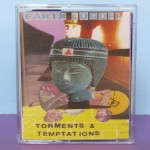
Artist: Earth Logoff
Title: Torments & Temptations
Format: Tape + Download
Label: Kitchen Leg (@)
Rated:

Title: Torments & Temptations
Format: Tape + Download
Label: Kitchen Leg (@)
Rated:
There is something reassuringly unreasonable about Earth Logoff. While much contemporary electronic music seems intent on polishing every transient until it could be used as a dental instrument, the Berlin duo prefer to make their machines sound as though they have developed several incompatible personalities and are refusing medication. "Torments & Temptations", their third release, expands the project's peculiar mixture of industrial abrasion, speedcore impulses, mutant techno and noisecore with an unexpectedly broad assortment of samples, from brass-band eruptions to brittle 8-bit fragments. The result is a kind of mechanical carnival in which the attractions are operated by faulty wiring and the amusement-park staff appear to have joined a militant percussion ensemble. It is unruly, frequently funny and considerably more disciplined than its surface behaviour might suggest.
Earth Logoff is the project of RBRT and Sanaa, both formerly involved with the Berlin noise-rock group Antihairball. Their musical vocabulary has moved a considerable distance from conventional band arrangements. RBRT works with a self-programmed controller, sampling and electronic devices, while Sanaa supplies the physical force of analogue drums. The duo describe their music as a form of apocalyptic dance music, which is a reasonably accurate description provided one imagines the apocalypse taking place in a basement club where the sound system has been assembled from industrial scrap. Their previous releases, "Fungym" (2019) and "Tritium" (2022), established an interest in strange rhythmic structures, abrasive electronics and an almost cartoonish approach to sonic destruction. The present album develops those elements while introducing Sanaa's voice more prominently, adding a human presence to music that often seems to be arguing with its own circuitry.
The opening "dronose" sets the tone through a collision of electronic disturbance and rhythmic insistence. There is little interest in establishing a stable groove and then politely maintaining it for the benefit of dancers who have paid good money for predictable entertainment. Instead, the beat behaves like a machine with a loose connection: it catches, accelerates, stumbles and resumes with an almost irritating determination. The industrial components are rough-edged, but the arrangement has an eccentric sense of proportion, allowing abrupt changes and unexpected details to interrupt the forward motion. The track's short duration is important. Earth Logoff understand that chaos becomes less effective when it is allowed to explain itself for too long.
"Eilat" and "farad" continue this unstable relationship between rhythm and abrasion. The former suggests a peculiar kind of dance-floor functionality, with electronic patterns and percussive elements pushing against one another rather than settling into a conventional hierarchy. "farad" takes the electricity metaphor rather literally, with a title borrowed from the unit of electrical capacitance. One can imagine the duo enjoying the thought of a musical system that stores energy only to discharge it at inconvenient moments. Their arrangements frequently create the impression of several musical ideas attempting to occupy the same space, with no clear agreement about who has priority. Yet there is an underlying precision to the construction. The drums may sound unruly, but Sanaa's playing is remarkably controlled, negotiating abrupt changes and irregular time signatures without sacrificing the physical impact.
"labiacs" brings Sanaa's voice into the picture, and the effect is particularly revealing. The vocal presence does not soften the music or provide the reassuring melodic centre that a more conventional producer might have introduced. Instead, it adds another layer of human unpredictability to an already unstable environment. The voice can sound confrontational, playful or deliberately absurd, while the instrumental backing continues its electronic misbehaviour. The contrast is central to the album's appeal: the machinery seems to be malfunctioning, but the people operating it are clearly having a rather good time. There is even a distinctly impudent sense of humour in the way the track treats the conventions of industrial music, refusing to take its own aggression entirely seriously.
"boredub", the fifth track, offers a title that hints at dub's spaciousness while suggesting that the musicians may have become impatient with the genre's more meditative habits. Earth Logoff are not particularly interested in giving the listener time to contemplate the spiritual significance of a delayed snare. Their use of repetition is more abrasive, with rhythmic elements and electronic fragments producing a kind of distorted dance music that keeps changing its mind about what it wants to be. The track provides a useful transition into the second half, where the album becomes even more unpredictable.
"shove it" makes its intentions fairly clear without requiring an elaborate programme note. The title is an appropriately blunt gesture, and the music follows suit, combining forceful percussion with the duo's familiar taste for sudden changes in texture. "ugli igli" is another highlight, its deliberately awkward title matching the music's appetite for odd rhythmic turns and distorted electronic colours. The brass-like blasts and crude digital sounds contribute to the impression of a musical environment assembled from incompatible parts. Yet these elements are not simply thrown together for the sake of novelty. Their placement creates a peculiar sense of momentum, as though the music were constantly discovering new ways to trip over itself while somehow managing to keep moving.
The final stretch, represented by "strumpf" and "umpf" in the supplied tracklist, maintains the album's refusal to settle into a single mood. The rhythmic structures remain forceful, but their relationship with noise and electronic detail keeps shifting. There is something almost physical about the way the percussion occupies the foreground, while RBRT's electronics continually distort the surrounding space. The resulting music is danceable in the same way that navigating a badly maintained staircase can be an exercise in athletic coordination: possible, certainly, but not recommended without a little preparation. The duo's sense of humour is particularly effective here because it never neutralises the music's intensity. The absurdity and the aggression coexist, each making the other more convincing.
What makes "Torments & Temptations" interesting is the way it balances programmed control with the unpredictability of live performance. RBRT's self-built electronic system provides a broad range of sounds, from abrasive industrial textures to almost toy-like digital patterns, while Sanaa's drumming gives the music a muscular, physical dimension. Her vocal contributions further complicate the picture, preventing the project from becoming a purely mechanical exercise. The duo's history in noise rock is still audible in their disregard for conventional musical polish, but their present approach is more rhythmically adventurous and less dependent on the familiar dynamics of a guitar-based band. The result occupies an eccentric territory between industrial, techno, noisecore and a particularly deranged form of experimental pop.
Kitchen Leg Records is a fitting home for this sort of activity. The Berlin-based cassette label has developed a catalogue that favours independent, idiosyncratic music, often with a strong affinity for no wave, experimental rock, noise and eccentric pop. Its releases tend to value personality over stylistic respectability, and Earth Logoff fit that ethos rather neatly. The cassette format also suits the project's deliberately rough character: there is something appropriate about hearing such an unruly collection of sounds through a medium that has its own history of mechanical imperfections and occasional acts of betrayal.
For all its abrasive tendencies, "Torments & Temptations" is not simply an exercise in sonic punishment. Its most appealing quality is the sense of play that runs through the music. Earth Logoff understand that industrial noise does not have to spend every minute impersonating the soundtrack to a collapsing factory. It can be grotesque, rhythmic, absurd and even mischievously entertaining. Their music may depict a world in which technology has gone rogue, but the humans remain firmly in charge of the entertainment budget. In an age when digital systems increasingly promise to make everything seamless, efficient and frictionless, there is something oddly liberating about a record that celebrates malfunction as a creative resource. "Torments & Temptations" makes a persuasive case for the dance floor as a place where disorder can be organised, briefly, into something resembling joy. The building may be on fire, but at least the drums are still working.
Felsenreich: Motif und Tempo

German band Felsenreich has been around since 1998, but unless you're from Europe or the U.K., chances are good that you never heard of them. They've released a bunch of albums since their inception and have played many gigs and festivals including Wave-Gotik-Treffen. While 'Motif und Tempo' is their sixth studio album, it certainly does not tell the whole story of Felsenreich. Their first couple of albums - 'Am Ende Der Zeit' (2001) and 'Tiefe' (2004) were reviewed here at Chain D.L.K., the latter positively, the former- not so much. Since I'm among those that have no prior familiarity with Felsenreich, I felt obliged to listen to those albums, plus some of their later work preceding 'Motif und Tempo.' The conclusion I came to is that Felsenreich was definitely an interesting gothic/darkwave band. (I emphasize the word "was.") I can't say that I loved every track on each album I heard but some of their work was absolutely excellent. Their change of style on 'Motif und Tempo' sends the band in a middle-of-the-road direction that I don't think is doing them any favors...at least not here in the U.S.
Felsenreich's sound used to be grand and dramatic. When female vocalist Romy Unger joined the band in 2006 (or 2007?) she enriched their sound for a good long period. She has a voice that leans classical/operatic, perfect for goth/darkwave. She left the band in 2021 or so, and I believe Felsenreich lost something in her departure. Even their more neofolk acoustic album, ‘Blumen' (2017) was richer for her participation. With Romy gone, that leaves the trio of Mathias Sohn ((keyboards, vocals, trumpet); Carsten Schaller (guitar, vocals) and Renato Wesley (vocal, acoustic guitar) to carry on. 'Motif und Tempo' is an album of ten tracks, eight sung in English and two in German. The opener, "Night Bound Train" sounds like it could have been done by any Euro synth-pop/alternative rock band. There is a barely audible female vocalist (Nathalie) singing on it in unison with Mathias or Renato (I have a hard time telling them apart) but she has nowhere near the presence Romy had. "I Will Tell You" is a bit more electro filled with melodic nostalgia but not dark in the least. "This Feeling" is another attempt to recapture the nostalgia of the past, beginning with the lyrics: "Do you remember the clubs? And the music? The spirit! The smell!! The feel. On the way..." This isn’t goth or darkwave. This is just alternative rock. It comes across somewhat like low-rent Bowie. (Nathalie's voice may be sort of buried in the mix.) I think the best thing about this track is Mathias's trumpet. Slowing things down with "The Fall," the song is melancholic and competent, but still not very dark. The first hint of gothiness comes in the up-tempo "Glorious Solution," reminiscent of Sisters of Mercy, but the song begs for a strong hook that never materializes. The first track in German, "Ein Hauch" follows with a sequenced synth rhythm and this one is pretty darn strong. (Dark music always seems to sound better in Deutsche.) "Island of Glory" proves that the drama isn't gone from Felsenreich with its martial theme, although I'm not sure what 'Island of Glory' they're talking about as the lyrics are more generic than specific. "Purpose of Roses" begins with a recitation before the sung lyrics, then moves back to recitation. This is another personally nostalgic number that likely only the band will truly understand. Another somewhat ordinary rock song, "I Get By" yawns by before the finale - "Uber uns der Himmel." It's somewhat dark and melancholic, but not a particularly strong ending.
There's no doubt these guys still have talent, but this mellowing out won't do them any favors over here, despite the album spending a fair amount of time in the top ten in the Deutsche Alternative Charts. When American audiences are looking for new dark music acts to follow, they want GOTH and DARKWAVE, not alternative rock bands that used to be that. The fact that they have a weak Spotify presence (70 monthly listeners), no Bandcamp site, and somewhat minimal YouTube presence isn't helping them. Being that they're on a pretty well-known dark music label, Danse Macabre, one would expect more.
OdNu + Ümlaut: Metamorphoses

Artist: OdNu + Ümlaut (@)
Title: Metamorphoses
Format: Download Only (MP3 + Lossless)
Label: Audiobulb (@)
Rated:
Title: Metamorphoses
Format: Download Only (MP3 + Lossless)
Label: Audiobulb (@)
Rated:
Metamorphosis is usually presented as a rather dramatic business: caterpillars become butterflies, gods turn into animals, and unfortunate mortals discover that offending the wrong deity can have consequences considerably worse than a parking ticket. For Michel Mazza and Jeff Düngfelder, however, transformation is a quieter, more gradual affair. Their third collaboration as OdNu + Ümlaut, "Metamorphoses", takes the form of a single sixty-minute composition in which sounds continually change their function, identity and surroundings. A guitar phrase becomes a distant recollection; a rhythmic figure briefly suggests a more conventional musical structure before dissolving; electronic tones acquire an almost physical presence. The album's central idea is therefore expressed through its actual construction: music that does not merely describe change, but makes change its principal organising principle.
The partnership has developed considerably since "Abandoned Spaces" (2024), where the two musicians combined processed guitars, bass lines, drums and delicate electronic details in a collection of interconnected pieces. "Mitochondria Johatsu" (2025) extended their shared vocabulary, moving further into abstraction while retaining a melodic sensibility. Here, the individual tracks have disappeared altogether. The decision to work with one uninterrupted composition is significant because it changes the listener's relationship with the material. There are no titles to suggest a succession of separate destinations, no convenient pauses in which to check whether the washing machine has finished. Instead, the music establishes its own internal chronology, allowing ideas to return in altered circumstances and making transitions as important as the sounds themselves.
The creative process began with Düngfelder constructing a broad foundation from tape loops, electronics and processed material. Mazza then entered this environment with electric and MIDI guitar, clarinet, electronics and effects, responding to its possibilities through improvisation. The distinction between these two stages is not always perceptible in the finished recording, which is precisely the point. Rather than presenting a familiar arrangement of accompaniment and soloist, "Metamorphoses" creates a musical environment in which the contributions continually affect one another. The guitar does not simply decorate an electronic backdrop, while the loops do not function as a passive support system. Both become part of a circulating network of gestures, repetitions and transformations.
Their respective backgrounds make this approach particularly coherent. Buenos Aires-born Michel Mazza, who works as OdNu, has released more than twenty albums and developed a sound based on processed guitar, small recurring melodies, synthesised textures and field recordings. His parallel work in film editing, sound design and music composition has clearly informed his attention to atmosphere and the cinematic potential of apparently modest musical details. Jeff Düngfelder's Ümlaut project is more closely associated with minimal electroacoustic composition, tape manipulation, field recordings and the relationship between silence and sound. His work often treats environmental material as something to be recollected and rearranged rather than merely documented. Their shared experience of New York City, followed by their relocation to the countryside north of the metropolis, also provides an interesting biographical backdrop to music that frequently moves between organic impressions and electronically constructed spaces.
The opening establishes a vocabulary of small sounds and tentative melodic gestures. Water-like noises and clicks emerge alongside a recurring guitar figure, while soft electronic layers gradually establish a sense of depth. The music does not announce itself with the sort of grand introductory gesture that would make a film trailer editor particularly happy. Instead, it begins almost incidentally, as though the listener has entered a room where something has already been happening for some time. A restrained rhythmic pulse briefly appears, then gives way to warbling tones, piano-like sounds and fragments that hover somewhere between melody and texture. These elements are recognisable enough to provide orientation, but never remain in place for long.
One of the composition's most engaging qualities is its ability to introduce rhythm without allowing it to become the governing principle. Percussive sounds surface at intervals, sometimes suggesting a beat, sometimes merely adding a momentary sense of movement. They are subsequently withdrawn, leaving the melodic and textural material to reorganise itself. This gives the piece an unusual elasticity. It can momentarily approach ambient jazz, drift towards electroacoustic abstraction, or hint at a more conventional electronic composition, only to abandon the suggestion before it becomes a settled identity. There is a certain mischievousness in this behaviour. Just when the listener thinks they have worked out what kind of music they are hearing, the musicians quietly rearrange the furniture.
The central portion contains some of the album's most striking episodes. Around the twenty-minute mark, reversed percussion and resonant piano-like figures introduce a slightly more mysterious atmosphere. A brighter melodic passage subsequently emerges, offering one of the composition's rare moments of unmistakable uplift. It is followed by environmental sounds and rustling textures that are incorporated into the musical fabric rather than presented as documentary interruptions. Later, a darker melodic fragment and processed, harp-like tones alter the emotional temperature again. These changes are not organised around conventional climaxes. Instead, the music accumulates small moments of contrast, allowing one atmosphere to contaminate the next. The effect is less like watching a story unfold than observing a series of images whose edges have begun to overlap.
Mazza's melodic instincts are particularly important in preventing the composition from becoming an exercise in atmospheric suspension. Even when the guitar is heavily processed, its phrasing retains a sense of human gesture. Brief melodic figures appear, disappear and return in modified form, providing a thread that connects otherwise disparate sections. His clarinet contribution is absorbed into the broader electronic palette, adding another possible source of timbre without demanding attention as a featured instrument. Düngfelder, meanwhile, gives the composition much of its structural continuity through loops and recurring sonic details. His approach allows repetition to function as a form of memory: something recognisable returns, but its surroundings have changed sufficiently to make it feel different.
The album's later passages become more spacious and occasionally more rhythmic. Guitars reappear against sustained electronic layers, with wind-like tones and heavily reverberated sounds giving the music an almost architectural depth. Gradually introduced drums and hi-hats briefly create a more defined pulse, while another melodic passage brings a welcome degree of brightness. Yet the apparent stability never lasts. Guitar effects become rougher, delayed sounds trail away into the mix, and the environmental material gradually assumes greater importance. Water returns in the closing stretch, recalling the opening while avoiding the neatness of a perfectly symmetrical ending. The composition eventually settles into sustained tones, bells and fading electronic details, with its final gestures suggesting continuation rather than resolution.
There is a potential danger in music of this kind: the hour-long format can easily become an excuse for simply accumulating agreeable textures until the available storage space runs out. "Metamorphoses" largely avoids that trap because its changes are not merely ornamental. The recurring melodic material, subtle rhythmic interventions and carefully placed environmental sounds provide a sense of development, even when the music remains deliberately understated. It also benefits from the fact that both musicians have established individual practices capable of supporting this kind of extended collaboration. Their shared language is not based on erasing every difference, but on allowing those differences to become useful components of a larger process.
The album's title inevitably invites philosophical associations, but its transformation is not especially interested in grand declarations about the nature of existence. It is more convincing when considered at the level of sound itself. A melody changes meaning according to its surroundings; a recording of water can become percussion, atmosphere or memory; an electronic pulse can briefly resemble something organic. These transformations are modest, sometimes almost imperceptible, yet they alter the listener's sense of what is happening. The artwork by Düngfelder, with its overlapping translucent forms, offers a visual counterpart to this method without needing to illustrate every musical development.
"Metamorphoses" ultimately rewards attention through accumulation rather than spectacle. Its sixty minutes contain enough changes to prevent the experience from becoming static, but the musicians resist the temptation to make every new idea announce its arrival with a fanfare. This is music that understands the value of letting an idea become familiar before quietly changing its circumstances. There is no need for a caterpillar to explain the mechanics of its transformation, and Mazza and Düngfelder wisely avoid doing so. They simply allow the sounds to alter, multiply, recede and return, until the listener realises that the landscape encountered at the beginning has become something else. The process is patient, occasionally playful and quietly absorbing, with the added advantage that nobody needs to emerge from a chrysalis at the end.
J.WLSN & Liam Keenan: Country/The Country

The countryside has an image problem. In popular culture, it tends to arrive pre-packaged with acoustic guitars, wholesome sunsets, sentimental memories and a suspiciously high number of people who look as though they have never had to deal with a blocked drain. J.WLSN and Liam Keenan have little interest in this postcard version of rural life. On "Country/The Country", their shared recollections of Western Sydney and the more distant regions of New South Wales emerge through distorted guitars, modular synthesis, cassette loops and the patient accumulation of sound. This is a landscape in which the horizon has lost some of its definition, the past refuses to stay in its allotted decade, and even suburbia can acquire the solemnity of an ancient geological formation.
The album grew out of a recording session in October 2024 at Lost Sound, the Marrickville studio of their friend David Akerman. At the time, both musicians were working as art and music curators at a major Sydney art museum, while maintaining their own musical practices. Their collaboration had been postponed for long enough to become one of those projects that friends keep mentioning until somebody finally books a room. The session became an opportunity to explore their overlapping experiences of places inhabited during different periods of their lives. J.WLSN handles a Make Noise modular system, a Pulsar-23 and cassette loops, while Keenan contributes Bass VI, a 335 guitar and effects. Lawrence English subsequently provided additional treatments, mixing and mastering, helping situate the recording within the carefully considered sonic world of Room40.
The title is a small but productive ambiguity. "Country" might suggest a genre, although anyone expecting twang, tidy choruses or a lyrical account of heartbreak beside a pickup truck should probably check their assumptions at the door. "The Country" points instead towards territory: land, distance, habitation and the peculiar ways in which a place persists in the imagination after its immediate details have changed. The slash between the two terms acts almost like a border on a map, separating two ideas that the music continually allows to bleed together. For these musicians, geography is neither neutral scenery nor a collection of picturesque views. It is something absorbed over time, carried around in the body and recalled imperfectly. Their music approaches this inheritance obliquely, through textures that seem to retain the pressure of their origins without offering a documentary account of them.
The opening "Teflon Blues" occupies nearly twenty-one minutes, a generous stretch of time in which the guitar's identity gradually becomes less certain. Keenan's string work is processed and softened at the edges, while electronic layers and repeating fragments accumulate around it. The blues in the title is less a recognisable musical form than a residue: a suggestion of something once expressive, perhaps even songlike, that has been left out in the weather. The sound has a curious, worn surface, as though a familiar tune had been recovered from a box of old photographs stored in a damp shed. Yet the music avoids the obvious drama of decay. It proceeds by small alterations in density, tone and emphasis, allowing the listener to notice how a sound changes character when it has been encountered repeatedly. A guitar note can begin as a gesture and end up resembling a distant landmark, while the surrounding electronics blur the distinction between foreground and background.
There is a quiet intelligence in this refusal to hurry. Long-form music can occasionally mistake duration for profundity, as though a track becomes automatically more meaningful once it has outlasted an average television episode. Here, the extended form has a clearer purpose. Repetition provides a framework in which memory can work: details return, but their significance shifts according to what has happened in the meantime. The recording feels less like a performance advancing towards a destination than a mind circling a place it cannot quite describe. There is no need for a dramatic climax, because the subject itself is the gradual transformation of perception.
"The Power of Emptiness", at more than twelve minutes, makes the album's central paradox more explicit. Emptiness is not an absence of material; it is a condition that allows material to become perceptible. The guitar tones are suspended in an atmosphere of electronic haze, with noise and resonance subtly reshaping their contours. What might initially seem spacious acquires weight through the pressure of its own lingering sounds. The title could easily have introduced a solemn lecture on metaphysics, complete with a lecturer wearing an expensive black shirt, but the piece is more persuasive than that. Its spaciousness is physical and audible. There is room for tones to breathe, but also for them to be swallowed, obscured or reduced to traces. Silence, in this setting, is less an empty room than the room's capacity to remember what has been inside it.
Then comes "Planned Obsolescence", a brief interruption of just over a minute. Its title brings industrial cynicism into a sequence otherwise preoccupied with slow time and geographical memory. The phrase usually describes the deliberate shortening of a product's useful life, the sort of business philosophy that ensures your perfectly functional appliance will eventually become an expensive paperweight. Placed here, it introduces a wry counterpoint to the album's concern with duration. Sounds are allowed to persist, degrade and change, but the modern world is organised around replacing things before they have finished telling us anything. The track's brevity makes it feel like a small crack in the album's temporal fabric, a reminder that the landscapes we remember are also subject to development, demolition and the relentless logic of the new.
"Suburban Dopamine" stretches out over fifteen minutes, and its title brings the record closer to the environments that often escape the romantic vocabulary of landscape music. Suburbia is neither pristine wilderness nor the city centre's theatrical density. It is a world of repetitive streets, scattered commercial zones, familiar journeys and modest domestic routines. For many people, it is also where childhood actually happened, rather than where childhood is retrospectively staged in glossy advertising. The music reflects this less glamorous familiarity through loops and gradual shifts in texture. Repetition suggests routine, but the surrounding guitar and electronic layers prevent it from settling into mere mechanical sameness. Small changes acquire disproportionate importance, much as a road travelled hundreds of times can suddenly appear different under a change of light or after a building has disappeared.
There is something affecting about the way the piece allows suburban space to become strange without turning it into a horror film. Its atmosphere is neither idyllic nor overtly threatening. Instead, it hints at the oddness concealed inside ordinary surroundings, where places can be emotionally charged without possessing any obvious beauty. A shopping strip, an empty field beside a road or a row of houses seen from a moving car can become inseparable from a particular period of life. The music seems to understand that nostalgia does not always need a beautiful object. Sometimes it attaches itself to the most unremarkable things, which is unfortunate for anyone attempting to explain their feelings at a dinner party.
The closing "Teflon Blues (edit)" compresses the opening piece into a little over five minutes. Its return changes the meaning of what came before. Rather than functioning as a simple bonus version, it offers a different experience of the same material: what was initially allowed to spread across an extended duration is now encountered as a more concentrated fragment. The edit inevitably sacrifices some of the slow accumulation that gives the longer version its character, but that compression is revealing in itself. Memory rarely preserves an event in its original proportions. It extracts a few details, discards others and constructs a version that can be carried around. The shorter "Teflon Blues" feels like such a recollection, a partial image of something whose full dimensions remain beyond reach.
Keenan's wider practice makes this collaboration particularly apt. The Gomeroi guitarist and curator has explored the possibilities of extended guitar techniques and improvised sound, including a 2024 Room40 collaboration with David Grubbs. J.WLSN, meanwhile, has pursued a musical practice attentive to the relationship between sound, perception and time. Their work together benefits from the difference between the two instrumental approaches: the guitar provides a human, tactile point of reference, while modular electronics and tape loops introduce repetition, instability and a sense of duration that is not necessarily governed by conventional musical development. Neither side dominates. Instead, the instruments become difficult to separate from the environments they appear to evoke.
That sense of place deserves a qualification. "Country/The Country" does not attempt to reproduce the Australian landscape through literal field recordings or a collection of recognisable environmental sounds. Its geography is interpretive, shaped by the musicians' histories and the friction between remembered terrain and present perception. The album's broad, blurred surfaces could evoke rural plains, distant hills or suburban sprawl, but they do not insist on a single picture. This openness is one of its strengths, although listeners looking for strong melodic signposts or sharply differentiated movements may find the material deliberately elusive. Its changes are often incremental, and its emotional vocabulary is built from tone, repetition and the interaction of sounds rather than conventional dramatic gestures.
The result is an album that treats memory as a process of editing, distortion and return. The past is neither restored nor neatly archived; it is continually revised by the person doing the remembering. In the hands of J.WLSN and Liam Keenan, guitars become weathered objects, loops behave like habitual routes, and electronic resonance gives ordinary spaces an unfamiliar scale. "Country/The Country" is not a musical travel guide, and it offers no guarantee that revisiting one's origins will lead to enlightenment. Sometimes the old place looks different, sometimes the road is still there, and sometimes all that remains is a sound that refuses to explain itself. That may be the most honest kind of country music: a record less concerned with where home is than with the strange, persistent ways in which home continues to sound.
Marie Delprat: What Remains After Desire

Artist: Marie Delprat
Title: What Remains After Desire
Format: Download Only (MP3 + Lossless)
Label: -OUS (@)
Rated:

Title: What Remains After Desire
Format: Download Only (MP3 + Lossless)
Label: -OUS (@)
Rated:
Desire gets a disproportionate amount of cultural attention. It has inspired operas, pop songs, bad decisions, excellent novels and an alarming number of messages sent after midnight. What happens afterwards receives considerably less publicity. Once the fever subsides, the object of longing loses its supernatural powers, and the emotional machinery that kept us moving begins to wind down, we are left with fatigue, uncertainty and the rather inconvenient task of living with ourselves. French musician and performer Marie Delprat makes this aftermath the subject of "What Remains After Desire", a three-track EP whose brief duration conceals a surprisingly substantial set of questions. Its electronic pop inhabits the territory between intimacy and estrangement, drawing on Baroque music, synthetic voices, bass synthesizers and minimal rhythmic structures to investigate the unstable relationship between feeling and its representation.
Delprat's background helps explain why this combination feels considered rather than decorative. Trained in recorder and early music at the Centre de musique baroque de Versailles and the Bern University of the Arts, she subsequently moved away from the relative certainties of structured musical systems towards improvisation, composition and performance. Her work has since explored the intersections of electronic sound, theatrical identity and the visual arts. The solo album "Life Is Sick", released on Unvague in 2023, established a practice attentive to literary and psychological material, while her project "Ethereal Realms – all fiction is metaphor" (2024) drew on Ursula K. Le Guin's "The Left Hand of Darkness" to develop a symbolic figure through which questions of identity and difference could be approached. Selected for the SHAPE+ platform in 2025, Delprat has continued to explore these concerns through hybrid performance formats, including her audiovisual collaboration with Tom Lane, "I Dreamt of Fire". On the present EP, her classical education supplies a particularly useful point of departure: Baroque music understood not as a museum exhibit, but as an art of making emotions legible through elaborate forms.
The comparison with pop is more revealing than it might initially appear. Both the Baroque aria and the contemporary song can concentrate an extravagant emotional situation into a relatively short span, using repetition, ornament and a carefully shaped vocal line to make an experience feel immediate. Delprat takes this principle into electronic territory, where the voice can be intimate and artificial at once. Synthetic layering complicates the familiar association between a human voice and a stable, knowable identity. What sounds personal may also be constructed; what feels fragile may owe its effect to meticulous technical decisions. The artifice does not necessarily diminish the emotion. It exposes the strange fact that emotional expression has always depended on some kind of staging, whether that means an operatic costume, a microphone, an autotuned vocal or the carefully rehearsed declaration that one is absolutely fine.
"Haboob" opens with a title referring to a powerful dust storm, and the music seems to take its cue from the instability of such a phenomenon. Inspired by the writing of Ariana Reines, Delprat considers exposure as both danger and an opportunity for transformation. The track's compact two-minute form does not attempt a literal sonic depiction of wind or sand. Instead, its electronic textures and vocal elements create an impression of vulnerability under pressure, a sensation of being caught in forces that cannot be controlled simply by naming them. There is an interesting contradiction here: the music is carefully shaped, yet its atmosphere suggests a loss of control. That tension makes the piece more compelling than an uncomplicated meditation on fragility. The storm is not merely an obstacle to be endured; it alters the conditions under which survival becomes possible.
The short duration also gives "Haboob" a quality of concentrated exposure. It arrives, establishes its emotional climate and withdraws before the listener can settle comfortably into it. There is no grand catharsis, no cinematic scene in which the clouds part at precisely the right moment. Delprat seems more interested in the moment when the self can no longer maintain its usual protective arrangements. Vulnerability, in this setting, becomes a form of attention: an awareness of one's surroundings and limitations rather than a performance of helplessness. It is a quietly political idea, especially in a culture that routinely treats invulnerability as proof of competence and exhaustion as a personal failure.
"Dust in my veins" turns towards fatigue, drawing on philosopher Éric Fiat's reflections on weariness as a consequence of caring, creating and participating fully in life. The title supplies a pleasingly uneasy image. Dust suggests what accumulates when movement slows, but veins imply circulation, vitality and the stubborn continuation of biological processes. The body is simultaneously depleted and alive, with no neat boundary between the two conditions. Delprat's electronic treatment reinforces this friction, placing the voice within a synthetic environment that can feel both supportive and oppressive. The resulting atmosphere is not simply mournful. There is energy in the music, but it seems to be energy spent rather than freshly generated, like the last electrical flicker of a device that has been left running long after everyone has gone home.
The subject could easily invite a familiar romanticisation of burnout, that fashionable idea that exhaustion is evidence of having lived more intensely than everyone else. Delprat's approach is subtler. Weariness emerges as the cost of involvement, and the possibility of recovery depends on recognising that cost rather than turning it into a badge of honour. The track's relationship between organic voice and electronic manipulation gives this idea a musical dimension: the voice remains expressive while being fractured and reshaped by the technology surrounding it. Its vulnerability is therefore neither wholly natural nor entirely simulated. It occupies the uneasy space where actual feeling meets the means by which feeling becomes audible. The title's dust is not just the residue of something finished. It is also part of the substance through which life continues.
With "Yous", Delprat approaches identity through the poetry of Kae Tempest, whose work frequently examines the self as something mutable, contradictory and shaped by relationships. The pluralised title is an effective little disturbance. A single self would be easier to catalogue, introduce at parties and maintain across social media accounts. Several selves complicate the administrative process. Yet the track treats this multiplicity as a condition of human connection rather than a defect requiring correction. Its longer running time, three minutes and forty-three seconds, allows the EP to move towards a more sustained consideration of voice, intimacy and transformation. Layers of synthetic sound create an environment in which the voice can seem to multiply, blur or slip away from any singular identity.
The emotional implication is not that identity is meaningless, but that it is continually negotiated. We change according to circumstance, encounter and memory, and the person we recognise as ourselves is partly assembled from these successive versions. Delprat's electronic treatment makes this fluidity audible without reducing it to a tidy conceptual illustration. The voice is at once a means of communication and a sound object, something that can reach another person while remaining difficult to pin down. There is tenderness in this ambiguity, although it is not the soft-focus tenderness of a reassuring conclusion. Connection requires a willingness to encounter people whose identities cannot be reduced to a convenient summary, including the versions of ourselves that we might prefer to disown.
Across its three pieces, "What Remains After Desire" is united by a concern with the distance between an emotion and the form through which it becomes perceptible. Delprat's Baroque inheritance matters here because ornament and structure are not simply historical references; they offer a way to think about how feeling is shaped, intensified and sometimes concealed. Her electronic palette introduces a further complication, making the voice feel both bodily and manufactured. Noémi Büchi's mixing and Maurizio Borgna's mastering help define the recorded space in which these elements interact, while Delprat retains a strong sense of authorship through her writing and production.
At just over eight minutes, the EP is too brief to exhaust its subject, but that brevity is appropriate to music concerned with what survives an intense experience. These tracks do not offer three stages of a therapeutic programme, complete with a worksheet and a certificate of emotional resilience. Instead, they leave their questions partially open. What remains after desire may be fatigue, but fatigue can testify to care; exposure can be frightening, but it may also loosen the defences that prevent contact; the self may change repeatedly without losing its capacity for intimacy. Delprat's achievement lies in allowing these ideas to inhabit the music without forcing every sound to behave like a philosophical footnote. The result is a delicate, sometimes disquieting piece of electronic avant-pop, in which artificial voices carry recognisably human uncertainties. Desire may be an excellent publicist, but Delprat gives the aftermath a voice of its own.