
Browse by Genre
Industrial Music / Industrial Metal / Aggro Industrial / Electro Metal
Industrial Noise / Power Noise / Harsh Noise
Synth Pop / Electro Pop / Synth-Electronica
Techno / Trance / Goa / Drum'n'Bass / Jungle / Tribal / Trip-Hop
Ambient / Electronica / Ethereal / Dub / Soundscapes / Abstract
Experimental / Avantgarde / Weird & Wired / Glitch / Noise / Field Recording
Dark / Gothic / Wave / New Wave / Dark Wave / Industrial Gothic
New Music / Downtown / Avantgarde Jazz / New Classical / World
Search Reviews
Music Reviews
Tim Ra & Jens Strüver: Kosmische Kuriere

There are two possible ways of making a record about the end of civilisation. One is to stare into the abyss until it starts looking marketable. The other is to put on a spacesuit, leave the planet for a while and see whether humanity looks any better from a sufficient distance. "Kosmische Kuriere" chooses the second option, although it sensibly leaves the spacesuit at home.
Tim Ra and Jens Strüver have constructed an album that treats outer space less as an escape route than as a change of perspective. The premise is unapologetically utopian: in a world increasingly organised around borders, hostility, technological anxiety and political exhaustion, the cosmic becomes a metaphor for a humanity capable of exceeding its own habits. It is an ambitious idea, perhaps even an unfashionably sincere one. Fortunately, the music is considerably more subtle than the manifesto might suggest.
The Berlin connection matters. Strüver's long engagement with Krautrock, minimal electronics, experimental archives and cinematic sound gives the project a strong historical memory, while Tim Ra's work as a producer, rapper and multimedia artist brings together synthesizers, sequencers, science fiction and AI-assisted processes. Their meeting point is not retro-futurism for its own sake, but a kind of speculative musical archaeology: familiar twentieth-century sounds are taken out of their original habitats and allowed to float somewhere else.
"Venus Matinee" is an elegant place to begin. Its soft shimmer and carefully arranged melodic details carry an unmistakable cinematic flavour, with the kind of sophisticated orchestral pop atmosphere that makes you expect someone in a perfectly tailored suit to walk into the room carrying a martini. Except the room is apparently Venus, so the dress code is presumably complicated. The track establishes one of the album's most appealing qualities: its futurism is not metallic or dystopian. It is warm, sensual and surprisingly human.
Then "Pulsar" introduces a more explicit rhythmic presence. The track seems to orbit between lounge jazz, exotica and electronic pulse, gradually becoming more expansive without ever needing to resort to brute-force propulsion. It is music that understands that a groove can suggest movement without necessarily requiring a kick drum to shout instructions at everyone.
That relaxed quality is central to "Kosmische Kuriere". The album often allows rhythm to become implied rather than declared. Structures breathe. Instruments appear almost weightlessly. Melodic fragments drift into one another instead of behaving like obedient pop hooks. The effect is cinematic, but not in the usual sense of providing a soundtrack to something that already exists. These pieces seem to construct their own imaginary films while playing.
"Labyrinth der Sterne" is one of the album's most concise examples. Barely two minutes long, it behaves more like a passage between dimensions than a conventional composition. "Planet außer Kurs", meanwhile, introduces a gentle instability into the journey. Its playful sense of disorientation is important because the album's utopianism could otherwise become dangerously well-behaved. Fortunately, the Cosmic Couriers understand that paradise without a little eccentricity would probably be unbearably dull.
"Saturn Soiree" then settles into a graceful cosmic lounge. The title is almost too perfect, but the music earns it. There is elegance here without stiffness, nostalgia without a desperate attempt to recreate a supposedly better past. It feels like an imaginary 1960s vision of the future that has somehow survived long enough to discover synthesizers, minimal techno and the internet.
The second half becomes more contemplative. "Darkstar" and "Nebula" move into darker territory, where choral textures and orchestral associations create a much larger sense of scale. The influence of classical and cinematic science fiction traditions can be felt without turning the pieces into exercises in quotation. There is a faint memory of grand cosmic narratives, of humanity standing beneath an enormous sky and suddenly realising that its political arguments are rather small.
"Nebula", at nearly nine minutes, is the album's great expansion. Rather than rushing toward some spectacular interstellar climax, it allows atmosphere to accumulate. Layers appear gradually, producing a sense of suspended motion. The music seems to be travelling without having a destination. That paradox suits the album perfectly: outer space is not presented as somewhere to conquer, but somewhere in which our usual categories become less convincing.
This is also where the collaboration's political dimension becomes most interesting. The idea of a "world without borders" could easily become the sort of grand statement that looks impressive on a gallery wall and collapses when someone asks what it actually means. Here, however, the music does some of the thinking itself. The tracks refuse rigid boundaries between jazz, classical music, exotica, electronic composition and cinematic sound. Their hybridity is not decoration. It is the argument.
Different musical histories are allowed to coexist without one being required to dominate the others.
That makes Strüver's archival sensibility particularly useful. His work with experimental traditions and overlooked musical histories has given him an ear for connections that aren't necessarily obvious. Ra brings a different kind of synthesis, one in which hip-hop, electronic production, multimedia art and artificial intelligence become part of the same imaginative vocabulary. Neither approach is treated as a novelty. The past is not museum material, and the future is not merely a collection of shiny gadgets. Which brings us to the album's relationship with AI.
In lesser hands, artificial intelligence in a utopian cosmic project could produce something painfully obvious: a machine-made vision of a machine-shaped paradise. "Kosmische Kuriere" instead uses technology as one ingredient in a broader human process. The result is not about surrendering imagination to algorithms, but about finding ways to use contemporary tools while retaining curiosity, taste and emotional intention. That distinction matters.
"Wasser des Lebens", the closing track, makes the point quietly. Its weightless sweetness provides no triumphant finale, no orchestral declaration that humanity has finally learned its lesson. It simply settles into a gentler emotional space. After all the planets, stars, nebulae and cosmic machinery, the album ends with something remarkably terrestrial: tenderness. And perhaps that is the real destination.
Despite all its talk of the cosmos, "Kosmische Kuriere" is ultimately concerned with earthly behaviour. It looks outward in order to reconsider how we inhabit the place we already have. The music's greatest achievement is therefore not its ability to evoke space, but its refusal to use space as an excuse for abandoning humanity.
There is something almost quaint about believing that empathy and love might still constitute a meaningful political proposition. In 2026, such optimism can seem considerably more radical than another dystopian soundtrack. We have accumulated enough cultural products predicting our extinction to fill several galaxies. What is rarer is an artistic work willing to imagine what might come after the catastrophe without pretending that catastrophe is inevitable.
"Kosmische Kuriere" does exactly that. It is not naïve. There are shadows here, moments of melancholy and uncertainty, and a persistent awareness that the old structures are failing. But the album refuses to turn collapse into spectacle. Instead, it proposes transformation: loosen the borders, scramble the categories, listen differently, and perhaps discover that the strange planet we were looking for was the one underneath our feet all along.
The Cosmic Couriers don't bring back a message from another civilisation. They bring back a slightly altered perspective on ours. And, considering the state of the delivery service down here, that may already count as interstellar progress.
Tim Ra and Jens Strüver have constructed an album that treats outer space less as an escape route than as a change of perspective. The premise is unapologetically utopian: in a world increasingly organised around borders, hostility, technological anxiety and political exhaustion, the cosmic becomes a metaphor for a humanity capable of exceeding its own habits. It is an ambitious idea, perhaps even an unfashionably sincere one. Fortunately, the music is considerably more subtle than the manifesto might suggest.
The Berlin connection matters. Strüver's long engagement with Krautrock, minimal electronics, experimental archives and cinematic sound gives the project a strong historical memory, while Tim Ra's work as a producer, rapper and multimedia artist brings together synthesizers, sequencers, science fiction and AI-assisted processes. Their meeting point is not retro-futurism for its own sake, but a kind of speculative musical archaeology: familiar twentieth-century sounds are taken out of their original habitats and allowed to float somewhere else.
"Venus Matinee" is an elegant place to begin. Its soft shimmer and carefully arranged melodic details carry an unmistakable cinematic flavour, with the kind of sophisticated orchestral pop atmosphere that makes you expect someone in a perfectly tailored suit to walk into the room carrying a martini. Except the room is apparently Venus, so the dress code is presumably complicated. The track establishes one of the album's most appealing qualities: its futurism is not metallic or dystopian. It is warm, sensual and surprisingly human.
Then "Pulsar" introduces a more explicit rhythmic presence. The track seems to orbit between lounge jazz, exotica and electronic pulse, gradually becoming more expansive without ever needing to resort to brute-force propulsion. It is music that understands that a groove can suggest movement without necessarily requiring a kick drum to shout instructions at everyone.
That relaxed quality is central to "Kosmische Kuriere". The album often allows rhythm to become implied rather than declared. Structures breathe. Instruments appear almost weightlessly. Melodic fragments drift into one another instead of behaving like obedient pop hooks. The effect is cinematic, but not in the usual sense of providing a soundtrack to something that already exists. These pieces seem to construct their own imaginary films while playing.
"Labyrinth der Sterne" is one of the album's most concise examples. Barely two minutes long, it behaves more like a passage between dimensions than a conventional composition. "Planet außer Kurs", meanwhile, introduces a gentle instability into the journey. Its playful sense of disorientation is important because the album's utopianism could otherwise become dangerously well-behaved. Fortunately, the Cosmic Couriers understand that paradise without a little eccentricity would probably be unbearably dull.
"Saturn Soiree" then settles into a graceful cosmic lounge. The title is almost too perfect, but the music earns it. There is elegance here without stiffness, nostalgia without a desperate attempt to recreate a supposedly better past. It feels like an imaginary 1960s vision of the future that has somehow survived long enough to discover synthesizers, minimal techno and the internet.
The second half becomes more contemplative. "Darkstar" and "Nebula" move into darker territory, where choral textures and orchestral associations create a much larger sense of scale. The influence of classical and cinematic science fiction traditions can be felt without turning the pieces into exercises in quotation. There is a faint memory of grand cosmic narratives, of humanity standing beneath an enormous sky and suddenly realising that its political arguments are rather small.
"Nebula", at nearly nine minutes, is the album's great expansion. Rather than rushing toward some spectacular interstellar climax, it allows atmosphere to accumulate. Layers appear gradually, producing a sense of suspended motion. The music seems to be travelling without having a destination. That paradox suits the album perfectly: outer space is not presented as somewhere to conquer, but somewhere in which our usual categories become less convincing.
This is also where the collaboration's political dimension becomes most interesting. The idea of a "world without borders" could easily become the sort of grand statement that looks impressive on a gallery wall and collapses when someone asks what it actually means. Here, however, the music does some of the thinking itself. The tracks refuse rigid boundaries between jazz, classical music, exotica, electronic composition and cinematic sound. Their hybridity is not decoration. It is the argument.
Different musical histories are allowed to coexist without one being required to dominate the others.
That makes Strüver's archival sensibility particularly useful. His work with experimental traditions and overlooked musical histories has given him an ear for connections that aren't necessarily obvious. Ra brings a different kind of synthesis, one in which hip-hop, electronic production, multimedia art and artificial intelligence become part of the same imaginative vocabulary. Neither approach is treated as a novelty. The past is not museum material, and the future is not merely a collection of shiny gadgets. Which brings us to the album's relationship with AI.
In lesser hands, artificial intelligence in a utopian cosmic project could produce something painfully obvious: a machine-made vision of a machine-shaped paradise. "Kosmische Kuriere" instead uses technology as one ingredient in a broader human process. The result is not about surrendering imagination to algorithms, but about finding ways to use contemporary tools while retaining curiosity, taste and emotional intention. That distinction matters.
"Wasser des Lebens", the closing track, makes the point quietly. Its weightless sweetness provides no triumphant finale, no orchestral declaration that humanity has finally learned its lesson. It simply settles into a gentler emotional space. After all the planets, stars, nebulae and cosmic machinery, the album ends with something remarkably terrestrial: tenderness. And perhaps that is the real destination.
Despite all its talk of the cosmos, "Kosmische Kuriere" is ultimately concerned with earthly behaviour. It looks outward in order to reconsider how we inhabit the place we already have. The music's greatest achievement is therefore not its ability to evoke space, but its refusal to use space as an excuse for abandoning humanity.
There is something almost quaint about believing that empathy and love might still constitute a meaningful political proposition. In 2026, such optimism can seem considerably more radical than another dystopian soundtrack. We have accumulated enough cultural products predicting our extinction to fill several galaxies. What is rarer is an artistic work willing to imagine what might come after the catastrophe without pretending that catastrophe is inevitable.
"Kosmische Kuriere" does exactly that. It is not naïve. There are shadows here, moments of melancholy and uncertainty, and a persistent awareness that the old structures are failing. But the album refuses to turn collapse into spectacle. Instead, it proposes transformation: loosen the borders, scramble the categories, listen differently, and perhaps discover that the strange planet we were looking for was the one underneath our feet all along.
The Cosmic Couriers don't bring back a message from another civilisation. They bring back a slightly altered perspective on ours. And, considering the state of the delivery service down here, that may already count as interstellar progress.
Dave Mech: Berlin Seite

There is a small but important difference between recording a live techno set and making a record about having played a live techno set. The former preserves a situation. The latter tends to clean up the evidence.
Dave Mech has chosen the first option.
"Berlin Seite", released by Diffuse Reality, is deliberately less interested in presenting techno as a perfectly engineered object than in preserving what happens when machines, a room and a crowd begin to influence one another. The ten-track digital edition gathers material recorded live at Berlin's Oxi and Aeden, while the vinyl edition condenses the experience into four tracks: “Berlin Seite Part 3”, “Roots”, “Concrete Jungle” and “Sledgehammer”. The distinction between the two formats is useful, because the vinyl feels like a concentrated statement while the digital version lets the night unfold at considerably greater length.
The old-school principle behind the project is simple: do not fix what happened. There is no extensive studio surgery afterwards, no attempt to make every transition mathematically symmetrical, no cosmetic operation designed to remove every trace of the human being who was actually standing behind the machines. Small sections have been looped to extend openings and endings, but otherwise the recordings retain their original shape, including the little leaks and repetitions that occur when one piece grows naturally into another. That decision gives "Berlin Seite" its character. It also gives it a certain sense of danger.
Not danger in the melodramatic sense. Nobody is about to ride a motorcycle through a wall. The danger is subtler: the possibility that the music might do something the producer did not completely anticipate. And techno is at its best when that possibility remains alive. Mech's background helps explain the balance. He is a Dutch producer and music coach whose musical history began with flamenco guitar at seven, later expanding into bass and drums before moving deeply into electronic production. His work combines synthesis, field recordings and sampling with a strong rhythmic instinct, while his live setup is deliberately compact, allowing him to improvise arrangements and grooves in real time. That combination of musician's reflexes and electronic precision is audible throughout "Berlin Seite".
The record is not built around spectacular drops. It is built around pressure. “Berlin Seite Part 1”, “Part 2” and “Part 3” form the most obvious example. The three sections share a sonic identity while refusing to behave like conventional sequential chapters. Their connective tissue is the peculiar sample that gives the album its title. The source is wonderfully mundane: an elevator announcement recorded by Mech in Berlin, telling passengers that the door will open on the other side. Through accidental editing, the phrase was chopped into something that sounds like “Berlin Seite”, then pitched down and gradually transformed into a recurring element of his live sets. On the record it appears across the opening sequence and on the vinyl's A1, occasionally functioning almost like a bassline.
This is exactly the sort of accident that techno understands better than almost any other musical form. A tiny piece of recorded reality goes into the machine and comes out with a completely different job. A voice intended to provide practical information becomes rhythm. Rhythm becomes texture. Texture becomes identity. Identity becomes the name of a record. Somewhere, an elevator technician is presumably unaware that their announcement has acquired a second career.
“Berlin Seite Part 3” is perhaps the most persuasive piece in the vinyl sequence because it makes that transformation feel complete. Rather than simply dropping the vocal sample in as a recognisable gimmick, Mech folds it into the rhythmic fabric. The phrase becomes part of the propulsion, its linguistic origin gradually less important than its shape as sound.
That is one of the album's recurring strategies. Mech likes sounds that can perform more than one function. A rhythmic figure can become atmosphere. A sampled fragment can become bass. A groove can carry a melodic suggestion. A transition can effectively become part of the composition rather than merely the corridor between two tracks.
This is where the Detroit influence becomes apparent. The music is concerned with forward motion, but not with motion for its own sake. There is space inside the groove. Synthesised elements appear above the rhythmic machinery without trying to dominate it, while the dub-inflected side of the production introduces depth and delay without turning the tracks into exercises in misty abstraction. The result is physical but not blunt.
“Roots” makes that particularly clear. The track carries the muscular repetition expected from peak-time techno, but its atmosphere is more patient than the title might suggest. The groove does not simply hammer away. It establishes a cycle and then allows small deviations to accumulate inside it. This is where the decision not to polish the recordings becomes valuable.
In a studio production, an unexpected overlap between tracks might be regarded as something to correct. Here it becomes evidence of continuity. Motifs recur because the performer is thinking across the set rather than treating each track as a sealed container. The music remembers itself. That is an important difference.
A club set is not experienced as ten separate files. It is experienced as one extended physical event in which ideas reappear after several minutes, sounds acquire new meaning because of what preceded them, and a rhythm can become familiar enough to feel almost architectural. "Berlin Seite" preserves some of that memory. “Inner City” continues the movement with a more driving emphasis, while “Off Into The Woods” and “Deep Into Woods” demonstrate that Mech is not particularly interested in maintaining one fixed speed or density. The published tempo information ranges from around 91 BPM to 146 BPM across the digital tracks, but those numbers only partly explain the sensation of movement.
The slower material is especially revealing. At reduced tempo, the same obsession with repetition takes on another physical quality. The groove stops feeling like something pushing the body forward and begins to feel like something pulling it downward. This is where Mech's dub sensibility becomes more apparent: space itself becomes rhythmic.
Then the faster tracks return, and the body is apparently expected to resume employment. “Concrete Jungle”, recorded at Aeden, is one of the strongest examples. The track's title might suggest urban claustrophobia, but the music is less about describing a city than reproducing its continuous mechanical movement. There is little sense of a beginning or ending. Everything seems already in motion. This is precisely why the live recording works.
A polished studio version might make the track more precise, but it would also make it less believable as a fragment of an actual night. Here the groove retains its rough edges. The imperfections are not presented as mistakes to be admired reverently. They simply remain part of the object. That distinction matters because “imperfection” has become a rather fashionable aesthetic.
Everyone wants their machines to sound slightly broken now. Digital technology has become so capable of correcting everything that artists have begun deliberately adding the appearance of failure, as though humanity has finally discovered a way to manufacture spontaneity on demand. Mech's approach is more convincing because the irregularities were actually produced by performance. The record therefore occupies an interesting middle ground between documentation and composition. It is not raw footage. Mech has selected the material, shaped the releases, extended some sections and decided how the different pieces should coexist. But neither is it a studio album pretending to be live. The tension between those two states is exactly what gives it life. “Sledgehammer” takes the most obvious route through the record's physical side. The groove is heavier, more insistent, and its title is hardly subtle. This is music that knows what a dance floor is for. Yet the track avoids becoming merely functional. There are enough changes in texture and enough movement inside the pattern to prevent the rhythm from turning into an industrial photocopier.
The club is present without being audible as a gimmick. You can almost feel the room rather than hear it. That may be the album's greatest achievement. Mech is attempting something notoriously difficult: recording the relationship between performer and audience when the audience itself cannot be included as a conventional musical element. There is no microphone pointed at a crowd screaming. Instead, the crowd's influence survives indirectly through the decisions being made at the machines.
The floor changes the performance. The performance changes the floor. That feedback loop is what "Berlin Seite" is really documenting. And this is why the title sample is more than an amusing anecdote. “The door will open on the other side” is a surprisingly good accidental metaphor for the record. A transition is announced, but the destination remains hidden. You move through one sonic space and emerge somewhere slightly different. The phrase itself becomes distorted, shortened and repurposed, but its original function remains buried inside it. That is essentially what the entire album does with techno history.
Old-school club energy meets contemporary production. Detroit groove meets dub space. Live improvisation meets carefully chosen hardware. A Berlin elevator meets a dance floor. A single voice becomes a bassline. Nothing is particularly sacred. Everything is potentially useful.
By the time “In Between” arrives, the title starts to feel almost descriptive rather than incidental. Mech's music is constantly suspended between states: between track and transition, repetition and variation, machine and performer, composition and documentation. It is also caught between nostalgia and forward motion. There is clearly affection here for an older idea of techno: the long night, the physical room, the DJ or live performer shaping material in real time, the crowd as an active component rather than a passive consumer. But "Berlin Seite" does not attempt to recreate a historical sound. Its production remains contemporary, and its interest in hybrid textures and live manipulation keeps the music moving forward. That balance prevents the record from becoming retro cosplay. It remembers the past without dressing up in its clothes.
The four-track vinyl edition is particularly effective in this regard. “Berlin Seite Part 3”, “Roots”, “Concrete Jungle” and “Sledgehammer” make for a compact journey through the record's main concerns: groove, repetition, atmosphere, pressure and movement. The six additional digital tracks broaden the picture, but the vinyl has the advantage of forcing the listener to encounter the music as a physical sequence rather than an enormous playlist. There is something appropriate about that. A record about physical presence should probably have some physical presence. "Berlin Seite" is ultimately less interested in perfection than in continuity. The tracks bleed into one another because that is what performances do. Motifs return because musicians remember what they have just played. Small imperfections survive because the moment has already passed and cannot be recreated in a studio without becoming something else. The record therefore succeeds not because it captures a Berlin night perfectly. It succeeds because it admits that no night can be captured perfectly.
What remains is the trace: a groove, a fragment of voice, a recurring bass figure, a change in pressure, a transition that happened once and now exists on vinyl. The elevator says the door will open on the other side. In "Berlin Seite", the door keeps opening. The useful trick is that Dave Mech never tells us exactly what is waiting there. He simply keeps the beat moving until we arrive.
Dave Mech has chosen the first option.
"Berlin Seite", released by Diffuse Reality, is deliberately less interested in presenting techno as a perfectly engineered object than in preserving what happens when machines, a room and a crowd begin to influence one another. The ten-track digital edition gathers material recorded live at Berlin's Oxi and Aeden, while the vinyl edition condenses the experience into four tracks: “Berlin Seite Part 3”, “Roots”, “Concrete Jungle” and “Sledgehammer”. The distinction between the two formats is useful, because the vinyl feels like a concentrated statement while the digital version lets the night unfold at considerably greater length.
The old-school principle behind the project is simple: do not fix what happened. There is no extensive studio surgery afterwards, no attempt to make every transition mathematically symmetrical, no cosmetic operation designed to remove every trace of the human being who was actually standing behind the machines. Small sections have been looped to extend openings and endings, but otherwise the recordings retain their original shape, including the little leaks and repetitions that occur when one piece grows naturally into another. That decision gives "Berlin Seite" its character. It also gives it a certain sense of danger.
Not danger in the melodramatic sense. Nobody is about to ride a motorcycle through a wall. The danger is subtler: the possibility that the music might do something the producer did not completely anticipate. And techno is at its best when that possibility remains alive. Mech's background helps explain the balance. He is a Dutch producer and music coach whose musical history began with flamenco guitar at seven, later expanding into bass and drums before moving deeply into electronic production. His work combines synthesis, field recordings and sampling with a strong rhythmic instinct, while his live setup is deliberately compact, allowing him to improvise arrangements and grooves in real time. That combination of musician's reflexes and electronic precision is audible throughout "Berlin Seite".
The record is not built around spectacular drops. It is built around pressure. “Berlin Seite Part 1”, “Part 2” and “Part 3” form the most obvious example. The three sections share a sonic identity while refusing to behave like conventional sequential chapters. Their connective tissue is the peculiar sample that gives the album its title. The source is wonderfully mundane: an elevator announcement recorded by Mech in Berlin, telling passengers that the door will open on the other side. Through accidental editing, the phrase was chopped into something that sounds like “Berlin Seite”, then pitched down and gradually transformed into a recurring element of his live sets. On the record it appears across the opening sequence and on the vinyl's A1, occasionally functioning almost like a bassline.
This is exactly the sort of accident that techno understands better than almost any other musical form. A tiny piece of recorded reality goes into the machine and comes out with a completely different job. A voice intended to provide practical information becomes rhythm. Rhythm becomes texture. Texture becomes identity. Identity becomes the name of a record. Somewhere, an elevator technician is presumably unaware that their announcement has acquired a second career.
“Berlin Seite Part 3” is perhaps the most persuasive piece in the vinyl sequence because it makes that transformation feel complete. Rather than simply dropping the vocal sample in as a recognisable gimmick, Mech folds it into the rhythmic fabric. The phrase becomes part of the propulsion, its linguistic origin gradually less important than its shape as sound.
That is one of the album's recurring strategies. Mech likes sounds that can perform more than one function. A rhythmic figure can become atmosphere. A sampled fragment can become bass. A groove can carry a melodic suggestion. A transition can effectively become part of the composition rather than merely the corridor between two tracks.
This is where the Detroit influence becomes apparent. The music is concerned with forward motion, but not with motion for its own sake. There is space inside the groove. Synthesised elements appear above the rhythmic machinery without trying to dominate it, while the dub-inflected side of the production introduces depth and delay without turning the tracks into exercises in misty abstraction. The result is physical but not blunt.
“Roots” makes that particularly clear. The track carries the muscular repetition expected from peak-time techno, but its atmosphere is more patient than the title might suggest. The groove does not simply hammer away. It establishes a cycle and then allows small deviations to accumulate inside it. This is where the decision not to polish the recordings becomes valuable.
In a studio production, an unexpected overlap between tracks might be regarded as something to correct. Here it becomes evidence of continuity. Motifs recur because the performer is thinking across the set rather than treating each track as a sealed container. The music remembers itself. That is an important difference.
A club set is not experienced as ten separate files. It is experienced as one extended physical event in which ideas reappear after several minutes, sounds acquire new meaning because of what preceded them, and a rhythm can become familiar enough to feel almost architectural. "Berlin Seite" preserves some of that memory. “Inner City” continues the movement with a more driving emphasis, while “Off Into The Woods” and “Deep Into Woods” demonstrate that Mech is not particularly interested in maintaining one fixed speed or density. The published tempo information ranges from around 91 BPM to 146 BPM across the digital tracks, but those numbers only partly explain the sensation of movement.
The slower material is especially revealing. At reduced tempo, the same obsession with repetition takes on another physical quality. The groove stops feeling like something pushing the body forward and begins to feel like something pulling it downward. This is where Mech's dub sensibility becomes more apparent: space itself becomes rhythmic.
Then the faster tracks return, and the body is apparently expected to resume employment. “Concrete Jungle”, recorded at Aeden, is one of the strongest examples. The track's title might suggest urban claustrophobia, but the music is less about describing a city than reproducing its continuous mechanical movement. There is little sense of a beginning or ending. Everything seems already in motion. This is precisely why the live recording works.
A polished studio version might make the track more precise, but it would also make it less believable as a fragment of an actual night. Here the groove retains its rough edges. The imperfections are not presented as mistakes to be admired reverently. They simply remain part of the object. That distinction matters because “imperfection” has become a rather fashionable aesthetic.
Everyone wants their machines to sound slightly broken now. Digital technology has become so capable of correcting everything that artists have begun deliberately adding the appearance of failure, as though humanity has finally discovered a way to manufacture spontaneity on demand. Mech's approach is more convincing because the irregularities were actually produced by performance. The record therefore occupies an interesting middle ground between documentation and composition. It is not raw footage. Mech has selected the material, shaped the releases, extended some sections and decided how the different pieces should coexist. But neither is it a studio album pretending to be live. The tension between those two states is exactly what gives it life. “Sledgehammer” takes the most obvious route through the record's physical side. The groove is heavier, more insistent, and its title is hardly subtle. This is music that knows what a dance floor is for. Yet the track avoids becoming merely functional. There are enough changes in texture and enough movement inside the pattern to prevent the rhythm from turning into an industrial photocopier.
The club is present without being audible as a gimmick. You can almost feel the room rather than hear it. That may be the album's greatest achievement. Mech is attempting something notoriously difficult: recording the relationship between performer and audience when the audience itself cannot be included as a conventional musical element. There is no microphone pointed at a crowd screaming. Instead, the crowd's influence survives indirectly through the decisions being made at the machines.
The floor changes the performance. The performance changes the floor. That feedback loop is what "Berlin Seite" is really documenting. And this is why the title sample is more than an amusing anecdote. “The door will open on the other side” is a surprisingly good accidental metaphor for the record. A transition is announced, but the destination remains hidden. You move through one sonic space and emerge somewhere slightly different. The phrase itself becomes distorted, shortened and repurposed, but its original function remains buried inside it. That is essentially what the entire album does with techno history.
Old-school club energy meets contemporary production. Detroit groove meets dub space. Live improvisation meets carefully chosen hardware. A Berlin elevator meets a dance floor. A single voice becomes a bassline. Nothing is particularly sacred. Everything is potentially useful.
By the time “In Between” arrives, the title starts to feel almost descriptive rather than incidental. Mech's music is constantly suspended between states: between track and transition, repetition and variation, machine and performer, composition and documentation. It is also caught between nostalgia and forward motion. There is clearly affection here for an older idea of techno: the long night, the physical room, the DJ or live performer shaping material in real time, the crowd as an active component rather than a passive consumer. But "Berlin Seite" does not attempt to recreate a historical sound. Its production remains contemporary, and its interest in hybrid textures and live manipulation keeps the music moving forward. That balance prevents the record from becoming retro cosplay. It remembers the past without dressing up in its clothes.
The four-track vinyl edition is particularly effective in this regard. “Berlin Seite Part 3”, “Roots”, “Concrete Jungle” and “Sledgehammer” make for a compact journey through the record's main concerns: groove, repetition, atmosphere, pressure and movement. The six additional digital tracks broaden the picture, but the vinyl has the advantage of forcing the listener to encounter the music as a physical sequence rather than an enormous playlist. There is something appropriate about that. A record about physical presence should probably have some physical presence. "Berlin Seite" is ultimately less interested in perfection than in continuity. The tracks bleed into one another because that is what performances do. Motifs return because musicians remember what they have just played. Small imperfections survive because the moment has already passed and cannot be recreated in a studio without becoming something else. The record therefore succeeds not because it captures a Berlin night perfectly. It succeeds because it admits that no night can be captured perfectly.
What remains is the trace: a groove, a fragment of voice, a recurring bass figure, a change in pressure, a transition that happened once and now exists on vinyl. The elevator says the door will open on the other side. In "Berlin Seite", the door keeps opening. The useful trick is that Dave Mech never tells us exactly what is waiting there. He simply keeps the beat moving until we arrive.
Paal Nilssen-Love Circus + The Ex Guitars: Calls!

Artist: Paal Nilssen-Love Circus + The Ex Guitars
Title: Calls!
Format: LP
Label: PNL Records (@)
Rated:
Title: Calls!
Format: LP
Label: PNL Records (@)
Rated:
Paal Nilssen-Love has never seemed particularly convinced that music should remain in the room where it was born. Jazz gets pushed towards noise, percussion wanders into composition, Brazilian rhythms enter Scandinavian improvisation, and sooner or later somebody from The Ex appears carrying an electric guitar. It is less a musical career than a long-running refusal to respect property boundaries.
"Calls!" is the third album by Paal Nilssen-Love Circus, following "Pairs of Three" and the live "Turn Thy Loose". The Circus began as an offshoot of Large Unit but gradually developed its own identity, with Nilssen-Love's compositions providing the framework and the musicians allowed considerable freedom in how those materials are assembled during live performances. Onstage, any part of any piece can appear at any time. The method is deliberately unstable: the musicians know the vocabulary, but not necessarily the sentence they are about to speak. For "Calls!", however, Nilssen-Love changes the rules.
The eight pieces were recorded separately in Amsterdam and Oslo and subsequently shaped into a studio album. Even the CD and LP have different running orders because Nilssen-Love considers the two formats to tell different stories. This may sound like the sort of conceptual distinction invented by someone who owns too many test pressings, but here it makes sense. The live Circus depends on collision and surprise; the studio version is concerned with juxtaposition, pacing and contrast. And then there are the guitars.
Terrie Hessels, Andy Moor and Arnold de Boer, all members of the legendary Dutch collective The Ex, join the six-piece Circus. Nilssen-Love's relationship with The Ex goes back decades, so this is hardly an exotic guest appearance. What makes the combination interesting is that The Ex guitars don't simply increase the volume. They change the musical grammar.
The Circus already has a strange internal chemistry: Juliana Venter's voice, Thomas Johansson's trumpet, Signe Emmeluth's alto saxophone and flute, Kalle Moberg's accordion, Christian Meaas Svendsen's bass and Nilssen-Love's drums. Add three electric guitars and, suddenly, the distinction between jazz ensemble, punk band and travelling circus becomes less theoretical.
The opening track, “Eg Såg”, is therefore almost mischievous. It begins with a broken-up excerpt from Arne Garborg's "Haugtussa", the great Norwegian poem-cycle about the visionary girl Veslemøy. Nilssen-Love plays not only drums and percussion but piano, and the arrangement has an unexpectedly intimate, chamber-like character. The piece seems to hover rather than march. Venter's voice inhabits the fragments of Garborg's text without turning them into a conventional song. It is a deceptive beginning.
Because then “Pussy Pussy Cha-Cha” arrives and the record remembers that it has a bass drum.
The track is one of the Circus's more seductive pieces, but seduction here is a slightly dangerous proposition. Venter delivers her own lyrics with an authority that makes the voice feel almost percussive, while Nilssen-Love establishes an infectious pulse underneath the increasingly unruly combination of saxophone, trumpet, accordion and guitar. The Ex's electric guitars provide precisely the sort of abrasive edge that keeps the groove from becoming merely funky. There is something almost indecently effective about it.
The Circus has discovered that a rhythm can be intellectually complicated and still make the body move. Experimental musicians occasionally behave as though dancing were a moral failure. Nilssen-Love seems to regard it as another available physical reaction.
“Calls: Let They Free!” takes that principle further. Arranged by Andy Moor, it is the album's obvious centre of gravity and perhaps the piece most likely to cause trouble in a room full of people who had arrived expecting an evening of serious improvisation. The track is danceable, muscular and politically charged, with Venter's words and Arnold de Boer's megaphone cutting through the rhythmic mass. Its political message is direct, but the music prevents it from becoming didactic.
There is no solemn background drone announcing that A VERY IMPORTANT MESSAGE is approaching. Instead, the song moves. It has the physical energy of a protest that has not yet been transformed into a press release. The guitars scratch and grind around the rhythm section, while the horns add flashes of colour rather than smoothing the edges. Nilssen-Love keeps the whole thing in motion. It is probably the closest "Calls!" comes to turning resistance into a dance floor. That is also why the song has appeared prominently in radio programming around the album. Rai Radio 3's "Battiti", for example, included it among its selections in May 2026.
“Nazaré” shifts the geography again. The piece comes from Mestre Barachinha, from Nazaré da Mata in Pernambuco, northeastern Brazil, and belongs to the continuing thread of Brazilian musical exploration that has run through Nilssen-Love's work with Circus. The composer's interest is not academic tourism. He encountered the music through direct experience in the region, after being taken into the cultural landscape of Pernambuco by Brazilian musicians and collaborators. The track is short, but it carries a remarkable rhythmic density.
This is where "Calls!" reveals another of its virtues: it does not treat rhythm as a decorative ethnic ingredient. Brazilian rhythmic ideas are part of the Circus's vocabulary, just as punk and free improvisation are. They sit beside one another without being forced into a synthetic “fusion” accent.
“Seven Times”, at barely two and a half minutes, is almost a miniature. It arrives, establishes its idea, and leaves before anybody has time to write an academic paper about it. This kind of brevity is important on an album otherwise packed with conflicting energies. It prevents the longer pieces from becoming overexplained and gives the sequence a sense of sudden changes in scale.
Then comes “I Should Be So Lucky”, which is not Kylie Minogue's famous pop song, despite the title. It is a cover of the Stretchheads, the obscure British punk band whose record Nilssen-Love encountered decades ago. The connection is revealing. The song comes from the kind of punk tradition that is much closer to the Circus's philosophy than its surface genre might suggest: short, abrasive, absurd, physically committed and completely uninterested in making itself comfortable.
Arnold de Boer contributes vocals here, while the three guitars turn the piece into something wonderfully compressed and unruly. The track lasts only 1:48. Humanity has apparently decided that two minutes is sufficient time to ruin everyone's hair and then move on.
“Slainté” is longer and stranger, moving back towards the Circus's more conceptual side. The title sounds convivial, but the music is not exactly asking us to raise a glass. The ensemble works through shifting patterns and instrumental combinations, allowing the accordion, horns and guitars to occupy different layers of the arrangement. There is an almost theatrical quality to the piece, but without the need for an explicit narrative. This is one of the places where the studio approach becomes especially apparent.
In a live setting, the Circus's freedom means that the listener is partly experiencing the uncertainty of the musicians themselves. On "Calls!", the uncertainty has been edited into shape. We can hear the deliberate contrast between pieces. We can hear where one musical world ends and another begins. The record is less about witnessing spontaneous construction and more about seeing what Nilssen-Love chooses to place next to what. That distinction makes "Calls!" a more composed object than its title might suggest.
The final “Song for Joe” is the album's most extended piece and one of its most affecting. Written by Juliana Venter and Nilssen-Love, it provides another opportunity for the quartet of voice, bass, piano and drums to breathe before the larger electric apparatus intervenes. The composition has a more reflective quality, and the sound of bamboo recorded outside the Francisco Brennand museum in Recife is incorporated into the piece and its aftermath.
That detail might sound almost excessively poetic on paper: bamboo in Recife, Scandinavian musicians, a Dutch punk guitarist, an Oslo studio. Yet it works because the album itself has already established this strange geography. "Calls!" is constantly moving between places and musical memories without pretending that they belong to a single tradition.
There is a particular kind of intelligence in Nilssen-Love's approach to collaboration. He does not seem interested in making everyone sound alike. The point is to put musicians with strong individual identities into situations where those identities become friction. The Ex are ideal for that purpose.
Founded in the late 1970s in the Netherlands, The Ex gradually moved far beyond their punk origins, developing a highly individual approach that incorporated improvisation, African music, experimental composition and collaborations with musicians from radically different backgrounds. Their presence here therefore makes more sense than it might initially appear. The Circus and The Ex share an underlying belief that rhythm can be both political and bodily, that repetition can create freedom rather than merely reinforce structure, and that the boundary between concert and confrontation is pleasantly porous.
The resulting sound is neither punk jazz nor free rock nor experimental dance music. It is simply a band with too many good ideas and insufficient respect for genre police. That may explain why "Calls!" feels more playful than some of Nilssen-Love's larger projects. The music is certainly capable of aggression, but it is rarely solemn about it. Venter can move from poetry to provocation; Moberg's accordion can make the music sound folkloric one second and distinctly unhinged the next; Johansson and Emmeluth supply brass and reed colours that prevent the guitar attack from dominating; Svendsen keeps the low end elastic; and Nilssen-Love is constantly adjusting the machinery underneath them.
The guitars, meanwhile, are not simply three versions of the same instrument. Moor, Hessels and de Boer bring different histories and different ways of occupying the electric spectrum. Their collective sound is rough-edged but remarkably disciplined. That is probably why the combination feels fresh despite the long history between Nilssen-Love and The Ex. The collaboration is familiar enough to be confident, but not so familiar that it becomes predictable.
There is also something quietly radical about the album's refusal to distinguish between the “serious” and the “silly”. "Eg Såg" draws from one of Norway's major literary works. “Calls: Let They Free!” turns political urgency into a danceable anthem. “Nazaré” carries Brazilian rhythmic traditions into the ensemble. “I Should Be So Lucky” comes from British punk. “Pussy Pussy Cha-Cha” has a title that sounds as though somebody lost a bet. All of it belongs here. That coherence does not come from stylistic similarity. It comes from attitude.
"Calls!" understands music as an activity rather than a category. The compositions provide structures, but the musicians remain free to make those structures behave badly. The studio version then adds another layer of control, arranging these episodes into a deliberate sequence. It is precisely this tension between freedom and construction that makes the album more interesting than a simple document of another Circus concert. And there is a nice irony in that.
The live Circus was built around the idea that any musician could suddenly play any part of any composition. The studio album, by contrast, is carefully assembled. The musicians are liberated inside the pieces, while Nilssen-Love becomes more authoritarian about the album as an object. Apparently even freedom needs an editor.
The result is a record that manages to sound both organised and slightly out of control. That is not an easy balance. Too much organisation and the music becomes polite. Too much chaos and the compositions lose their identity. "Calls!" keeps both possibilities active.
Its best moments are therefore not necessarily the loudest ones. They are the moments when the ingredients suddenly lock together: Venter's voice against the guitars, the bass underneath an unruly rhythm, an accordion phrase appearing where a guitar might normally be expected, a Brazilian pattern surfacing inside a Scandinavian ensemble, or a political lyric carried by music that refuses to become solemn.
The album's title becomes increasingly appropriate in that context.
"Calls!" is full of calls: voices, horns, guitars, percussion, references, melodies, political demands, fragments of poetry and musical memories travelling between countries and decades. Some are answered. Others collide. A few simply disappear into the noise. But the important thing is that the band keeps listening.
And that is probably the real strength of this version of Paal Nilssen-Love Circus. It does not attempt to turn its numerous influences into a seamless identity. It lets the seams show. Punk remains punk enough to bite, Brazilian rhythm remains rhythmically alive, Norwegian poetry retains its particular atmosphere, free improvisation remains unpredictable, and the electric guitars are allowed to sound like three people who have no intention of asking permission.
"Calls!" is consequently less a synthesis than a controlled traffic accident.
A remarkably musical one.
"Calls!" is the third album by Paal Nilssen-Love Circus, following "Pairs of Three" and the live "Turn Thy Loose". The Circus began as an offshoot of Large Unit but gradually developed its own identity, with Nilssen-Love's compositions providing the framework and the musicians allowed considerable freedom in how those materials are assembled during live performances. Onstage, any part of any piece can appear at any time. The method is deliberately unstable: the musicians know the vocabulary, but not necessarily the sentence they are about to speak. For "Calls!", however, Nilssen-Love changes the rules.
The eight pieces were recorded separately in Amsterdam and Oslo and subsequently shaped into a studio album. Even the CD and LP have different running orders because Nilssen-Love considers the two formats to tell different stories. This may sound like the sort of conceptual distinction invented by someone who owns too many test pressings, but here it makes sense. The live Circus depends on collision and surprise; the studio version is concerned with juxtaposition, pacing and contrast. And then there are the guitars.
Terrie Hessels, Andy Moor and Arnold de Boer, all members of the legendary Dutch collective The Ex, join the six-piece Circus. Nilssen-Love's relationship with The Ex goes back decades, so this is hardly an exotic guest appearance. What makes the combination interesting is that The Ex guitars don't simply increase the volume. They change the musical grammar.
The Circus already has a strange internal chemistry: Juliana Venter's voice, Thomas Johansson's trumpet, Signe Emmeluth's alto saxophone and flute, Kalle Moberg's accordion, Christian Meaas Svendsen's bass and Nilssen-Love's drums. Add three electric guitars and, suddenly, the distinction between jazz ensemble, punk band and travelling circus becomes less theoretical.
The opening track, “Eg Såg”, is therefore almost mischievous. It begins with a broken-up excerpt from Arne Garborg's "Haugtussa", the great Norwegian poem-cycle about the visionary girl Veslemøy. Nilssen-Love plays not only drums and percussion but piano, and the arrangement has an unexpectedly intimate, chamber-like character. The piece seems to hover rather than march. Venter's voice inhabits the fragments of Garborg's text without turning them into a conventional song. It is a deceptive beginning.
Because then “Pussy Pussy Cha-Cha” arrives and the record remembers that it has a bass drum.
The track is one of the Circus's more seductive pieces, but seduction here is a slightly dangerous proposition. Venter delivers her own lyrics with an authority that makes the voice feel almost percussive, while Nilssen-Love establishes an infectious pulse underneath the increasingly unruly combination of saxophone, trumpet, accordion and guitar. The Ex's electric guitars provide precisely the sort of abrasive edge that keeps the groove from becoming merely funky. There is something almost indecently effective about it.
The Circus has discovered that a rhythm can be intellectually complicated and still make the body move. Experimental musicians occasionally behave as though dancing were a moral failure. Nilssen-Love seems to regard it as another available physical reaction.
“Calls: Let They Free!” takes that principle further. Arranged by Andy Moor, it is the album's obvious centre of gravity and perhaps the piece most likely to cause trouble in a room full of people who had arrived expecting an evening of serious improvisation. The track is danceable, muscular and politically charged, with Venter's words and Arnold de Boer's megaphone cutting through the rhythmic mass. Its political message is direct, but the music prevents it from becoming didactic.
There is no solemn background drone announcing that A VERY IMPORTANT MESSAGE is approaching. Instead, the song moves. It has the physical energy of a protest that has not yet been transformed into a press release. The guitars scratch and grind around the rhythm section, while the horns add flashes of colour rather than smoothing the edges. Nilssen-Love keeps the whole thing in motion. It is probably the closest "Calls!" comes to turning resistance into a dance floor. That is also why the song has appeared prominently in radio programming around the album. Rai Radio 3's "Battiti", for example, included it among its selections in May 2026.
“Nazaré” shifts the geography again. The piece comes from Mestre Barachinha, from Nazaré da Mata in Pernambuco, northeastern Brazil, and belongs to the continuing thread of Brazilian musical exploration that has run through Nilssen-Love's work with Circus. The composer's interest is not academic tourism. He encountered the music through direct experience in the region, after being taken into the cultural landscape of Pernambuco by Brazilian musicians and collaborators. The track is short, but it carries a remarkable rhythmic density.
This is where "Calls!" reveals another of its virtues: it does not treat rhythm as a decorative ethnic ingredient. Brazilian rhythmic ideas are part of the Circus's vocabulary, just as punk and free improvisation are. They sit beside one another without being forced into a synthetic “fusion” accent.
“Seven Times”, at barely two and a half minutes, is almost a miniature. It arrives, establishes its idea, and leaves before anybody has time to write an academic paper about it. This kind of brevity is important on an album otherwise packed with conflicting energies. It prevents the longer pieces from becoming overexplained and gives the sequence a sense of sudden changes in scale.
Then comes “I Should Be So Lucky”, which is not Kylie Minogue's famous pop song, despite the title. It is a cover of the Stretchheads, the obscure British punk band whose record Nilssen-Love encountered decades ago. The connection is revealing. The song comes from the kind of punk tradition that is much closer to the Circus's philosophy than its surface genre might suggest: short, abrasive, absurd, physically committed and completely uninterested in making itself comfortable.
Arnold de Boer contributes vocals here, while the three guitars turn the piece into something wonderfully compressed and unruly. The track lasts only 1:48. Humanity has apparently decided that two minutes is sufficient time to ruin everyone's hair and then move on.
“Slainté” is longer and stranger, moving back towards the Circus's more conceptual side. The title sounds convivial, but the music is not exactly asking us to raise a glass. The ensemble works through shifting patterns and instrumental combinations, allowing the accordion, horns and guitars to occupy different layers of the arrangement. There is an almost theatrical quality to the piece, but without the need for an explicit narrative. This is one of the places where the studio approach becomes especially apparent.
In a live setting, the Circus's freedom means that the listener is partly experiencing the uncertainty of the musicians themselves. On "Calls!", the uncertainty has been edited into shape. We can hear the deliberate contrast between pieces. We can hear where one musical world ends and another begins. The record is less about witnessing spontaneous construction and more about seeing what Nilssen-Love chooses to place next to what. That distinction makes "Calls!" a more composed object than its title might suggest.
The final “Song for Joe” is the album's most extended piece and one of its most affecting. Written by Juliana Venter and Nilssen-Love, it provides another opportunity for the quartet of voice, bass, piano and drums to breathe before the larger electric apparatus intervenes. The composition has a more reflective quality, and the sound of bamboo recorded outside the Francisco Brennand museum in Recife is incorporated into the piece and its aftermath.
That detail might sound almost excessively poetic on paper: bamboo in Recife, Scandinavian musicians, a Dutch punk guitarist, an Oslo studio. Yet it works because the album itself has already established this strange geography. "Calls!" is constantly moving between places and musical memories without pretending that they belong to a single tradition.
There is a particular kind of intelligence in Nilssen-Love's approach to collaboration. He does not seem interested in making everyone sound alike. The point is to put musicians with strong individual identities into situations where those identities become friction. The Ex are ideal for that purpose.
Founded in the late 1970s in the Netherlands, The Ex gradually moved far beyond their punk origins, developing a highly individual approach that incorporated improvisation, African music, experimental composition and collaborations with musicians from radically different backgrounds. Their presence here therefore makes more sense than it might initially appear. The Circus and The Ex share an underlying belief that rhythm can be both political and bodily, that repetition can create freedom rather than merely reinforce structure, and that the boundary between concert and confrontation is pleasantly porous.
The resulting sound is neither punk jazz nor free rock nor experimental dance music. It is simply a band with too many good ideas and insufficient respect for genre police. That may explain why "Calls!" feels more playful than some of Nilssen-Love's larger projects. The music is certainly capable of aggression, but it is rarely solemn about it. Venter can move from poetry to provocation; Moberg's accordion can make the music sound folkloric one second and distinctly unhinged the next; Johansson and Emmeluth supply brass and reed colours that prevent the guitar attack from dominating; Svendsen keeps the low end elastic; and Nilssen-Love is constantly adjusting the machinery underneath them.
The guitars, meanwhile, are not simply three versions of the same instrument. Moor, Hessels and de Boer bring different histories and different ways of occupying the electric spectrum. Their collective sound is rough-edged but remarkably disciplined. That is probably why the combination feels fresh despite the long history between Nilssen-Love and The Ex. The collaboration is familiar enough to be confident, but not so familiar that it becomes predictable.
There is also something quietly radical about the album's refusal to distinguish between the “serious” and the “silly”. "Eg Såg" draws from one of Norway's major literary works. “Calls: Let They Free!” turns political urgency into a danceable anthem. “Nazaré” carries Brazilian rhythmic traditions into the ensemble. “I Should Be So Lucky” comes from British punk. “Pussy Pussy Cha-Cha” has a title that sounds as though somebody lost a bet. All of it belongs here. That coherence does not come from stylistic similarity. It comes from attitude.
"Calls!" understands music as an activity rather than a category. The compositions provide structures, but the musicians remain free to make those structures behave badly. The studio version then adds another layer of control, arranging these episodes into a deliberate sequence. It is precisely this tension between freedom and construction that makes the album more interesting than a simple document of another Circus concert. And there is a nice irony in that.
The live Circus was built around the idea that any musician could suddenly play any part of any composition. The studio album, by contrast, is carefully assembled. The musicians are liberated inside the pieces, while Nilssen-Love becomes more authoritarian about the album as an object. Apparently even freedom needs an editor.
The result is a record that manages to sound both organised and slightly out of control. That is not an easy balance. Too much organisation and the music becomes polite. Too much chaos and the compositions lose their identity. "Calls!" keeps both possibilities active.
Its best moments are therefore not necessarily the loudest ones. They are the moments when the ingredients suddenly lock together: Venter's voice against the guitars, the bass underneath an unruly rhythm, an accordion phrase appearing where a guitar might normally be expected, a Brazilian pattern surfacing inside a Scandinavian ensemble, or a political lyric carried by music that refuses to become solemn.
The album's title becomes increasingly appropriate in that context.
"Calls!" is full of calls: voices, horns, guitars, percussion, references, melodies, political demands, fragments of poetry and musical memories travelling between countries and decades. Some are answered. Others collide. A few simply disappear into the noise. But the important thing is that the band keeps listening.
And that is probably the real strength of this version of Paal Nilssen-Love Circus. It does not attempt to turn its numerous influences into a seamless identity. It lets the seams show. Punk remains punk enough to bite, Brazilian rhythm remains rhythmically alive, Norwegian poetry retains its particular atmosphere, free improvisation remains unpredictable, and the electric guitars are allowed to sound like three people who have no intention of asking permission.
"Calls!" is consequently less a synthesis than a controlled traffic accident.
A remarkably musical one.
It Was Her Idea: Daughter of War
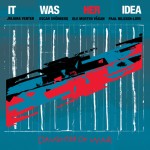
Artist: It Was Her Idea
Title: Daughter of War
Format: CD & 12" + Download
Label: PNL Records (@)
Rated:

Title: Daughter of War
Format: CD & 12" + Download
Label: PNL Records (@)
Rated:
There is something suspiciously self-protective about calling a band "It Was Her Idea". It sounds like the musical equivalent of leaving the room before the vase hits the floor. Whatever happened, somebody else suggested it.
In this case, however, the name is almost too appropriate. "Daughter of War" is the debut of a quartet that seems to have been assembled not because its members wanted to reproduce a particular genre, but because four already well-developed musical personalities had discovered that their individual obsessions could be made to interfere productively with one another.
Juliana Venter, Oscar Grönberg, Ole Morten Vågan and Paal Nilssen-Love began playing together in 2022, each bringing compositions to the group. The result is not a Nilssen-Love project with three supporting musicians, nor a conventional vocal quartet. The writing belongs to all four, and that difference is audible almost immediately.
Venter is the obvious focal point, but not necessarily because she sings in the way one expects a vocalist to sing. Her background already gives away the problem with that assumption. Born in Pretoria and raised between Namibia and South Africa before moving through several European cities and eventually settling in Norway, she has worked across classical singing, theatre, film, jazz, free improvisation, contemporary music, folk traditions and extended vocal techniques. Her voice therefore refuses to sit politely on top of the instrumentation. It moves through it.
The opening track, “Three Free Wheels”, provides a good introduction. Piano and double bass establish an atmosphere that initially feels almost chamber-like, with Grönberg's harmonic language creating an uncertain floor beneath the piece. Venter enters without immediately revealing the full extent of what she can do. There is something almost cautious about the beginning, but the caution does not last. Her voice starts to bend away from conventional melodic behaviour, and the quartet gradually reveals itself as something considerably stranger than an acoustic jazz group.
The music seems to be asking a deceptively simple question: what exactly is a song when the singer is allowed to treat singing as only one of the available possibilities? The answer changes from track to track.
“Tickle Tickle” is more mischievous, with the quartet playing around repetition, articulation and rhythmic expectation. The title is almost embarrassingly cheerful for music that keeps refusing to settle into a stable mood. This is one of the pleasures of the album: its seriousness is continually interrupted by a sense of play. Nilssen-Love's drumming is particularly effective because he does not dominate the proceedings. He can puncture a phrase, shadow it, or simply leave enough room for the piano and bass to establish their own little traps.
Grönberg is crucial here. His piano playing gives the quartet an unusually flexible harmonic centre, capable of suggesting a conventional jazz language before suddenly stepping sideways. He has become an increasingly visible presence in the Scandinavian scene, and this recording makes clear why. His contribution is not simply accompaniment. He often seems to be constructing temporary rooms for Venter's voice to enter, occupy and then dismantle.
Ole Morten Vågan provides the other indispensable architectural element. The double bass is both foundation and disturbance, capable of maintaining the physical weight of the ensemble while also pulling against its apparent direction. His long-standing relationship with Nilssen-Love makes the pairing feel natural, but the combination is more interesting than that familiarity might suggest. Without the enormous instrumentation of Large Unit or the relentless rhythmic pressure of some of Nilssen-Love's other projects, the drummer has to listen differently. Here he is less a force of nature than an exceptionally alert conversationalist.
Then comes the title track.
“Daughter of War” is built around music by Juliana Venter and a poem by Khaleda Froagh, the Afghan poet whose work addresses conflict, violence, displacement and the persistence of human experience under circumstances designed to destroy it. This is where the record's eccentricity suddenly acquires gravity.
Venter does not turn the poem into a theatrical monologue in the conventional sense. Her performance is visceral, but also controlled. She can sound exposed without becoming sentimental, and the trio understands that the most effective accompaniment is sometimes almost nothing. Piano, bass and drums create a shifting frame around her rather than forcing the text into a predetermined emotional shape.
There is an important distinction here. The piece is not powerful because it is “about war”. There are already far too many records congratulating themselves for having Serious Themes. It is powerful because Venter makes the voice carry the tension between the personal and the historical. The title suggests a person born into circumstances she did not choose. The song consequently feels less like a declaration about geopolitics than an attempt to give individual presence to something usually discussed in numbers, maps and headlines.
The war is enormous. The voice is not. That imbalance is precisely what makes the piece work.
After this centre of gravity, “Three Grooves for Freya” offers a change of temperature. The piece is more rhythmically playful, but the quartet still avoids the temptation to become a straightforward groove band. The title itself hints at a compositional interest in small units and repeated structures, and Nilssen-Love seems particularly comfortable in this setting, where rhythm can be suggested rather than unleashed.
Then comes “Baæ Baæ Lille Lakselus”, lasting barely eighty seconds.
Human beings have a peculiar habit of putting tiny things in the middle of serious things and then acting surprised when the tiny thing changes everything. Here the miniature piece works almost like a musical wink. Its brevity prevents the album from becoming overdetermined. Just when the listener might start constructing an elaborate theory about the relationship between voice, violence, improvisation and Scandinavian contemporary music, the quartet gives the whole intellectual machinery a gentle shove.
It is useful.
“Cough Song” is considerably more extended and much less decorative. The voice becomes physical again, approaching the body as a source of rhythm and texture rather than merely pitch. The cough itself is an almost absurdly ordinary bodily event, but in this context it becomes musical material. Venter's performance can be abrasive, comic, vulnerable and unsettling without clearly announcing which of these qualities the listener is supposed to choose. That ambiguity is one of the album's strengths.
The quartet does not always distinguish between the beautiful and the awkward. A vocal gesture can be attractive because it is technically accomplished, or because it sounds as though the body is struggling to produce it. A piano chord can function harmonically and then suddenly become a percussive object. A bass line can establish a tonal centre only to undermine it seconds later.
This is where the “noise” and “conceptual” elements mentioned in the album's description actually become meaningful. They are not genres pasted onto a jazz foundation. They describe a willingness to regard musical behaviour itself as material.
The closing “Little Cage” takes this principle to its sparsest extreme. The piece has been compared to the chance-oriented experiments associated with John Cage, and that comparison is useful without needing to turn the track into a Cage imitation. What matters is the removal of expectation.
After the vocal and instrumental density of the preceding tracks, "Little Cage" feels almost like someone has opened a window. Small sounds become conspicuous. Space acquires weight. The quartet no longer needs to demonstrate what it can do because it has already spent the preceding forty minutes demonstrating that it can do rather a lot.
There is also something revealing about the album's sequencing. "Daughter of War" is not constructed as a continuous escalation from accessibility towards abstraction, nor does it proceed according to the usual experimental-music logic in which each track is required to become more difficult than the last. It behaves more like a collection of encounters. Each composition proposes a different relationship between the four musicians, and the album's coherence emerges from the personalities rather than from a single stylistic formula.
That may be why the debut feels convincing without feeling completely settled.
The recording, made by Dag Erik Johansen at Athletic Sound in Halden in May 2025 and subsequently mixed and mastered by Joe Talia, gives the quartet enough definition for those relationships to remain audible. Nothing is buried simply because the music is unconventional. The instruments retain their physical identities, while Venter's voice occupies the centre without becoming artificially separated from the trio.
That balance is essential. Because "Daughter of War" is ultimately not a vocalist-plus-trio record.
It is four composers negotiating what happens when their materials collide.
Nilssen-Love's presence is perhaps the most misleading thing about the project. His name carries associations with large-scale improvisation, percussion-heavy intensity and the kind of free jazz in which the drummer occasionally appears to have declared war on the concept of moderation. Here, however, he is part of a much more intimate mechanism. His playing is often economical, attentive to the spaces between gestures. The album demonstrates that his musical identity is not dependent on sheer volume or physical force.
Venter provides the emotional volatility, Grönberg much of the harmonic uncertainty, Vågan the muscular elasticity of the bass, and Nilssen-Love the rhythmic intelligence that keeps these competing tendencies from becoming four separate records accidentally occupying the same CD.
There is humour in the arrangement of all this seriousness. The band is called "It Was Her Idea". There is a song about coughing. There is a Norwegian children's-song title involving a little salmon louse. There are pieces whose names sound like instructions from a surrealist kindergarten. And yet the album can turn, without warning, towards a poem about war and human devastation.
That tonal flexibility prevents the record from becoming solemn. And solemnity would have been its enemy.
"Daughter of War" works because it understands that experimental music does not need to wear a black suit at all times. It can be grotesque, playful, fragile, irritating, beautiful and politically serious within the same forty-five minutes. Human beings are inconveniently complicated creatures, and music that reflects that complexity is usually more convincing than music that tries to tidy it away.
The album's title track may therefore be its emotional centre, but the record as a whole is more interesting than that one piece. Its real achievement lies in the way the quartet refuses to establish a hierarchy between song, improvisation, composition, noise and theatrical gesture. Everything is allowed into the same room, provided it has something to contribute. And perhaps the most promising thing about this debut is that it does not sound like the final definition of "It Was Her Idea".
It sounds like four musicians have discovered a useful problem. How far can they push the relationship between voice and instruments without turning either into decoration? How much structure can survive improvisation? How strange can a song become before it stops being a song?
"Daughter of War" does not answer these questions conclusively. It does something better. It keeps making them audible.
In this case, however, the name is almost too appropriate. "Daughter of War" is the debut of a quartet that seems to have been assembled not because its members wanted to reproduce a particular genre, but because four already well-developed musical personalities had discovered that their individual obsessions could be made to interfere productively with one another.
Juliana Venter, Oscar Grönberg, Ole Morten Vågan and Paal Nilssen-Love began playing together in 2022, each bringing compositions to the group. The result is not a Nilssen-Love project with three supporting musicians, nor a conventional vocal quartet. The writing belongs to all four, and that difference is audible almost immediately.
Venter is the obvious focal point, but not necessarily because she sings in the way one expects a vocalist to sing. Her background already gives away the problem with that assumption. Born in Pretoria and raised between Namibia and South Africa before moving through several European cities and eventually settling in Norway, she has worked across classical singing, theatre, film, jazz, free improvisation, contemporary music, folk traditions and extended vocal techniques. Her voice therefore refuses to sit politely on top of the instrumentation. It moves through it.
The opening track, “Three Free Wheels”, provides a good introduction. Piano and double bass establish an atmosphere that initially feels almost chamber-like, with Grönberg's harmonic language creating an uncertain floor beneath the piece. Venter enters without immediately revealing the full extent of what she can do. There is something almost cautious about the beginning, but the caution does not last. Her voice starts to bend away from conventional melodic behaviour, and the quartet gradually reveals itself as something considerably stranger than an acoustic jazz group.
The music seems to be asking a deceptively simple question: what exactly is a song when the singer is allowed to treat singing as only one of the available possibilities? The answer changes from track to track.
“Tickle Tickle” is more mischievous, with the quartet playing around repetition, articulation and rhythmic expectation. The title is almost embarrassingly cheerful for music that keeps refusing to settle into a stable mood. This is one of the pleasures of the album: its seriousness is continually interrupted by a sense of play. Nilssen-Love's drumming is particularly effective because he does not dominate the proceedings. He can puncture a phrase, shadow it, or simply leave enough room for the piano and bass to establish their own little traps.
Grönberg is crucial here. His piano playing gives the quartet an unusually flexible harmonic centre, capable of suggesting a conventional jazz language before suddenly stepping sideways. He has become an increasingly visible presence in the Scandinavian scene, and this recording makes clear why. His contribution is not simply accompaniment. He often seems to be constructing temporary rooms for Venter's voice to enter, occupy and then dismantle.
Ole Morten Vågan provides the other indispensable architectural element. The double bass is both foundation and disturbance, capable of maintaining the physical weight of the ensemble while also pulling against its apparent direction. His long-standing relationship with Nilssen-Love makes the pairing feel natural, but the combination is more interesting than that familiarity might suggest. Without the enormous instrumentation of Large Unit or the relentless rhythmic pressure of some of Nilssen-Love's other projects, the drummer has to listen differently. Here he is less a force of nature than an exceptionally alert conversationalist.
Then comes the title track.
“Daughter of War” is built around music by Juliana Venter and a poem by Khaleda Froagh, the Afghan poet whose work addresses conflict, violence, displacement and the persistence of human experience under circumstances designed to destroy it. This is where the record's eccentricity suddenly acquires gravity.
Venter does not turn the poem into a theatrical monologue in the conventional sense. Her performance is visceral, but also controlled. She can sound exposed without becoming sentimental, and the trio understands that the most effective accompaniment is sometimes almost nothing. Piano, bass and drums create a shifting frame around her rather than forcing the text into a predetermined emotional shape.
There is an important distinction here. The piece is not powerful because it is “about war”. There are already far too many records congratulating themselves for having Serious Themes. It is powerful because Venter makes the voice carry the tension between the personal and the historical. The title suggests a person born into circumstances she did not choose. The song consequently feels less like a declaration about geopolitics than an attempt to give individual presence to something usually discussed in numbers, maps and headlines.
The war is enormous. The voice is not. That imbalance is precisely what makes the piece work.
After this centre of gravity, “Three Grooves for Freya” offers a change of temperature. The piece is more rhythmically playful, but the quartet still avoids the temptation to become a straightforward groove band. The title itself hints at a compositional interest in small units and repeated structures, and Nilssen-Love seems particularly comfortable in this setting, where rhythm can be suggested rather than unleashed.
Then comes “Baæ Baæ Lille Lakselus”, lasting barely eighty seconds.
Human beings have a peculiar habit of putting tiny things in the middle of serious things and then acting surprised when the tiny thing changes everything. Here the miniature piece works almost like a musical wink. Its brevity prevents the album from becoming overdetermined. Just when the listener might start constructing an elaborate theory about the relationship between voice, violence, improvisation and Scandinavian contemporary music, the quartet gives the whole intellectual machinery a gentle shove.
It is useful.
“Cough Song” is considerably more extended and much less decorative. The voice becomes physical again, approaching the body as a source of rhythm and texture rather than merely pitch. The cough itself is an almost absurdly ordinary bodily event, but in this context it becomes musical material. Venter's performance can be abrasive, comic, vulnerable and unsettling without clearly announcing which of these qualities the listener is supposed to choose. That ambiguity is one of the album's strengths.
The quartet does not always distinguish between the beautiful and the awkward. A vocal gesture can be attractive because it is technically accomplished, or because it sounds as though the body is struggling to produce it. A piano chord can function harmonically and then suddenly become a percussive object. A bass line can establish a tonal centre only to undermine it seconds later.
This is where the “noise” and “conceptual” elements mentioned in the album's description actually become meaningful. They are not genres pasted onto a jazz foundation. They describe a willingness to regard musical behaviour itself as material.
The closing “Little Cage” takes this principle to its sparsest extreme. The piece has been compared to the chance-oriented experiments associated with John Cage, and that comparison is useful without needing to turn the track into a Cage imitation. What matters is the removal of expectation.
After the vocal and instrumental density of the preceding tracks, "Little Cage" feels almost like someone has opened a window. Small sounds become conspicuous. Space acquires weight. The quartet no longer needs to demonstrate what it can do because it has already spent the preceding forty minutes demonstrating that it can do rather a lot.
There is also something revealing about the album's sequencing. "Daughter of War" is not constructed as a continuous escalation from accessibility towards abstraction, nor does it proceed according to the usual experimental-music logic in which each track is required to become more difficult than the last. It behaves more like a collection of encounters. Each composition proposes a different relationship between the four musicians, and the album's coherence emerges from the personalities rather than from a single stylistic formula.
That may be why the debut feels convincing without feeling completely settled.
The recording, made by Dag Erik Johansen at Athletic Sound in Halden in May 2025 and subsequently mixed and mastered by Joe Talia, gives the quartet enough definition for those relationships to remain audible. Nothing is buried simply because the music is unconventional. The instruments retain their physical identities, while Venter's voice occupies the centre without becoming artificially separated from the trio.
That balance is essential. Because "Daughter of War" is ultimately not a vocalist-plus-trio record.
It is four composers negotiating what happens when their materials collide.
Nilssen-Love's presence is perhaps the most misleading thing about the project. His name carries associations with large-scale improvisation, percussion-heavy intensity and the kind of free jazz in which the drummer occasionally appears to have declared war on the concept of moderation. Here, however, he is part of a much more intimate mechanism. His playing is often economical, attentive to the spaces between gestures. The album demonstrates that his musical identity is not dependent on sheer volume or physical force.
Venter provides the emotional volatility, Grönberg much of the harmonic uncertainty, Vågan the muscular elasticity of the bass, and Nilssen-Love the rhythmic intelligence that keeps these competing tendencies from becoming four separate records accidentally occupying the same CD.
There is humour in the arrangement of all this seriousness. The band is called "It Was Her Idea". There is a song about coughing. There is a Norwegian children's-song title involving a little salmon louse. There are pieces whose names sound like instructions from a surrealist kindergarten. And yet the album can turn, without warning, towards a poem about war and human devastation.
That tonal flexibility prevents the record from becoming solemn. And solemnity would have been its enemy.
"Daughter of War" works because it understands that experimental music does not need to wear a black suit at all times. It can be grotesque, playful, fragile, irritating, beautiful and politically serious within the same forty-five minutes. Human beings are inconveniently complicated creatures, and music that reflects that complexity is usually more convincing than music that tries to tidy it away.
The album's title track may therefore be its emotional centre, but the record as a whole is more interesting than that one piece. Its real achievement lies in the way the quartet refuses to establish a hierarchy between song, improvisation, composition, noise and theatrical gesture. Everything is allowed into the same room, provided it has something to contribute. And perhaps the most promising thing about this debut is that it does not sound like the final definition of "It Was Her Idea".
It sounds like four musicians have discovered a useful problem. How far can they push the relationship between voice and instruments without turning either into decoration? How much structure can survive improvisation? How strange can a song become before it stops being a song?
"Daughter of War" does not answer these questions conclusively. It does something better. It keeps making them audible.
Large Unit: Small Units: What Just Happened?

Artist: Large Unit: Small Units
Title: What Just Happened?
Format: CD + Download
Label: PNL Records (@)
Rated:
Title: What Just Happened?
Format: CD + Download
Label: PNL Records (@)
Rated:
There is something wonderfully perverse about "What Just Happened?" being released under the name Large Unit: Small Units. Paal Nilssen-Love has spent much of his career proving that an ensemble can behave like a weather system with a percussion section, and here he takes that considerable mass of musicianship and reduces it to four compact experiments: five drummers, six saxophones, three accordions and three tubas. The title sounds less like a statement than the expression of someone discovering, several hours too late, that his scientific experiment has escaped the laboratory.
That response is, in fact, precisely what Nilssen-Love was after. The title originated with his series of Large Unit projects in Oslo, where the intention was to leave performers and listeners uncertain about exactly what had happened to them. The same principle remains at the heart of this 49-minute record, recorded at Tøyen Kirke in June 2025 and released through his own PNL Records.
Nilssen-Love is perhaps best known as one of the great physical forces of contemporary improvised music, a drummer whose career has involved important collaborations with figures such as Peter Brötzmann, Frode Gjerstad and a long procession of musicians unwilling to behave themselves. With Large Unit, however, his role has expanded considerably. Since the ensemble's beginnings, he has used it as a laboratory for collective playing, bringing together younger Norwegian musicians with more established figures while gradually giving composition a more prominent role. PNL Records, founded by Nilssen-Love in 2007, has become an extension of that activity, documenting his own work as well as the many branches growing from the Large Unit family tree.
"What Just Happened?" makes an intriguing proposition: what happens when an ensemble associated with abundance is organised around instrumental monoculture? Quite a lot, as it turns out.
“5 X 10”, written for five drummers, begins by treating percussion almost as a field of controlled disturbance. The five players do not simply pile up rhythms until the poor listener starts checking the smoke detector. Nilssen-Love gives them patterns, repetitions and gradual shifts, making the snare drum itself the protagonist. The effect can initially seem austere, even ceremonial, before small alterations begin to destabilise the apparent order. Five drummers playing essentially the same instrument might sound like an invitation to rhythmic anarchy, but Nilssen-Love is interested in the opposite possibility: how much difference can be extracted from sameness?
This is also where the album establishes one of its central ideas. Limitation becomes an instrument in itself. When every musician has access to the same sonic family, individuality has to emerge through timing, pressure, articulation and restraint. The performers become less like five separate drummers than five different ways of making a snare drum misbehave.
“Spread Rain” moves into more volatile territory. Six saxophones, joined here by Andreas Røysum on bass clarinet, produce a remarkably flexible collective voice, capable of moving from thin air and delicate mechanical noises towards much denser eruptions. The arrangement allows the reeds to behave almost like a single organism at certain moments, before individual voices suddenly protrude from the mass.
This is probably the most immediately convincing piece on the album because Nilssen-Love understands that six saxophones do not need to sound like a larger saxophone section. The interest lies in friction: breath against pitch, multiphonics against recognisable tone, coordinated movement against individual resistance. The piece can be fragile one moment and positively unruly the next. It also demonstrates why this project cannot simply be filed under “free jazz” and left there with a small administrative stamp. There is too much attention to proportion and orchestration. Improvisation is present, but so is the composer standing behind the curtain, moving the furniture around.
Then comes “Dragespel”, perhaps the album's strangest and most rewarding proposition. Three accordions are capable of sounding sentimental, folkloric, comic, funereal or downright threatening, sometimes within the same breath. Nilssen-Love exploits all of those associations without allowing the instrument to settle comfortably into any of them. The piece starts from a sustained, almost organ-like sonority before fragmenting into sharper gestures, sudden movements and strange mechanical eruptions.
The accordion is particularly well suited to this kind of treatment because its expressive mechanism is already slightly theatrical: bellows inhale and exhale, reeds chatter, buttons and keys trigger tiny changes in pressure. Put three of them together and the instrument's traditional musical identity begins to fray. What remains is a wonderfully awkward machine for producing sound. Kalle Moberg, Maren Sofie Nyland Johansen and Mykola Sheremeta seem perfectly happy to investigate the machine room rather than perform the usual postcard version of accordion music. Humanity has spent centuries inventing instruments and then immediately deciding what they are supposed to sound like. Nilssen-Love's answer is essentially: let's not.
“Zlang!” closes the album with three tubas and an impressive refusal to behave like a dignified brass ensemble. Per Ake Holmlander, Børre Mølstad and Sondre Ross Folkestad explore the tuba's enormous lower register as though it were a piece of industrial equipment whose warranty expired sometime in 1978.
There is humour here, but it is not novelty humour. The tuba is funny partly because of its physical presence, yet the composition uses that ridiculousness intelligently. Low brass can sound monumental, absurd, threatening and cartoonish almost simultaneously. Nilssen-Love keeps those possibilities in circulation, allowing fanfare-like gestures to collide with subterranean groans and deliberately ungainly exchanges. It is difficult to imagine another instrument producing quite the same combination of majesty and mild panic. The album's most interesting achievement is therefore conceptual rather than spectacular. Nilssen-Love has taken four instrumental groups that might ordinarily be considered rather limited and discovered that limitation can become a source of compositional abundance. Five snares, six reeds, three accordions, three tubas: the numbers are small, but the possibilities are not.
This also explains why "What Just Happened?" occupies an unusual position within the Large Unit catalogue. Earlier projects have demonstrated Nilssen-Love's appetite for large-scale collective improvisation and increasingly ambitious compositional structures. The Small Units project turns that process inside out. Instead of asking how much sound a large ensemble can generate, it asks how much musical information can survive when the available materials are severely restricted. The answer is enough to fill almost fifty minutes without resorting to the usual free-jazz arms race, where everyone eventually plays louder because somebody apparently misplaced the emergency exit.
The recording at Tøyen Kirke is crucial to the experience. Christian Brynildsen Obermayer handled recording, mixing and mastering, while Nilssen-Love produced the album himself; the church setting gives the instruments enough acoustic presence to reveal their physical qualities without turning everything into reverberant soup.
There is, admittedly, a certain dryness to parts of the record. One recent review found the opening percussion piece comparatively static and regarded the album as the least dynamically varied of Nilssen-Love's three closely related releases. That criticism is not entirely unreasonable. “5 X 10” demands patience, and "What Just Happened?" is not constructed around the instant gratification of escalating intensity. Its pleasures are cumulative, embedded in microscopic changes and in the performers' command of their instruments.
But that apparent austerity is also part of the point. Nilssen-Love is not trying to make a miniature Large Unit. He is dismantling the expectation that more musicians automatically means more possibilities. Sometimes the opposite is true. Remove the safety net of variety and every sound acquires a sharper responsibility.
The record's title consequently becomes more amusing with each listen. At first it sounds like bewilderment. Eventually it feels more like a methodological question. What just happened? A rhythm? A composition? An improvisation? A joke involving three tubas? A serious investigation into instrumental behaviour disguised as an extremely strange afternoon at church? Probably all of them. And perhaps that is the most Paal Nilssen-Love thing about "What Just Happened?": the music never chooses between discipline and mischief. It keeps both alive, letting formal ideas collide with the wonderfully unreasonable fact that humans have built machines out of metal, wood, leather and buttons, then spent centuries finding increasingly inventive ways to make them scream.
That response is, in fact, precisely what Nilssen-Love was after. The title originated with his series of Large Unit projects in Oslo, where the intention was to leave performers and listeners uncertain about exactly what had happened to them. The same principle remains at the heart of this 49-minute record, recorded at Tøyen Kirke in June 2025 and released through his own PNL Records.
Nilssen-Love is perhaps best known as one of the great physical forces of contemporary improvised music, a drummer whose career has involved important collaborations with figures such as Peter Brötzmann, Frode Gjerstad and a long procession of musicians unwilling to behave themselves. With Large Unit, however, his role has expanded considerably. Since the ensemble's beginnings, he has used it as a laboratory for collective playing, bringing together younger Norwegian musicians with more established figures while gradually giving composition a more prominent role. PNL Records, founded by Nilssen-Love in 2007, has become an extension of that activity, documenting his own work as well as the many branches growing from the Large Unit family tree.
"What Just Happened?" makes an intriguing proposition: what happens when an ensemble associated with abundance is organised around instrumental monoculture? Quite a lot, as it turns out.
“5 X 10”, written for five drummers, begins by treating percussion almost as a field of controlled disturbance. The five players do not simply pile up rhythms until the poor listener starts checking the smoke detector. Nilssen-Love gives them patterns, repetitions and gradual shifts, making the snare drum itself the protagonist. The effect can initially seem austere, even ceremonial, before small alterations begin to destabilise the apparent order. Five drummers playing essentially the same instrument might sound like an invitation to rhythmic anarchy, but Nilssen-Love is interested in the opposite possibility: how much difference can be extracted from sameness?
This is also where the album establishes one of its central ideas. Limitation becomes an instrument in itself. When every musician has access to the same sonic family, individuality has to emerge through timing, pressure, articulation and restraint. The performers become less like five separate drummers than five different ways of making a snare drum misbehave.
“Spread Rain” moves into more volatile territory. Six saxophones, joined here by Andreas Røysum on bass clarinet, produce a remarkably flexible collective voice, capable of moving from thin air and delicate mechanical noises towards much denser eruptions. The arrangement allows the reeds to behave almost like a single organism at certain moments, before individual voices suddenly protrude from the mass.
This is probably the most immediately convincing piece on the album because Nilssen-Love understands that six saxophones do not need to sound like a larger saxophone section. The interest lies in friction: breath against pitch, multiphonics against recognisable tone, coordinated movement against individual resistance. The piece can be fragile one moment and positively unruly the next. It also demonstrates why this project cannot simply be filed under “free jazz” and left there with a small administrative stamp. There is too much attention to proportion and orchestration. Improvisation is present, but so is the composer standing behind the curtain, moving the furniture around.
Then comes “Dragespel”, perhaps the album's strangest and most rewarding proposition. Three accordions are capable of sounding sentimental, folkloric, comic, funereal or downright threatening, sometimes within the same breath. Nilssen-Love exploits all of those associations without allowing the instrument to settle comfortably into any of them. The piece starts from a sustained, almost organ-like sonority before fragmenting into sharper gestures, sudden movements and strange mechanical eruptions.
The accordion is particularly well suited to this kind of treatment because its expressive mechanism is already slightly theatrical: bellows inhale and exhale, reeds chatter, buttons and keys trigger tiny changes in pressure. Put three of them together and the instrument's traditional musical identity begins to fray. What remains is a wonderfully awkward machine for producing sound. Kalle Moberg, Maren Sofie Nyland Johansen and Mykola Sheremeta seem perfectly happy to investigate the machine room rather than perform the usual postcard version of accordion music. Humanity has spent centuries inventing instruments and then immediately deciding what they are supposed to sound like. Nilssen-Love's answer is essentially: let's not.
“Zlang!” closes the album with three tubas and an impressive refusal to behave like a dignified brass ensemble. Per Ake Holmlander, Børre Mølstad and Sondre Ross Folkestad explore the tuba's enormous lower register as though it were a piece of industrial equipment whose warranty expired sometime in 1978.
There is humour here, but it is not novelty humour. The tuba is funny partly because of its physical presence, yet the composition uses that ridiculousness intelligently. Low brass can sound monumental, absurd, threatening and cartoonish almost simultaneously. Nilssen-Love keeps those possibilities in circulation, allowing fanfare-like gestures to collide with subterranean groans and deliberately ungainly exchanges. It is difficult to imagine another instrument producing quite the same combination of majesty and mild panic. The album's most interesting achievement is therefore conceptual rather than spectacular. Nilssen-Love has taken four instrumental groups that might ordinarily be considered rather limited and discovered that limitation can become a source of compositional abundance. Five snares, six reeds, three accordions, three tubas: the numbers are small, but the possibilities are not.
This also explains why "What Just Happened?" occupies an unusual position within the Large Unit catalogue. Earlier projects have demonstrated Nilssen-Love's appetite for large-scale collective improvisation and increasingly ambitious compositional structures. The Small Units project turns that process inside out. Instead of asking how much sound a large ensemble can generate, it asks how much musical information can survive when the available materials are severely restricted. The answer is enough to fill almost fifty minutes without resorting to the usual free-jazz arms race, where everyone eventually plays louder because somebody apparently misplaced the emergency exit.
The recording at Tøyen Kirke is crucial to the experience. Christian Brynildsen Obermayer handled recording, mixing and mastering, while Nilssen-Love produced the album himself; the church setting gives the instruments enough acoustic presence to reveal their physical qualities without turning everything into reverberant soup.
There is, admittedly, a certain dryness to parts of the record. One recent review found the opening percussion piece comparatively static and regarded the album as the least dynamically varied of Nilssen-Love's three closely related releases. That criticism is not entirely unreasonable. “5 X 10” demands patience, and "What Just Happened?" is not constructed around the instant gratification of escalating intensity. Its pleasures are cumulative, embedded in microscopic changes and in the performers' command of their instruments.
But that apparent austerity is also part of the point. Nilssen-Love is not trying to make a miniature Large Unit. He is dismantling the expectation that more musicians automatically means more possibilities. Sometimes the opposite is true. Remove the safety net of variety and every sound acquires a sharper responsibility.
The record's title consequently becomes more amusing with each listen. At first it sounds like bewilderment. Eventually it feels more like a methodological question. What just happened? A rhythm? A composition? An improvisation? A joke involving three tubas? A serious investigation into instrumental behaviour disguised as an extremely strange afternoon at church? Probably all of them. And perhaps that is the most Paal Nilssen-Love thing about "What Just Happened?": the music never chooses between discipline and mischief. It keeps both alive, letting formal ideas collide with the wonderfully unreasonable fact that humans have built machines out of metal, wood, leather and buttons, then spent centuries finding increasingly inventive ways to make them scream.