
Thursday, October 15, 2026
Browse by Genre
Industrial Music / Industrial Metal / Aggro Industrial / Electro Metal
Industrial Noise / Power Noise / Harsh Noise
Synth Pop / Electro Pop / Synth-Electronica
Techno / Trance / Goa / Drum'n'Bass / Jungle / Tribal / Trip-Hop
Ambient / Electronica / Ethereal / Dub / Soundscapes / Abstract
Experimental / Avantgarde / Weird & Wired / Glitch / Noise / Field Recording
Dark / Gothic / Wave / New Wave / Dark Wave / Industrial Gothic
New Music / Downtown / Avantgarde Jazz / New Classical / World
Search Reviews
Music Reviews
PlanetDamage: Relapse Protocol
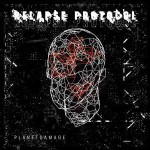
Artist: PlanetDamage
Title: Relapse Protocol
Format: CD + Download
Label: self-released
Title: Relapse Protocol
Format: CD + Download
Label: self-released
Most of Planetdamage’s debut album “Relapse Protocol” follows an electro-cyberpunk formula that is, on the surface at least, very familiar. Pulsing synth lines and drum patterns are the bed on which are laid angsty, semi-shouted, mildly distorted monologues about politics and the state of the world, infused with frustration and determination. It’s the lyrics that are placed centre stage, while the electronics are mostly there to provide a frame and a sense of urgency.
“Kompromat”’’s assertion that ‘history is deepfaked’, and “So Is Europe”’s talk of ‘sandbox fuckery’ (I think) and the remarkably understated side question, ‘what about the US?’. “Hi Rez Lo Life” turns its attention to online and social media, talking about pays per clicks and demanding “got no need for engagement” (always a difficult claim for musicians trying to promote themselves online), while “Vex” resorts to naming a selection of multinational companies to be viewed with suspicion. “The Mark” resorts to the chant of ‘question authority!’, which I have to suspect is a message that will only reach those who already do. Whilst I wouldn’t necessarily disagree with any of it, it does feel somewhat mansplained at times.
Unfortunately, despite being relatively short (40 minutes), it ends up being a little bit undramatic and one-note. The fact that the tracks are segued together seamlessly, sometimes a really interesting musical move, in this case unfortunately only serves to highlight the excessive similarities in tone and pace between each of the tracks. The vocal delivery is the same throughout all the tracks, which under-sells the message it’s trying to convey at times. There’s a decided lack of drama in the delivery, both lyrically and musically- the synths are mildly aggressive but never really given teeth, and fills and drops are sparse, curt and simple. The opening of “Regret Gunner” shows dramatic promise, then flattens out. And while not trying to bow to mainstream popular culture, a few stronger hooks or riffs would not have gone amiss.
There is some great techno work under there- “Firewalls” into the light acid tones of “The Mark” was a highlight area for me musically- but in the social-media driven industry that the lyrics complain about, I don’t think there’s enough distinct character, nor lyrical insightfulness, for this to really gain traction.
“Kompromat”’’s assertion that ‘history is deepfaked’, and “So Is Europe”’s talk of ‘sandbox fuckery’ (I think) and the remarkably understated side question, ‘what about the US?’. “Hi Rez Lo Life” turns its attention to online and social media, talking about pays per clicks and demanding “got no need for engagement” (always a difficult claim for musicians trying to promote themselves online), while “Vex” resorts to naming a selection of multinational companies to be viewed with suspicion. “The Mark” resorts to the chant of ‘question authority!’, which I have to suspect is a message that will only reach those who already do. Whilst I wouldn’t necessarily disagree with any of it, it does feel somewhat mansplained at times.
Unfortunately, despite being relatively short (40 minutes), it ends up being a little bit undramatic and one-note. The fact that the tracks are segued together seamlessly, sometimes a really interesting musical move, in this case unfortunately only serves to highlight the excessive similarities in tone and pace between each of the tracks. The vocal delivery is the same throughout all the tracks, which under-sells the message it’s trying to convey at times. There’s a decided lack of drama in the delivery, both lyrically and musically- the synths are mildly aggressive but never really given teeth, and fills and drops are sparse, curt and simple. The opening of “Regret Gunner” shows dramatic promise, then flattens out. And while not trying to bow to mainstream popular culture, a few stronger hooks or riffs would not have gone amiss.
There is some great techno work under there- “Firewalls” into the light acid tones of “The Mark” was a highlight area for me musically- but in the social-media driven industry that the lyrics complain about, I don’t think there’s enough distinct character, nor lyrical insightfulness, for this to really gain traction.
Droughtwerk: Glare EP

Artist: Droughtwerk
Title: Glare EP
Format: 12" + Download
Label: self-released
Title: Glare EP
Format: 12" + Download
Label: self-released
“Glare” is a four-pack of thick techno with singular purpose. It’s dominated by heavy kick drums that are four-to-the-floor with bells on, that open both the title track and “Disintegrate”, before other acid and harsh-cut electronic loops gradually fade in, and then slowly out, keeping everything firmly flat and direct. Alarm-like tuned top end tones add to the sense of urgency. The occasional eight-bar drop-out of certain elements is the closest skirting with drama in an otherwise unbreakable wall of sonic attack.
A more rubbery kick in “Vivid” gives it just a hint of happy hardcore flavour initially, but there’s no sense of fun or novelty here, and the tone of “Somber” is so consistent that on my first listen I didn’t even notice that we’d switched tracks.
I’d say it’s actually rare to hear a release that’s quite as direct as this one, both in terms of its sonics and also its determination that it has struck on a simple and successful formula and it intends to stick to it. It’s techno with a lot of front and it doesn’t try to be clever.
A more rubbery kick in “Vivid” gives it just a hint of happy hardcore flavour initially, but there’s no sense of fun or novelty here, and the tone of “Somber” is so consistent that on my first listen I didn’t even notice that we’d switched tracks.
I’d say it’s actually rare to hear a release that’s quite as direct as this one, both in terms of its sonics and also its determination that it has struck on a simple and successful formula and it intends to stick to it. It’s techno with a lot of front and it doesn’t try to be clever.
Joana Guerra: Chão Vermelho

Artist: Joana Guerra
Title: Chão Vermelho
Format: 12"
Label: Miasmah
Title: Chão Vermelho
Format: 12"
Label: Miasmah
Cellist and singer Joana Guerra’s “Chão Vermelho” (“red floor”) is a series of laments about the increasingly dry ground in the area of South Portugal where Guerra lives. It is part folksy, part tribalistic, part experimental, but in every case it wears its emotions on its sleeve- predominantly sorrow, but with elements of love and hope. Regeneration is the hope.
Guerra herself, as well as cello and voice (mostly Portuguese, but English on “White Animal”), also plays Portuguese guitar, prepared electric guitar and keyboard, and is joined by friends contributing violin, percussion, “objects”, bass, and additional voice. The length of this list suggests a busy sound, or a party, but it is nothing of the sort. Most of the pieces are limited to only two or three performers at most, concentrating on one instrument each and with a focus on the space between the notes. Unnecessary virtuosity or complexity has been stripped back to concentrate on the texture and expressiveness of single notes and plucks- though there does seem to be at least a slight sense of enjoyment of the sound-bending process, exhibited for example in the rubbery bass tones of “Lume”.
There’s either a discordant edge or an attitude to the bowing in pieces like “Onna-bugeisha”, and a strong theatrical sense that comes through in pieces like “Oasis”. It’s an unusual blend of somewhat longer pieces, five or six minutes, contrasted against tiny sketches such as the 26-second-long “Entropicar” or the frantic scratchy solo cello work of “Reducao”.
There’s both a bleakness and an intimacy at play in “Chão Vermelho” that is at times uncomfortable, but there is a power behind it that makes it a very engaging and mood-changing listening experience.
Kazumichi Komatsu: Emboss Star

Artist: Kazumichi Komatsu
Title: Emboss Star
Format: 12" + Download
Label: FLAU
Title: Emboss Star
Format: 12" + Download
Label: FLAU
Kazumichi Komatsu has been putting out releases fairly prolifically since about 2012, using the Madegg alias until 2016, then his own name, but this is his first full album release under his own name, which must in some way feel like a peak of a personal musical expression. It certainly feels emotive, but more so it feels like peering into a stranger’s sketchbook, at a variety of different styles, some of them perfected, some of them more prototypical.
It’s a collection of ten short, mostly laid back and semi-experimental electronica pieces, almost all of them under three minutes long. Everything is fair game sonically, from acoustic and traditional-sounding plucked instruments to crafting sound out of found sound, samples, and noises. These are layered up into arrangements that are mostly grooves, steady, undramatic and short. It’s chill music, but with something wilfully ‘off’ about it, as typified in tracks like “Skip” with its gentle plucked melody and chopped-up, more urgent-sounding spoken words, or the underlying disquiet in “Come In”. Other tracks substitute gentle piano work as the melody.
“Umi Ga Kikoeru”, featuring Dove & Le Makeup, is a really strong curiosity, playing a relatively conventional verse-chorus vocal structure against an interestingly back-to-front arrangement, an experiment in how to construct a pop ballad out of all the wrong sounds and still make it work (just about- it’s likely to be a bit divisive to some audiences). The other fully-fledged song on the album, “Followers” with Cristal Bere, is a touch more conventional in arrangement, piano-led and uniquely English-language, but concentrates less on the vocal hook, a stronger one of which could’ve made this a track with strong crossover potential.
“Weight Of Smoke” is notable for its increased tension initially, with an opening that feels like an intro to a much more aggressive, almost EDM album, before dropping quite abruptly into a padded sci-fi soundscape. It’s the exception to the rule in regard to my earlier comment about the tracks being undramatic.
At only 27 minutes it’s very compact, practically a mini-album, but it packs a fair bit of musical quality into that small package. Certainly one to try out if you like your chilled out musical experiences to be very off-kilter.
Gintas K: Sound & Spaces

Artist: Gintas K
Title: Sound & Spaces
Format: Tape + Download
Label: Powdered Hearts
Title: Sound & Spaces
Format: Tape + Download
Label: Powdered Hearts
There’s something consciously small about the tone of established Lithuanian sound artist Gintas K’s work in “Sound & Spaces”, which was recorded in one take with no overdubbing, using just “a computer”, MIDI keyboard and controller.
Obviously “a computer” can mean almost anything nowadays and almost any genre can be created using one, but the sounds created here are largely throwbacks to what people would think of as computer sounds in the 1970’s- lots of dot-matrix-printer-esque whirring, curt bleeps and beeps. This is layered up live predominantly driven by contrasts, such as in the first numbered piece where a steady rhythmic motor sound is pulled against sporadic and impulsive heavy glitching. The fourth part broadens the contrast further, with high watery bubbly notes in opposition to deep, toothy synthetic bass impulses that sometimes sound (and not in a bad way) like a broken hedge trimmer.
The contrast between chaos and calm is also present in reasonable abundance- part five is frantic and disorientating, others less so. Piece 6 manages to contain both.
It’s a 41-minute audio bath with a certain amount of abrasion, and at times, a feeling of randomness rather than improvisation. But it’s a rich abstraction of sound that enjoyers of a difficult listen will emerge from smiling at the end.