
Monday, September 14, 2026
Browse by Genre
Industrial Music / Industrial Metal / Aggro Industrial / Electro Metal
Industrial Noise / Power Noise / Harsh Noise
Synth Pop / Electro Pop / Synth-Electronica
Techno / Trance / Goa / Drum'n'Bass / Jungle / Tribal / Trip-Hop
Ambient / Electronica / Ethereal / Dub / Soundscapes / Abstract
Experimental / Avantgarde / Weird & Wired / Glitch / Noise / Field Recording
Dark / Gothic / Wave / New Wave / Dark Wave / Industrial Gothic
New Music / Downtown / Avantgarde Jazz / New Classical / World
Search Reviews
Music Reviews
Nurse With Wound: Creakiness and Other Misdemeanors

Artist: Nurse With Wound
Title: Creakiness and Other Misdemeanors
Format: CD
Label: United Jnana (@)
Distributor: Midheaven
Rated:


Title: Creakiness and Other Misdemeanors
Format: CD
Label: United Jnana (@)
Distributor: Midheaven
Rated:
The five tracks that make up Creakiness And Other Misdemeanours will take you on a bizarre voyage, journeying through vintage arcades, through forests and across dark rivers, where jeweled crocodiles and pagan priestesses cavort along the banks, performing obscure rituals for unnamed purposes.
Creakiness... is comprised of rare recordings that span 14 years. "Creakiness" was originally released in 1991, as a split 12" with the group Spasm. For this outing, Nurse with Wound were Stephen Stapleton, Joolie Wood, James Mannox, and Tony Wakeford, and it is a five part sound poem of car horns and Warner Brothers cartoons, Bugs Bunny and Daffy Duck cavorting around the stereo field in a dizzying array, smoothly segueing into a haunted house atmosphere of creaking doors and pagan mantras, and the unearthly beauty of heartfelt mysticism is doubly effective, arising from the goofiness.
"Twisted Mona" and "Mona Twisted" are actually two halves to the same coin, originally released as Salt Women Tragedy, the third installment in the Echo Poeme Sequence series, as a 7" for Klanggalerie in 2005. The original was notoriously plagued by pressing issues, so a proper re-issue makes sense. The two Monas are a meditation on the human voice, a subdued woman's voice incanting in German, slowly panning from left to right, while temple bells that sound like clanking boats give a ghost ship ambiance. It sounds like another world, an alternate reality full of magick and romance, the slow repetitions hypnotic and soothing, pleasant on the ears. It'll have you swaying.
"Little Dipper Minus Two (echo poeme sequence 1) has more siren's song, alluring and seductive, with swelling electronic feedback punctuated by quicksilver stabs of synthesizer, little puffs of steam, and the occasional barking dog. It seems like something is happening, there is some narrative work at here, but it is murky, undefined, mysterious. The ambiance seems to rise and fall in a random fashion, there is a sense of an inner logic, but the structure seems organic, frayed and trailing, yet hanging together, like an auditory ecosystem.
"A Perfectly Natural Explanation" finishes things off; a woman's voice simply repeating the song title, while broken radio static fills the left side of the headphones, and a submerged string quartet takes the right.
Considering the disparate sources of the various tracks, it makes sense that Creakiness would come across as a somewhat disjointed affair but it makes sense, after a fashion. Since the beginning, Stephen Stapleton has described NWW as "surrealist music," citing the likes of Dali and the Comte de Leautremont as influences, right along with fellow wreckers of civilization like Throbbing Gristle and Z' ev. NWW's music has always been expansive and unpredictable, and it has always had more of a sense of humor than the bleak misanthropy of his industrial contemporaries, which just makes the uneasy listening more unsettling. The secret sauce that makes Nurse With Wound's music work, is a familiarity with the roots of electronic music, musique concrete and early synth experiments, and the way that sounds are tuned and placed in the stereo field reveal a master's touch. Nurse With Wound are simultaneously high- and low- brow, goofy and mystical. Complex.
Stapleton's music is most definitely not for everyone, and i don't believe i've ever encountered an artist that has such a polarizing effect on crowds. Chance Meeting On A Dissecting Table..., their infamous first record, will clear out a party faster than a dog fart, possibly annulling marriages in the process. The songs are long and avoid succumbing to the strictures of pop music, like harmony, melody, rhythm. They are works of abstract sound-art. For those disposed towards letting music infect their inner worlds, blossoming like phosphorescent fungal blooms behind closed eyelids, Nurse With Wound is essential listening.
Creakiness... is comprised of rare recordings that span 14 years. "Creakiness" was originally released in 1991, as a split 12" with the group Spasm. For this outing, Nurse with Wound were Stephen Stapleton, Joolie Wood, James Mannox, and Tony Wakeford, and it is a five part sound poem of car horns and Warner Brothers cartoons, Bugs Bunny and Daffy Duck cavorting around the stereo field in a dizzying array, smoothly segueing into a haunted house atmosphere of creaking doors and pagan mantras, and the unearthly beauty of heartfelt mysticism is doubly effective, arising from the goofiness.
"Twisted Mona" and "Mona Twisted" are actually two halves to the same coin, originally released as Salt Women Tragedy, the third installment in the Echo Poeme Sequence series, as a 7" for Klanggalerie in 2005. The original was notoriously plagued by pressing issues, so a proper re-issue makes sense. The two Monas are a meditation on the human voice, a subdued woman's voice incanting in German, slowly panning from left to right, while temple bells that sound like clanking boats give a ghost ship ambiance. It sounds like another world, an alternate reality full of magick and romance, the slow repetitions hypnotic and soothing, pleasant on the ears. It'll have you swaying.
"Little Dipper Minus Two (echo poeme sequence 1) has more siren's song, alluring and seductive, with swelling electronic feedback punctuated by quicksilver stabs of synthesizer, little puffs of steam, and the occasional barking dog. It seems like something is happening, there is some narrative work at here, but it is murky, undefined, mysterious. The ambiance seems to rise and fall in a random fashion, there is a sense of an inner logic, but the structure seems organic, frayed and trailing, yet hanging together, like an auditory ecosystem.
"A Perfectly Natural Explanation" finishes things off; a woman's voice simply repeating the song title, while broken radio static fills the left side of the headphones, and a submerged string quartet takes the right.
Considering the disparate sources of the various tracks, it makes sense that Creakiness would come across as a somewhat disjointed affair but it makes sense, after a fashion. Since the beginning, Stephen Stapleton has described NWW as "surrealist music," citing the likes of Dali and the Comte de Leautremont as influences, right along with fellow wreckers of civilization like Throbbing Gristle and Z' ev. NWW's music has always been expansive and unpredictable, and it has always had more of a sense of humor than the bleak misanthropy of his industrial contemporaries, which just makes the uneasy listening more unsettling. The secret sauce that makes Nurse With Wound's music work, is a familiarity with the roots of electronic music, musique concrete and early synth experiments, and the way that sounds are tuned and placed in the stereo field reveal a master's touch. Nurse With Wound are simultaneously high- and low- brow, goofy and mystical. Complex.
Stapleton's music is most definitely not for everyone, and i don't believe i've ever encountered an artist that has such a polarizing effect on crowds. Chance Meeting On A Dissecting Table..., their infamous first record, will clear out a party faster than a dog fart, possibly annulling marriages in the process. The songs are long and avoid succumbing to the strictures of pop music, like harmony, melody, rhythm. They are works of abstract sound-art. For those disposed towards letting music infect their inner worlds, blossoming like phosphorescent fungal blooms behind closed eyelids, Nurse With Wound is essential listening.
Foust!: Space Sickness

Artist: Foust! (http://www.anti-naturals.org/swill) (@)
Title: Space Sickness
Format: CD
Label: The Anti-Naturals (@)
Distributor: Eh? Audio Repository (http://www.publiceyesore.com/)
Rated:
Title: Space Sickness
Format: CD
Label: The Anti-Naturals (@)
Distributor: Eh? Audio Repository (http://www.publiceyesore.com/)
Rated:
Space Sickness, the second transmission from Scott Foust's Foust! solo project, sounds like outer space, but its more like space station music than the void itself; there's lots of buzzing and whirring, crackles and static. Its like listening to machines do their thing. Mostly comprised of static drones drifting in and out of phase, creating a dense and invigorating atmosphere, lots to listen to, but each element is given enough space to be appreciated. Space Sickness was recorded during the same session that produced the first half of 2006's Jungle Fever, but while that record was dense and organic, Space Sickness is all clinical minimalism - 10 sound sculptures of claustrophobia and encroaching madness.
Most music that attempts to emulate the vast emptiness of space falls upon hackneyed dark ambient cliches of chorused synth pads, and the ubiquitous reverbed vocal sample, probably swiped from In The Mouth of Madness, but Foust knows better; he hates New Age music. Instead, he harkens back to the period of late '70s industrial noise, like Boyd Rice's NON project, tone poems and metal machine music. The chirping telegraph sounds, hissing airlock steam and binaural beats, make for interesting mental movies, and the relatively unchanging nature of each piece make for a meditative listening experience. Foust's years as a dedicated listener, as well as playing in a whole slew of different bands, means that he has learned how to avoid the perilous pitfalls many novices succumb to, such as recording straight to hard disk. He appreciates tone quality, room sound, and recording fidelity. Space Sickness is easy on the ears, which makest it ieasy to get lost in its lulling languorous spell.
Some people may find Space Sickness to be dull and lifeless, monotonous and irritating. Either you are going to love this record, or hate it. But if you like to close yr eyes and go for a drift, if you find yrself listening to the radiator hiss and hum when no one is looking, if you legitimately like the works of Pierre Schaefer or Bernard Parmegiani, if you dig Tarkovsky's Solaris or play sounds from a radio telescope during dinner parties, then you are in for a real treat.
Most music that attempts to emulate the vast emptiness of space falls upon hackneyed dark ambient cliches of chorused synth pads, and the ubiquitous reverbed vocal sample, probably swiped from In The Mouth of Madness, but Foust knows better; he hates New Age music. Instead, he harkens back to the period of late '70s industrial noise, like Boyd Rice's NON project, tone poems and metal machine music. The chirping telegraph sounds, hissing airlock steam and binaural beats, make for interesting mental movies, and the relatively unchanging nature of each piece make for a meditative listening experience. Foust's years as a dedicated listener, as well as playing in a whole slew of different bands, means that he has learned how to avoid the perilous pitfalls many novices succumb to, such as recording straight to hard disk. He appreciates tone quality, room sound, and recording fidelity. Space Sickness is easy on the ears, which makest it ieasy to get lost in its lulling languorous spell.
Some people may find Space Sickness to be dull and lifeless, monotonous and irritating. Either you are going to love this record, or hate it. But if you like to close yr eyes and go for a drift, if you find yrself listening to the radiator hiss and hum when no one is looking, if you legitimately like the works of Pierre Schaefer or Bernard Parmegiani, if you dig Tarkovsky's Solaris or play sounds from a radio telescope during dinner parties, then you are in for a real treat.
White Load: Wayne's World III b/w Godfather IV

Artist: White Load (http://loadrecords.com/bands/white-load/)
Title: Wayne's World III b/w Godfather IV
Format: 12"
Label: Load Records
Distributor: Carrot Top Distribution
Rated:
Title: Wayne's World III b/w Godfather IV
Format: 12"
Label: Load Records
Distributor: Carrot Top Distribution
Rated:
White Load run the gamut from Black Flag to Big Black; Minor Threat to The Melvins - a event horizon of hardcore, condensed and delivered like a blow to the sternum. Listening to Wayne's World III b/w Godfather IV is like having a load of gravel poured down yr ear canal; it is like remembering a blackout. Twelve inches, twenty minutes, twenty-five songs, this manic outburst from this Providence, RI trio will push all the right buttons for those that prefer the original Iggy Pop mix of Raw Power, to those that like to listen to chopped & screwed Cypress Hill remixes. For those that like their rock dirty, drug-addled and rude, this will make yr summer.
The two sides of Wayne's World III & Godfather IV are interchangeable - the guitars churn along like a piranha tank at feeding time, the vocals gibber unintelligbly, there's hardly even a break between songs, just a frantic '1234' click of the sticks, White Load stick to the Ramone's school of Blitzkrieg bop, the songs so fast and blaring they border on grindcore but sounds like classic Punk Rock or Hardcore, catchy rhythm guitar, powerful pounding percussion, chanting vocals that sneer and snarl. The classic formulae are smeared with a viscous layer of fuzz, distant-sounding and captured in a hurry; it sounds like it was recorded live, and if that be the case, this band must be a force of nature in concert. Beneath the dirt and grit and don't-give-a fuck -sarcasm, though, you can tell this band clearly DOES give a fuck; beneath the oil-slick swims a very tight and focused musical leviathan - there's enough drum breaks, guitar fills, build-ups and breakdowns to show that this band has practiced A LOT, and that kind of dedication is what makes or breaks a recording, even of dirty garage punk.
Its refreshing to come across a slab of authentic, demented rock 'n roll with the murky production style making Wayne's World III b/w Godfather IV seem mysterious and intriguing, something to be re-visited and re-evaluated. It comes across like a legitimate lo-fi punk record from the mid '80s, the kind of thing you'd find at the flea market for .50 cents five years ago. It is unpretentious and the music speaks for itself, these 25 tracks become like a sugar dependency - once you've tasted a little, you'll keep coming back for more. This record makes me want to drive really, really fast - and possibly cook meat. It's a true work of art.
The two sides of Wayne's World III & Godfather IV are interchangeable - the guitars churn along like a piranha tank at feeding time, the vocals gibber unintelligbly, there's hardly even a break between songs, just a frantic '1234' click of the sticks, White Load stick to the Ramone's school of Blitzkrieg bop, the songs so fast and blaring they border on grindcore but sounds like classic Punk Rock or Hardcore, catchy rhythm guitar, powerful pounding percussion, chanting vocals that sneer and snarl. The classic formulae are smeared with a viscous layer of fuzz, distant-sounding and captured in a hurry; it sounds like it was recorded live, and if that be the case, this band must be a force of nature in concert. Beneath the dirt and grit and don't-give-a fuck -sarcasm, though, you can tell this band clearly DOES give a fuck; beneath the oil-slick swims a very tight and focused musical leviathan - there's enough drum breaks, guitar fills, build-ups and breakdowns to show that this band has practiced A LOT, and that kind of dedication is what makes or breaks a recording, even of dirty garage punk.
Its refreshing to come across a slab of authentic, demented rock 'n roll with the murky production style making Wayne's World III b/w Godfather IV seem mysterious and intriguing, something to be re-visited and re-evaluated. It comes across like a legitimate lo-fi punk record from the mid '80s, the kind of thing you'd find at the flea market for .50 cents five years ago. It is unpretentious and the music speaks for itself, these 25 tracks become like a sugar dependency - once you've tasted a little, you'll keep coming back for more. This record makes me want to drive really, really fast - and possibly cook meat. It's a true work of art.
Anenome Tube: Death Over China

Artist: Anenome Tube (@)
Title: Death Over China
Format: CD
Label: Topeth Prophet/Silken Tofu (@)
Rated:
Title: Death Over China
Format: CD
Label: Topeth Prophet/Silken Tofu (@)
Rated:
Death Over China is the second part of "The Suicide Series by German noise artist Anemone Tube, where he is contemplating humanity's headlong rush into extinction. As he puts it in the press release, 'Death over China' is a retaliation of nature against humankind. In the same moment it is a dedication to our untamed curiosity for the essence of death and our (inherent in our collective action) secret death wish."
Death Over China is made up of primarily untreated field recordings made during a trip to Nanjing and Shanghai in 2007, with occasional bursts of fluorescent white noise and screeching feedback. Album opener "Black Death Rise" is the most raw and unedited sounding, painting a mental scenario of a street scene in Shangai: the lull of traffic, the play of children, a police whistle. The reedy whine of small engines. The sounds are expertly manipulated in space and time, panning from left to right and back again.
The stage is set, and Anemone Tube lures you into the psychogeography of these places, getting progressively more abstract as the album goes along. There seems to be a story unfolding, a point being made, and the ghostly atmosphere is constantly evolving, textures appearing out of nowhere, new sounds emerging, then disappearing into thin air, like the tiny bit of synth on "I Shall Ever Invoke." Keeps things moving along, keeps things interesting. With a good pair of headphones and some attention, Death Over China is as engrossing as a good movie or book, creating eccentric imagery between yr ears, layers of levels of meaning, that can be re-visited again and again.
With "The Announcement (Death Over China)," the moral of the story is revealed, where an older woman's voice proclaims, "I just want to kiss life. Where there's life there's hope," over and over, with a banshee wailing in the background, before being swallowed by the crushing miasma of "The Desecration From Within," the album's apex and crowning achievement. Rusted behemonth machinery, a warning siren, transgressive poetry from a tin can, it has a basement industrial feel to it, like it was summoned to be broadcast through beefy distorted PAs. Heavy as lead, and satisfyingly gritty. Anenome Tube is clearly not foreseeing an optimistic outcome to the Industrial Revolution in China, bleak and existential and doom laden. The overall effect is more hypnotic and ghost-like than violent, however, even the power electronics have a soothing quality to them; its like walking by the waterfront in the mist.
Death Over China is Anemone Tube's first solo release since 2001, and when you look at the classy smooth paper packaging, you really get the sense that this album is something special, that a great deal of time and care has been placed in putting this album together, it is clearly a labor of passion. As a piece de resistance, Death Over China was mastered by James Plotkin, so everything is in its right place, placed just so, and sounds totally great. In about 2 years time, this will be considered a rare and precious sound-art object, so get one while you can.
Death Over China is made up of primarily untreated field recordings made during a trip to Nanjing and Shanghai in 2007, with occasional bursts of fluorescent white noise and screeching feedback. Album opener "Black Death Rise" is the most raw and unedited sounding, painting a mental scenario of a street scene in Shangai: the lull of traffic, the play of children, a police whistle. The reedy whine of small engines. The sounds are expertly manipulated in space and time, panning from left to right and back again.
The stage is set, and Anemone Tube lures you into the psychogeography of these places, getting progressively more abstract as the album goes along. There seems to be a story unfolding, a point being made, and the ghostly atmosphere is constantly evolving, textures appearing out of nowhere, new sounds emerging, then disappearing into thin air, like the tiny bit of synth on "I Shall Ever Invoke." Keeps things moving along, keeps things interesting. With a good pair of headphones and some attention, Death Over China is as engrossing as a good movie or book, creating eccentric imagery between yr ears, layers of levels of meaning, that can be re-visited again and again.
With "The Announcement (Death Over China)," the moral of the story is revealed, where an older woman's voice proclaims, "I just want to kiss life. Where there's life there's hope," over and over, with a banshee wailing in the background, before being swallowed by the crushing miasma of "The Desecration From Within," the album's apex and crowning achievement. Rusted behemonth machinery, a warning siren, transgressive poetry from a tin can, it has a basement industrial feel to it, like it was summoned to be broadcast through beefy distorted PAs. Heavy as lead, and satisfyingly gritty. Anenome Tube is clearly not foreseeing an optimistic outcome to the Industrial Revolution in China, bleak and existential and doom laden. The overall effect is more hypnotic and ghost-like than violent, however, even the power electronics have a soothing quality to them; its like walking by the waterfront in the mist.
Death Over China is Anemone Tube's first solo release since 2001, and when you look at the classy smooth paper packaging, you really get the sense that this album is something special, that a great deal of time and care has been placed in putting this album together, it is clearly a labor of passion. As a piece de resistance, Death Over China was mastered by James Plotkin, so everything is in its right place, placed just so, and sounds totally great. In about 2 years time, this will be considered a rare and precious sound-art object, so get one while you can.
The Caretaker: Patience (After Sebold)
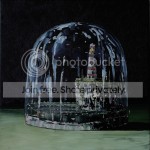
Artist: The Caretaker
Title: Patience (After Sebold)
Format: CD
Label: History Always Favors The Winners
Distributor: Forced Exposure
Rated:
Title: Patience (After Sebold)
Format: CD
Label: History Always Favors The Winners
Distributor: Forced Exposure
Rated:
Leyland Kirby is interested in memories; in an interview for the Headphone Commute, in 2011, he described the fascination: "We are our memories and the saddest thing and big fear we all have is of losing our ability to remember as then really we are nothing only a shell and it's tragic for those around us to witness this descent into a living hell (even though we ourselves would not recognise anything being wrong)."
Patience (After Sebold) is the soundtrack to a documentary by Grant Gee, where he re-traced the steps of author WG Sebold's journey down the British sea coast. as chronicled in his most famous book, 'The Rings Of Saturn'. The book, and the film, both deal with the nature of memory and perception, of their unreliability, creating a ghost-like nether world in which the author floats and observes. Leyland Kirby's smeary, dreamy melancholia is the perfect score for this limbo.
After a number of releases under his own name, most notably "Sadly, The Future Is No Longer What It Once Was," with its ambitious six sides of antiquated chamber piano, where Leyland Kirby was focused more on composing and performing the pieces, and giving achieving a much more emotional and personal vision, 'Patience (After Sebold)', returns to The Caretaker's signature wax cylinder deconstructions. Named after Jack Torrance in The Shining, Leyland Kirby has been conjuring music for the haunted ballroom since 1999, but Patience (After Sebold) is much more classical than vaudeville, re-purposing sounds from Franz Schubert's 'Winterreise'; most of the album consists of locked piano grooves, with slurred disembodied choirs and pipe organs 3 miles in the sky, the whole affair is chopped and blurred with cotton swabs of reverb, like watching seaweed drift, through the surface of a fish tank.
"Patience (After Sebold)" seems distant, receding, like a rusting space station, drifting beyond Earth's radiosphere, dying transmissions from the familiar, and the voices that sent them now long since passed, anyway. Haunting, bittersweet, elegant, classic; Leyland Kirby has a way with working with tiny vignettes of music, cobbling them together like a sterling automaton, and creating something utterly distinctive and unique. Along with William Basinski, he is Master of the Loop.
Patience (After Sebold) is the soundtrack to a documentary by Grant Gee, where he re-traced the steps of author WG Sebold's journey down the British sea coast. as chronicled in his most famous book, 'The Rings Of Saturn'. The book, and the film, both deal with the nature of memory and perception, of their unreliability, creating a ghost-like nether world in which the author floats and observes. Leyland Kirby's smeary, dreamy melancholia is the perfect score for this limbo.
After a number of releases under his own name, most notably "Sadly, The Future Is No Longer What It Once Was," with its ambitious six sides of antiquated chamber piano, where Leyland Kirby was focused more on composing and performing the pieces, and giving achieving a much more emotional and personal vision, 'Patience (After Sebold)', returns to The Caretaker's signature wax cylinder deconstructions. Named after Jack Torrance in The Shining, Leyland Kirby has been conjuring music for the haunted ballroom since 1999, but Patience (After Sebold) is much more classical than vaudeville, re-purposing sounds from Franz Schubert's 'Winterreise'; most of the album consists of locked piano grooves, with slurred disembodied choirs and pipe organs 3 miles in the sky, the whole affair is chopped and blurred with cotton swabs of reverb, like watching seaweed drift, through the surface of a fish tank.
"Patience (After Sebold)" seems distant, receding, like a rusting space station, drifting beyond Earth's radiosphere, dying transmissions from the familiar, and the voices that sent them now long since passed, anyway. Haunting, bittersweet, elegant, classic; Leyland Kirby has a way with working with tiny vignettes of music, cobbling them together like a sterling automaton, and creating something utterly distinctive and unique. Along with William Basinski, he is Master of the Loop.