
Browse by Genre
Industrial Music / Industrial Metal / Aggro Industrial / Electro Metal
Industrial Noise / Power Noise / Harsh Noise
Synth Pop / Electro Pop / Synth-Electronica
Techno / Trance / Goa / Drum'n'Bass / Jungle / Tribal / Trip-Hop
Ambient / Electronica / Ethereal / Dub / Soundscapes / Abstract
Experimental / Avantgarde / Weird & Wired / Glitch / Noise / Field Recording
Dark / Gothic / Wave / New Wave / Dark Wave / Industrial Gothic
New Music / Downtown / Avantgarde Jazz / New Classical / World
Search Reviews
Music Reviews
Fade: Lo-Fi/Taino
Artist: Fade (@)
Title: Lo-Fi/Taino
Format: Download Only (MP3 + Lossless)
Label: Boundless Beatz (@)
Rated:


Title: Lo-Fi/Taino
Format: Download Only (MP3 + Lossless)
Label: Boundless Beatz (@)
Rated:
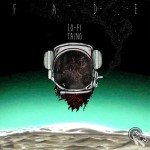
I already spoke of Kiev-born producer Eugene Galushchenko, better known as Fade, as he is one the most interesting drum N bass maker at the moment. The Ukrainian mastermind recently re-appeared on German label Boundless Beatz by means of a couple of amazing tunes: an obscure electronic sparkling, which gradually fades into a sneaky low-frequency, hiccuping vocals and a minal quasi-melody over a lush arabesque of tribal drumming, features "Lo-Fi", the tune where Fade's blend of deeply darker sonorities and structured percussions is more recognisable, while "Taino" got inspired by ritual music and dances of Taino, the indigenous people who inhabited the Caribbean, and somehow mirrors their culture by a sneaky melody (according to Taino's religion - not so different from Maya's one -, the Sun was born from the union of two reptile divinities) and bouncy beats...you should know they used to play a sort of soccer for ceremonial purposes (called batey) by kicking a bouncy ball (supposedly made from a mixture of rubber and resins) in a rectangular field before bouncy balls begun to be used in European people, who credit themselves for inventing football! Check it out!
Troum: Acouasme
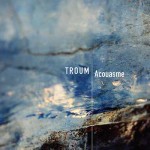
As this album is presented as "harsher and more Industrial" than previous release by this project, there's a concern about this word means for this release. In fact, there's nothing truly noisy, a term closely related to the mentioned genres, but there's an attention to the details, and a deviation to the usual scheme of dark ambient based on a drone spanning the whole track, which places this release above other releases in this field. Noise is derived from field recordings so it's used as cinematography i.e., a way to set a context for sound.
The first minutes of "Aliens Laughing About Us" sets a form that is based on drone which are fastly developing above a background of small noises giving to the whole structure a sense of cinematic movement toward something represented by the final crescendo. The low frequency background of "Acouasme" are a canvas for the high pitch tones moving in the aural spectrum and the bass tones of the second part of the track. "Omega Melancholicum" juxtaposes layers of drones until, at half his length, the focus is on a drone slowly increasing his volume to mask the underlying soundscape while "Outer Brain Outsourcing" renounces partly to this structure as it juxtaposes drones until it fulfills all the spectrum maximizing his impact. "Somnolenz" is a track whose tones ebb and flow as the title suggests. "Signe Du Miroir" closes this release with even a drum part that creates a frame for all elements of the other tracks which evoke a sense of loss created by a drone progressively masking the beat and closing the release with a reverberated noise.
Using noise as coloring element rather than for his musical impact, this is a release that need headphone to fully appreciate the craft of the sound production which escape boredom and triviality whenever possible. Truly recommended.
The first minutes of "Aliens Laughing About Us" sets a form that is based on drone which are fastly developing above a background of small noises giving to the whole structure a sense of cinematic movement toward something represented by the final crescendo. The low frequency background of "Acouasme" are a canvas for the high pitch tones moving in the aural spectrum and the bass tones of the second part of the track. "Omega Melancholicum" juxtaposes layers of drones until, at half his length, the focus is on a drone slowly increasing his volume to mask the underlying soundscape while "Outer Brain Outsourcing" renounces partly to this structure as it juxtaposes drones until it fulfills all the spectrum maximizing his impact. "Somnolenz" is a track whose tones ebb and flow as the title suggests. "Signe Du Miroir" closes this release with even a drum part that creates a frame for all elements of the other tracks which evoke a sense of loss created by a drone progressively masking the beat and closing the release with a reverberated noise.
Using noise as coloring element rather than for his musical impact, this is a release that need headphone to fully appreciate the craft of the sound production which escape boredom and triviality whenever possible. Truly recommended.
God Body Disconnect: Dredge Portals
This new release from Cryo Chamber is presented in their usual austere way as "an emotional roller coaster" with "a strong narrative of storytelling" and this way of describe the records lets the listener free to hear the album with a clear mind. "Dredge Portals" sounds as a concept album centered on a lonely man which is the narrator of his thought about living in a world where there's, apparently, no one else and this story is described with field recording and foley sounds rather than drones that act as mere support of the landscape evoked by the sounds.
The narrator of "Rise of the Dormant Host" opens this release with a pistol shot and introduces the listener into a story of, perhaps, zombie and it starts on almost canonical track of evocative drone but resolved with a synth melody. The sound of rain opens "The Reflection Tower" whose drone crescendo is juxtaposed to traffic sound to enhance his emotive character. "Descend with Demons" uses drones to create a sense of tension exalted by the use of sudden noises. This sense of danger is partly resolved by the crescendo of "Heart of the Mirror's Abyss" and its samples of a running man. The return of the narrator in "Lost in the Astral World" starts the second half of this release and it's another ambient track focused on crescendo while "Perpetually Devoured" is closer to the canonical dark ambient format. "Dreaming of Glaciers" closes this release with a dreamy drone and some gentle piano notes that introduces the return of the narrator.
While the second part is more orthodox in his declination of the genre, in the first part it's evident the search for storytelling in this release which is obtained mostly with the use of field recording closer to musique concrète rather than dark ambient and result the real focus of the musical writing. It's true cinema for the ears.
The narrator of "Rise of the Dormant Host" opens this release with a pistol shot and introduces the listener into a story of, perhaps, zombie and it starts on almost canonical track of evocative drone but resolved with a synth melody. The sound of rain opens "The Reflection Tower" whose drone crescendo is juxtaposed to traffic sound to enhance his emotive character. "Descend with Demons" uses drones to create a sense of tension exalted by the use of sudden noises. This sense of danger is partly resolved by the crescendo of "Heart of the Mirror's Abyss" and its samples of a running man. The return of the narrator in "Lost in the Astral World" starts the second half of this release and it's another ambient track focused on crescendo while "Perpetually Devoured" is closer to the canonical dark ambient format. "Dreaming of Glaciers" closes this release with a dreamy drone and some gentle piano notes that introduces the return of the narrator.
While the second part is more orthodox in his declination of the genre, in the first part it's evident the search for storytelling in this release which is obtained mostly with the use of field recording closer to musique concrète rather than dark ambient and result the real focus of the musical writing. It's true cinema for the ears.
Chihei Hatakeyama & Dirk Serries: The Storm of Silence
Artist: Chihei Hatakeyama & Dirk Serries (@)
Title: The Storm of Silence
Format: CD
Label: Glacial Movements (@)
Rated:
Title: The Storm of Silence
Format: CD
Label: Glacial Movements (@)
Rated:
This new release from Glacial Movements features one of the historical names in ambient music as Dirk Serries, a.k.a. Vidna Obmana, has released some of the key album in this field and one of the names, Chihei Hatakeyama, less known mainly for the increasingly descending longing to known new names and music rather to hear a bunch of classic seen as the cornerstone of music. This release is presented as based on the moment in winter "when nature becomes almost super linear, less expressive in color but with equal strength and severity" which is one of the key concept of ambient music: let tones resonate until they achieve a sort of independent nature as timbre.
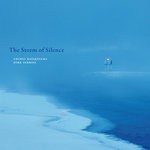
The quiet drone of "Kulde" opens this release and introduces the listener into a landscape made out of open spaces and absent clouds. "Uvaer" is based on a drone that acts a canvas for other drones and sounds until all element gently fades into the final silence. "Fryst" seems based on the same format, however the foreground drone slowly evolves generating the evocative cover with his immersive blue. "Hvit" closes this release depicting the sense of a music working with detail instead of a form.
This is a release based on a well known form, whose however Dirk Serries is one of his builders, but reminds of how this music is based on subtle nuances rather on sonic impact and reveals how the careful choice of tones is fundamental so it has to heard with a proper equipment instead of pc speakers. It's worth a listen perhaps for everyone.
The quiet drone of "Kulde" opens this release and introduces the listener into a landscape made out of open spaces and absent clouds. "Uvaer" is based on a drone that acts a canvas for other drones and sounds until all element gently fades into the final silence. "Fryst" seems based on the same format, however the foreground drone slowly evolves generating the evocative cover with his immersive blue. "Hvit" closes this release depicting the sense of a music working with detail instead of a form.
This is a release based on a well known form, whose however Dirk Serries is one of his builders, but reminds of how this music is based on subtle nuances rather on sonic impact and reveals how the careful choice of tones is fundamental so it has to heard with a proper equipment instead of pc speakers. It's worth a listen perhaps for everyone.
S36NZ-Okh: Meditzina Katastrof
An apt album to soundtrack Doom 5, should it ever come out. Especially the parts when your main character ventures through some narrow, dimly-lit tunnel where creatures grab at you from the darkness. Producer Kirill Rozhkov succeeds in crafting a horror narrative set in a post-apocalyptic world of desolate factories, torture chambers, unnerving subway rides, futurist ports and machine rooms, with the odd mosque-in-prayer session thrown in for effect. The opening title track, 'Meditzina Katastrof' starts off eerily enough, with vacuous noises and vintage broadcast radio voice-overs in Russian that gives way to creepy ambience and in turn is subdued by very nice power synth sweeps with a grandiose melody. 'Meditzina...' would fit perfectly on a 4AD compilation. The samples interplay nicely with heavy, electronic sweeps and canon-blast percussion. 'Sanatorium' has a bit of a haunted-house-in-a-theme-park vibe to it. An eerie wind is followed by an industral hum and what could be sinister growling or an idling mega truck. Further into the track, disembodied voices sing in chorus as austere keyboard notes from horror films join clanging from clumsy blue collar workers who cannot seem to get a firm grip on their tools. 'Island of Renaissance (Yersinia Pestis)' is rich and heavy in the low end bass and sets a tense backdrop for what could be a Russian horror radio play. Next, there is the torture chamber-esque 'Masha/Dasha' where voices dialogue calmly amidst a chorus of power tools and manic screams. To this listener, there appears to be a music box sample from the theme music to the 80's-era Twilight Zone. Towards the end of the track, as the samples hit a kind of crescendo, a heavy feedback drone washes in and sweeps the torture chamber clean for the next customers. Enter a ride on the world's most rickety and dilapidated subway train filled with workers who just finished a long stint in the salt mines and members of the Soviet arts council'on 'P424 (Snegir')'. People who murmur in Russian could be heard through cacophony of the train rumbling through a tunnel while opera singers practice vocal scales. 'Sweet Dreams' has nothing to do with the Eurythmics, rather a rumbling bass-drone is a canvas for a recitation of the opening passage of the Quaran, followed by a collective 'amen'. I will hazard a guess that the voice over is probably from a Chechyn talking about being a Mujahid (Jihadist martyr). Given Russia's ventures in Afghanistan, Chechnya, and now Syria, I could see how this could be part of the topical horror theme. Now, I realize 'Vaccination of Work' is supposed to be yet another horror-themed track, but to my ears, the power-surge generator hums remind me of the giant robots of Pacific Rim, while the chatter of men and assorted mechanical bleeping and clamor from machines could easily pass for a maintenance bay. Go robots! 'Official Version' closes the album on a decidedly sci-fi note with a bit of an eerie tinge. Wind chimes play against oscillating tones wile looped voices are steeply reverbed as if in a cavernous room. The noise could pass for a space station bay with chirps from a control station. Meditzin Katastrof is an issue of a 2003-2004 recording session in Saint Petersburg, Russia. Though the packaging is minimal, a simple cardboard sleeve, the design is a work of Industrial-esque art and hand numbered. If you are into dark, horror movie sound scapes with a tinge of sci-fi, this disc is for you.