
Browse by Genre
Industrial Music / Industrial Metal / Aggro Industrial / Electro Metal
Industrial Noise / Power Noise / Harsh Noise
Synth Pop / Electro Pop / Synth-Electronica
Techno / Trance / Goa / Drum'n'Bass / Jungle / Tribal / Trip-Hop
Ambient / Electronica / Ethereal / Dub / Soundscapes / Abstract
Experimental / Avantgarde / Weird & Wired / Glitch / Noise / Field Recording
Dark / Gothic / Wave / New Wave / Dark Wave / Industrial Gothic
New Music / Downtown / Avantgarde Jazz / New Classical / World
Search Reviews
Music Reviews
deNeuve: Ugly
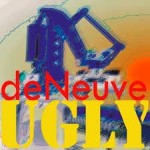
It wasn't terribly long ago that I reviewed deNeuve's 'Old Bruce' 12" and I found that work enigmatic and difficult. 'Ugly' might be considered deNeuve's "commercial album" in comparison, although it is far from commercial. André Bach & Mark Tegefoss have been busy constructing short pieces (only one is a couple seconds over 5 minutes) that rely heavily on layered loops. Now obviously looping is nothing new in electro-industrial music, and from all the technology available now to do it there has never been a better time for the looping artist. Unfortunately there has also never been a worse time as any yahoo with a decent digial toolbox can create and layer loops. (I even have some experience in this myself.) What matters though is how interesting these compositions are, and a lot of them tend to get boring due to the repetition factor, and also a lack of creativity. Plenty of repetition here on 'Ugly' but nothing I would call boring or uncreative.
From the get-go on the opener "Wolfspace", deNeuve go absolutely cuckoo with industrial beats and synths and samples of children's voices. It's an attention getter to say the least and you can bet your ass I'm going to that little girl's party just to see what the hell is going on there. The tracks are unified by certain elements - looped drum and percusion rhythms; looped synth sequences; recurring cinema dialogue samples; other looped elements. On "Our English House" there is a dance beat, low moaning synth, looped bass guitar pattern, looped dialogue sample ("there are certain things"..."you can't understand"..."the moon"..."repeated"..."do as I say"..."let me worry about"...) and other elements. It has a tribal feel, and although the rhythm is nearly constant, other elements change over time. Intense without going into overkill. "Anna Camprena", a fairly slow piece, makes use of what seems like orchestral string samples and foreign dialogue samples, among other elements. Some cleverly combined rhythm loops - drums/percussion, bass, musical box, form the basis for "Paris Deaux 55", and they're pitch-shifted over the course of the track, while various snippets of French dialogue are woven throughout. "Molotrop" makes use of trip hop drumkit and percussion loops and accompanying bass while various voices electronically manipulated beyond intelligibility appear and disappear into the mix. There is a weird feel about this one that just has to be experienced rather than merely described. Still, maybe the most "normal" thing so far. The rhythm doesn't begin on "Western" until 1:25 has elapsed, and prior to that you get some bassy synth sonics and other electronics, snippets of dialogue samples, and squawking guitar chord samples. When the rhythm comes, it's relentless (with a few breaks) and the mix of samples is controlled chaos. "Young Lines" sounds like spastic Philip Glass in a blender. I particularly like the electro-acoutic rhythm looping that begins "Killing Alvin", but that changes soon enough. Electronic seagulls, vocal and dialogue snippets, an incessant bass rhythm, and other rhythmic elements combine to form a very strange scenario. I can't even describe "1980 Anger" but it just might be the most abrasive thing on the album. Quite relentless. "Lee and Margot" has an aura of mystery to it, depending on a variety of echoed electronic (or electronically manipulated sound samples) for its rhythm. Psychedelic to say the least. The Ugly Mix of "Old Bruce" doesn't do much to change the original in my estimation, but it does seem to fit right in with this album. Finally we have "Morning Boy" (also from the 'Old Bruce' 12", and here this piece seems to fit right in as well.
While many might find 12 tracks of this madness a bit overwhelming at once, in small doses (a couple of tracks at a time) it should be easily digestible and often quite rewarding. There is plenty of variety, and enough variation so the repetiveness doesn't get tiresome. I know a lot of work must have gone into this, and hopefully deNeuve will be rewarded by enough purchases from the fine folks at Blowpipe to affirm the quality of their latest endeavor.
From the get-go on the opener "Wolfspace", deNeuve go absolutely cuckoo with industrial beats and synths and samples of children's voices. It's an attention getter to say the least and you can bet your ass I'm going to that little girl's party just to see what the hell is going on there. The tracks are unified by certain elements - looped drum and percusion rhythms; looped synth sequences; recurring cinema dialogue samples; other looped elements. On "Our English House" there is a dance beat, low moaning synth, looped bass guitar pattern, looped dialogue sample ("there are certain things"..."you can't understand"..."the moon"..."repeated"..."do as I say"..."let me worry about"...) and other elements. It has a tribal feel, and although the rhythm is nearly constant, other elements change over time. Intense without going into overkill. "Anna Camprena", a fairly slow piece, makes use of what seems like orchestral string samples and foreign dialogue samples, among other elements. Some cleverly combined rhythm loops - drums/percussion, bass, musical box, form the basis for "Paris Deaux 55", and they're pitch-shifted over the course of the track, while various snippets of French dialogue are woven throughout. "Molotrop" makes use of trip hop drumkit and percussion loops and accompanying bass while various voices electronically manipulated beyond intelligibility appear and disappear into the mix. There is a weird feel about this one that just has to be experienced rather than merely described. Still, maybe the most "normal" thing so far. The rhythm doesn't begin on "Western" until 1:25 has elapsed, and prior to that you get some bassy synth sonics and other electronics, snippets of dialogue samples, and squawking guitar chord samples. When the rhythm comes, it's relentless (with a few breaks) and the mix of samples is controlled chaos. "Young Lines" sounds like spastic Philip Glass in a blender. I particularly like the electro-acoutic rhythm looping that begins "Killing Alvin", but that changes soon enough. Electronic seagulls, vocal and dialogue snippets, an incessant bass rhythm, and other rhythmic elements combine to form a very strange scenario. I can't even describe "1980 Anger" but it just might be the most abrasive thing on the album. Quite relentless. "Lee and Margot" has an aura of mystery to it, depending on a variety of echoed electronic (or electronically manipulated sound samples) for its rhythm. Psychedelic to say the least. The Ugly Mix of "Old Bruce" doesn't do much to change the original in my estimation, but it does seem to fit right in with this album. Finally we have "Morning Boy" (also from the 'Old Bruce' 12", and here this piece seems to fit right in as well.
While many might find 12 tracks of this madness a bit overwhelming at once, in small doses (a couple of tracks at a time) it should be easily digestible and often quite rewarding. There is plenty of variety, and enough variation so the repetiveness doesn't get tiresome. I know a lot of work must have gone into this, and hopefully deNeuve will be rewarded by enough purchases from the fine folks at Blowpipe to affirm the quality of their latest endeavor.
Rapoon: Blue Days
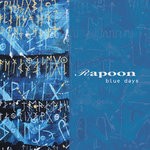
The new release from Robin Storey's project is a return to a more concise form while his previous releases of new material were based on long composition mostly based on drones or on sonic research. "Blue Days" is a partial return to his classic style with great emphasis on the rhythmic element and the meditative use of oriental wind instrument, however in this release there's a research for a defined sound spectrum that was absent in those releases that were mainly based on the hypnotic effect.
The metallic beats of "winters chime deep" introduce the listener into a sonic field vaguely reminiscent of the past of this artist but with an better attention to details. "On frozen air" is an hypnotic track based on a sound texture and a fistful of samples. The synth line of "no one came" gives an undoubtable charm to the track while "in black" is characterized by the oriental beats typical of his classic pages. "Long time ago now" is one of the few track featuring a proper vocal track while "the angels called" recalls the ability of Robin Storey to develops tracks using almost only percussions as elements. "In golden church" is an ethereal track based on drones while "with dance of trees" is based on loops of flutes. "Air gliden" is based on a soundscape obtained by filtered samples to expand their resonances and echoes. "Black shadows" features his known structure for flute and percussions. "In static bursts" is a small noise interlude while "small light" is another interlude for bells. "Endless" is a meditative track for voice and synth and "blue days" uses an hypnotic beat and slowed down samples and the voice closes this release singing the album's title.
Obviously far enough for any important deviation from a form which has influenced many artists, it's a release that confirms the Rapoon's ability to evolve his language neither overturning it nor being trivial. It's really worth a listen.
The metallic beats of "winters chime deep" introduce the listener into a sonic field vaguely reminiscent of the past of this artist but with an better attention to details. "On frozen air" is an hypnotic track based on a sound texture and a fistful of samples. The synth line of "no one came" gives an undoubtable charm to the track while "in black" is characterized by the oriental beats typical of his classic pages. "Long time ago now" is one of the few track featuring a proper vocal track while "the angels called" recalls the ability of Robin Storey to develops tracks using almost only percussions as elements. "In golden church" is an ethereal track based on drones while "with dance of trees" is based on loops of flutes. "Air gliden" is based on a soundscape obtained by filtered samples to expand their resonances and echoes. "Black shadows" features his known structure for flute and percussions. "In static bursts" is a small noise interlude while "small light" is another interlude for bells. "Endless" is a meditative track for voice and synth and "blue days" uses an hypnotic beat and slowed down samples and the voice closes this release singing the album's title.
Obviously far enough for any important deviation from a form which has influenced many artists, it's a release that confirms the Rapoon's ability to evolve his language neither overturning it nor being trivial. It's really worth a listen.
Thomas Buckner, Claudio Parodi: Taken From A True Story
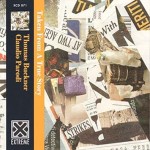
Artist: Thomas Buckner, Claudio Parodi (@)
Title: Taken From A True Story
Format: CD
Label: Extreme (@)
Rated:


Title: Taken From A True Story
Format: CD
Label: Extreme (@)
Rated:
This album is the recording of two day's improvisation of Thomas Buckner with his baritone voice and Claudio Parodi on Turkish clarinet recorded, according to the cd's liner notes, direct to hard disc. The overall result is on the path of certain reductionism searching for subtle details of the instrument's palette as the baritone uses his voice as an instrument rather than traditionally sing and so it develops a real dialog with the clarinet which is not forced to accompany a text.
The clarinet opens "They Are Taking Our Jobs And Our Women" with fragmented lines under the quiet gabble of the voice that slowly develops it in amplitude and complexity until the end of the track. The sustained notes of the voice develop a subtle melody in "Never Have Sex On The First Date" that is doubled by a clarinet that doesn't disdain even some roughness while, in the second part of the track, it develops a true dialectic with the voice. "In The Courtyard" is a small intermezzo that introduces "Boxing-Match" where, as the title ironically suggests, there's a vocal research to introduces his tones without resorting to a scream to balance the high pitch of the clarinet, while "Vegetarian Food Is Delicious, But God Bless The Pork" there's some real tonal superimposition between the voice and the clarinet. "A Sailor Gets Back Home" is a short track closer to a song form as the clarinet seems to accompany the voice while "Obituary" starts as an humble meditation for voice and clarinet and evolve as a religious chant without his rhetoric. "Rave Party" is the juxtaposition of a voice and clarinet searching, in an almost inaudible volume, subtle nuances of tones while "Coming Out" juxtaposes sustained tones. "Not For Beginners" closes this release with the voice and the clarinet in a dialogue when the slow development of the voice line is opposed to the fast phrases of the clarinet.
Recorded in an almost old fashioned way to fully reenact the proper musical dynamics, this is not a simple listening as the musicians often prefer to play at pianissimo level searching a sort of hiding place in the environment. In times where music is often used as a background for other activities, this kind of music, even is codified, maintains intact his property of social commentary and requires a real intention to listen. If someone prefers to hear could rate it with two star but the others would rate it almost five so the average is 3.5.
The clarinet opens "They Are Taking Our Jobs And Our Women" with fragmented lines under the quiet gabble of the voice that slowly develops it in amplitude and complexity until the end of the track. The sustained notes of the voice develop a subtle melody in "Never Have Sex On The First Date" that is doubled by a clarinet that doesn't disdain even some roughness while, in the second part of the track, it develops a true dialectic with the voice. "In The Courtyard" is a small intermezzo that introduces "Boxing-Match" where, as the title ironically suggests, there's a vocal research to introduces his tones without resorting to a scream to balance the high pitch of the clarinet, while "Vegetarian Food Is Delicious, But God Bless The Pork" there's some real tonal superimposition between the voice and the clarinet. "A Sailor Gets Back Home" is a short track closer to a song form as the clarinet seems to accompany the voice while "Obituary" starts as an humble meditation for voice and clarinet and evolve as a religious chant without his rhetoric. "Rave Party" is the juxtaposition of a voice and clarinet searching, in an almost inaudible volume, subtle nuances of tones while "Coming Out" juxtaposes sustained tones. "Not For Beginners" closes this release with the voice and the clarinet in a dialogue when the slow development of the voice line is opposed to the fast phrases of the clarinet.
Recorded in an almost old fashioned way to fully reenact the proper musical dynamics, this is not a simple listening as the musicians often prefer to play at pianissimo level searching a sort of hiding place in the environment. In times where music is often used as a background for other activities, this kind of music, even is codified, maintains intact his property of social commentary and requires a real intention to listen. If someone prefers to hear could rate it with two star but the others would rate it almost five so the average is 3.5.
Ivan Iusco: Transients
Artist: Ivan Iusco
Title: Transients
Format: CD
Label: Minus Habens (@)
Distributor: Family Affair Distributions srl
Rated:
Title: Transients
Format: CD
Label: Minus Habens (@)
Distributor: Family Affair Distributions srl
Rated:
I've been familiar with Iusco's name since the early '90es as the founder of Minus Habens, one of Italy's most prominent electronic music labels (which released things by Angelo Badalamenti, Brian Eno, Depeche Mode and a number of Italian artists). I was less familiar with Iusco as a composer, but it turns out he's moved operations to Los Angeles and has been working hard as a film composer scoring mostly Italian movies for the better part of the last 15 years.
"Transients" is his second album and showcases his evolution from electronic music tinkerer to full blown orchestral composer. The cover art work of the digi pack looks like a blurred version of a dutch masters painting or a Rembrant portrait but it's actually by the internationally-acclaimed artists Miaz Brothers.
The album starts off with tracks that are very cinematic (as is most of the record, really) and more orchestral. Layers of more than 20 real world wind, brass, string instruments and atmospheres that range from mysterious and melancholic to grand and majestic... When there is a real violin (like on track "Mobilis in Mobili", played by Pantaleo Gadaleta, who also played with the great Morricone and Antony and the Johnsons) you can really hear how the track is lifted to a whole other level, proof of what true musicianship can contribute to any computer generate music project! Then from the fifth track on Iusco pulls out his nails and teeth out and sinks them into the largely unprepared listener with some great mean-ass IDM/industrial/electronic sounds... Two tracks later the album takes another sudden turn and becomes a more vintage sounding, dare I say, almost nostalgic old-school electronica record (echoes of Clock DVA, maybe even Tangerine Dream...). On the eight track ("Circuitless") a female vocalist is introduced (it's Tying Tiffany, who's been featured on CSI, The Hunger Games)... Then Ivan dips back into ethereal ambient soundscapism that almost leaves you with a sense of uneasiness and peace at the same time. But obviously, he prefers to pick things up again and go out in a blaze of glory because the closing "Unconquered" track is what you'd expect from the end scene of some epic battle movie or even a spaceship battle sci-fi film: it's as victorious, dazzling and magnum opus-like as you'd imagine it, the perfect end credit music for this album, even though it almost ends too soon and abruptly...
If you are into soundtracks and epic movie music that is a mixture of electronica and classical music, or any of those genres taken on their own for that matter, I'd recommend you give this a spin, or at least preview it on iTunes. There's some really good stuff in there!
"Transients" is his second album and showcases his evolution from electronic music tinkerer to full blown orchestral composer. The cover art work of the digi pack looks like a blurred version of a dutch masters painting or a Rembrant portrait but it's actually by the internationally-acclaimed artists Miaz Brothers.
The album starts off with tracks that are very cinematic (as is most of the record, really) and more orchestral. Layers of more than 20 real world wind, brass, string instruments and atmospheres that range from mysterious and melancholic to grand and majestic... When there is a real violin (like on track "Mobilis in Mobili", played by Pantaleo Gadaleta, who also played with the great Morricone and Antony and the Johnsons) you can really hear how the track is lifted to a whole other level, proof of what true musicianship can contribute to any computer generate music project! Then from the fifth track on Iusco pulls out his nails and teeth out and sinks them into the largely unprepared listener with some great mean-ass IDM/industrial/electronic sounds... Two tracks later the album takes another sudden turn and becomes a more vintage sounding, dare I say, almost nostalgic old-school electronica record (echoes of Clock DVA, maybe even Tangerine Dream...). On the eight track ("Circuitless") a female vocalist is introduced (it's Tying Tiffany, who's been featured on CSI, The Hunger Games)... Then Ivan dips back into ethereal ambient soundscapism that almost leaves you with a sense of uneasiness and peace at the same time. But obviously, he prefers to pick things up again and go out in a blaze of glory because the closing "Unconquered" track is what you'd expect from the end scene of some epic battle movie or even a spaceship battle sci-fi film: it's as victorious, dazzling and magnum opus-like as you'd imagine it, the perfect end credit music for this album, even though it almost ends too soon and abruptly...
If you are into soundtracks and epic movie music that is a mixture of electronica and classical music, or any of those genres taken on their own for that matter, I'd recommend you give this a spin, or at least preview it on iTunes. There's some really good stuff in there!
Doomsday Virus: Mutually Abusive
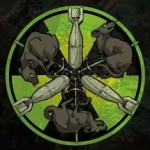
Unless you're a follower of the Upstate New York Goth-Industrial scene you may never have heard or heard of Doomsday Virus, but that's about to change. The project was first conceived in the basement of a rat-infested Buffalo, New York apartment building during the spring of 1998 by leader N. Dru Virus, but it wasn't until he relocated to Albany in the winter of 2001 that the incubation period really began. The earliest releases go back to 2005 - 'Cries of All Things Left Unsaid" and 'Catastrophic Error,' with a followup, 'Drink the Kool-Aid' in 2008. Now they're back eight years later with 'Mutually Abusive' with the lineup of N. Dru Virus - vocals, synth & drum programming and shitty guitars (his adjective, not mine); RaHb Eleven - synth & drum programming, legit guitars; and Matt Vellocet - live synths, recording engineer and whip cracking. Doomsday Virus is an industrial metal band in the vein of Ministry and KMFDM, with a touch of aggrotech, ala Combichrist.
The band has grown considerably since their previous releases, and 'Mutually Abusive' is an album on steroids compared what went before. From the thunderous opening of "Cracks in the Facade" all kinds of hell is unleashed on the unsuspecting listener. It's a tumultuous rage-fueled juggernaut that lets you know in no uncertain terms where these guys stand. It gets no less malovlent on "Die Alone" as the band hits its stride. You can dance to this, you can headbang to this, and it has a decent hook too! R.E.'s industrial guitar holds up with the best of them. I thought maybe that Doomsday Virus didn't have much of a sense of humor until I heard "Save Our Souls," the likely hit of the album. Synths are a little more prominent on this one, and the vocals quite intelligible. N. Dru rhymes more "shun" words in this song than Bill Leeb ever did - combination, tribulation, frustration, temptation, etc., etc. His vocals are remarkably similar to Andy LaPlegua's in many places, but this is no Combichrist clone. "Cold, Colder" could only have been written by someone who survived last winter here in Upstate NY. DV bring plenty of nastiness to the table on "Fool Me," a caustic warning of sorts. Imagine if Marilyn Manson fronted Front Line Assembly for a day...the result might just be "Flatline". All the stops get pulled out on "Life Deleted," a track that proves Doomsday Virus can go toe-to-toe with the heavyweights on the industrial music scene. Technically the album ends with "I Hope You Expected to Be Let Down," and for me, there was just a little too much chaos on this one. But wait...there's more, but only if you buy the CD as opposed to the download. "Waiting" is the tenth track, not named on the CD. It's much slower than anything else on the album, but perhaps more virulent. They go out with one big, heavy bang and no whimper.
'Mutually Abusive' should get these guys further than any of their previous efforts, and for fans of the genre, will likely provoke a positive response. When it comes to this kind of music, touring is essential, and if they can convey it live, Doomsday Virus should spread like a plague.
The band has grown considerably since their previous releases, and 'Mutually Abusive' is an album on steroids compared what went before. From the thunderous opening of "Cracks in the Facade" all kinds of hell is unleashed on the unsuspecting listener. It's a tumultuous rage-fueled juggernaut that lets you know in no uncertain terms where these guys stand. It gets no less malovlent on "Die Alone" as the band hits its stride. You can dance to this, you can headbang to this, and it has a decent hook too! R.E.'s industrial guitar holds up with the best of them. I thought maybe that Doomsday Virus didn't have much of a sense of humor until I heard "Save Our Souls," the likely hit of the album. Synths are a little more prominent on this one, and the vocals quite intelligible. N. Dru rhymes more "shun" words in this song than Bill Leeb ever did - combination, tribulation, frustration, temptation, etc., etc. His vocals are remarkably similar to Andy LaPlegua's in many places, but this is no Combichrist clone. "Cold, Colder" could only have been written by someone who survived last winter here in Upstate NY. DV bring plenty of nastiness to the table on "Fool Me," a caustic warning of sorts. Imagine if Marilyn Manson fronted Front Line Assembly for a day...the result might just be "Flatline". All the stops get pulled out on "Life Deleted," a track that proves Doomsday Virus can go toe-to-toe with the heavyweights on the industrial music scene. Technically the album ends with "I Hope You Expected to Be Let Down," and for me, there was just a little too much chaos on this one. But wait...there's more, but only if you buy the CD as opposed to the download. "Waiting" is the tenth track, not named on the CD. It's much slower than anything else on the album, but perhaps more virulent. They go out with one big, heavy bang and no whimper.
'Mutually Abusive' should get these guys further than any of their previous efforts, and for fans of the genre, will likely provoke a positive response. When it comes to this kind of music, touring is essential, and if they can convey it live, Doomsday Virus should spread like a plague.