
Borghesia: Proti kapitulaciji (Against Capitulation)
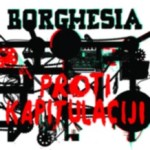
Artist: Borghesia (@)
Title: Proti kapitulaciji (Against Capitulation)
Format: CD + Download
Label: Moonlee Records (@)
Rated:


Title: Proti kapitulaciji (Against Capitulation)
Format: CD + Download
Label: Moonlee Records (@)
Rated:
Bogrhesia is a Slovenian band I have heard of (all the way back to the early 1990s) but never actually heard as I could not find any of their albums in the pre-Internet commerce era when you had to find a record shop that carried product. I can attribute my discovery of them to the Trouser Press Record Guide, a book I consider responsible for awakening my interest in many non-mainstream artists such as Current 93, In The Nursery, Legendary Pink Dots, X Marks the Pedwalk and many, many more. Borghesia have been around since 1982, formed by members of the alternative theatre group Theatre FV-112/15. As you might imagine they've amassed a sizable discography over the years, none of which I've heard previously, unfortunately.
'Proti kapitulaciji' (Against Capitulation) appears to be their 13th album after 'And Man Created God' (2014) and 'Better Live Than Dead' (2016). According to the label-provided one-sheet, this album "is a free-floating rock epic based on Srecko Kosovel's modernist poetry that sits somewhere between an alternative soundtrack of 'Blade Runner,' the uncanny ambience of Coil, melancholy Berlin era David Bowie and the immediacy of Nine Inch Nails. After giving 'PK' an initial listen I can understand why the label stated those things, but I don't necessarily agree with them. Yes, this is a very unusual album with industrial and electronica elements, but it doesn't sound anything like Blade Runner, Bowie or NIN.
The first thing you need to know is the album is sung entirely in Slovene, and while that may be off-putting to some, it shouldn't be dismissed out of hand, because there is still much of value here. However, one caveat - there are more than just a few tracks where an English translation might come in handy. (You can get one at Borghesia's website.) The first track, "Odprite Muzeje," equates "Open Museums" with dead ideas and tombs haunting Europe. (How's that for inspirational tourism!) Vocals are dual male/female, as often done on this album. This is set to a backdrop of vintage analogue electronica. It has a somewhat surreal, trance induced quality as the lyrics almost seemed almost chanted. It is no less surreal on the following track, "Kons," about a hollow, empty, culturally dead Europe with an overwhelming aura of melancholy. Musically everything is well-integrated with a chugging rhythm, and instrumentation of guitar and electronics which support rather than detract from the melody of the vocals. "Na piramidi" (In A Pyramid) is where the album really comes alive though and all elements seem to be on an unstoppable dark track. Things only get stranger after this one.
The deeper you go, the more intense and wacky the songs get. There is absolutely nothing mainstream about this album, even though much of it is in a (sort of) rock format. It becomes evident that Srecko Kosovel's poetry, used as the song lyrics, is the most important element of this album. Thematically it speaks of how Europe is dead, art and culture are dead, and it all needs to be destroyed. Good people got sold out, civilization has no heart, capitalism ruins everything, and nothing can save you. Yes, it's a potent sort of pessimistic misanthropy more aimed at the collective than the individual, society in general. I'm sure a little gets lost in translation because even following along listening while reading the English translation at times it seems there is something missing that might be better expressed in the original Slovenian.
What I find interesting is that Kosovel lived way back in the first few decades of the 20th century (1904-1926), died quite young at age 22, but managed to complete 500 poems. He was labeled an impressionistic poet and a political poet, often compared to Rimbaud, and is now considered a Slovenian poetic icon. When you realize the time during which he lived was dominated by World War I, you'll understand better the reason for such pessimism and misanthropy. Kosovel's poetry still seems pretty relevant today (when I first read the lyeics, I thought they had been written recently!) and Borghesia's execution in the music makes it seem all the more contemporary. Although Borghesia are well-versed in the musical idioms of EBM, synthpop and industrial, there is no one genre they subscribe to here. Instead, the presentation is much more theatrical, is if in an electronic a musical. The closest prior work of theirs to this one is 'And Man Created God,’ but even that only hints at the full-bore of 'Proti kapitulaciji'.
This is an album sure to have only limited appeal outside of the Slavic region of Europe, partly because of the language, and partly due to unfamiliarity with Borghesia and Kosovel’s poetry. It’s a worthy venture for the intrepid explorer though, discovering a near century-old major modernist poet filtered through the more modern musical lens of his countrymen.
'Proti kapitulaciji' (Against Capitulation) appears to be their 13th album after 'And Man Created God' (2014) and 'Better Live Than Dead' (2016). According to the label-provided one-sheet, this album "is a free-floating rock epic based on Srecko Kosovel's modernist poetry that sits somewhere between an alternative soundtrack of 'Blade Runner,' the uncanny ambience of Coil, melancholy Berlin era David Bowie and the immediacy of Nine Inch Nails. After giving 'PK' an initial listen I can understand why the label stated those things, but I don't necessarily agree with them. Yes, this is a very unusual album with industrial and electronica elements, but it doesn't sound anything like Blade Runner, Bowie or NIN.
The first thing you need to know is the album is sung entirely in Slovene, and while that may be off-putting to some, it shouldn't be dismissed out of hand, because there is still much of value here. However, one caveat - there are more than just a few tracks where an English translation might come in handy. (You can get one at Borghesia's website.) The first track, "Odprite Muzeje," equates "Open Museums" with dead ideas and tombs haunting Europe. (How's that for inspirational tourism!) Vocals are dual male/female, as often done on this album. This is set to a backdrop of vintage analogue electronica. It has a somewhat surreal, trance induced quality as the lyrics almost seemed almost chanted. It is no less surreal on the following track, "Kons," about a hollow, empty, culturally dead Europe with an overwhelming aura of melancholy. Musically everything is well-integrated with a chugging rhythm, and instrumentation of guitar and electronics which support rather than detract from the melody of the vocals. "Na piramidi" (In A Pyramid) is where the album really comes alive though and all elements seem to be on an unstoppable dark track. Things only get stranger after this one.
The deeper you go, the more intense and wacky the songs get. There is absolutely nothing mainstream about this album, even though much of it is in a (sort of) rock format. It becomes evident that Srecko Kosovel's poetry, used as the song lyrics, is the most important element of this album. Thematically it speaks of how Europe is dead, art and culture are dead, and it all needs to be destroyed. Good people got sold out, civilization has no heart, capitalism ruins everything, and nothing can save you. Yes, it's a potent sort of pessimistic misanthropy more aimed at the collective than the individual, society in general. I'm sure a little gets lost in translation because even following along listening while reading the English translation at times it seems there is something missing that might be better expressed in the original Slovenian.
What I find interesting is that Kosovel lived way back in the first few decades of the 20th century (1904-1926), died quite young at age 22, but managed to complete 500 poems. He was labeled an impressionistic poet and a political poet, often compared to Rimbaud, and is now considered a Slovenian poetic icon. When you realize the time during which he lived was dominated by World War I, you'll understand better the reason for such pessimism and misanthropy. Kosovel's poetry still seems pretty relevant today (when I first read the lyeics, I thought they had been written recently!) and Borghesia's execution in the music makes it seem all the more contemporary. Although Borghesia are well-versed in the musical idioms of EBM, synthpop and industrial, there is no one genre they subscribe to here. Instead, the presentation is much more theatrical, is if in an electronic a musical. The closest prior work of theirs to this one is 'And Man Created God,’ but even that only hints at the full-bore of 'Proti kapitulaciji'.
This is an album sure to have only limited appeal outside of the Slavic region of Europe, partly because of the language, and partly due to unfamiliarity with Borghesia and Kosovel’s poetry. It’s a worthy venture for the intrepid explorer though, discovering a near century-old major modernist poet filtered through the more modern musical lens of his countrymen.
Comments
Browse by Genre
Industrial Music / Industrial Metal / Aggro Industrial / Electro Metal
Industrial Noise / Power Noise / Harsh Noise
Synth Pop / Electro Pop / Synth-Electronica
Techno / Trance / Goa / Drum'n'Bass / Jungle / Tribal / Trip-Hop
Ambient / Electronica / Ethereal / Dub / Soundscapes / Abstract
Experimental / Avantgarde / Weird & Wired / Glitch / Noise / Field Recording
Dark / Gothic / Wave / New Wave / Dark Wave / Industrial Gothic
New Music / Downtown / Avantgarde Jazz / New Classical / World