
Saturday, August 29, 2026
Allen Ravenstine: Nautilus
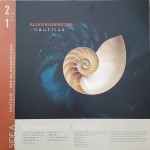


I was unfamiliar with Allen Ravenstine when this series of four discs showed up in my mailbox, but he was a member of Pere Ubu and has made a name for himself in his own right. This is part 3 in the series of EPs that make up the “Tyranny of Fiction” series. This disc would be right at home in the soundtrack of a film noir picture, and the liner notes set the stage well. The opening line is "I read this morning about the moment a woman learned that all of the lights would not be green for her and that reminded me of the night I was killed in a car crash." Seems promising, so let’s see what he have with this installment.
We kick it off with “Fog (Devil’s Island Mix,” which is an accordion piece with field recordings of ocean and seagulls and give it kind of an old world feel. It almost feels like being on a boardwalk somewhere as a sidewalk busker is playing the accordion. Next up we have “A Day at the Beach,” which has analog synth with firecrackers and other noises interspersed, which then somehow gives way to a ska beat with horn, which is kind of odd. “Meadowlark” is up next with a slow piece that has slow bass line and flute. “Heteromorph” is a short string piece that goes just over a minute. “Nautilus” is a slow, brooding number with percussion and synth and crackling noises. “Java Head” keeps the slow synth movement going with wave samples and what sounds like castanets. “Prelude” is a short piano piece; it’s pretty and serves mainly as incidental music. “Tuxedo Moonlight” is a peaceful track with piano, strings, and bells, with some samples of water flowing. No points for figuring out what the main instrument in “Moonlight Marimba,” but this is a short chill piece that weighs in at less than 2 minutes. Finally, “Red Skies at Night” closes it down with some slow strings and analog synth atmosphere.
Overall this was a bit more experimental than “Shore Leave,” but still much more typical in composition. However, Ravenstine’s genius seems to be the ability to put together an atmosphere that makes you feel like you’re in a place a particular place. You get the sense that these are compositions that were meant to be placed somewhere or, more specifically, experienced somewhere. He weaves snippets of voice in various languages, samples of phone messages that tell you you’ve received the wrong number, guitar and the ever present modular synth, and other field recordings that create a cinematic feel. In short, it was a pleasant listen but if you’re looking for more experimental work you’d be better off going with “Rue Du Poisson Noir.”
We kick it off with “Fog (Devil’s Island Mix,” which is an accordion piece with field recordings of ocean and seagulls and give it kind of an old world feel. It almost feels like being on a boardwalk somewhere as a sidewalk busker is playing the accordion. Next up we have “A Day at the Beach,” which has analog synth with firecrackers and other noises interspersed, which then somehow gives way to a ska beat with horn, which is kind of odd. “Meadowlark” is up next with a slow piece that has slow bass line and flute. “Heteromorph” is a short string piece that goes just over a minute. “Nautilus” is a slow, brooding number with percussion and synth and crackling noises. “Java Head” keeps the slow synth movement going with wave samples and what sounds like castanets. “Prelude” is a short piano piece; it’s pretty and serves mainly as incidental music. “Tuxedo Moonlight” is a peaceful track with piano, strings, and bells, with some samples of water flowing. No points for figuring out what the main instrument in “Moonlight Marimba,” but this is a short chill piece that weighs in at less than 2 minutes. Finally, “Red Skies at Night” closes it down with some slow strings and analog synth atmosphere.
Overall this was a bit more experimental than “Shore Leave,” but still much more typical in composition. However, Ravenstine’s genius seems to be the ability to put together an atmosphere that makes you feel like you’re in a place a particular place. You get the sense that these are compositions that were meant to be placed somewhere or, more specifically, experienced somewhere. He weaves snippets of voice in various languages, samples of phone messages that tell you you’ve received the wrong number, guitar and the ever present modular synth, and other field recordings that create a cinematic feel. In short, it was a pleasant listen but if you’re looking for more experimental work you’d be better off going with “Rue Du Poisson Noir.”
Comments
Browse by Genre
Industrial Music / Industrial Metal / Aggro Industrial / Electro Metal
Industrial Noise / Power Noise / Harsh Noise
Synth Pop / Electro Pop / Synth-Electronica
Techno / Trance / Goa / Drum'n'Bass / Jungle / Tribal / Trip-Hop
Ambient / Electronica / Ethereal / Dub / Soundscapes / Abstract
Experimental / Avantgarde / Weird & Wired / Glitch / Noise / Field Recording
Dark / Gothic / Wave / New Wave / Dark Wave / Industrial Gothic
New Music / Downtown / Avantgarde Jazz / New Classical / World