
Saturday, August 29, 2026
K?the Kruse mit Edda Kruse Rosset: Krieg
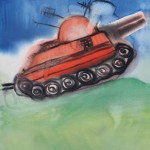
Artist: K?the Kruse mit Edda Kruse Rosset (@)
Title: Krieg
Format: 12" x 2
Label: self-released
Rated:

Title: Krieg
Format: 12" x 2
Label: self-released
Rated:
Released across three staggered dates in 2024 and culminating in a full performance in 2025, this double LP is an uncompromising exploration of war as an eternal and omnipresent backdrop to human existence. Together with her daughter, percussionist Edda Kruse Rosset, KÄthe Kruse offers an arresting and profoundly unsettling experience: the cold, clinical recitation of every known war since the start of the Common Era, accompanied by relentless drumming and the ever-present crackle of fire.
Listening to "Krieg" feels like stepping into an echo chamber of history’s tragedies. Kruse’s voice, deliberate yet charged with quiet urgency, reads from an unending list of wars. The drumming - intense, unwavering, and almost ritualistic - becomes a visceral heartbeat of violence, underscoring the futility and rhythm of perpetual conflict. It’s as though Edda’s sticks are striking the pulse of time itself, relentless and unyielding, while the faint crackling of fire suggests both destruction and purification.
The work is born from Kruse’s disquiet over the fragility of peace. Initially intending to create a project about harmony, her research instead uncovered the stark reality: peace is the anomaly, not the norm. This realization, rooted in a catalog of wars pulled from Wikipedia, became the foundation of her performance and, later, this album. What might seem an abstract concept in theory becomes a harrowing experience in practice, as the sheer volume of conflicts accumulates into an almost unbearable weight.
Fans of experimental sound art, particularly those familiar with Kruse’s legacy as a member of Die Tödliche Doris - Berlin’s avant-garde enfant terrible of the ‘80s - will recognize her penchant for blending absurdity with gravity. Yet, "Krieg" feels like an evolution, a work of stark minimalism where the message is stripped bare and inescapable. The influence of industrial pioneers and conceptual artists like Einstürzende Neubauten or Laurie Anderson can be felt in the disciplined interplay between sound, text, and raw emotion.
The beauty - and terror - of "Krieg" lies in its refusal to let the listener off the hook. There’s no crescendo, no release, only the endless rhythm of violence. As Kruse accelerates her recitation, the impossibility of completing the list becomes a chilling metaphor for humanity’s inability to break free from the cycle of war. The performance itself becomes an act of resistance: a confrontation with history’s horrors that demands attention, reflection, and accountability.
At times haunting, at times overwhelming, "Krieg" is a profound artistic statement. It doesn’t offer easy answers or catharsis; instead, it insists that we face the uncomfortable truths about our collective past - and, perhaps, our future. This is not an album for casual listening; it is a work to be witnessed, absorbed, and pondered. In a world too often anesthetized to conflict, "Krieg" dares to make us feel the weight of every war, one drumbeat at a time.
Listening to "Krieg" feels like stepping into an echo chamber of history’s tragedies. Kruse’s voice, deliberate yet charged with quiet urgency, reads from an unending list of wars. The drumming - intense, unwavering, and almost ritualistic - becomes a visceral heartbeat of violence, underscoring the futility and rhythm of perpetual conflict. It’s as though Edda’s sticks are striking the pulse of time itself, relentless and unyielding, while the faint crackling of fire suggests both destruction and purification.
The work is born from Kruse’s disquiet over the fragility of peace. Initially intending to create a project about harmony, her research instead uncovered the stark reality: peace is the anomaly, not the norm. This realization, rooted in a catalog of wars pulled from Wikipedia, became the foundation of her performance and, later, this album. What might seem an abstract concept in theory becomes a harrowing experience in practice, as the sheer volume of conflicts accumulates into an almost unbearable weight.
Fans of experimental sound art, particularly those familiar with Kruse’s legacy as a member of Die Tödliche Doris - Berlin’s avant-garde enfant terrible of the ‘80s - will recognize her penchant for blending absurdity with gravity. Yet, "Krieg" feels like an evolution, a work of stark minimalism where the message is stripped bare and inescapable. The influence of industrial pioneers and conceptual artists like Einstürzende Neubauten or Laurie Anderson can be felt in the disciplined interplay between sound, text, and raw emotion.
The beauty - and terror - of "Krieg" lies in its refusal to let the listener off the hook. There’s no crescendo, no release, only the endless rhythm of violence. As Kruse accelerates her recitation, the impossibility of completing the list becomes a chilling metaphor for humanity’s inability to break free from the cycle of war. The performance itself becomes an act of resistance: a confrontation with history’s horrors that demands attention, reflection, and accountability.
At times haunting, at times overwhelming, "Krieg" is a profound artistic statement. It doesn’t offer easy answers or catharsis; instead, it insists that we face the uncomfortable truths about our collective past - and, perhaps, our future. This is not an album for casual listening; it is a work to be witnessed, absorbed, and pondered. In a world too often anesthetized to conflict, "Krieg" dares to make us feel the weight of every war, one drumbeat at a time.
Comments
Browse by Genre
Industrial Music / Industrial Metal / Aggro Industrial / Electro Metal
Industrial Noise / Power Noise / Harsh Noise
Synth Pop / Electro Pop / Synth-Electronica
Techno / Trance / Goa / Drum'n'Bass / Jungle / Tribal / Trip-Hop
Ambient / Electronica / Ethereal / Dub / Soundscapes / Abstract
Experimental / Avantgarde / Weird & Wired / Glitch / Noise / Field Recording
Dark / Gothic / Wave / New Wave / Dark Wave / Industrial Gothic
New Music / Downtown / Avantgarde Jazz / New Classical / World