
Saturday, August 29, 2026
Yoko Ono / The Great Learning Orchestra: Selected Recordings From Grapefruit
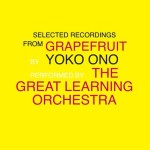
Artist: Yoko Ono / The Great Learning Orchestra (@)
Title: Selected Recordings From Grapefruit
Format: CD x 2 (double CD)
Label: Karlrecords (http://www.karlrecords.net/) (@)
Rated:

Title: Selected Recordings From Grapefruit
Format: CD x 2 (double CD)
Label: Karlrecords (http://www.karlrecords.net/) (@)
Rated:
For 60 years, "Grapefruit" has lived in a space of pure potential - a book filled with poetic invitations rather than instructions, a score meant more for the mind than the stage. Yoko Ono’s 1964 collection of event scores, drawings, and texts became a foundation for conceptual art, a kind of Fluxus handbook that encouraged readers to experience art beyond materiality. Her instructions often called for performances that existed in thought alone. “Listen to a heart beat”, she wrote, “Watch the sun until it becomes square”. Many of her pieces were never performed in a traditional sense, not because they were impossible, but because their truest realization was in the moment of reading them.
Now, six decades after "Grapefruit" first appeared, "Selected Recordings From Grapefruit" offers something remarkable: the first full album of recorded realizations based on Ono’s event scores. Performed by The Great Learning Orchestra - a Stockholm-based ensemble dedicated to deep listening, structured chance, and the occasional sonic prank, a collective that has spent 25 years exploring the boundaries of music, sound, and listening - this collection finally brings to ear what had mostly existed in the realm of imagination. With 20 tracks spanning 85 minutes, it moves fluidly between structured performances, chance encounters, and environmental recordings, shaping an auditory world as vivid and open-ended as Ono’s original text.
The Great Learning Orchestra does not treat Ono’s scores as fixed compositions, nor do they force them into conventional musical forms. Instead, they embrace their essence: a spirit of openness, fluidity, and deep listening. Some tracks unfold like delicate sonic experiments - voices, breath, strings trembling in space. Others emerge as pure environmental recordings, as if the world itself were the performer. Doors creak. Steps shuffle. Wind moves through leaves. Silence stretches.
It’s in this range of approaches that the album reveals its genius. Ono’s work has always blurred the boundaries between music, performance, and daily life, and here, the Orchestra extends that vision. Many of the recordings are live, acoustic, and unmanipulated, capturing real-time actions and environments exactly as they happened. It is music not as an abstraction, but as an event - a moment lived and shared.
In some pieces, the presence of the musicians is barely felt. A distant hum. A single tone held in suspension. A presence vanishing as quickly as it appears. Other pieces are more structured, built from ensemble performances that recall the participatory spirit of Fluxus and the experimental traditions of Cornelius Cardew, Gavin Bryars, and Pauline Oliveros (all of whom have influenced or collaborated with The Great Learning Orchestra). In true Fluxus spirit, the recordings are neither strict interpretations nor wild improvisations, but something stranger: documents of ideas becoming sound, then dissolving again. Some pieces unfurl slowly, like "Secret Piece", a composition that asks for music to be played “with the accompaniment of the birds singing at dawn”. Others barely register before vanishing - "Voice Piece for Soprano" clocks in under 30 seconds, but in that brief window, it dares you to scream. There are instructions about peeling, peeking, tearing, touching - suggestions that could apply as much to an orchestra as to everyday life. And then there’s "Disappearing Piece", a fitting coda for an album that often feels like a séance for lost gestures.
Perhaps the most striking aspect of this album is its relationship with silence. Ono’s instructions often invite stillness, emptiness, the kind of deep listening that makes you aware of every breath and shift in the room. "Selected Recordings From Grapefruit" honors this fully. Some tracks feel almost like spaces to think rather than sounds to hear.
Take, for instance, a track built around an action score - where sound is created not through instruments, but through movement, through interaction with objects and space. Or another piece where a single spoken word dissipates into quiet, like a ripple in water. Even in its most sonically active moments, the album feels like an extension of Ono’s idea of “Music of the Mind”, the notion that the most profound performances happen internally, in the listener’s own imagination.
Beyond being the first full recording of "Grapefruit"’s scores, this album also serves as an archival document. The accompanying booklet features rare performance photos and original typewritten scores from Ono’s personal archive, offering not just a recording, but a historical and artistic context. Yet, like Ono’s book, this album does not seek to finalize anything - it remains open-ended. Every listener is invited to mentally complete these pieces, to take part in their own realization of them.
For those who have followed Ono’s career - from her early loft performances in New York to her groundbreaking solo albums like "Plastic Ono Band" and "Fly" - this album is an essential listen. It connects her early conceptual work with the contemporary world, proving that "Grapefruit" is not just a historical artifact but a living, breathing set of possibilities. For newcomers, it offers an entry point into one of the most radical and influential artistic minds of the 20th century.
More than just a tribute, "Selected Recordings From Grapefruit" is an act of translation - from text to sound, from idea to air. It asks us to listen not just to music, but to the spaces between it. And in doing so, it reminds us that the most powerful performances may not always be heard, but felt.
Now, six decades after "Grapefruit" first appeared, "Selected Recordings From Grapefruit" offers something remarkable: the first full album of recorded realizations based on Ono’s event scores. Performed by The Great Learning Orchestra - a Stockholm-based ensemble dedicated to deep listening, structured chance, and the occasional sonic prank, a collective that has spent 25 years exploring the boundaries of music, sound, and listening - this collection finally brings to ear what had mostly existed in the realm of imagination. With 20 tracks spanning 85 minutes, it moves fluidly between structured performances, chance encounters, and environmental recordings, shaping an auditory world as vivid and open-ended as Ono’s original text.
The Great Learning Orchestra does not treat Ono’s scores as fixed compositions, nor do they force them into conventional musical forms. Instead, they embrace their essence: a spirit of openness, fluidity, and deep listening. Some tracks unfold like delicate sonic experiments - voices, breath, strings trembling in space. Others emerge as pure environmental recordings, as if the world itself were the performer. Doors creak. Steps shuffle. Wind moves through leaves. Silence stretches.
It’s in this range of approaches that the album reveals its genius. Ono’s work has always blurred the boundaries between music, performance, and daily life, and here, the Orchestra extends that vision. Many of the recordings are live, acoustic, and unmanipulated, capturing real-time actions and environments exactly as they happened. It is music not as an abstraction, but as an event - a moment lived and shared.
In some pieces, the presence of the musicians is barely felt. A distant hum. A single tone held in suspension. A presence vanishing as quickly as it appears. Other pieces are more structured, built from ensemble performances that recall the participatory spirit of Fluxus and the experimental traditions of Cornelius Cardew, Gavin Bryars, and Pauline Oliveros (all of whom have influenced or collaborated with The Great Learning Orchestra). In true Fluxus spirit, the recordings are neither strict interpretations nor wild improvisations, but something stranger: documents of ideas becoming sound, then dissolving again. Some pieces unfurl slowly, like "Secret Piece", a composition that asks for music to be played “with the accompaniment of the birds singing at dawn”. Others barely register before vanishing - "Voice Piece for Soprano" clocks in under 30 seconds, but in that brief window, it dares you to scream. There are instructions about peeling, peeking, tearing, touching - suggestions that could apply as much to an orchestra as to everyday life. And then there’s "Disappearing Piece", a fitting coda for an album that often feels like a séance for lost gestures.
Perhaps the most striking aspect of this album is its relationship with silence. Ono’s instructions often invite stillness, emptiness, the kind of deep listening that makes you aware of every breath and shift in the room. "Selected Recordings From Grapefruit" honors this fully. Some tracks feel almost like spaces to think rather than sounds to hear.
Take, for instance, a track built around an action score - where sound is created not through instruments, but through movement, through interaction with objects and space. Or another piece where a single spoken word dissipates into quiet, like a ripple in water. Even in its most sonically active moments, the album feels like an extension of Ono’s idea of “Music of the Mind”, the notion that the most profound performances happen internally, in the listener’s own imagination.
Beyond being the first full recording of "Grapefruit"’s scores, this album also serves as an archival document. The accompanying booklet features rare performance photos and original typewritten scores from Ono’s personal archive, offering not just a recording, but a historical and artistic context. Yet, like Ono’s book, this album does not seek to finalize anything - it remains open-ended. Every listener is invited to mentally complete these pieces, to take part in their own realization of them.
For those who have followed Ono’s career - from her early loft performances in New York to her groundbreaking solo albums like "Plastic Ono Band" and "Fly" - this album is an essential listen. It connects her early conceptual work with the contemporary world, proving that "Grapefruit" is not just a historical artifact but a living, breathing set of possibilities. For newcomers, it offers an entry point into one of the most radical and influential artistic minds of the 20th century.
More than just a tribute, "Selected Recordings From Grapefruit" is an act of translation - from text to sound, from idea to air. It asks us to listen not just to music, but to the spaces between it. And in doing so, it reminds us that the most powerful performances may not always be heard, but felt.
Comments
Stream
Browse by Genre
Industrial Music / Industrial Metal / Aggro Industrial / Electro Metal
Industrial Noise / Power Noise / Harsh Noise
Synth Pop / Electro Pop / Synth-Electronica
Techno / Trance / Goa / Drum'n'Bass / Jungle / Tribal / Trip-Hop
Ambient / Electronica / Ethereal / Dub / Soundscapes / Abstract
Experimental / Avantgarde / Weird & Wired / Glitch / Noise / Field Recording
Dark / Gothic / Wave / New Wave / Dark Wave / Industrial Gothic
New Music / Downtown / Avantgarde Jazz / New Classical / World