
Saturday, August 29, 2026
Rudy Adrian: Along the Coppermine Ridge
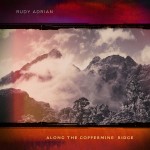
Artist: Rudy Adrian (@)
Title: Along the Coppermine Ridge
Format: CD + Download
Label: Spotted Peccary Music (@)
Rated:


Title: Along the Coppermine Ridge
Format: CD + Download
Label: Spotted Peccary Music (@)
Rated:
New Zealand soundscape artist Rudy Adrian is back with a new album for his 21st (not counting 'The Sleepy Hills 6 Extended,' sort of a continuation of 2024's 'Beyond The Sleepy Hills') over all and 11th on the Spotted Peccary label, attesting to his prolific output as an ambient artist. I didn't much think about this until now, but Adrian's albums are always easy to listen to but bloody hard to review. There is so much more "space" between the actual music (notes, chords, timbres) that often is the compositional main ingredient that cannot be easily defined and quantified. Both in the promo text from Adrian's Bandcamp site and Spotted Peccary, [the album]"... is like the essence of landscape photography in sonic form. Here, in vast texture and shimmering chimes, Adrian conjures dense forests and dramatic mountain crests, breeze-buffeted snowdrifts and swirling cloud formations of self-reflection." That reads a lot into the music from imagination, and not everyone is going to imagine the same scenario. Take the opener, "Castle Rocks," with its reverb-saturated ostinado piano chords that seem to float on formless ambient effects. From this one could imagine a forgotten gothic graveyard, or a heavenly cloud. It's all subjective. While "Ridgetop Clouds" does have an airy ambience about it, the trickling sound of water brings it back down to earth. Light, amorphic chordal pads with organic overtones and incidental synth sounds could either be construed as a spiritual experience, or a balloon ride over a vast landscape. Unless one is willing to describe all the sonic elements of each track in detail, all we have to convey is just our imagination, and describing each and every sonic event is just too much work for me. Like Adrian's other albums, you get a good number of tracks (11) in over an hour's worth (62 minutes) of peaceful, thoughtful ambient compositions that flow gently into one another with moments of light and dark, but nothing thematic you can easily define. Rudy is careful to present only the vaguest of melodic motifs (as in the guitar on "Where the Skylarks Sing,") avoiding any thematic development beyond a notion. Adrian's compositional subtlety is certainly not lost on me but there is not much really new here on 'Along the Coppermine Ridge.' If I had to put it into a seasonal perspective, I think I'd classify this work as a winter album, which seems to just fit the climate of right now.
Comments
Stream
Browse by Genre
Industrial Music / Industrial Metal / Aggro Industrial / Electro Metal
Industrial Noise / Power Noise / Harsh Noise
Synth Pop / Electro Pop / Synth-Electronica
Techno / Trance / Goa / Drum'n'Bass / Jungle / Tribal / Trip-Hop
Ambient / Electronica / Ethereal / Dub / Soundscapes / Abstract
Experimental / Avantgarde / Weird & Wired / Glitch / Noise / Field Recording
Dark / Gothic / Wave / New Wave / Dark Wave / Industrial Gothic
New Music / Downtown / Avantgarde Jazz / New Classical / World