
Saturday, October 24, 2026
Nagløed: Everything Is In Everything Else
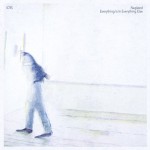
Artist: Nagløed (@)
Title: Everything Is In Everything Else
Format: CD + Download
Label: Icarus Records (@)
Rated:

Title: Everything Is In Everything Else
Format: CD + Download
Label: Icarus Records (@)
Rated:
Seven years is enough time for a band to reinvent itself, disappear, or quietly repeat the same ideas with better haircuts. Nagløed chooses a less predictable route with "Everything Is In Everything Else": it returns sounding both more grounded and more elusive, like a conversation that has matured but refuses to settle on a single conclusion.
The trio - Dillian Fevry, Andreas Lagrou and Matthias Dewilde - moves away from the denser electronic textures of their debut "NowHere" and leans into a more acoustic, breathable space. Which doesn’t mean simplicity. It means exposure. There’s less to hide behind, and they seem aware of it.
From the opening “Reality In The Dream”, the album establishes a circular logic that borders on philosophical insistence. Themes return, refract, dissolve, then reappear slightly altered, as if the music itself were testing the idea suggested by the title: that everything contains traces of everything else. It’s a bold premise, dangerously close to sounding like a slogan you’d find printed on a tote bag. Fortunately, the music does the heavier lifting.
“Myuzu” and “Ashore” drift between jazz-informed improvisation and indie-inflected songwriting without committing fully to either. Fevry’s guitar lines stretch and hesitate, occasionally brushing against lyricism before retreating into something more ambiguous. His vocals, when they surface, feel less like declarations and more like fragments of thought - unfinished, searching, unwilling to impose clarity where none exists.
The rhythm section operates with a quiet intelligence. Lagrou’s drumming avoids both rigidity and excess, shaping space rather than filling it, while Dewilde’s keys provide a shifting harmonic ground that never quite settles. There’s a constant sense of negotiation, as if each instrument is testing how far it can go without disrupting the fragile balance.
Tracks like “Dillsong” and “Anima” lean into the band’s more cinematic tendencies, but without tipping into sentimentality. The atmosphere is there, but it’s never allowed to become decorative. Instead, it functions as a kind of emotional undertow, pulling the listener inward rather than surrounding them with easy beauty.
The title track, “Everything Is In Everything Else”, sits at the conceptual center, not by offering resolution but by embodying the album’s core tension. Motifs echo, overlap, and subtly contradict each other, creating a sense of interconnectedness that feels earned rather than imposed. It’s less a statement than a demonstration.
Then there’s “Kontiki” and “Topanga/Psalming”, where the band stretches out, allowing improvisation to take a more prominent role. These longer pieces flirt with drift, occasionally risking dilution, but they also reveal the trio’s strength: an ability to sustain attention without relying on obvious markers of progression. Time expands, contracts, becomes slightly unreliable.
By the time “The Dream In Reality” closes the album, the circular structure becomes explicit. Beginning and end mirror each other, but not perfectly. Something has shifted, subtly but irreversibly. The journey hasn’t resolved anything; it has altered perception.
Mixed by Koen Gisen, the album maintains a delicate clarity, allowing each element to breathe while preserving the overall cohesion. Nothing feels overcrowded, yet nothing feels empty. It’s a careful balance, and one that suits the band’s evolving language.
There’s an underlying sincerity to "Everything Is In Everything Else" that could easily have become heavy-handed. Instead, Nagløed approaches its philosophical ambitions with restraint, letting the music suggest connections rather than insisting on them.
It doesn’t offer answers. It doesn’t even pretend to. What it does is create a space where contradictions can coexist without needing to be resolved.
Which, given the title, feels like the only honest outcome.
The trio - Dillian Fevry, Andreas Lagrou and Matthias Dewilde - moves away from the denser electronic textures of their debut "NowHere" and leans into a more acoustic, breathable space. Which doesn’t mean simplicity. It means exposure. There’s less to hide behind, and they seem aware of it.
From the opening “Reality In The Dream”, the album establishes a circular logic that borders on philosophical insistence. Themes return, refract, dissolve, then reappear slightly altered, as if the music itself were testing the idea suggested by the title: that everything contains traces of everything else. It’s a bold premise, dangerously close to sounding like a slogan you’d find printed on a tote bag. Fortunately, the music does the heavier lifting.
“Myuzu” and “Ashore” drift between jazz-informed improvisation and indie-inflected songwriting without committing fully to either. Fevry’s guitar lines stretch and hesitate, occasionally brushing against lyricism before retreating into something more ambiguous. His vocals, when they surface, feel less like declarations and more like fragments of thought - unfinished, searching, unwilling to impose clarity where none exists.
The rhythm section operates with a quiet intelligence. Lagrou’s drumming avoids both rigidity and excess, shaping space rather than filling it, while Dewilde’s keys provide a shifting harmonic ground that never quite settles. There’s a constant sense of negotiation, as if each instrument is testing how far it can go without disrupting the fragile balance.
Tracks like “Dillsong” and “Anima” lean into the band’s more cinematic tendencies, but without tipping into sentimentality. The atmosphere is there, but it’s never allowed to become decorative. Instead, it functions as a kind of emotional undertow, pulling the listener inward rather than surrounding them with easy beauty.
The title track, “Everything Is In Everything Else”, sits at the conceptual center, not by offering resolution but by embodying the album’s core tension. Motifs echo, overlap, and subtly contradict each other, creating a sense of interconnectedness that feels earned rather than imposed. It’s less a statement than a demonstration.
Then there’s “Kontiki” and “Topanga/Psalming”, where the band stretches out, allowing improvisation to take a more prominent role. These longer pieces flirt with drift, occasionally risking dilution, but they also reveal the trio’s strength: an ability to sustain attention without relying on obvious markers of progression. Time expands, contracts, becomes slightly unreliable.
By the time “The Dream In Reality” closes the album, the circular structure becomes explicit. Beginning and end mirror each other, but not perfectly. Something has shifted, subtly but irreversibly. The journey hasn’t resolved anything; it has altered perception.
Mixed by Koen Gisen, the album maintains a delicate clarity, allowing each element to breathe while preserving the overall cohesion. Nothing feels overcrowded, yet nothing feels empty. It’s a careful balance, and one that suits the band’s evolving language.
There’s an underlying sincerity to "Everything Is In Everything Else" that could easily have become heavy-handed. Instead, Nagløed approaches its philosophical ambitions with restraint, letting the music suggest connections rather than insisting on them.
It doesn’t offer answers. It doesn’t even pretend to. What it does is create a space where contradictions can coexist without needing to be resolved.
Which, given the title, feels like the only honest outcome.
Comments
Stream
Browse by Genre
Industrial Music / Industrial Metal / Aggro Industrial / Electro Metal
Industrial Noise / Power Noise / Harsh Noise
Synth Pop / Electro Pop / Synth-Electronica
Techno / Trance / Goa / Drum'n'Bass / Jungle / Tribal / Trip-Hop
Ambient / Electronica / Ethereal / Dub / Soundscapes / Abstract
Experimental / Avantgarde / Weird & Wired / Glitch / Noise / Field Recording
Dark / Gothic / Wave / New Wave / Dark Wave / Industrial Gothic
New Music / Downtown / Avantgarde Jazz / New Classical / World