
Saturday, October 24, 2026
Arnold Dreyblatt: Descendants
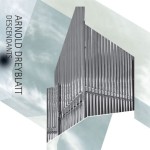


There are composers who write pieces, and then there are those who design entire acoustic ecosystems and let you wander inside, hoping you won’t get lost. Arnold Dreyblatt belongs, stubbornly, to the second category.
"Descendants" is not a composition in the usual sense. It’s a space that has been tuned until it begins to think on its own.
Commissioned for the Orgelpark in Amsterdam and released by Unsounds in collaboration with Echonance Festival, the piece unfolds across four pipe organs - each with its own historical baggage, mechanical temperament, and stubborn personality. Instead of forcing them into polite agreement, Dreyblatt lets them coexist within his custom just-intonation system, derived from harmonic overtones that behave less like notes and more like gravitational fields.
If that sounds abstract, it is. Comfortingly so.
The tuning itself - anchored to a fundamental C with A at 415 Hz - creates intervals that don’t quite align with what your ears have been trained to accept as “in tune”. Not wrong, just… differently right. Slightly skewed relationships between pitches generate beating patterns, interference, slow pulsations. The sound doesn’t sit still. It breathes, wavers, recalibrates itself in real time, like a structure constantly adjusting its own foundations.
The result is a 50-minute continuum that resists segmentation, even though it’s technically organized into five sections. You don’t hear “movements” so much as shifts in atmospheric pressure. One cluster of harmonics thickens, another recedes. Certain frequencies bloom unexpectedly, filling the hall like light filtering through uneven glass. Others withdraw, leaving behind a faint afterimage.
Dreyblatt’s background in the second wave of New York minimalism is still audible, but only in spirit. The steady pulse that once defined his early work has been dissolved into something more diffuse. Time here isn’t marked by rhythm, but by accumulation and decay. Events don’t happen; they emerge.
What makes "Descendants" particularly effective is its relationship to the instruments themselves. These are not neutral sound sources. A 15th-century organ reconstruction does not behave like a contemporary one, and Dreyblatt doesn’t pretend otherwise. He distributes his harmonic material across them in a way that highlights their differences rather than smoothing them out. The piece becomes a negotiation between architectures - wood, metal, air, history - each contributing its own resistance.
Performed by Claudio F. Baroni, Reiner van Houdt, Dreyblatt himself, and Lucie Nezri, the work maintains a remarkable balance between precision and instability. You get the sense that everything is carefully calibrated, yet always on the verge of drifting. It’s controlled, but not rigid. Structured, but not fixed.
There’s also a quiet physicality to the experience. Pipe organs don’t just produce sound; they move air. And here, that movement becomes part of the composition. Low frequencies press against the body, higher ones shimmer just out of reach, and in between there’s a constant negotiation between presence and absence. Listening becomes less about following a line and more about inhabiting a field.
As the third volume in the Echonance series, "Descendants" fits neatly into a broader exploration of spatial and perceptual listening. But it also stands on its own as a particularly uncompromising statement. It doesn’t guide you, doesn’t explain itself, doesn’t offer narrative footholds.
It simply exists, with quiet insistence.
And somewhere within that shifting lattice of harmonics, you start to notice something slightly inconvenient: your ears adjusting, your expectations recalibrating, your sense of “tuning” quietly rewritten. Not dramatically. Just enough to make everything else sound a little less certain afterward.
Which, one suspects, was the point all along.
"Descendants" is not a composition in the usual sense. It’s a space that has been tuned until it begins to think on its own.
Commissioned for the Orgelpark in Amsterdam and released by Unsounds in collaboration with Echonance Festival, the piece unfolds across four pipe organs - each with its own historical baggage, mechanical temperament, and stubborn personality. Instead of forcing them into polite agreement, Dreyblatt lets them coexist within his custom just-intonation system, derived from harmonic overtones that behave less like notes and more like gravitational fields.
If that sounds abstract, it is. Comfortingly so.
The tuning itself - anchored to a fundamental C with A at 415 Hz - creates intervals that don’t quite align with what your ears have been trained to accept as “in tune”. Not wrong, just… differently right. Slightly skewed relationships between pitches generate beating patterns, interference, slow pulsations. The sound doesn’t sit still. It breathes, wavers, recalibrates itself in real time, like a structure constantly adjusting its own foundations.
The result is a 50-minute continuum that resists segmentation, even though it’s technically organized into five sections. You don’t hear “movements” so much as shifts in atmospheric pressure. One cluster of harmonics thickens, another recedes. Certain frequencies bloom unexpectedly, filling the hall like light filtering through uneven glass. Others withdraw, leaving behind a faint afterimage.
Dreyblatt’s background in the second wave of New York minimalism is still audible, but only in spirit. The steady pulse that once defined his early work has been dissolved into something more diffuse. Time here isn’t marked by rhythm, but by accumulation and decay. Events don’t happen; they emerge.
What makes "Descendants" particularly effective is its relationship to the instruments themselves. These are not neutral sound sources. A 15th-century organ reconstruction does not behave like a contemporary one, and Dreyblatt doesn’t pretend otherwise. He distributes his harmonic material across them in a way that highlights their differences rather than smoothing them out. The piece becomes a negotiation between architectures - wood, metal, air, history - each contributing its own resistance.
Performed by Claudio F. Baroni, Reiner van Houdt, Dreyblatt himself, and Lucie Nezri, the work maintains a remarkable balance between precision and instability. You get the sense that everything is carefully calibrated, yet always on the verge of drifting. It’s controlled, but not rigid. Structured, but not fixed.
There’s also a quiet physicality to the experience. Pipe organs don’t just produce sound; they move air. And here, that movement becomes part of the composition. Low frequencies press against the body, higher ones shimmer just out of reach, and in between there’s a constant negotiation between presence and absence. Listening becomes less about following a line and more about inhabiting a field.
As the third volume in the Echonance series, "Descendants" fits neatly into a broader exploration of spatial and perceptual listening. But it also stands on its own as a particularly uncompromising statement. It doesn’t guide you, doesn’t explain itself, doesn’t offer narrative footholds.
It simply exists, with quiet insistence.
And somewhere within that shifting lattice of harmonics, you start to notice something slightly inconvenient: your ears adjusting, your expectations recalibrating, your sense of “tuning” quietly rewritten. Not dramatically. Just enough to make everything else sound a little less certain afterward.
Which, one suspects, was the point all along.
Comments
Stream
Browse by Genre
Industrial Music / Industrial Metal / Aggro Industrial / Electro Metal
Industrial Noise / Power Noise / Harsh Noise
Synth Pop / Electro Pop / Synth-Electronica
Techno / Trance / Goa / Drum'n'Bass / Jungle / Tribal / Trip-Hop
Ambient / Electronica / Ethereal / Dub / Soundscapes / Abstract
Experimental / Avantgarde / Weird & Wired / Glitch / Noise / Field Recording
Dark / Gothic / Wave / New Wave / Dark Wave / Industrial Gothic
New Music / Downtown / Avantgarde Jazz / New Classical / World