
Sunday, October 18, 2026
Anton Toorell: Solos II
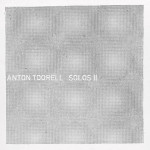
Artist: Anton Toorell (@)
Title: Solos II
Format: 12" + Download
Label: Thanatosis Produktion (@)
Rated:

Title: Solos II
Format: 12" + Download
Label: Thanatosis Produktion (@)
Rated:
There is a particular danger surrounding solo guitar records. Too often they become demonstrations of technical fluency disguised as spiritual revelation, endless cascades of notes desperately trying to convince the listener that complexity itself constitutes meaning. Fortunately, Solos II by Anton Toorell avoids nearly all of those traps by pursuing something far more elusive: resonance not merely as sound, but as environment, physical process, and altered state of attention.
Released by Thanatosis Produktion, "Solos II" expands upon the open-tuned acoustic investigations of Toorell’s 2022 debut while simultaneously stripping the process back toward something more exposed and elemental. Where many contemporary experimental guitar records layer electronics until the instrument becomes almost unrecognizable, Toorell instead moves closer to the material reality of strings, wood, air, and architectural space itself. The result feels both rigorously constructed and strangely weightless.
The central technique alone sounds almost absurdly impractical: playing two guitars simultaneously, one positioned conventionally and the other laid across the lap, with each hand performing independent functions. In lesser hands this could easily become an exercise in conceptual athletics, the sort of thing critics describe as innovative while secretly wondering whether anyone actually enjoys listening to it. Yet Toorell’s approach never feels demonstrative. The complexity dissolves into flow.
That may be the album’s most remarkable quality. One hears not effort but movement.
The opening “Volta”, stretching close to seventeen minutes, unfolds like an evolving lattice of shimmering harmonics and cyclical figures. Repetition becomes less structural device than breathing pattern. Tiny tonal shifts accumulate gradually, producing a sensation of suspended motion somewhere between minimalism, folk memory, and acoustic illusionism. The piece seems simultaneously ancient and impossibly delicate, as though somebody had translated water reflections into tunings.
Toorell’s relationship with repetition is particularly fascinating. There are obvious distant affinities with figures like Terry Riley or even aspects of early Seefeel, especially in the hypnotic cycling structures of “Cripta”, yet Toorell avoids both minimalist rigidity and post-rock haze. His repetitions breathe unevenly. Human touch remains audible everywhere: tiny hesitations, accidental resonances, minute fluctuations in attack and decay. The music continuously reminds the listener that transcendence, when it occurs, emerges through physical imperfection rather than mechanical precision.
The recording environment plays an enormous role in shaping the album’s identity. Captured inside a sixteenth-century wine cellar at Palazzo Stabile in Piemonte, the room itself becomes an active participant in the music. Reverberation is not applied decoration here; it is compositional material. Notes bloom, linger, collide with architectural surfaces, and return transformed. Toorell reportedly searched for tunings that would open up the room, and one can genuinely hear that dialogue throughout the album. The space listens back.
This interaction between performer, instrument, and architecture gives "Solos II" an almost ecological quality. The music does not dominate the environment but negotiates with it. One becomes increasingly aware of resonance as physical event rather than abstract sonic property. The cellar breathes through the guitars. The guitars expose the cellar’s hidden frequencies. Human beings continue building streaming algorithms to compress sound into disposable background texture while records like this quietly insist that listening remains a bodily experience.
“Cripta” perhaps best demonstrates Toorell’s compositional intelligence. The looping structures spiral inward hypnotically, producing subtle psychoacoustic effects where harmonics appear to drift independently from the strings generating them. At moments the piece resembles an acoustic mirage, simultaneously intimate and spatially disorienting. There is motion everywhere, yet no urgency. Toorell trusts duration enough to let perception reorganize itself naturally.
Then comes “Scala”, the shortest and perhaps most emotionally revealing piece on the album. After the denser cyclical movement of the earlier works, its calmer pacing allows the recording space to emerge even more clearly. One hears air moving around notes, the room’s quiet response to vibration, the fragile physicality of acoustic sound unfolding in real time. The track feels almost ceremonial in its restraint. Toorell’s methods are undoubtedly intricate, informed by jazz studies, electroacoustic composition, and years of collaborative experimentation across Scandinavian improvised music scenes. Yet none of that knowledge calcifies into academic severity. The album remains deeply tactile, almost luminous in places.
There is also something quietly radical about its patience. These three extended pieces do not chase climax or emotional manipulation. Instead, they create conditions for attention itself to deepen. Listening becomes immersive not through overwhelming density, but through sustained intimacy with microscopic variation. By the midpoint of “Volta” or “Cripta”, one begins noticing harmonic movements so subtle they would vanish entirely under ordinary distracted listening conditions.
And perhaps that is where the album’s emotional power truly resides. "Solos II" invites the listener into a different relationship with time, resonance, and physical presence. The music exists somewhere between improvisation and architecture, between meditative ritual and mechanical process, between the rigor of structure and the unpredictability of touch.
A deceptively modest record, then, but one containing immense spatial and emotional depth. Anton Toorell does not simply play guitars here. He allows them to converse with stone, air, repetition, and silence itself until the distinctions begin dissolving.
Released by Thanatosis Produktion, "Solos II" expands upon the open-tuned acoustic investigations of Toorell’s 2022 debut while simultaneously stripping the process back toward something more exposed and elemental. Where many contemporary experimental guitar records layer electronics until the instrument becomes almost unrecognizable, Toorell instead moves closer to the material reality of strings, wood, air, and architectural space itself. The result feels both rigorously constructed and strangely weightless.
The central technique alone sounds almost absurdly impractical: playing two guitars simultaneously, one positioned conventionally and the other laid across the lap, with each hand performing independent functions. In lesser hands this could easily become an exercise in conceptual athletics, the sort of thing critics describe as innovative while secretly wondering whether anyone actually enjoys listening to it. Yet Toorell’s approach never feels demonstrative. The complexity dissolves into flow.
That may be the album’s most remarkable quality. One hears not effort but movement.
The opening “Volta”, stretching close to seventeen minutes, unfolds like an evolving lattice of shimmering harmonics and cyclical figures. Repetition becomes less structural device than breathing pattern. Tiny tonal shifts accumulate gradually, producing a sensation of suspended motion somewhere between minimalism, folk memory, and acoustic illusionism. The piece seems simultaneously ancient and impossibly delicate, as though somebody had translated water reflections into tunings.
Toorell’s relationship with repetition is particularly fascinating. There are obvious distant affinities with figures like Terry Riley or even aspects of early Seefeel, especially in the hypnotic cycling structures of “Cripta”, yet Toorell avoids both minimalist rigidity and post-rock haze. His repetitions breathe unevenly. Human touch remains audible everywhere: tiny hesitations, accidental resonances, minute fluctuations in attack and decay. The music continuously reminds the listener that transcendence, when it occurs, emerges through physical imperfection rather than mechanical precision.
The recording environment plays an enormous role in shaping the album’s identity. Captured inside a sixteenth-century wine cellar at Palazzo Stabile in Piemonte, the room itself becomes an active participant in the music. Reverberation is not applied decoration here; it is compositional material. Notes bloom, linger, collide with architectural surfaces, and return transformed. Toorell reportedly searched for tunings that would open up the room, and one can genuinely hear that dialogue throughout the album. The space listens back.
This interaction between performer, instrument, and architecture gives "Solos II" an almost ecological quality. The music does not dominate the environment but negotiates with it. One becomes increasingly aware of resonance as physical event rather than abstract sonic property. The cellar breathes through the guitars. The guitars expose the cellar’s hidden frequencies. Human beings continue building streaming algorithms to compress sound into disposable background texture while records like this quietly insist that listening remains a bodily experience.
“Cripta” perhaps best demonstrates Toorell’s compositional intelligence. The looping structures spiral inward hypnotically, producing subtle psychoacoustic effects where harmonics appear to drift independently from the strings generating them. At moments the piece resembles an acoustic mirage, simultaneously intimate and spatially disorienting. There is motion everywhere, yet no urgency. Toorell trusts duration enough to let perception reorganize itself naturally.
Then comes “Scala”, the shortest and perhaps most emotionally revealing piece on the album. After the denser cyclical movement of the earlier works, its calmer pacing allows the recording space to emerge even more clearly. One hears air moving around notes, the room’s quiet response to vibration, the fragile physicality of acoustic sound unfolding in real time. The track feels almost ceremonial in its restraint. Toorell’s methods are undoubtedly intricate, informed by jazz studies, electroacoustic composition, and years of collaborative experimentation across Scandinavian improvised music scenes. Yet none of that knowledge calcifies into academic severity. The album remains deeply tactile, almost luminous in places.
There is also something quietly radical about its patience. These three extended pieces do not chase climax or emotional manipulation. Instead, they create conditions for attention itself to deepen. Listening becomes immersive not through overwhelming density, but through sustained intimacy with microscopic variation. By the midpoint of “Volta” or “Cripta”, one begins noticing harmonic movements so subtle they would vanish entirely under ordinary distracted listening conditions.
And perhaps that is where the album’s emotional power truly resides. "Solos II" invites the listener into a different relationship with time, resonance, and physical presence. The music exists somewhere between improvisation and architecture, between meditative ritual and mechanical process, between the rigor of structure and the unpredictability of touch.
A deceptively modest record, then, but one containing immense spatial and emotional depth. Anton Toorell does not simply play guitars here. He allows them to converse with stone, air, repetition, and silence itself until the distinctions begin dissolving.
Comments
Stream
Browse by Genre
Industrial Music / Industrial Metal / Aggro Industrial / Electro Metal
Industrial Noise / Power Noise / Harsh Noise
Synth Pop / Electro Pop / Synth-Electronica
Techno / Trance / Goa / Drum'n'Bass / Jungle / Tribal / Trip-Hop
Ambient / Electronica / Ethereal / Dub / Soundscapes / Abstract
Experimental / Avantgarde / Weird & Wired / Glitch / Noise / Field Recording
Dark / Gothic / Wave / New Wave / Dark Wave / Industrial Gothic
New Music / Downtown / Avantgarde Jazz / New Classical / World