
Thursday, September 10, 2026
schntzl: Fata Morgana
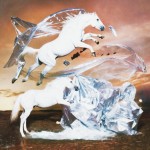


There is something deeply Belgian about "Fata Morgana". Not just because schntzl emerge from that fertile stretch of Europe where surrealism seems less an artistic movement than a weather condition, but because the album treats contradiction as a native language. It is playful and abrasive, euphoric and claustrophobic, emotionally sincere and faintly ridiculous in the same breath. Like finding enlightenment inside a malfunctioning arcade cabinet while someone in the next room is aggressively remixing a rave from 1997.
The duo of Hendrik Lasure and Casper Van De Velde have long occupied an unusual position within contemporary experimental music. Both are highly respected figures in Belgium’s jazz ecosystem, yet schntzl has never behaved like a “jazz project” in any conventional sense. Improvisation is certainly central, but it is weaponized less for virtuoso display than for destabilization. Their music continuously sabotages its own momentum, constructing shimmering emotional architectures only to kick holes through the walls moments later. On earlier releases, especially "Holiday", there was still a trace of chamber-like intimacy lingering beneath the electronics. "Fata Morgana" feels far less interested in comfort. Here, trance is not a genre reference but a psychological state: repetition stretched until it becomes delirium.
The title itself is perfect. A fata morgana is a mirage, an illusion hovering at the edge of perception, and the album constantly behaves like one. Sounds appear solid before dissolving into vapor. Rhythms suggest club propulsion before mutating into fractured abstraction. Hooks emerge like half-remembered dreams from a childhood spent too close to cheap CD-ROM games and overlit shopping centers. The duo understands that nostalgia is most effective when slightly poisoned.
“Magicland” opens the record like the entrance to an abandoned amusement park where the rides still function despite obvious electrical hazards. The synths glitter with synthetic optimism while the percussion twitches underneath like machinery overdue for maintenance. From there, “Fanta Merino” unfolds into one of the album’s strongest pieces, balancing trance-inflected arpeggios with an undercurrent of unease. schntzl seem fascinated by what happens when ecstatic forms are denied emotional resolution. Every build-up threatens catharsis, then sidesteps it with a smirk.
That balance between sincerity and sabotage becomes one of the record’s great strengths. “Tamagotchi Baby” could almost collapse under the weight of its own absurd title, yet beneath the irony lies something strangely tender. The duo clearly understands the emotional residue embedded inside obsolete digital culture. Their references are not lazy retro gestures aimed at people who miss flip phones and glow sticks. Instead, these sounds resemble archaeological fragments from a civilization that believed technology would make everyone happier before social media turned human consciousness into a shopping mall food court with anxiety disorders.
There are moments throughout "Fata Morgana" where the influence of artists like Oneohtrix Point Never or Giant Claw becomes perceptible in the hyper-digital processing and collapsing textures, but schntzl avoid imitation through sheer volatility. The drumming in particular gives the music an unstable physicality. Van De Velde never settles into predictable pulse mechanics; his rhythms constantly feel on the verge of outrunning the tracks themselves. Meanwhile Lasure’s synth work oscillates between luminous beauty and total sensory overload.
“Oasis” and “The Hill” briefly allow air into the system. These tracks reveal the duo’s remarkable understanding of pacing. Beneath all the fragmentation lies an intuitive compositional intelligence. Even the album’s most chaotic passages are carefully balanced. Nothing overstays its welcome. At just over thirty-five minutes, "Fata Morgana" understands a truth many experimental albums forget: disorientation is far more effective in concentrated doses. Nobody wants to wander endlessly through someone else’s conceptual maze. Human beings get tired. They start checking emails. Civilization collapses.
The emotional centerpiece may well be “My Singing Heart”, where sentimentality finally surfaces without disguise. Yet even here, schntzl resist straightforward beauty. The melody flickers through layers of distortion like a damaged transmission trying to remember itself. It is moving precisely because it feels unstable, never fully secured against collapse.
What ultimately makes "Fata Morgana" compelling is the sense that schntzl are less interested in genre than in perception itself. Their music continuously asks how much instability a listener can tolerate before confusion transforms into revelation. The album behaves like a hall of mirrors where every reflection carries a different emotional temperature. Some are euphoric, some vaguely menacing, some unexpectedly funny. A few feel strangely intimate, as though the machines themselves have become emotionally overextended.
And perhaps that is the album’s quiet achievement. Beneath the digital chaos, the kitsch loops, the trance ghosts and absurd detours, "Fata Morgana" is fundamentally about human interaction: two musicians listening, reacting, interrupting, destabilizing, rescuing each other in real time. Improvisation here becomes a social act, a negotiation between competing impulses. The mirage never fully disappears because neither artist allows the other to settle into certainty.
In a musical landscape increasingly obsessed with frictionless perfection, schntzl instead celebrate instability, awkwardness, overload and ecstatic imbalance. "Fata Morgana" does not offer escape from the modern condition. It simply throws brighter colors onto the collapse and hands you a pair of broken 3D glasses to watch it through.
The duo of Hendrik Lasure and Casper Van De Velde have long occupied an unusual position within contemporary experimental music. Both are highly respected figures in Belgium’s jazz ecosystem, yet schntzl has never behaved like a “jazz project” in any conventional sense. Improvisation is certainly central, but it is weaponized less for virtuoso display than for destabilization. Their music continuously sabotages its own momentum, constructing shimmering emotional architectures only to kick holes through the walls moments later. On earlier releases, especially "Holiday", there was still a trace of chamber-like intimacy lingering beneath the electronics. "Fata Morgana" feels far less interested in comfort. Here, trance is not a genre reference but a psychological state: repetition stretched until it becomes delirium.
The title itself is perfect. A fata morgana is a mirage, an illusion hovering at the edge of perception, and the album constantly behaves like one. Sounds appear solid before dissolving into vapor. Rhythms suggest club propulsion before mutating into fractured abstraction. Hooks emerge like half-remembered dreams from a childhood spent too close to cheap CD-ROM games and overlit shopping centers. The duo understands that nostalgia is most effective when slightly poisoned.
“Magicland” opens the record like the entrance to an abandoned amusement park where the rides still function despite obvious electrical hazards. The synths glitter with synthetic optimism while the percussion twitches underneath like machinery overdue for maintenance. From there, “Fanta Merino” unfolds into one of the album’s strongest pieces, balancing trance-inflected arpeggios with an undercurrent of unease. schntzl seem fascinated by what happens when ecstatic forms are denied emotional resolution. Every build-up threatens catharsis, then sidesteps it with a smirk.
That balance between sincerity and sabotage becomes one of the record’s great strengths. “Tamagotchi Baby” could almost collapse under the weight of its own absurd title, yet beneath the irony lies something strangely tender. The duo clearly understands the emotional residue embedded inside obsolete digital culture. Their references are not lazy retro gestures aimed at people who miss flip phones and glow sticks. Instead, these sounds resemble archaeological fragments from a civilization that believed technology would make everyone happier before social media turned human consciousness into a shopping mall food court with anxiety disorders.
There are moments throughout "Fata Morgana" where the influence of artists like Oneohtrix Point Never or Giant Claw becomes perceptible in the hyper-digital processing and collapsing textures, but schntzl avoid imitation through sheer volatility. The drumming in particular gives the music an unstable physicality. Van De Velde never settles into predictable pulse mechanics; his rhythms constantly feel on the verge of outrunning the tracks themselves. Meanwhile Lasure’s synth work oscillates between luminous beauty and total sensory overload.
“Oasis” and “The Hill” briefly allow air into the system. These tracks reveal the duo’s remarkable understanding of pacing. Beneath all the fragmentation lies an intuitive compositional intelligence. Even the album’s most chaotic passages are carefully balanced. Nothing overstays its welcome. At just over thirty-five minutes, "Fata Morgana" understands a truth many experimental albums forget: disorientation is far more effective in concentrated doses. Nobody wants to wander endlessly through someone else’s conceptual maze. Human beings get tired. They start checking emails. Civilization collapses.
The emotional centerpiece may well be “My Singing Heart”, where sentimentality finally surfaces without disguise. Yet even here, schntzl resist straightforward beauty. The melody flickers through layers of distortion like a damaged transmission trying to remember itself. It is moving precisely because it feels unstable, never fully secured against collapse.
What ultimately makes "Fata Morgana" compelling is the sense that schntzl are less interested in genre than in perception itself. Their music continuously asks how much instability a listener can tolerate before confusion transforms into revelation. The album behaves like a hall of mirrors where every reflection carries a different emotional temperature. Some are euphoric, some vaguely menacing, some unexpectedly funny. A few feel strangely intimate, as though the machines themselves have become emotionally overextended.
And perhaps that is the album’s quiet achievement. Beneath the digital chaos, the kitsch loops, the trance ghosts and absurd detours, "Fata Morgana" is fundamentally about human interaction: two musicians listening, reacting, interrupting, destabilizing, rescuing each other in real time. Improvisation here becomes a social act, a negotiation between competing impulses. The mirage never fully disappears because neither artist allows the other to settle into certainty.
In a musical landscape increasingly obsessed with frictionless perfection, schntzl instead celebrate instability, awkwardness, overload and ecstatic imbalance. "Fata Morgana" does not offer escape from the modern condition. It simply throws brighter colors onto the collapse and hands you a pair of broken 3D glasses to watch it through.
Comments
Stream
Browse by Genre
Industrial Music / Industrial Metal / Aggro Industrial / Electro Metal
Industrial Noise / Power Noise / Harsh Noise
Synth Pop / Electro Pop / Synth-Electronica
Techno / Trance / Goa / Drum'n'Bass / Jungle / Tribal / Trip-Hop
Ambient / Electronica / Ethereal / Dub / Soundscapes / Abstract
Experimental / Avantgarde / Weird & Wired / Glitch / Noise / Field Recording
Dark / Gothic / Wave / New Wave / Dark Wave / Industrial Gothic
New Music / Downtown / Avantgarde Jazz / New Classical / World