
Wednesday, September 9, 2026
Four Ears: Love Is Faster Than Light
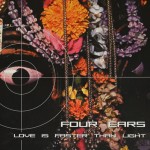
Artist: Four Ears
Title: Love Is Faster Than Light
Format: Download Only (MP3 + Lossless)
Label: Compost Records (@)
Rated:

Title: Love Is Faster Than Light
Format: Download Only (MP3 + Lossless)
Label: Compost Records (@)
Rated:
Twenty-six years is a long time in electronic music. Entire genres are born, commercialised, declared dead, resurrected, and eventually sold back to their original audience as "heritage culture". Yet listening to "Love Is Faster Than Light" today, one is struck less by its age than by how comfortably it sidesteps chronology. What Four Ears created in 2000 was not a snapshot of a particular scene but a restless exploration of possibilities, and the 2026 remaster serves less as an archaeological exercise than as a reminder that some musical futures simply arrive ahead of schedule.
The Berlin duo of Bym Stempka and Curt Nolte emerged from a cultural ecosystem where boundaries between club culture, experimental music, film, punk, jazz, and electronic innovation were unusually porous. Both musicians carried extensive histories into the project. Stempka's trajectory runs through Berlin's underground from the post-punk turbulence of the early 1980s to the city's formative techno and drum & bass years, while Nolte's background spans soundtrack composition, journalism, multimedia performance, and various experimental ensembles. Together they formed a partnership that approached genres not as destinations but as raw materials.
That philosophy defines "Love Is Faster Than Light". The album occupies a fascinating territory where jazz improvisation, cinematic ambience, drum & bass propulsion, downtempo electronica, and abstract sound design coexist without ever feeling forced. Unlike many turn-of-the-millennium fusion projects, Four Ears were not interested in proving that styles could be combined. They simply behaved as if the borders had never existed.
The title track immediately establishes this attitude. Stretching beyond ten minutes, it unfolds like a city viewed through multiple windows at once. Rhythms emerge, dissolve, and reconfigure themselves; melodic fragments appear like fleeting conversations overheard on public transport. The track feels less composed than navigated, as if the duo were discovering pathways through an evolving sonic landscape rather than imposing a predetermined structure.
Throughout the record, one hears echoes of late-1990s drum & bass experimentation, but never its clichés. Tracks such as "Point Blank" and "The Moo" carry rhythmic sophistication without surrendering to functional club mechanics. The beats are kinetic yet oddly philosophical. They move, certainly, but they seem equally interested in pondering why they are moving in the first place.
A recurring strength of the album lies in its cinematic sensibility. This should come as little surprise given Nolte's extensive work in film scoring. Movie dialogue snippets drift through the compositions not as nostalgic references but as narrative ghosts. They function like half-remembered dreams or fragments of radio transmissions intercepted during a long nocturnal drive. The result is an album that frequently feels visual without ever becoming illustrative.
The vocal contribution of Chi Chi on "When I Was Young" introduces one of the record's most striking moments. Amid an album largely devoted to instrumental storytelling, the human voice arrives almost as a plot twist. Rather than anchoring the music, however, it deepens its ambiguity, adding emotional texture without resolving any of the surrounding mysteries.
What remains particularly impressive is the album's refusal to settle into a single mood. "Blue Angel" drifts through smoky jazz-inflected atmospheres, while "(This Would Never Happen In) Bombay" stretches into a sprawling twelve-minute journey where global influences are absorbed into the duo's distinctive language rather than treated as exotic decoration. "From ∞ To ?" may possess one of the most appropriate titles on the record: a composition that seems perpetually suspended between expansion and uncertainty.
The remaster also highlights how sophisticated the production was for its time. Recorded and mixed entirely in the band's own studio, the album demonstrates a remarkable balance between precision and spontaneity. Every texture feels carefully considered, yet nothing sounds sterile. There is room for accidents, for friction, for unexpected encounters between machine logic and human instinct.
Perhaps that is what makes "Love Is Faster Than Light" feel so relevant today. Contemporary electronic music often oscillates between immaculate digital perfection and deliberate lo-fi imperfection. Four Ears seemed uninterested in either camp. Their music embraces complexity without fetishising it. The tracks remain exploratory but never academic, intelligent without becoming self-important.
The album's title suggests an impossible proposition. Physics, after all, remains stubbornly unconvinced. Yet as the record unfolds, the phrase begins to make a different kind of sense. These compositions travel through memory, genre, geography, and imagination with a freedom that linear logic struggles to explain. They leap between emotional states faster than analysis can comfortably follow.
Twenty-six years after its original release, "Love Is Faster Than Light" still feels like a message arriving from a parallel timeline where jazz musicians, drum & bass producers, film composers, and sonic adventurers all agreed to stop worrying about categories and simply see what happened. Fortunately, what happened was extraordinary.
The Berlin duo of Bym Stempka and Curt Nolte emerged from a cultural ecosystem where boundaries between club culture, experimental music, film, punk, jazz, and electronic innovation were unusually porous. Both musicians carried extensive histories into the project. Stempka's trajectory runs through Berlin's underground from the post-punk turbulence of the early 1980s to the city's formative techno and drum & bass years, while Nolte's background spans soundtrack composition, journalism, multimedia performance, and various experimental ensembles. Together they formed a partnership that approached genres not as destinations but as raw materials.
That philosophy defines "Love Is Faster Than Light". The album occupies a fascinating territory where jazz improvisation, cinematic ambience, drum & bass propulsion, downtempo electronica, and abstract sound design coexist without ever feeling forced. Unlike many turn-of-the-millennium fusion projects, Four Ears were not interested in proving that styles could be combined. They simply behaved as if the borders had never existed.
The title track immediately establishes this attitude. Stretching beyond ten minutes, it unfolds like a city viewed through multiple windows at once. Rhythms emerge, dissolve, and reconfigure themselves; melodic fragments appear like fleeting conversations overheard on public transport. The track feels less composed than navigated, as if the duo were discovering pathways through an evolving sonic landscape rather than imposing a predetermined structure.
Throughout the record, one hears echoes of late-1990s drum & bass experimentation, but never its clichés. Tracks such as "Point Blank" and "The Moo" carry rhythmic sophistication without surrendering to functional club mechanics. The beats are kinetic yet oddly philosophical. They move, certainly, but they seem equally interested in pondering why they are moving in the first place.
A recurring strength of the album lies in its cinematic sensibility. This should come as little surprise given Nolte's extensive work in film scoring. Movie dialogue snippets drift through the compositions not as nostalgic references but as narrative ghosts. They function like half-remembered dreams or fragments of radio transmissions intercepted during a long nocturnal drive. The result is an album that frequently feels visual without ever becoming illustrative.
The vocal contribution of Chi Chi on "When I Was Young" introduces one of the record's most striking moments. Amid an album largely devoted to instrumental storytelling, the human voice arrives almost as a plot twist. Rather than anchoring the music, however, it deepens its ambiguity, adding emotional texture without resolving any of the surrounding mysteries.
What remains particularly impressive is the album's refusal to settle into a single mood. "Blue Angel" drifts through smoky jazz-inflected atmospheres, while "(This Would Never Happen In) Bombay" stretches into a sprawling twelve-minute journey where global influences are absorbed into the duo's distinctive language rather than treated as exotic decoration. "From ∞ To ?" may possess one of the most appropriate titles on the record: a composition that seems perpetually suspended between expansion and uncertainty.
The remaster also highlights how sophisticated the production was for its time. Recorded and mixed entirely in the band's own studio, the album demonstrates a remarkable balance between precision and spontaneity. Every texture feels carefully considered, yet nothing sounds sterile. There is room for accidents, for friction, for unexpected encounters between machine logic and human instinct.
Perhaps that is what makes "Love Is Faster Than Light" feel so relevant today. Contemporary electronic music often oscillates between immaculate digital perfection and deliberate lo-fi imperfection. Four Ears seemed uninterested in either camp. Their music embraces complexity without fetishising it. The tracks remain exploratory but never academic, intelligent without becoming self-important.
The album's title suggests an impossible proposition. Physics, after all, remains stubbornly unconvinced. Yet as the record unfolds, the phrase begins to make a different kind of sense. These compositions travel through memory, genre, geography, and imagination with a freedom that linear logic struggles to explain. They leap between emotional states faster than analysis can comfortably follow.
Twenty-six years after its original release, "Love Is Faster Than Light" still feels like a message arriving from a parallel timeline where jazz musicians, drum & bass producers, film composers, and sonic adventurers all agreed to stop worrying about categories and simply see what happened. Fortunately, what happened was extraordinary.
Comments
Stream
Browse by Genre
Industrial Music / Industrial Metal / Aggro Industrial / Electro Metal
Industrial Noise / Power Noise / Harsh Noise
Synth Pop / Electro Pop / Synth-Electronica
Techno / Trance / Goa / Drum'n'Bass / Jungle / Tribal / Trip-Hop
Ambient / Electronica / Ethereal / Dub / Soundscapes / Abstract
Experimental / Avantgarde / Weird & Wired / Glitch / Noise / Field Recording
Dark / Gothic / Wave / New Wave / Dark Wave / Industrial Gothic
New Music / Downtown / Avantgarde Jazz / New Classical / World