
Saturday, October 24, 2026
Christophe Clébard: Le Futur C'est La Drogue
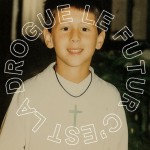
Artist: Christophe Clébard (@)
Title: Le Futur C'est La Drogue
Format: 12" + Download
Label: moli del tro
Rated:

Title: Le Futur C'est La Drogue
Format: 12" + Download
Label: moli del tro
Rated:
Christophe Clébard's sixth album arrives like a sleepless monologue muttered under flickering neon lights. Not the dramatic kind of insomnia celebrated by poets and filmmakers, but the more familiar modern variety: a mind looping endlessly through unresolved conversations, recurring fears, vanished faces, and the persistent suspicion that contemporary life has become a system of dependencies disguised as freedom.
The Belgium-based artist, originally from Italy, has spent years carving out a singular position within Europe's DIY underground, drawing equally from synth-punk, industrial minimalism, cold wave, and electronic repetition. On "Le Futur C'est La Drogue", he pushes these tendencies toward their most distilled form. The music rarely seeks complexity. Instead, it embraces obsession. Drum machines advance with stubborn determination, synthesizers oscillate between abrasion and hypnosis, and repetition becomes less a compositional device than a psychological condition.
The album's title might initially suggest social commentary, but the record operates on a far more intimate level. Addiction here appears not merely as substance dependency but as a broader human predicament. People become addicted to memories, to absence, to self-doubt, to routines, to the gaze of others, even to their own suffering. Throughout the album, characters seem trapped inside emotional feedback loops, unable to distinguish between comfort and confinement.
This theme emerges through Clébard's peculiar lyrical approach. His texts often reject conventional narrative structure, favouring fragmented thoughts, recurring images, abrupt associations, and simple phrases repeated until their meaning begins to mutate. What initially sounds naive gradually reveals itself as unsettlingly precise. Like certain forms of outsider art, the apparent simplicity conceals a deeper emotional complexity. The words do not describe anxiety; they perform it.
The music mirrors this strategy perfectly. Tracks unfold through insistence rather than development. Rhythms hammer away with mechanical persistence while battered synthesizer figures circle around unresolved emotional centres. Yet despite the album's bleak subject matter, there is something strangely inviting about its atmosphere. Clébard understands that despair often arrives dancing.
Several songs revolve around the instability of human connection. Encounters remain ambiguous, conversations seem incomplete, identities blur. People look at one another without necessarily understanding what they see. Relationships become mirrors reflecting uncertainty rather than clarity. Even love appears less as a destination than as a temporary shelter from existential weather.
The album's most moving moments emerge from its recurring fascination with solitude. Being alone is portrayed neither as tragedy nor liberation, but as a condition to be negotiated repeatedly. The protagonists inhabiting these songs appear suspended between a desire for intimacy and an equally powerful impulse toward withdrawal. It is a contradiction many listeners will recognise, whether they admit it or not.
Musically, Clébard's synth-punk framework occasionally brushes against electro, minimal wave, and industrial dance music, though never comfortably enough to settle into any category. "Disco Lento", appropriately enough, encapsulates much of the record's appeal. Its title suggests movement, but the music feels almost reluctant to move forward, caught between pleasure and paralysis. It is dance music for people contemplating their life choices while staring into a half-empty glass.
The collaboration with Chris Imler introduces a welcome dose of surrealism. Linguistic shifts and dislocated imagery create one of the album's most disorienting passages, reinforcing the sense that Clébard's universe obeys emotional logic rather than rational structure.
What ultimately distinguishes "Le Futur C'est La Drogue" is its refusal to beautify discomfort. Clébard does not package alienation as fashionable melancholy. His songs feel rough around the edges, occasionally awkward, sometimes repetitive to the point of irritation. But that irritation is often precisely the point. These tracks inhabit the same mental spaces as intrusive thoughts, recurring memories, and unanswered questions. They linger because they refuse resolution.
In an era when so much music seeks either escapism or certainty, Clébard offers neither. Instead, he presents a collection of damaged mantras, mechanical confessions, and nocturnal reflections that stare directly into contemporary restlessness. The future may indeed resemble a dependency, the album seems to suggest. But at least here the diagnosis arrives accompanied by a stubborn beat and enough dark humour to keep the lights on a little longer.
The Belgium-based artist, originally from Italy, has spent years carving out a singular position within Europe's DIY underground, drawing equally from synth-punk, industrial minimalism, cold wave, and electronic repetition. On "Le Futur C'est La Drogue", he pushes these tendencies toward their most distilled form. The music rarely seeks complexity. Instead, it embraces obsession. Drum machines advance with stubborn determination, synthesizers oscillate between abrasion and hypnosis, and repetition becomes less a compositional device than a psychological condition.
The album's title might initially suggest social commentary, but the record operates on a far more intimate level. Addiction here appears not merely as substance dependency but as a broader human predicament. People become addicted to memories, to absence, to self-doubt, to routines, to the gaze of others, even to their own suffering. Throughout the album, characters seem trapped inside emotional feedback loops, unable to distinguish between comfort and confinement.
This theme emerges through Clébard's peculiar lyrical approach. His texts often reject conventional narrative structure, favouring fragmented thoughts, recurring images, abrupt associations, and simple phrases repeated until their meaning begins to mutate. What initially sounds naive gradually reveals itself as unsettlingly precise. Like certain forms of outsider art, the apparent simplicity conceals a deeper emotional complexity. The words do not describe anxiety; they perform it.
The music mirrors this strategy perfectly. Tracks unfold through insistence rather than development. Rhythms hammer away with mechanical persistence while battered synthesizer figures circle around unresolved emotional centres. Yet despite the album's bleak subject matter, there is something strangely inviting about its atmosphere. Clébard understands that despair often arrives dancing.
Several songs revolve around the instability of human connection. Encounters remain ambiguous, conversations seem incomplete, identities blur. People look at one another without necessarily understanding what they see. Relationships become mirrors reflecting uncertainty rather than clarity. Even love appears less as a destination than as a temporary shelter from existential weather.
The album's most moving moments emerge from its recurring fascination with solitude. Being alone is portrayed neither as tragedy nor liberation, but as a condition to be negotiated repeatedly. The protagonists inhabiting these songs appear suspended between a desire for intimacy and an equally powerful impulse toward withdrawal. It is a contradiction many listeners will recognise, whether they admit it or not.
Musically, Clébard's synth-punk framework occasionally brushes against electro, minimal wave, and industrial dance music, though never comfortably enough to settle into any category. "Disco Lento", appropriately enough, encapsulates much of the record's appeal. Its title suggests movement, but the music feels almost reluctant to move forward, caught between pleasure and paralysis. It is dance music for people contemplating their life choices while staring into a half-empty glass.
The collaboration with Chris Imler introduces a welcome dose of surrealism. Linguistic shifts and dislocated imagery create one of the album's most disorienting passages, reinforcing the sense that Clébard's universe obeys emotional logic rather than rational structure.
What ultimately distinguishes "Le Futur C'est La Drogue" is its refusal to beautify discomfort. Clébard does not package alienation as fashionable melancholy. His songs feel rough around the edges, occasionally awkward, sometimes repetitive to the point of irritation. But that irritation is often precisely the point. These tracks inhabit the same mental spaces as intrusive thoughts, recurring memories, and unanswered questions. They linger because they refuse resolution.
In an era when so much music seeks either escapism or certainty, Clébard offers neither. Instead, he presents a collection of damaged mantras, mechanical confessions, and nocturnal reflections that stare directly into contemporary restlessness. The future may indeed resemble a dependency, the album seems to suggest. But at least here the diagnosis arrives accompanied by a stubborn beat and enough dark humour to keep the lights on a little longer.
Comments
Stream
Browse by Genre
Industrial Music / Industrial Metal / Aggro Industrial / Electro Metal
Industrial Noise / Power Noise / Harsh Noise
Synth Pop / Electro Pop / Synth-Electronica
Techno / Trance / Goa / Drum'n'Bass / Jungle / Tribal / Trip-Hop
Ambient / Electronica / Ethereal / Dub / Soundscapes / Abstract
Experimental / Avantgarde / Weird & Wired / Glitch / Noise / Field Recording
Dark / Gothic / Wave / New Wave / Dark Wave / Industrial Gothic
New Music / Downtown / Avantgarde Jazz / New Classical / World