
Wednesday, September 16, 2026
DELREI feat.Collin Hegna: Wicked Wicked Ways
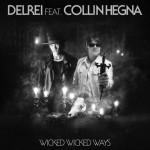
Artist: DELREI feat.Collin Hegna
Title: Wicked Wicked Ways
Format: Download Only (MP3 + Lossless)
Label: Projekt (@)
Rated:

Title: Wicked Wicked Ways
Format: Download Only (MP3 + Lossless)
Label: Projekt (@)
Rated:
There is a particular kind of darkness that belongs neither to horror nor to sadness. It is the darkness of memory when it refuses to leave. Not dramatic enough to become a tragedy, not distant enough to become a lesson. DELREI's "Wicked Wicked Ways" inhabits precisely that territory: a twilight landscape where desire and regret continue their endless dance, stepping on each other's feet while pretending to be in love.
Behind the project is Italian musician Alessandro Mercanzin, who has steadily developed a distinctive aesthetic that draws from post-punk, darkwave, Americana, and cinematic atmospheres without fully settling into any of them. His music often feels suspended between geographical and emotional coordinates, as if the European imagination were dreaming of the American frontier through the lens of a sleepless night. On this three-track EP, that vision becomes more focused and more confident.
The presence of Collin Hegna, known for his work with the legendary Portland collective Wovenhand, proves particularly significant. His voice carries a weathered gravity that perfectly suits these songs. Rather than dominating the material, he inhabits it like a ghost returning to a familiar house, recognizing every room yet feeling slightly unsettled by the passage of time.
The title track opens the EP with a slow-burning meditation on toxic attraction. Mercanzin avoids the temptation to portray emotional dysfunction as glamorous. Instead, the song captures the uncomfortable coexistence of fascination and self-preservation. The arrangement moves with deliberate restraint, allowing guitars, bass, and synthesizers to create an atmosphere that feels simultaneously intimate and expansive. One can almost picture a horizon at dusk, beautiful enough to admire, dangerous enough to avoid. Human beings, naturally, tend to walk straight toward it.
What distinguishes DELREI from many contemporary darkwave projects is his understanding of space. These songs are not overcrowded with effects or nostalgic references. Every instrument appears carefully placed, as if the silence surrounding the notes were as important as the notes themselves. The result is music that breathes. It lingers rather than rushes.
The brief instrumental interlude "In Darkness" functions as more than a transition. Lasting little more than a minute, it serves as a corridor between worlds. Rather than developing into a full composition, it presents a fragment, a glimpse through a partially opened door. Such restraint is refreshing in an era where every idea is expected to justify its existence through maximum exposure. Sometimes mystery remains the most effective special effect.
The EP reaches its emotional center with "Give Your Heart to Me". Here the themes of attachment, dependency, and surrender acquire an almost ceremonial quality. The inclusion of a spoken passage inspired by an ancient hymn introduces an unexpected spiritual dimension. What could have remained a simple tale of doomed romance becomes something broader: a reflection on the rituals through which human beings seek comfort, meaning, and protection, even when walking willingly into situations they know may wound them.
Throughout the record, one senses an artist increasingly comfortable with ambiguity. There are traces of post-punk's emotional austerity, dark Americana's expansive horizons, and dreamlike cinematic textures, yet none of these influences become dominant. Mercanzin assembles them into a language of his own, one that feels less concerned with genre than with mood.
At barely nine minutes in length, "Wicked Wicked Ways" could easily be dismissed as a minor release. That would be a mistake. Some works function not as destinations but as signposts, revealing the direction an artist intends to travel. This EP suggests that DELREI is refining a world rather than merely writing songs: a world populated by restless hearts, empty roads, half-remembered promises, and shadows that seem surprisingly reluctant to disappear.
The most compelling aspect of "Wicked Wicked Ways" is that it never treats darkness as an aesthetic accessory. Instead, it approaches it as a condition of human experience, one that can be unsettling, seductive, illuminating, and occasionally absurd all at once. Much like memory itself, the songs refuse to stay where they are placed. They follow the listener home.
Behind the project is Italian musician Alessandro Mercanzin, who has steadily developed a distinctive aesthetic that draws from post-punk, darkwave, Americana, and cinematic atmospheres without fully settling into any of them. His music often feels suspended between geographical and emotional coordinates, as if the European imagination were dreaming of the American frontier through the lens of a sleepless night. On this three-track EP, that vision becomes more focused and more confident.
The presence of Collin Hegna, known for his work with the legendary Portland collective Wovenhand, proves particularly significant. His voice carries a weathered gravity that perfectly suits these songs. Rather than dominating the material, he inhabits it like a ghost returning to a familiar house, recognizing every room yet feeling slightly unsettled by the passage of time.
The title track opens the EP with a slow-burning meditation on toxic attraction. Mercanzin avoids the temptation to portray emotional dysfunction as glamorous. Instead, the song captures the uncomfortable coexistence of fascination and self-preservation. The arrangement moves with deliberate restraint, allowing guitars, bass, and synthesizers to create an atmosphere that feels simultaneously intimate and expansive. One can almost picture a horizon at dusk, beautiful enough to admire, dangerous enough to avoid. Human beings, naturally, tend to walk straight toward it.
What distinguishes DELREI from many contemporary darkwave projects is his understanding of space. These songs are not overcrowded with effects or nostalgic references. Every instrument appears carefully placed, as if the silence surrounding the notes were as important as the notes themselves. The result is music that breathes. It lingers rather than rushes.
The brief instrumental interlude "In Darkness" functions as more than a transition. Lasting little more than a minute, it serves as a corridor between worlds. Rather than developing into a full composition, it presents a fragment, a glimpse through a partially opened door. Such restraint is refreshing in an era where every idea is expected to justify its existence through maximum exposure. Sometimes mystery remains the most effective special effect.
The EP reaches its emotional center with "Give Your Heart to Me". Here the themes of attachment, dependency, and surrender acquire an almost ceremonial quality. The inclusion of a spoken passage inspired by an ancient hymn introduces an unexpected spiritual dimension. What could have remained a simple tale of doomed romance becomes something broader: a reflection on the rituals through which human beings seek comfort, meaning, and protection, even when walking willingly into situations they know may wound them.
Throughout the record, one senses an artist increasingly comfortable with ambiguity. There are traces of post-punk's emotional austerity, dark Americana's expansive horizons, and dreamlike cinematic textures, yet none of these influences become dominant. Mercanzin assembles them into a language of his own, one that feels less concerned with genre than with mood.
At barely nine minutes in length, "Wicked Wicked Ways" could easily be dismissed as a minor release. That would be a mistake. Some works function not as destinations but as signposts, revealing the direction an artist intends to travel. This EP suggests that DELREI is refining a world rather than merely writing songs: a world populated by restless hearts, empty roads, half-remembered promises, and shadows that seem surprisingly reluctant to disappear.
The most compelling aspect of "Wicked Wicked Ways" is that it never treats darkness as an aesthetic accessory. Instead, it approaches it as a condition of human experience, one that can be unsettling, seductive, illuminating, and occasionally absurd all at once. Much like memory itself, the songs refuse to stay where they are placed. They follow the listener home.
Comments
Stream
Browse by Genre
Industrial Music / Industrial Metal / Aggro Industrial / Electro Metal
Industrial Noise / Power Noise / Harsh Noise
Synth Pop / Electro Pop / Synth-Electronica
Techno / Trance / Goa / Drum'n'Bass / Jungle / Tribal / Trip-Hop
Ambient / Electronica / Ethereal / Dub / Soundscapes / Abstract
Experimental / Avantgarde / Weird & Wired / Glitch / Noise / Field Recording
Dark / Gothic / Wave / New Wave / Dark Wave / Industrial Gothic
New Music / Downtown / Avantgarde Jazz / New Classical / World