
Re-Ghoster Extended: Dreaming With The Lights On
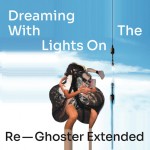
Artist: Re-Ghoster Extended (@)
Title: Dreaming With The Lights On
Format: LP
Label: Konnekt (@)
Rated:

Title: Dreaming With The Lights On
Format: LP
Label: Konnekt (@)
Rated:
Most improvised music asks listeners to abandon expectations. Re-Ghoster Extended's "Dreaming With The Lights On" goes one step further: it asks listeners to abandon orientation. Up, down, foreground, background, cause, effect, instrument, noise, intention, accident. Everything remains visible, yet nothing stays obedient. It is less like entering a composition than stepping into a room where the furniture has quietly negotiated new laws of physics while nobody was looking.
The ensemble behind this remarkable recording is hardly lacking in adventurous credentials. Swiss percussionist and composer Nicolas Field, long active at the intersection of improvisation, contemporary composition, and electronic experimentation, joins forces with pianist Thomas Florin, tape manipulator Jérôme Noetinger, vocal provocateur Fritz Welch, and trumpet explorer Nate Wooley. Each musician has spent years challenging the conventional behaviour of their chosen instrument. Together, they create a collective intelligence that often feels less like a band than a temporary ecosystem.
Recorded live at Geneva's Archipel Festival, the album captures a performance that thrives on instability. Yet instability should not be mistaken for chaos. There is a crucial difference. Chaos merely collapses; this music continuously reorganizes itself. Sounds emerge, collide, mutate, vanish, and reappear in altered forms, as though the performance were engaged in a constant process of self-editing.
The title piece occupies almost an entire side of the record and serves as an ideal entry point into the group's peculiar logic. Percussion appears not as rhythmic foundation but as a source of kinetic suggestion. Piano gestures arrive as fragments of architecture, briefly erecting structures that electronics immediately begin to erode. Noetinger's tape manipulations introduce a strange temporal elasticity, allowing sounds to feel simultaneously present and remembered. Meanwhile, Wooley's trumpet and Welch's voice drift through the texture like visitors from neighbouring realities who forgot to bring identification.
One of the album's greatest strengths lies in its treatment of improvisation. Many free-improvised recordings celebrate spontaneity as an end in itself. Re-Ghoster Extended appears more interested in what spontaneity can reveal. The musicians listen with extraordinary attentiveness, responding not only to what is being played but to what is implied, suggested, or momentarily imagined. The result is a form of collective dreaming conducted in broad daylight.
"Soon Blind" deepens this sensation. The title suggests loss of perception, yet the music seems to generate additional senses. Tiny sonic events acquire disproportionate significance. A scrape, a breath, a metallic resonance, a distorted vocal fragment: each becomes a clue in a mystery that refuses to provide a solution. Listening feels oddly similar to watching clouds. Patterns emerge. Narratives suggest themselves. Then everything changes shape before certainty can arrive.
The shorter closing piece, "Extended Impressions", functions almost like a series of afterimages. Rather than offering resolution, it leaves traces. Fragments linger in memory long after they have disappeared from the speakers. One begins to realize that the album's real subject may not be sound itself, but perception: how we organize experience, and how fragile those organizing systems actually are.
Humour also plays an important role, albeit a subtle one. Experimental music is often accused of taking itself too seriously, as though every squeak carried the burden of explaining the universe. Re-Ghoster Extended avoids this trap. Beneath the complexity lies a playful spirit. The musicians seem genuinely curious about what might happen if sounds are allowed to misbehave. The performance occasionally feels like a laboratory run by highly intelligent pranksters who have replaced the instruction manual with a collection of riddles.
The group's history helps explain this chemistry. Since its formation, Re-Ghoster has steadily expanded its language, moving from trio configurations into larger electroacoustic networks while maintaining an unusual balance between compositional frameworks and improvisational freedom. The addition of figures such as Wooley and Welch has not simply enlarged the ensemble; it has multiplied the possible trajectories available within each performance.
What ultimately makes "Dreaming With The Lights On" so compelling is its refusal to separate imagination from materiality. The album never retreats into abstraction for its own sake. Every strange texture, every unstable gesture, every unexpected collision remains tactile. One can almost feel the surfaces of the sounds: rough, elastic, metallic, porous, occasionally absurd.
The title proves unexpectedly accurate. This is indeed dream music, but not the soft-focus variety. These dreams occur under full illumination. Everything is exposed, every mechanism visible, every mutation happening in plain sight. Yet the mystery remains intact. The lights are on, the room is familiar, and somehow the walls have started breathing.
The ensemble behind this remarkable recording is hardly lacking in adventurous credentials. Swiss percussionist and composer Nicolas Field, long active at the intersection of improvisation, contemporary composition, and electronic experimentation, joins forces with pianist Thomas Florin, tape manipulator Jérôme Noetinger, vocal provocateur Fritz Welch, and trumpet explorer Nate Wooley. Each musician has spent years challenging the conventional behaviour of their chosen instrument. Together, they create a collective intelligence that often feels less like a band than a temporary ecosystem.
Recorded live at Geneva's Archipel Festival, the album captures a performance that thrives on instability. Yet instability should not be mistaken for chaos. There is a crucial difference. Chaos merely collapses; this music continuously reorganizes itself. Sounds emerge, collide, mutate, vanish, and reappear in altered forms, as though the performance were engaged in a constant process of self-editing.
The title piece occupies almost an entire side of the record and serves as an ideal entry point into the group's peculiar logic. Percussion appears not as rhythmic foundation but as a source of kinetic suggestion. Piano gestures arrive as fragments of architecture, briefly erecting structures that electronics immediately begin to erode. Noetinger's tape manipulations introduce a strange temporal elasticity, allowing sounds to feel simultaneously present and remembered. Meanwhile, Wooley's trumpet and Welch's voice drift through the texture like visitors from neighbouring realities who forgot to bring identification.
One of the album's greatest strengths lies in its treatment of improvisation. Many free-improvised recordings celebrate spontaneity as an end in itself. Re-Ghoster Extended appears more interested in what spontaneity can reveal. The musicians listen with extraordinary attentiveness, responding not only to what is being played but to what is implied, suggested, or momentarily imagined. The result is a form of collective dreaming conducted in broad daylight.
"Soon Blind" deepens this sensation. The title suggests loss of perception, yet the music seems to generate additional senses. Tiny sonic events acquire disproportionate significance. A scrape, a breath, a metallic resonance, a distorted vocal fragment: each becomes a clue in a mystery that refuses to provide a solution. Listening feels oddly similar to watching clouds. Patterns emerge. Narratives suggest themselves. Then everything changes shape before certainty can arrive.
The shorter closing piece, "Extended Impressions", functions almost like a series of afterimages. Rather than offering resolution, it leaves traces. Fragments linger in memory long after they have disappeared from the speakers. One begins to realize that the album's real subject may not be sound itself, but perception: how we organize experience, and how fragile those organizing systems actually are.
Humour also plays an important role, albeit a subtle one. Experimental music is often accused of taking itself too seriously, as though every squeak carried the burden of explaining the universe. Re-Ghoster Extended avoids this trap. Beneath the complexity lies a playful spirit. The musicians seem genuinely curious about what might happen if sounds are allowed to misbehave. The performance occasionally feels like a laboratory run by highly intelligent pranksters who have replaced the instruction manual with a collection of riddles.
The group's history helps explain this chemistry. Since its formation, Re-Ghoster has steadily expanded its language, moving from trio configurations into larger electroacoustic networks while maintaining an unusual balance between compositional frameworks and improvisational freedom. The addition of figures such as Wooley and Welch has not simply enlarged the ensemble; it has multiplied the possible trajectories available within each performance.
What ultimately makes "Dreaming With The Lights On" so compelling is its refusal to separate imagination from materiality. The album never retreats into abstraction for its own sake. Every strange texture, every unstable gesture, every unexpected collision remains tactile. One can almost feel the surfaces of the sounds: rough, elastic, metallic, porous, occasionally absurd.
The title proves unexpectedly accurate. This is indeed dream music, but not the soft-focus variety. These dreams occur under full illumination. Everything is exposed, every mechanism visible, every mutation happening in plain sight. Yet the mystery remains intact. The lights are on, the room is familiar, and somehow the walls have started breathing.
Comments
Stream
Browse by Genre
Industrial Music / Industrial Metal / Aggro Industrial / Electro Metal
Industrial Noise / Power Noise / Harsh Noise
Synth Pop / Electro Pop / Synth-Electronica
Techno / Trance / Goa / Drum'n'Bass / Jungle / Tribal / Trip-Hop
Ambient / Electronica / Ethereal / Dub / Soundscapes / Abstract
Experimental / Avantgarde / Weird & Wired / Glitch / Noise / Field Recording
Dark / Gothic / Wave / New Wave / Dark Wave / Industrial Gothic
New Music / Downtown / Avantgarde Jazz / New Classical / World