
Saturday, September 5, 2026
Jozef Van Wissem: This Is My Blood
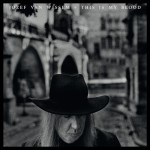
Artist: Jozef Van Wissem (@)
Title: This Is My Blood
Format: CD & 12" + Download
Label: Incunabulum Records (@)
Rated:

Title: This Is My Blood
Format: CD & 12" + Download
Label: Incunabulum Records (@)
Rated:
There are musicians who spend entire careers trying to modernise ancient instruments. Jozef Van Wissem has always chosen a stranger and far more convincing route: he lets the ancient instrument quietly modernise us instead. For over three decades the Dutch composer and lutenist has treated the Renaissance and Baroque lute not as a museum relic but as an unsettling contemporary voice, capable of conversing with drones, electronics, industrial textures and minimalist repetition without ever sounding like an academic experiment. If anything, his black Baroque lute often feels less nostalgic than many brand-new synthesizers. Wood, it turns out, ages more gracefully than software.
"This Is My Blood" continues the singular path Van Wissem has refined across an extensive catalogue and numerous collaborations, most famously with filmmaker Jim Jarmusch, whose partnership culminated in the Cannes Soundtrack Award-winning score for "Only Lovers Left Alive". His work for cinema, from "Nosferatu" to "Irma Vep", has consistently demonstrated his ability to treat music as architecture rather than accompaniment, allowing silence, resonance and repetition to shape emotional space with remarkable precision. That cinematic sensibility permeates this latest release, although its landscapes feel intensely inward.
The album opens and closes with two improvisations originally conceived for Joaquim Pujol's film "Maquina", creating a circular structure that immediately suggests journey rather than destination. "What The Eternal Beginning Is" emerges almost hesitantly from silence, each plucked string carrying extraordinary weight. The Colorado desert that inspired these recordings becomes less a geographical location than a psychological terrain, vast enough for thoughts to echo against themselves.
Long-form listening has become something of an endangered species. Contemporary culture politely suggests that profound experiences should preferably fit between two notifications. Van Wissem, characteristically indifferent to such practical advice, builds compositions that unfold according to their own internal respiration. Nothing here hurries toward resolution. Time stretches, folds back upon itself and occasionally seems to stop altogether.
The title "This Is My Blood" inevitably evokes religious imagery, yet Van Wissem has long occupied a fascinating space where Christian symbolism functions less as doctrine than as poetic vocabulary. His recurring themes of suffering, redemption, mortality and transcendence are presented with remarkable ambiguity. Rather than preaching belief, he investigates the emotional architecture these symbols have built across centuries. Even listeners untouched by religious traditions may find themselves responding to the ritualistic gravity embedded within these pieces.
The magnificent "Praise Shall Sound From Shore To Shore, Until The Sun Shall Rise And Set No More" demonstrates this perfectly. Its repeating lute figures gradually accumulate subtle electronic shadows until the distinction between acoustic performance and spectral resonance begins to dissolve. Minimal changes produce disproportionately powerful emotional shifts, a compositional strategy recalling both Renaissance counterpoint and twentieth-century minimalism without belonging entirely to either tradition.
Throughout the album Van Wissem balances opposites with extraordinary discipline. His Renaissance and Baroque lutes remain unmistakably physical, every string vibration retaining its tactile presence, while electronics quietly extend rather than overwhelm their natural resonance. Drones emerge like distant weather systems. Beats appear sparingly, never seeking rhythmic dominance but gently disturbing the otherwise timeless surface. Even darkness is handled with unusual restraint. Rather than embracing gothic excess, Van Wissem cultivates an atmosphere where melancholy becomes luminous rather than oppressive.
"Concerning Our Saviours Silence" and "How You Must Enter Into Suffering" continue this exploration with almost monastic concentration. Their titles suggest theological meditation, yet the music avoids solemnity. Instead, the repeated figures function almost like breathing exercises, encouraging attentive listening rather than passive consumption. Van Wissem understands that repetition is never simple duplication. Every return arrives slightly altered by memory, expectation and the listener's own shifting perception.
The album's emotional centre arrives with "Remission", the sole vocal piece. Van Wissem's understated delivery has always possessed an almost incantatory quality, neither traditionally expressive nor emotionally detached. Here his voice feels less like narrative than confession whispered across centuries. The lyrics, sparse and direct, reinforce the album's ongoing meditation on loss, endurance and fragile hope without succumbing to melodrama.
The closing pair, "All You Do All You Bare" and "What The Eternal End Is", complete the circle with remarkable elegance. The final track mirrors the opening composition without merely repeating it, suggesting that beginnings and endings are perhaps distinguished only by perspective. After nearly forty minutes, one realises that very little has happened in conventional musical terms. Yet internally, something has shifted. Van Wissem specialises in precisely this paradox: music that appears static while quietly reorganising one's sense of time.
There is considerable courage in making records like this today. They refuse easy categorisation, avoid fashionable production tricks and demand genuine attention from their audience. In exchange, they offer something increasingly uncommon: the possibility of contemplation without instruction, mystery without obscurity, and beauty without sentimentality.
"This Is My Blood" is not an album that seeks immediate affection. Like many sacred spaces, abandoned buildings or ancient texts, it reveals itself gradually to those willing to remain present. Jozef Van Wissem once again demonstrates that the lute is far from an obsolete instrument. In his hands it becomes a vessel through which centuries continue speaking to one another, reminding us that while technologies inevitably age, the human search for meaning remains stubbornly, beautifully unresolved.
"This Is My Blood" continues the singular path Van Wissem has refined across an extensive catalogue and numerous collaborations, most famously with filmmaker Jim Jarmusch, whose partnership culminated in the Cannes Soundtrack Award-winning score for "Only Lovers Left Alive". His work for cinema, from "Nosferatu" to "Irma Vep", has consistently demonstrated his ability to treat music as architecture rather than accompaniment, allowing silence, resonance and repetition to shape emotional space with remarkable precision. That cinematic sensibility permeates this latest release, although its landscapes feel intensely inward.
The album opens and closes with two improvisations originally conceived for Joaquim Pujol's film "Maquina", creating a circular structure that immediately suggests journey rather than destination. "What The Eternal Beginning Is" emerges almost hesitantly from silence, each plucked string carrying extraordinary weight. The Colorado desert that inspired these recordings becomes less a geographical location than a psychological terrain, vast enough for thoughts to echo against themselves.
Long-form listening has become something of an endangered species. Contemporary culture politely suggests that profound experiences should preferably fit between two notifications. Van Wissem, characteristically indifferent to such practical advice, builds compositions that unfold according to their own internal respiration. Nothing here hurries toward resolution. Time stretches, folds back upon itself and occasionally seems to stop altogether.
The title "This Is My Blood" inevitably evokes religious imagery, yet Van Wissem has long occupied a fascinating space where Christian symbolism functions less as doctrine than as poetic vocabulary. His recurring themes of suffering, redemption, mortality and transcendence are presented with remarkable ambiguity. Rather than preaching belief, he investigates the emotional architecture these symbols have built across centuries. Even listeners untouched by religious traditions may find themselves responding to the ritualistic gravity embedded within these pieces.
The magnificent "Praise Shall Sound From Shore To Shore, Until The Sun Shall Rise And Set No More" demonstrates this perfectly. Its repeating lute figures gradually accumulate subtle electronic shadows until the distinction between acoustic performance and spectral resonance begins to dissolve. Minimal changes produce disproportionately powerful emotional shifts, a compositional strategy recalling both Renaissance counterpoint and twentieth-century minimalism without belonging entirely to either tradition.
Throughout the album Van Wissem balances opposites with extraordinary discipline. His Renaissance and Baroque lutes remain unmistakably physical, every string vibration retaining its tactile presence, while electronics quietly extend rather than overwhelm their natural resonance. Drones emerge like distant weather systems. Beats appear sparingly, never seeking rhythmic dominance but gently disturbing the otherwise timeless surface. Even darkness is handled with unusual restraint. Rather than embracing gothic excess, Van Wissem cultivates an atmosphere where melancholy becomes luminous rather than oppressive.
"Concerning Our Saviours Silence" and "How You Must Enter Into Suffering" continue this exploration with almost monastic concentration. Their titles suggest theological meditation, yet the music avoids solemnity. Instead, the repeated figures function almost like breathing exercises, encouraging attentive listening rather than passive consumption. Van Wissem understands that repetition is never simple duplication. Every return arrives slightly altered by memory, expectation and the listener's own shifting perception.
The album's emotional centre arrives with "Remission", the sole vocal piece. Van Wissem's understated delivery has always possessed an almost incantatory quality, neither traditionally expressive nor emotionally detached. Here his voice feels less like narrative than confession whispered across centuries. The lyrics, sparse and direct, reinforce the album's ongoing meditation on loss, endurance and fragile hope without succumbing to melodrama.
The closing pair, "All You Do All You Bare" and "What The Eternal End Is", complete the circle with remarkable elegance. The final track mirrors the opening composition without merely repeating it, suggesting that beginnings and endings are perhaps distinguished only by perspective. After nearly forty minutes, one realises that very little has happened in conventional musical terms. Yet internally, something has shifted. Van Wissem specialises in precisely this paradox: music that appears static while quietly reorganising one's sense of time.
There is considerable courage in making records like this today. They refuse easy categorisation, avoid fashionable production tricks and demand genuine attention from their audience. In exchange, they offer something increasingly uncommon: the possibility of contemplation without instruction, mystery without obscurity, and beauty without sentimentality.
"This Is My Blood" is not an album that seeks immediate affection. Like many sacred spaces, abandoned buildings or ancient texts, it reveals itself gradually to those willing to remain present. Jozef Van Wissem once again demonstrates that the lute is far from an obsolete instrument. In his hands it becomes a vessel through which centuries continue speaking to one another, reminding us that while technologies inevitably age, the human search for meaning remains stubbornly, beautifully unresolved.
Comments
Stream
Browse by Genre
Industrial Music / Industrial Metal / Aggro Industrial / Electro Metal
Industrial Noise / Power Noise / Harsh Noise
Synth Pop / Electro Pop / Synth-Electronica
Techno / Trance / Goa / Drum'n'Bass / Jungle / Tribal / Trip-Hop
Ambient / Electronica / Ethereal / Dub / Soundscapes / Abstract
Experimental / Avantgarde / Weird & Wired / Glitch / Noise / Field Recording
Dark / Gothic / Wave / New Wave / Dark Wave / Industrial Gothic
New Music / Downtown / Avantgarde Jazz / New Classical / World