
Monday, September 7, 2026
Till Hillbrecht & Zimoun: Warp Slow
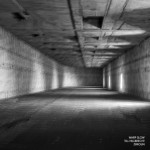
Artist: Till Hillbrecht & Zimoun (@)
Title: Warp Slow
Format: Download Only (MP3 + Lossless)
Label: Room40 (@)
Rated:

Title: Warp Slow
Format: Download Only (MP3 + Lossless)
Label: Room40 (@)
Rated:
Some records move forward. Others move inward. "Warp Slow" seems to do neither, preferring instead to stretch sideways until space itself begins to lose confidence in its dimensions. The title proves remarkably accurate: this is music that warps not through dramatic gestures, but through prolonged exposure, bending perception one repetition at a time.
The collaboration between Till Hillbrecht and Zimoun feels almost inevitable in retrospect. Swiss artist Zimoun has spent the better part of two decades redefining the relationship between sculpture, mechanics and sound, building astonishing installations from humble materials such as cardboard boxes, DC motors, cotton balls and wires. His work inhabits galleries and museums across the world, yet it rarely behaves like visual art with incidental audio. Instead, sound becomes the architecture itself, transforming repetitive mechanical actions into immersive acoustic ecosystems. Hillbrecht, whose practice similarly explores minimal processes and the physical behavior of sound, proves an ideal counterpart in an album concerned less with melody than with the invisible forces that shape listening.
The premise is almost laughably simple. Nine gestures, one instrument, endless repetition.
Naturally, simplicity refuses to stay simple.
Across these nine pieces, tiny repeated figures accumulate into dense harmonic landscapes where distortion, resonance and overtone interactions become the true protagonists. Rather than composing through constant invention, Hillbrecht and Zimoun allow the material to evolve under its own internal pressures. Every repeated gesture slowly mutates as frequencies collide, reinforcing some harmonics while erasing others. The music appears static only in the way a river appears motionless from an airplane.
Opening with the concise "Warp 1", the album immediately establishes its peculiar relationship with time. Notes repeat with unwavering patience, yet subtle acoustic interactions constantly reshape the sonic surface. By "Warp 2", the space has expanded dramatically, the repetitions blooming into vast reverberant structures that evoke abandoned industrial halls as much as sacred architecture. The distinction hardly matters. Both were built by humans hoping to contain something larger than themselves.
What distinguishes "Warp Slow" from many minimalist drone records is its physicality. The duo repeatedly speaks of friction, and friction becomes the album's central metaphor. Low frequencies grind gently against shimmering overtones; clean tones dissolve into rough distortion; moments of crystalline beauty suddenly develop abrasive edges. Peace here is never passive. It is negotiated continuously, like two tectonic plates agreeing not to cause another earthquake today.
The longer compositions reveal the project's real ambition. "Warp 5" and especially the monumental twenty-four-minute "Warp 9" demonstrate extraordinary confidence in gradual transformation. These are not pieces concerned with destination but with sustained attention. The smallest timbral shift acquires dramatic significance simply because the music teaches the listener to hear on its own microscopic scale.
This approach recalls aspects of composers such as Éliane Radigue or La Monte Young, while also echoing the process-oriented thinking of certain installation artists. Yet Hillbrecht and Zimoun never sound derivative. Their fascination lies not in sustained tones themselves but in how sustained tones behave once left alone long enough. Sound becomes less an object than a living material, constantly reorganizing itself through acoustic interaction.
There is, admittedly, something quietly humorous about devoting nearly ninety minutes to what initially resembles one persistent sonic idea. The joke, however, is entirely on the listener. Five minutes in, one may wonder whether anything is actually changing. Twenty minutes later, one begins noticing delicate fluctuations previously hidden beneath habitual listening. Forty minutes later, ordinary environmental noises start sounding strangely musical. By the end, even your refrigerator deserves a recording contract.
Room40 has consistently championed artists working at the intersection of composition, sound art and spatial listening, and "Warp Slow" sits comfortably within that tradition. Lawrence English's mastering preserves an impressive sense of scale, allowing both the immense bass foundations and the fragile upper harmonics enough room to breathe without collapsing into undifferentiated density.
Perhaps the album's greatest achievement lies in its refusal to dramatize minimalism. There are no grand conceptual manifestos disguised as music, no exaggerated austerity demanding admiration. Instead, Hillbrecht and Zimoun quietly trust that repetition itself contains inexhaustible complexity, provided one listens with sufficient patience. That trust proves contagious.
"Warp Slow" ultimately asks an unfashionable question: what if progress were less interesting than attention? In a culture increasingly obsessed with acceleration, novelty and instant transformation, the album proposes another model altogether. Stay with one sound. Stay longer than feels comfortable. Watch it become something else without ever ceasing to be itself.
Like light slowly changing across the surface of a mountain, nothing spectacular appears to happen. Until you realize the entire landscape has shifted while you were busy believing it hadn't. That is the peculiar magic of "Warp Slow": not the promise of escape, but the revelation that stillness has been moving all along.
The collaboration between Till Hillbrecht and Zimoun feels almost inevitable in retrospect. Swiss artist Zimoun has spent the better part of two decades redefining the relationship between sculpture, mechanics and sound, building astonishing installations from humble materials such as cardboard boxes, DC motors, cotton balls and wires. His work inhabits galleries and museums across the world, yet it rarely behaves like visual art with incidental audio. Instead, sound becomes the architecture itself, transforming repetitive mechanical actions into immersive acoustic ecosystems. Hillbrecht, whose practice similarly explores minimal processes and the physical behavior of sound, proves an ideal counterpart in an album concerned less with melody than with the invisible forces that shape listening.
The premise is almost laughably simple. Nine gestures, one instrument, endless repetition.
Naturally, simplicity refuses to stay simple.
Across these nine pieces, tiny repeated figures accumulate into dense harmonic landscapes where distortion, resonance and overtone interactions become the true protagonists. Rather than composing through constant invention, Hillbrecht and Zimoun allow the material to evolve under its own internal pressures. Every repeated gesture slowly mutates as frequencies collide, reinforcing some harmonics while erasing others. The music appears static only in the way a river appears motionless from an airplane.
Opening with the concise "Warp 1", the album immediately establishes its peculiar relationship with time. Notes repeat with unwavering patience, yet subtle acoustic interactions constantly reshape the sonic surface. By "Warp 2", the space has expanded dramatically, the repetitions blooming into vast reverberant structures that evoke abandoned industrial halls as much as sacred architecture. The distinction hardly matters. Both were built by humans hoping to contain something larger than themselves.
What distinguishes "Warp Slow" from many minimalist drone records is its physicality. The duo repeatedly speaks of friction, and friction becomes the album's central metaphor. Low frequencies grind gently against shimmering overtones; clean tones dissolve into rough distortion; moments of crystalline beauty suddenly develop abrasive edges. Peace here is never passive. It is negotiated continuously, like two tectonic plates agreeing not to cause another earthquake today.
The longer compositions reveal the project's real ambition. "Warp 5" and especially the monumental twenty-four-minute "Warp 9" demonstrate extraordinary confidence in gradual transformation. These are not pieces concerned with destination but with sustained attention. The smallest timbral shift acquires dramatic significance simply because the music teaches the listener to hear on its own microscopic scale.
This approach recalls aspects of composers such as Éliane Radigue or La Monte Young, while also echoing the process-oriented thinking of certain installation artists. Yet Hillbrecht and Zimoun never sound derivative. Their fascination lies not in sustained tones themselves but in how sustained tones behave once left alone long enough. Sound becomes less an object than a living material, constantly reorganizing itself through acoustic interaction.
There is, admittedly, something quietly humorous about devoting nearly ninety minutes to what initially resembles one persistent sonic idea. The joke, however, is entirely on the listener. Five minutes in, one may wonder whether anything is actually changing. Twenty minutes later, one begins noticing delicate fluctuations previously hidden beneath habitual listening. Forty minutes later, ordinary environmental noises start sounding strangely musical. By the end, even your refrigerator deserves a recording contract.
Room40 has consistently championed artists working at the intersection of composition, sound art and spatial listening, and "Warp Slow" sits comfortably within that tradition. Lawrence English's mastering preserves an impressive sense of scale, allowing both the immense bass foundations and the fragile upper harmonics enough room to breathe without collapsing into undifferentiated density.
Perhaps the album's greatest achievement lies in its refusal to dramatize minimalism. There are no grand conceptual manifestos disguised as music, no exaggerated austerity demanding admiration. Instead, Hillbrecht and Zimoun quietly trust that repetition itself contains inexhaustible complexity, provided one listens with sufficient patience. That trust proves contagious.
"Warp Slow" ultimately asks an unfashionable question: what if progress were less interesting than attention? In a culture increasingly obsessed with acceleration, novelty and instant transformation, the album proposes another model altogether. Stay with one sound. Stay longer than feels comfortable. Watch it become something else without ever ceasing to be itself.
Like light slowly changing across the surface of a mountain, nothing spectacular appears to happen. Until you realize the entire landscape has shifted while you were busy believing it hadn't. That is the peculiar magic of "Warp Slow": not the promise of escape, but the revelation that stillness has been moving all along.
Comments
Stream
Browse by Genre
Industrial Music / Industrial Metal / Aggro Industrial / Electro Metal
Industrial Noise / Power Noise / Harsh Noise
Synth Pop / Electro Pop / Synth-Electronica
Techno / Trance / Goa / Drum'n'Bass / Jungle / Tribal / Trip-Hop
Ambient / Electronica / Ethereal / Dub / Soundscapes / Abstract
Experimental / Avantgarde / Weird & Wired / Glitch / Noise / Field Recording
Dark / Gothic / Wave / New Wave / Dark Wave / Industrial Gothic
New Music / Downtown / Avantgarde Jazz / New Classical / World