
Friday, September 25, 2026
Akio Suzuki: Soundsphere
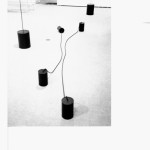


There are artists who compose music, and there are artists who spend a lifetime asking a single, deceptively simple question: "what is sound before we decide to call it music?" Akio Suzuki belongs firmly to the latter category. For more than six decades, the Japanese sound artist, performer, and inventor has quietly occupied a singular place within experimental music, building instruments, activating spaces, and transforming listening itself into the central act of creation. Long before "sound art" became a fashionable umbrella term, Suzuki was already exploring echoes in abandoned architecture, treating landscapes as collaborators rather than backdrops.
"Soundsphere", reissued by Room40 from a remarkable 1990 recording at Eindhoven's legendary Het Apollohuis, serves less as a historical document than as evidence that genuinely radical ideas refuse to age. If anything, the album feels more contemporary today than many releases made with infinitely more sophisticated technology. Apparently, decades of software updates remain no match for a curious mind armed with springs, glass, air, and patience.
The recording revolves around two of Suzuki's self-designed instruments: the Analapos, an extraordinary echo instrument developed in the early 1970s, and his reinterpretation of the Glass Harmonica. Yet calling them "instruments" almost undersells their function. They behave more like acoustic ecosystems, encouraging interactions rather than performances. Suzuki doesn't dominate them. He negotiates with them.
The opening "De Koolmees: Suzuki Type - Glass Harmonica" immediately establishes the album's peculiar gravity. Glass tones shimmer with astonishing delicacy, suspended somewhere between ritual, meditation, and laboratory experiment. Harmonics bloom and dissolve before they fully settle, producing a constantly shifting field of resonance. Rather than progressing toward a climax, the piece expands sideways, inviting the listener to inhabit its internal architecture. One quickly realizes that silence here isn't the absence of sound; it's another instrument joining the ensemble.
The three Analapos pieces reveal Suzuki's astonishing command of resonance. "Analapos A: Voice" intertwines breath and vocal vibration with the instrument's coiled springs, creating drones that seem simultaneously human and geological. His voice doesn't sing in any conventional sense. Instead, it activates the instrument's body until one can no longer distinguish performer from object. It feels as though the room itself has quietly decided to start humming.
"Multiple Stand" broadens the palette further, layering metallic resonance into slowly evolving harmonic constellations. Nothing arrives in a hurry. Every gesture appears to test the physical limits of vibration, allowing microscopic changes in texture to become dramatic events. The experience demands attention but rewards it generously, like watching sunlight crawl across a wall until you suddenly notice the wall has become an entire landscape.
The closing "Object For A Single Person" may be the album's most intimate statement. Sparse interventions generate vast acoustic consequences, reminding us that scale in music has surprisingly little to do with volume. Suzuki consistently demonstrates how minimal physical action can generate enormous perceptual space.
Lawrence English's careful remastering deserves recognition without drawing attention to itself. The transfer preserves the fragile dynamics and intricate resonances with admirable transparency, allowing every overtone to retain its physical presence. Rather than polishing history, the mastering simply removes the dust from an already luminous object.
There is also something quietly moving about revisiting this material today. Much contemporary experimental music embraces complexity through accumulation: more processing, more layers, more conceptual framing. Suzuki moves in precisely the opposite direction. He removes almost everything until listening itself becomes the composition. It is a reminder that innovation sometimes arrives not by inventing new sounds, but by hearing familiar ones with impossible concentration.
"Soundsphere" is not nostalgic, despite its archival origins. It feels strangely prophetic. At a time when algorithms increasingly predict our musical preferences before we even know them ourselves, Suzuki proposes something beautifully inconvenient: genuine listening cannot be automated. It requires curiosity, vulnerability, and the willingness to become slightly lost inside a vibrating piece of metal or a singing glass tube.
Some albums ask to be understood. "Soundsphere" simply asks to be heard, deeply and without haste. That turns out to be a far more demanding request, and perhaps a far more generous one.
"Soundsphere", reissued by Room40 from a remarkable 1990 recording at Eindhoven's legendary Het Apollohuis, serves less as a historical document than as evidence that genuinely radical ideas refuse to age. If anything, the album feels more contemporary today than many releases made with infinitely more sophisticated technology. Apparently, decades of software updates remain no match for a curious mind armed with springs, glass, air, and patience.
The recording revolves around two of Suzuki's self-designed instruments: the Analapos, an extraordinary echo instrument developed in the early 1970s, and his reinterpretation of the Glass Harmonica. Yet calling them "instruments" almost undersells their function. They behave more like acoustic ecosystems, encouraging interactions rather than performances. Suzuki doesn't dominate them. He negotiates with them.
The opening "De Koolmees: Suzuki Type - Glass Harmonica" immediately establishes the album's peculiar gravity. Glass tones shimmer with astonishing delicacy, suspended somewhere between ritual, meditation, and laboratory experiment. Harmonics bloom and dissolve before they fully settle, producing a constantly shifting field of resonance. Rather than progressing toward a climax, the piece expands sideways, inviting the listener to inhabit its internal architecture. One quickly realizes that silence here isn't the absence of sound; it's another instrument joining the ensemble.
The three Analapos pieces reveal Suzuki's astonishing command of resonance. "Analapos A: Voice" intertwines breath and vocal vibration with the instrument's coiled springs, creating drones that seem simultaneously human and geological. His voice doesn't sing in any conventional sense. Instead, it activates the instrument's body until one can no longer distinguish performer from object. It feels as though the room itself has quietly decided to start humming.
"Multiple Stand" broadens the palette further, layering metallic resonance into slowly evolving harmonic constellations. Nothing arrives in a hurry. Every gesture appears to test the physical limits of vibration, allowing microscopic changes in texture to become dramatic events. The experience demands attention but rewards it generously, like watching sunlight crawl across a wall until you suddenly notice the wall has become an entire landscape.
The closing "Object For A Single Person" may be the album's most intimate statement. Sparse interventions generate vast acoustic consequences, reminding us that scale in music has surprisingly little to do with volume. Suzuki consistently demonstrates how minimal physical action can generate enormous perceptual space.
Lawrence English's careful remastering deserves recognition without drawing attention to itself. The transfer preserves the fragile dynamics and intricate resonances with admirable transparency, allowing every overtone to retain its physical presence. Rather than polishing history, the mastering simply removes the dust from an already luminous object.
There is also something quietly moving about revisiting this material today. Much contemporary experimental music embraces complexity through accumulation: more processing, more layers, more conceptual framing. Suzuki moves in precisely the opposite direction. He removes almost everything until listening itself becomes the composition. It is a reminder that innovation sometimes arrives not by inventing new sounds, but by hearing familiar ones with impossible concentration.
"Soundsphere" is not nostalgic, despite its archival origins. It feels strangely prophetic. At a time when algorithms increasingly predict our musical preferences before we even know them ourselves, Suzuki proposes something beautifully inconvenient: genuine listening cannot be automated. It requires curiosity, vulnerability, and the willingness to become slightly lost inside a vibrating piece of metal or a singing glass tube.
Some albums ask to be understood. "Soundsphere" simply asks to be heard, deeply and without haste. That turns out to be a far more demanding request, and perhaps a far more generous one.
Comments
Stream
Browse by Genre
Industrial Music / Industrial Metal / Aggro Industrial / Electro Metal
Industrial Noise / Power Noise / Harsh Noise
Synth Pop / Electro Pop / Synth-Electronica
Techno / Trance / Goa / Drum'n'Bass / Jungle / Tribal / Trip-Hop
Ambient / Electronica / Ethereal / Dub / Soundscapes / Abstract
Experimental / Avantgarde / Weird & Wired / Glitch / Noise / Field Recording
Dark / Gothic / Wave / New Wave / Dark Wave / Industrial Gothic
New Music / Downtown / Avantgarde Jazz / New Classical / World