
Negative Agent: Terminal Days
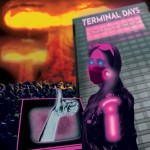


Industrial music has always had an awkward relationship with the future. It spent decades warning us about surveillance, corporate power, dehumanization and technological dependency, only to discover that reality was taking notes. "Terminal Days", the debut album from New York's Negative Agent, arrives in a political and cultural climate where dystopian fiction increasingly resembles yesterday's news feed. Rather than offering detached science fiction, Brian Stillman channels that uncomfortable overlap into an album that refuses neutrality. It is loud, confrontational, often sarcastic, and entirely unconcerned with appearing diplomatic.
Stillman is hardly a newcomer to the industrial underground. Having been immersed in New York's goth and industrial scene since the early 1990s and co-running the long-lived Contempt club night for over a decade, he understands that industrial music was never merely about distorted drum machines or intimidating aesthetics. At its strongest, it has always weaponized rhythm against complacency, from the mechanized assaults of Ministry and Front Line Assembly to the metallic futurism of Fear Factory and the post-punk fury of Killing Joke. "Terminal Days" consciously places itself within that lineage while updating its targets for the algorithmic age.
The album opens with "Mind Wipe", immediately establishing its central anxiety: the gradual replacement of human agency by data extraction, artificial intelligence, corporate manipulation and endless digital mediation. The lyrics could easily collapse under the weight of their own outrage, yet Stillman avoids turning the song into a lecture by wrapping every accusation inside muscular riffs, tightly programmed electronics and memorable hooks. The anger is genuine, but so is the craftsmanship.
That balance continues throughout the record. "Pain Control" shifts its attention toward systemic inequality and political corruption, combining relentless guitars with pounding electronic percussion that recalls the dancefloor instincts of classic electro-industrial. One of the album's strengths is its refusal to separate protest from pleasure. These songs are built to move bodies as much as consciences. Humans have always coped with catastrophe by dancing. Sometimes history resembles an apocalypse with surprisingly good bass response.
The title track, "Terminal Days", arguably represents the album's conceptual centre. Here the recurring themes of technological alienation, algorithmic control and cultural erosion merge into imagery that feels simultaneously cyberpunk and painfully contemporary. Rather than relying on futuristic fantasy, the song describes a world where creativity itself risks becoming another commodity to be mined, optimized and monetized. The production reinforces this tension beautifully, layering grinding guitars with nervous synthesizers and glitch-like textures that never overwhelm the songs themselves.
Perhaps the album's most provocative moment arrives with "Fascist Beatdown". Its deliberately blunt title leaves little room for interpretative gymnastics, and its tongue-in-cheek swagger injects a welcome dose of black humour into otherwise bleak subject matter. Industrial has often flirted with authoritarian imagery in deliberately ambiguous ways, sometimes to uncomfortable effect. Negative Agent rejects ambiguity entirely, opting instead for open confrontation wrapped inside a chorus designed for sweaty clubs rather than academic debates.
Elsewhere, "Boot Licker" examines the psychology of complicity rather than overt oppression, suggesting that authoritarian systems survive not only through power but through ordinary acts of surrender. Meanwhile "Dead in Berlin" broadens the album's narrative scope, drawing on Cold War iconography and espionage cinema to create one of the record's most atmospheric pieces. Echoes of David Bowie and Brian Eno hover over its rain-soaked streets without becoming empty nostalgia, transforming Berlin into both a physical city and a metaphor for fractured identities.
Musically, "Terminal Days" rarely tries to reinvent industrial metal. Instead, it refines familiar vocabulary with conviction and attention to dynamics. Thick guitar walls collide with precise electronic programming, while guest appearances from Steve Wiener and Greg Schwan add subtle variation without distracting from Stillman's singular vision. The closing Voidscan remix of "Fascist Beatdown" naturally shifts the emphasis toward club functionality, reminding listeners that resistance occasionally wears combat boots and occasionally dancing shoes.
What ultimately separates "Terminal Days" from many overtly political records is its awareness that outrage alone rarely produces memorable music. Stillman understands pacing, melody and texture. Even when the lyrics deliver uncompromising criticism of surveillance capitalism, authoritarian politics or technological evangelism, the compositions remain engaging as songs rather than functioning solely as ideological pamphlets.
Whether one shares every political conclusion is almost beside the point. The album succeeds because it captures an emotional landscape familiar to many contemporary listeners: exhaustion, disbelief, anger, dark humour and the stubborn refusal to surrender completely. Its vision of America may be bleak, but beneath the distortion lies an insistence that speaking out still matters, even when the machines seem to be winning.
"Terminal Days" is not interested in comforting anyone. It is interested in shaking shoulders, rattling speakers and reminding listeners that industrial music was never supposed to provide safe spaces. It was built to make comfortable people uncomfortable, and uncomfortable people feel a little less alone. On that front, Negative Agent's debut lands with impressive force.
Stillman is hardly a newcomer to the industrial underground. Having been immersed in New York's goth and industrial scene since the early 1990s and co-running the long-lived Contempt club night for over a decade, he understands that industrial music was never merely about distorted drum machines or intimidating aesthetics. At its strongest, it has always weaponized rhythm against complacency, from the mechanized assaults of Ministry and Front Line Assembly to the metallic futurism of Fear Factory and the post-punk fury of Killing Joke. "Terminal Days" consciously places itself within that lineage while updating its targets for the algorithmic age.
The album opens with "Mind Wipe", immediately establishing its central anxiety: the gradual replacement of human agency by data extraction, artificial intelligence, corporate manipulation and endless digital mediation. The lyrics could easily collapse under the weight of their own outrage, yet Stillman avoids turning the song into a lecture by wrapping every accusation inside muscular riffs, tightly programmed electronics and memorable hooks. The anger is genuine, but so is the craftsmanship.
That balance continues throughout the record. "Pain Control" shifts its attention toward systemic inequality and political corruption, combining relentless guitars with pounding electronic percussion that recalls the dancefloor instincts of classic electro-industrial. One of the album's strengths is its refusal to separate protest from pleasure. These songs are built to move bodies as much as consciences. Humans have always coped with catastrophe by dancing. Sometimes history resembles an apocalypse with surprisingly good bass response.
The title track, "Terminal Days", arguably represents the album's conceptual centre. Here the recurring themes of technological alienation, algorithmic control and cultural erosion merge into imagery that feels simultaneously cyberpunk and painfully contemporary. Rather than relying on futuristic fantasy, the song describes a world where creativity itself risks becoming another commodity to be mined, optimized and monetized. The production reinforces this tension beautifully, layering grinding guitars with nervous synthesizers and glitch-like textures that never overwhelm the songs themselves.
Perhaps the album's most provocative moment arrives with "Fascist Beatdown". Its deliberately blunt title leaves little room for interpretative gymnastics, and its tongue-in-cheek swagger injects a welcome dose of black humour into otherwise bleak subject matter. Industrial has often flirted with authoritarian imagery in deliberately ambiguous ways, sometimes to uncomfortable effect. Negative Agent rejects ambiguity entirely, opting instead for open confrontation wrapped inside a chorus designed for sweaty clubs rather than academic debates.
Elsewhere, "Boot Licker" examines the psychology of complicity rather than overt oppression, suggesting that authoritarian systems survive not only through power but through ordinary acts of surrender. Meanwhile "Dead in Berlin" broadens the album's narrative scope, drawing on Cold War iconography and espionage cinema to create one of the record's most atmospheric pieces. Echoes of David Bowie and Brian Eno hover over its rain-soaked streets without becoming empty nostalgia, transforming Berlin into both a physical city and a metaphor for fractured identities.
Musically, "Terminal Days" rarely tries to reinvent industrial metal. Instead, it refines familiar vocabulary with conviction and attention to dynamics. Thick guitar walls collide with precise electronic programming, while guest appearances from Steve Wiener and Greg Schwan add subtle variation without distracting from Stillman's singular vision. The closing Voidscan remix of "Fascist Beatdown" naturally shifts the emphasis toward club functionality, reminding listeners that resistance occasionally wears combat boots and occasionally dancing shoes.
What ultimately separates "Terminal Days" from many overtly political records is its awareness that outrage alone rarely produces memorable music. Stillman understands pacing, melody and texture. Even when the lyrics deliver uncompromising criticism of surveillance capitalism, authoritarian politics or technological evangelism, the compositions remain engaging as songs rather than functioning solely as ideological pamphlets.
Whether one shares every political conclusion is almost beside the point. The album succeeds because it captures an emotional landscape familiar to many contemporary listeners: exhaustion, disbelief, anger, dark humour and the stubborn refusal to surrender completely. Its vision of America may be bleak, but beneath the distortion lies an insistence that speaking out still matters, even when the machines seem to be winning.
"Terminal Days" is not interested in comforting anyone. It is interested in shaking shoulders, rattling speakers and reminding listeners that industrial music was never supposed to provide safe spaces. It was built to make comfortable people uncomfortable, and uncomfortable people feel a little less alone. On that front, Negative Agent's debut lands with impressive force.
Comments
Stream
Browse by Genre
Industrial Music / Industrial Metal / Aggro Industrial / Electro Metal
Industrial Noise / Power Noise / Harsh Noise
Synth Pop / Electro Pop / Synth-Electronica
Techno / Trance / Goa / Drum'n'Bass / Jungle / Tribal / Trip-Hop
Ambient / Electronica / Ethereal / Dub / Soundscapes / Abstract
Experimental / Avantgarde / Weird & Wired / Glitch / Noise / Field Recording
Dark / Gothic / Wave / New Wave / Dark Wave / Industrial Gothic
New Music / Downtown / Avantgarde Jazz / New Classical / World