
Thursday, September 24, 2026
Dionée: Mille-feuilles
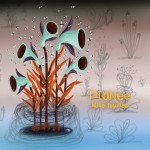


There are records that politely ask for your attention. Others kick the door open with volume. Dionée's "Mille-feuilles" does neither. It simply occupies the room until you begin hearing differently. That may sound suspiciously mystical, but the trio's music has little interest in transcendence for its own sake. Instead, it patiently constructs a landscape where unlikely materials coexist with startling naturalness: chamber music elegance brushing against the grain of drone, post-rock weight appearing without guitars, electroacoustic abstraction refusing to become mere academic exercise. It is, as the press release jokingly suggests, somewhere between Black Sabbath and Morton Feldman. Ridiculous on paper. Surprisingly convincing in practice.
Dionée is the latest project led by Québec composer and bassist Éric Normand, a prolific figure in Canada's experimental music community whose career has moved effortlessly between free improvisation, composition, and large ensemble work. His collaborations with improvisers such as Xavier Charles, Franz Hautzinger, and Anne-F Jacques have established him as an artist who thrives on instability, constantly seeking new relationships between sound sources rather than fixed stylistic identities. With Clarisse Bériault and Robin Servant, however, the objective feels different. Rather than celebrating improvisational friction, the trio pursues cohesion without sacrificing unpredictability.
The instrumentation alone deserves a raised eyebrow. Oboe, diatonic accordion, electric bass, oscillators, effects, beatboxing and electronics should, by all reasonable expectations, compete for attention. Instead they dissolve into what frequently resembles a chamber orchestra viewed through frosted glass. Individual instruments lose their sharp outlines, merging into slow-moving masses where acoustic resonance and electronic coloration become almost impossible to separate. One spends less time identifying who plays what than wondering how such familiar sounds became so strangely anonymous.
Normand's compositional approach favours gradual transformation over dramatic contrast. The two extended pieces unfold like evolving ecosystems rather than conventional compositions with clearly marked destinations. Themes emerge almost accidentally before being swallowed by sustained drones, harmonic shadows or subtle rhythmic currents. There is movement everywhere, yet very little appears hurried. The music trusts the listener's patience, a quality becoming increasingly rare in an era where albums often seem terrified of silence.
Bériault's oboe plays an especially fascinating role. Traditionally associated with pastoral lyricism or orchestral melancholy, it becomes something far less predictable here. Sometimes it cuts through the dense textures with almost vocal fragility; elsewhere it functions as another layer within the harmonic fog, its identity deliberately obscured by electronics and processing. Servant's accordion undergoes a similar transformation. Any expectation of folk nostalgia is quickly dismantled as its reeds become sources of sustained harmonic pressure rather than melodic comfort.
The album's title, "Mille-feuilles", inevitably evokes layers, and layering is indeed central to the listening experience. Yet these are not neatly stacked architectural strata. They resemble geological deposits compressed over centuries, where traces of different musical histories remain visible without ever separating cleanly. Minimalism rubs shoulders with doom-like harmonic gravity, contemporary classical restraint brushes against noise aesthetics, and occasional melodic fragments appear like half-remembered conversations overheard through thick walls.
One of the album's quiet achievements lies in how it handles density. Many experimental records equate complexity with saturation, filling every available frequency until subtlety suffocates. Dionée exercises remarkable restraint. Even at its heaviest, the music breathes. Empty spaces are not absences but active participants, allowing resonance to linger long enough for the ear to discover secondary events hidden beneath the obvious ones. It rewards repeated listening not because it is deliberately obscure, but because its internal relationships remain fluid.
There is also an understated cinematic quality throughout, though thankfully one that avoids becoming "soundtrack music" in the fashionable sense. Rather than illustrating imaginary scenes, these compositions generate psychological environments. They suggest abandoned industrial halls, dense northern forests, forgotten religious architecture, or perhaps none of these at all. The images remain personal, shaped as much by the listener's memory as by the musicians' intentions.
The two lengthy tracks refuse convenient climaxes. Instead they accumulate emotional weight through persistence, allowing microscopic shifts in timbre or harmony to feel monumental. This approach demands concentration, but it also offers something increasingly uncommon: the satisfaction of inhabiting a musical space instead of merely consuming it.
If there is humour here, it comes from the trio's quiet defiance of categorisation. Calling this chamber music feels incomplete. Calling it drone undersells its melodic intelligence. Labeling it post-rock ignores its compositional sophistication. Experimental music has always enjoyed inventing increasingly specialised boxes; "Mille-feuilles" politely stacks those boxes into a bonfire and continues playing.
Beautifully recorded and enhanced by Marnix Everaert's striking visual presentation, the album confirms that adventurous music need not choose between intellectual curiosity and emotional resonance. Dionée builds bridges where others erect boundaries, demonstrating that the distance between Feldman's stillness and Sabbath's physicality may not be as vast as genre maps would have us believe. Sometimes all it takes is three musicians willing to ignore the signposts and trust that listeners are capable of getting pleasantly lost.
Dionée is the latest project led by Québec composer and bassist Éric Normand, a prolific figure in Canada's experimental music community whose career has moved effortlessly between free improvisation, composition, and large ensemble work. His collaborations with improvisers such as Xavier Charles, Franz Hautzinger, and Anne-F Jacques have established him as an artist who thrives on instability, constantly seeking new relationships between sound sources rather than fixed stylistic identities. With Clarisse Bériault and Robin Servant, however, the objective feels different. Rather than celebrating improvisational friction, the trio pursues cohesion without sacrificing unpredictability.
The instrumentation alone deserves a raised eyebrow. Oboe, diatonic accordion, electric bass, oscillators, effects, beatboxing and electronics should, by all reasonable expectations, compete for attention. Instead they dissolve into what frequently resembles a chamber orchestra viewed through frosted glass. Individual instruments lose their sharp outlines, merging into slow-moving masses where acoustic resonance and electronic coloration become almost impossible to separate. One spends less time identifying who plays what than wondering how such familiar sounds became so strangely anonymous.
Normand's compositional approach favours gradual transformation over dramatic contrast. The two extended pieces unfold like evolving ecosystems rather than conventional compositions with clearly marked destinations. Themes emerge almost accidentally before being swallowed by sustained drones, harmonic shadows or subtle rhythmic currents. There is movement everywhere, yet very little appears hurried. The music trusts the listener's patience, a quality becoming increasingly rare in an era where albums often seem terrified of silence.
Bériault's oboe plays an especially fascinating role. Traditionally associated with pastoral lyricism or orchestral melancholy, it becomes something far less predictable here. Sometimes it cuts through the dense textures with almost vocal fragility; elsewhere it functions as another layer within the harmonic fog, its identity deliberately obscured by electronics and processing. Servant's accordion undergoes a similar transformation. Any expectation of folk nostalgia is quickly dismantled as its reeds become sources of sustained harmonic pressure rather than melodic comfort.
The album's title, "Mille-feuilles", inevitably evokes layers, and layering is indeed central to the listening experience. Yet these are not neatly stacked architectural strata. They resemble geological deposits compressed over centuries, where traces of different musical histories remain visible without ever separating cleanly. Minimalism rubs shoulders with doom-like harmonic gravity, contemporary classical restraint brushes against noise aesthetics, and occasional melodic fragments appear like half-remembered conversations overheard through thick walls.
One of the album's quiet achievements lies in how it handles density. Many experimental records equate complexity with saturation, filling every available frequency until subtlety suffocates. Dionée exercises remarkable restraint. Even at its heaviest, the music breathes. Empty spaces are not absences but active participants, allowing resonance to linger long enough for the ear to discover secondary events hidden beneath the obvious ones. It rewards repeated listening not because it is deliberately obscure, but because its internal relationships remain fluid.
There is also an understated cinematic quality throughout, though thankfully one that avoids becoming "soundtrack music" in the fashionable sense. Rather than illustrating imaginary scenes, these compositions generate psychological environments. They suggest abandoned industrial halls, dense northern forests, forgotten religious architecture, or perhaps none of these at all. The images remain personal, shaped as much by the listener's memory as by the musicians' intentions.
The two lengthy tracks refuse convenient climaxes. Instead they accumulate emotional weight through persistence, allowing microscopic shifts in timbre or harmony to feel monumental. This approach demands concentration, but it also offers something increasingly uncommon: the satisfaction of inhabiting a musical space instead of merely consuming it.
If there is humour here, it comes from the trio's quiet defiance of categorisation. Calling this chamber music feels incomplete. Calling it drone undersells its melodic intelligence. Labeling it post-rock ignores its compositional sophistication. Experimental music has always enjoyed inventing increasingly specialised boxes; "Mille-feuilles" politely stacks those boxes into a bonfire and continues playing.
Beautifully recorded and enhanced by Marnix Everaert's striking visual presentation, the album confirms that adventurous music need not choose between intellectual curiosity and emotional resonance. Dionée builds bridges where others erect boundaries, demonstrating that the distance between Feldman's stillness and Sabbath's physicality may not be as vast as genre maps would have us believe. Sometimes all it takes is three musicians willing to ignore the signposts and trust that listeners are capable of getting pleasantly lost.
Comments
Stream
Browse by Genre
Industrial Music / Industrial Metal / Aggro Industrial / Electro Metal
Industrial Noise / Power Noise / Harsh Noise
Synth Pop / Electro Pop / Synth-Electronica
Techno / Trance / Goa / Drum'n'Bass / Jungle / Tribal / Trip-Hop
Ambient / Electronica / Ethereal / Dub / Soundscapes / Abstract
Experimental / Avantgarde / Weird & Wired / Glitch / Noise / Field Recording
Dark / Gothic / Wave / New Wave / Dark Wave / Industrial Gothic
New Music / Downtown / Avantgarde Jazz / New Classical / World