
Saturday, August 8, 2026
Oren Ambarchi & Will Guthrie: Cold Shoulder
Artist: Oren Ambarchi & Will Guthrie (@)
Title: Cold Shoulder
Format: LP
Label: Futura Resistenza (@)
Rated:

Title: Cold Shoulder
Format: LP
Label: Futura Resistenza (@)
Rated:
There is a particular kind of confidence that only arrives after decades of curiosity, failure, experimentation, and a healthy refusal to behave like the music industry expects. "Cold Shoulder", the new collaboration between Oren Ambarchi and Will Guthrie, feels like the work of two musicians who have finally reached the point where they no longer need to prove anything. They simply listen, react, disappear into the sound, and allow the music to become something larger than either player. A rare luxury in a world where everyone seems compelled to announce their own genius every five minutes, preferably through a social media caption written in capital letters.
The two musicians have been travelling along parallel but wonderfully irregular paths for many years. Australian guitarist and composer Oren Ambarchi has built a singular career by transforming the guitar into something almost unrecognisable: not a traditional harmonic instrument, but a laboratory of vibrations, resonances, electrical ghosts and architectural spaces. His work has moved between experimental electronics, minimalism, improvisation and the physical weight of rock, collaborating with artists as diverse as Jim O’Rourke, Keith Rowe, Keiji Haino and members of Sunn O))).
Will Guthrie, meanwhile, has always approached percussion as a universe rather than a role. A drummer in the most expanded sense of the word, he has explored the relationship between rhythm, objects, electronics and physical resonance, moving from the radical electro-acoustic investigations of his earlier years to a renewed fascination with drums, gongs and gamelan-inspired structures. His Ensemble Nist-Nah project further demonstrates his interest in percussion as a meeting point between cultures, bodies and collective memory.
On "Cold Shoulder", recorded live in Berlin in late 2024, the history between the two artists becomes almost audible. This is not a meeting of strangers searching awkwardly for a common language. It is a conversation between old friends who already know when silence is more important than sound. The album consists of two lengthy pieces, each occupying one side of the vinyl, and this format feels almost inevitable: these are not compositions that demand attention through dramatic gestures, but slow-moving ecosystems where every small change becomes meaningful.
The opening moments reveal Ambarchi’s guitar transformed into a drifting, organ-like presence. His familiar use of Leslie effects creates a sensation of circular movement, as if the sound itself were slowly rotating in a vast empty room. Yet the apparent calm is deceptive. Beneath the surface, tiny shifts constantly reshape the landscape. A harmonic shadow appears, a tone stretches into infinity, a vibration begins to suggest melody before dissolving again. Ambarchi has always been fascinated by the border between recognisable music and pure physical sensation, and here he finds one of his most elegant balances between the two.
Guthrie’s contribution is equally fascinating because of what he chooses not to do. This is not percussion as punctuation, nor rhythm as an obvious driving force. His playing operates like weather: sometimes barely visible, sometimes suddenly revealing the enormous amount of movement hidden inside apparent stillness. Cymbals shimmer like distant metallic reflections, subtle pulses emerge and vanish, and the drums become less a rhythmic machine than a living surface responding to the vibrations around them.
The magic of "Cold Shoulder" lies precisely in this tension between stability and uncertainty. The music feels peaceful, but never passive. It floats, yet never loses direction. Like watching clouds slowly rearrange themselves, it creates the illusion of simplicity while hiding an extraordinary amount of control. Humans have spent centuries inventing increasingly complicated tools to make things easier, then created experimental music to remind themselves that complexity was there all along. A wonderfully inefficient species, really.
The album also represents something important in the wider story of improvisational music: maturity not as reduction, but as freedom. The younger versions of Ambarchi and Guthrie explored extremes, fragmentation, noise and abstraction. Those experiences remain present, but they no longer need to dominate the conversation. The violence has become texture; the chaos has learned patience.
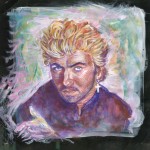
There is also a playful side to the release, symbolised by the wonderfully unexpected cover image featuring George Michael. It is a reminder that experimental music does not have to exist behind a wall of seriousness and academic gloom. Sometimes the most radical gesture is simply allowing beauty, humour and contradiction to coexist. The universe is strange enough already, so perhaps a drone record with a pop icon watching over it is actually the most logical artistic statement possible.
"Cold Shoulder" is therefore not a record about distance despite its title. It is about intimacy achieved through space, about two musicians comfortable enough with each other to leave room for uncertainty. It is music that does not chase the listener but quietly changes the atmosphere around them. A slow-burning conversation between electricity, skin, metal and memory.
After twenty years of collaboration, Ambarchi and Guthrie have produced something that feels neither like a retrospective nor a conclusion. It feels like a continuation, a reminder that experience does not necessarily make artists predictable. Sometimes it simply gives them the confidence to wander further.
And fortunately, they still know how to get wonderfully lost.
The two musicians have been travelling along parallel but wonderfully irregular paths for many years. Australian guitarist and composer Oren Ambarchi has built a singular career by transforming the guitar into something almost unrecognisable: not a traditional harmonic instrument, but a laboratory of vibrations, resonances, electrical ghosts and architectural spaces. His work has moved between experimental electronics, minimalism, improvisation and the physical weight of rock, collaborating with artists as diverse as Jim O’Rourke, Keith Rowe, Keiji Haino and members of Sunn O))).
Will Guthrie, meanwhile, has always approached percussion as a universe rather than a role. A drummer in the most expanded sense of the word, he has explored the relationship between rhythm, objects, electronics and physical resonance, moving from the radical electro-acoustic investigations of his earlier years to a renewed fascination with drums, gongs and gamelan-inspired structures. His Ensemble Nist-Nah project further demonstrates his interest in percussion as a meeting point between cultures, bodies and collective memory.
On "Cold Shoulder", recorded live in Berlin in late 2024, the history between the two artists becomes almost audible. This is not a meeting of strangers searching awkwardly for a common language. It is a conversation between old friends who already know when silence is more important than sound. The album consists of two lengthy pieces, each occupying one side of the vinyl, and this format feels almost inevitable: these are not compositions that demand attention through dramatic gestures, but slow-moving ecosystems where every small change becomes meaningful.
The opening moments reveal Ambarchi’s guitar transformed into a drifting, organ-like presence. His familiar use of Leslie effects creates a sensation of circular movement, as if the sound itself were slowly rotating in a vast empty room. Yet the apparent calm is deceptive. Beneath the surface, tiny shifts constantly reshape the landscape. A harmonic shadow appears, a tone stretches into infinity, a vibration begins to suggest melody before dissolving again. Ambarchi has always been fascinated by the border between recognisable music and pure physical sensation, and here he finds one of his most elegant balances between the two.
Guthrie’s contribution is equally fascinating because of what he chooses not to do. This is not percussion as punctuation, nor rhythm as an obvious driving force. His playing operates like weather: sometimes barely visible, sometimes suddenly revealing the enormous amount of movement hidden inside apparent stillness. Cymbals shimmer like distant metallic reflections, subtle pulses emerge and vanish, and the drums become less a rhythmic machine than a living surface responding to the vibrations around them.
The magic of "Cold Shoulder" lies precisely in this tension between stability and uncertainty. The music feels peaceful, but never passive. It floats, yet never loses direction. Like watching clouds slowly rearrange themselves, it creates the illusion of simplicity while hiding an extraordinary amount of control. Humans have spent centuries inventing increasingly complicated tools to make things easier, then created experimental music to remind themselves that complexity was there all along. A wonderfully inefficient species, really.
The album also represents something important in the wider story of improvisational music: maturity not as reduction, but as freedom. The younger versions of Ambarchi and Guthrie explored extremes, fragmentation, noise and abstraction. Those experiences remain present, but they no longer need to dominate the conversation. The violence has become texture; the chaos has learned patience.
There is also a playful side to the release, symbolised by the wonderfully unexpected cover image featuring George Michael. It is a reminder that experimental music does not have to exist behind a wall of seriousness and academic gloom. Sometimes the most radical gesture is simply allowing beauty, humour and contradiction to coexist. The universe is strange enough already, so perhaps a drone record with a pop icon watching over it is actually the most logical artistic statement possible.
"Cold Shoulder" is therefore not a record about distance despite its title. It is about intimacy achieved through space, about two musicians comfortable enough with each other to leave room for uncertainty. It is music that does not chase the listener but quietly changes the atmosphere around them. A slow-burning conversation between electricity, skin, metal and memory.
After twenty years of collaboration, Ambarchi and Guthrie have produced something that feels neither like a retrospective nor a conclusion. It feels like a continuation, a reminder that experience does not necessarily make artists predictable. Sometimes it simply gives them the confidence to wander further.
And fortunately, they still know how to get wonderfully lost.
Comments
Stream
Browse by Genre
Industrial Music / Industrial Metal / Aggro Industrial / Electro Metal
Industrial Noise / Power Noise / Harsh Noise
Synth Pop / Electro Pop / Synth-Electronica
Techno / Trance / Goa / Drum'n'Bass / Jungle / Tribal / Trip-Hop
Ambient / Electronica / Ethereal / Dub / Soundscapes / Abstract
Experimental / Avantgarde / Weird & Wired / Glitch / Noise / Field Recording
Dark / Gothic / Wave / New Wave / Dark Wave / Industrial Gothic
New Music / Downtown / Avantgarde Jazz / New Classical / World