
Saturday, September 19, 2026
Atonauer: Ocean in A
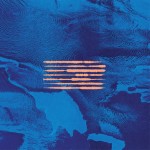


There are many ways of making an album about the ocean. One can record waves, imitate waves, invoke the sublime, stare meaningfully at the horizon and, if absolutely necessary, put a whale somewhere on the cover. Lauri Wuolio chooses a stranger route. For "Ocean in A", his debut as Atonauer, the ocean is not so much represented as approached through a chain of transformations: blue becomes sound, sound becomes vibration, vibration becomes time, and time becomes something that refuses to stay still even when the music barely seems to move.
Atonauer is a new artistic persona for Wuolio, the Finnish composer and sound artist already known internationally through Kumea Sound, whose work has explored handpan-based music, electronics, resonance and spatial experience. The character appeared to him in a dream in 2023 and subsequently developed through writing, drawings and music. Wuolio's background makes the project less surprising than it initially sounds: he studied time- and space-related arts at the Finnish Academy of Fine Arts, has worked extensively across film, theatre, dance and installation, and has spent years considering sound as something that occupies physical space rather than merely travelling through it. His official biography describes Atonauer as a move toward post-ambient, drone and experimental music, and "Ocean in A" as a deliberately simplified exploration of sustained tones and spatial textures.
The strangest and most beautiful part of the album's origin story is the jar. Wuolio had been making abstract blue paintings in Europe until the colour itself began to acquire too much historical baggage. Rather than continuing to paint blue, he scraped the pigment from the canvases, sealed it in a glass jar and carried it with him to America, along with a Sony Walkman and very little else. In New York, a broken Roland Space Echo supplied by his friend Taka, together with Joachim Sala's experimental filtering devices, transformed urban recordings into harmonic abstraction. At some point, blue stopped being something to look at. It became something to hear.
This is more than an eccentric anecdote. It explains why "Ocean in A" feels less like music attempting to describe the sea than an investigation into how one sensory experience can migrate into another. The album is not particularly interested in making us hear “the ocean” in the literal sense. Instead, it asks what qualities associated with blue, depth, water and distance might survive after the image has been removed. What remains is resonance.
The answer begins with "A1", whose low drone is accompanied by a mechanical breathing sound and a series of pulses that refuse to settle into a common tempo. The effect is remarkably physical. The track seems to breathe without possessing a single body, as though several organisms had accidentally synchronised for a moment and then remembered they had better things to do. The entire album revolves around the note A, which functions less as a conventional key than as a fixed point from which the surrounding frequencies can wander.
That choice is crucial. Atonauer's minimalism is not primarily about reducing the number of sounds; it is about increasing the amount of attention available to each one. A single sustained tone can acquire internal movement through overtones, modulation, feedback and tiny changes in density. The note remains apparently static while its surroundings keep revealing new behaviour. Music Map likewise identifies the A as a gravitational centre rather than a conventional constraint, with drones and harmonics generating movement through minute variations rather than conventional harmonic progression.
"A2" moves further into that upper register of perception, where the fundamental tone becomes less important than the frequencies hovering around it. It is the sonic equivalent of looking at one colour until the colour stops being a single thing. The apparent simplicity begins to contain several layers of activity. This is one of the record's most convincing achievements: Wuolio makes stillness feel populated.
Then "A3" reveals the importance of the New York experience. The broken Space Echo and filtering experiments do not merely provide vintage equipment fetishism, although there is certainly enough malfunctioning analogue hardware here to satisfy the traditional experimental-music requirement that at least one machine must appear to have been rescued from a basement. Their real function is transformational. City noise becomes harmonic fog; mechanical imperfection becomes compositional material. The external world is not recorded and presented as documentary evidence. It is reduced, reorganised and allowed to lose its original identity.
That process continues through "A4", perhaps the album's most delicate piece. A minimal whistle passing through the Space Echo acquires the distant character of a foghorn, and suddenly the music seems to inhabit the strange hour before morning properly begins. It is not quite melancholy, not quite peaceful. There is a suspended emotional state here, the peculiar emptiness in which nothing has happened yet but something inevitably will. The attached notes describe it as a moment before emotional impact, and that seems exactly right.
At the centre sits "A5", the eight-minute heart of the record. Here Wuolio's earlier experiments with the Tascam Portastudio and a salvaged 1950s Buescher saxophone become part of the album's transformation of painting into sound. The saxophone is not deployed as a conventional melodic instrument. Its materiality becomes another source of resonance, another surface to be rubbed, stretched and listened to. The ocean finally appears not as scenery but as pressure: something physically overwhelming whose emotional force is even harder to contain.
This distinction matters because "Ocean in A" is ultimately less interested in beauty than in proximity. Wuolio's own framing repeatedly returns to the impossibility of completely comprehending or containing the ocean, blue or time. The album therefore avoids the temptation to provide a musical equivalent of a postcard. It stays close to the phenomenon without pretending to possess it.
"A6" makes that philosophy considerably more concrete. When the old Space Echo begins malfunctioning again, its mechanical noises are fed back into the tape until they produce ghostly, almost choral harmonies. Control becomes an accidental participant. The machine effectively starts composing, or at least starts refusing to obey. This is where the album's technological and philosophical sides meet most successfully: the equipment is not simply a tool used to realise an idea. Its failures become part of the idea.
There is a pleasing circularity in the final "A7". Rhythm returns, but not as a conventional beat. Space itself becomes rhythmic, while the sustained materials accumulated throughout the album begin to suggest the possibility of song. The ending therefore does not resolve the oceanic metaphor. It expands it. What began as breath and a single note has become a much larger question about duration, movement and the limits of representation.
Some external responses have understandably concentrated on the album's minimalism and its submerged, darkly expansive atmosphere. One review also points to the transatlantic journey between Finland and New York as an important dimension of the work. That geographical reading is useful, but "Ocean in A" ultimately makes geography feel secondary to transformation. Finland becomes New York, painting becomes sound, a broken effects unit becomes an instrument, and a particular pitch becomes a place from which an entire album can be imagined.
Wuolio's wider practice helps explain this unusual elasticity. Through Kumea Sound he has worked extensively with handpans and resonant acoustic instruments, while his film, theatre, dance and installation work has accustomed him to thinking about sound in relation to image, movement and physical environment. His long-running interest in spatial experience is especially relevant here: "Ocean in A" does not merely produce a sequence of sounds, it constructs a space in which those sounds can continue happening after the listener has stopped looking for conventional musical events.
The danger with music this restrained is obvious. Minimalism can become minimal effort. A drone can be profound, but it can also be a very expensive way of discovering that nothing happens for eight minutes. "Ocean in A" mostly avoids that trap because Wuolio understands that repetition only becomes interesting when the listener's perception is changing inside it. The sound may remain nearly still, but we do not. That difference is the real engine of the album.
And perhaps that is what the jar of blue ultimately represents. It was never possible to carry the ocean in it. Nor was it possible to carry blue intact from one medium into another. The pigment had to be abandoned as pigment, just as the ocean has to be abandoned as scenery. What survives is the impulse to keep translating one experience into another, knowing perfectly well that something will be lost.
"Ocean in A" is therefore not an album that captures the sea. It is an album about the futility, and strange necessity, of trying. Its seven movements stay anchored to one note while imagining an almost immeasurable space around it. Its machines break, its sounds dissolve, its rhythms wander, and its central colour disappears into vibration. The result is music that understands a useful truth: sometimes the only honest way to hold something vast is to stop trying to hold it at all.
Atonauer is a new artistic persona for Wuolio, the Finnish composer and sound artist already known internationally through Kumea Sound, whose work has explored handpan-based music, electronics, resonance and spatial experience. The character appeared to him in a dream in 2023 and subsequently developed through writing, drawings and music. Wuolio's background makes the project less surprising than it initially sounds: he studied time- and space-related arts at the Finnish Academy of Fine Arts, has worked extensively across film, theatre, dance and installation, and has spent years considering sound as something that occupies physical space rather than merely travelling through it. His official biography describes Atonauer as a move toward post-ambient, drone and experimental music, and "Ocean in A" as a deliberately simplified exploration of sustained tones and spatial textures.
The strangest and most beautiful part of the album's origin story is the jar. Wuolio had been making abstract blue paintings in Europe until the colour itself began to acquire too much historical baggage. Rather than continuing to paint blue, he scraped the pigment from the canvases, sealed it in a glass jar and carried it with him to America, along with a Sony Walkman and very little else. In New York, a broken Roland Space Echo supplied by his friend Taka, together with Joachim Sala's experimental filtering devices, transformed urban recordings into harmonic abstraction. At some point, blue stopped being something to look at. It became something to hear.
This is more than an eccentric anecdote. It explains why "Ocean in A" feels less like music attempting to describe the sea than an investigation into how one sensory experience can migrate into another. The album is not particularly interested in making us hear “the ocean” in the literal sense. Instead, it asks what qualities associated with blue, depth, water and distance might survive after the image has been removed. What remains is resonance.
The answer begins with "A1", whose low drone is accompanied by a mechanical breathing sound and a series of pulses that refuse to settle into a common tempo. The effect is remarkably physical. The track seems to breathe without possessing a single body, as though several organisms had accidentally synchronised for a moment and then remembered they had better things to do. The entire album revolves around the note A, which functions less as a conventional key than as a fixed point from which the surrounding frequencies can wander.
That choice is crucial. Atonauer's minimalism is not primarily about reducing the number of sounds; it is about increasing the amount of attention available to each one. A single sustained tone can acquire internal movement through overtones, modulation, feedback and tiny changes in density. The note remains apparently static while its surroundings keep revealing new behaviour. Music Map likewise identifies the A as a gravitational centre rather than a conventional constraint, with drones and harmonics generating movement through minute variations rather than conventional harmonic progression.
"A2" moves further into that upper register of perception, where the fundamental tone becomes less important than the frequencies hovering around it. It is the sonic equivalent of looking at one colour until the colour stops being a single thing. The apparent simplicity begins to contain several layers of activity. This is one of the record's most convincing achievements: Wuolio makes stillness feel populated.
Then "A3" reveals the importance of the New York experience. The broken Space Echo and filtering experiments do not merely provide vintage equipment fetishism, although there is certainly enough malfunctioning analogue hardware here to satisfy the traditional experimental-music requirement that at least one machine must appear to have been rescued from a basement. Their real function is transformational. City noise becomes harmonic fog; mechanical imperfection becomes compositional material. The external world is not recorded and presented as documentary evidence. It is reduced, reorganised and allowed to lose its original identity.
That process continues through "A4", perhaps the album's most delicate piece. A minimal whistle passing through the Space Echo acquires the distant character of a foghorn, and suddenly the music seems to inhabit the strange hour before morning properly begins. It is not quite melancholy, not quite peaceful. There is a suspended emotional state here, the peculiar emptiness in which nothing has happened yet but something inevitably will. The attached notes describe it as a moment before emotional impact, and that seems exactly right.
At the centre sits "A5", the eight-minute heart of the record. Here Wuolio's earlier experiments with the Tascam Portastudio and a salvaged 1950s Buescher saxophone become part of the album's transformation of painting into sound. The saxophone is not deployed as a conventional melodic instrument. Its materiality becomes another source of resonance, another surface to be rubbed, stretched and listened to. The ocean finally appears not as scenery but as pressure: something physically overwhelming whose emotional force is even harder to contain.
This distinction matters because "Ocean in A" is ultimately less interested in beauty than in proximity. Wuolio's own framing repeatedly returns to the impossibility of completely comprehending or containing the ocean, blue or time. The album therefore avoids the temptation to provide a musical equivalent of a postcard. It stays close to the phenomenon without pretending to possess it.
"A6" makes that philosophy considerably more concrete. When the old Space Echo begins malfunctioning again, its mechanical noises are fed back into the tape until they produce ghostly, almost choral harmonies. Control becomes an accidental participant. The machine effectively starts composing, or at least starts refusing to obey. This is where the album's technological and philosophical sides meet most successfully: the equipment is not simply a tool used to realise an idea. Its failures become part of the idea.
There is a pleasing circularity in the final "A7". Rhythm returns, but not as a conventional beat. Space itself becomes rhythmic, while the sustained materials accumulated throughout the album begin to suggest the possibility of song. The ending therefore does not resolve the oceanic metaphor. It expands it. What began as breath and a single note has become a much larger question about duration, movement and the limits of representation.
Some external responses have understandably concentrated on the album's minimalism and its submerged, darkly expansive atmosphere. One review also points to the transatlantic journey between Finland and New York as an important dimension of the work. That geographical reading is useful, but "Ocean in A" ultimately makes geography feel secondary to transformation. Finland becomes New York, painting becomes sound, a broken effects unit becomes an instrument, and a particular pitch becomes a place from which an entire album can be imagined.
Wuolio's wider practice helps explain this unusual elasticity. Through Kumea Sound he has worked extensively with handpans and resonant acoustic instruments, while his film, theatre, dance and installation work has accustomed him to thinking about sound in relation to image, movement and physical environment. His long-running interest in spatial experience is especially relevant here: "Ocean in A" does not merely produce a sequence of sounds, it constructs a space in which those sounds can continue happening after the listener has stopped looking for conventional musical events.
The danger with music this restrained is obvious. Minimalism can become minimal effort. A drone can be profound, but it can also be a very expensive way of discovering that nothing happens for eight minutes. "Ocean in A" mostly avoids that trap because Wuolio understands that repetition only becomes interesting when the listener's perception is changing inside it. The sound may remain nearly still, but we do not. That difference is the real engine of the album.
And perhaps that is what the jar of blue ultimately represents. It was never possible to carry the ocean in it. Nor was it possible to carry blue intact from one medium into another. The pigment had to be abandoned as pigment, just as the ocean has to be abandoned as scenery. What survives is the impulse to keep translating one experience into another, knowing perfectly well that something will be lost.
"Ocean in A" is therefore not an album that captures the sea. It is an album about the futility, and strange necessity, of trying. Its seven movements stay anchored to one note while imagining an almost immeasurable space around it. Its machines break, its sounds dissolve, its rhythms wander, and its central colour disappears into vibration. The result is music that understands a useful truth: sometimes the only honest way to hold something vast is to stop trying to hold it at all.
Comments
Stream
Browse by Genre
Industrial Music / Industrial Metal / Aggro Industrial / Electro Metal
Industrial Noise / Power Noise / Harsh Noise
Synth Pop / Electro Pop / Synth-Electronica
Techno / Trance / Goa / Drum'n'Bass / Jungle / Tribal / Trip-Hop
Ambient / Electronica / Ethereal / Dub / Soundscapes / Abstract
Experimental / Avantgarde / Weird & Wired / Glitch / Noise / Field Recording
Dark / Gothic / Wave / New Wave / Dark Wave / Industrial Gothic
New Music / Downtown / Avantgarde Jazz / New Classical / World