
Saturday, September 19, 2026
Darkswoon: Antivenom
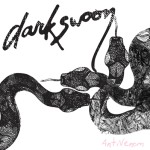


There are albums that use darkness as an aesthetic, and then there are albums that have clearly spent some time finding out what darkness actually costs. "Antivenom", the fourth full-length by Portland trio Darkswoon, belongs to the second category. Its title suggests a cure, but the music is more interested in what happens when the poison has already entered the bloodstream: grief, fear, alienation, anxiety, political exhaustion, damaged relationships, the uneasy business of remaining a person while the surrounding world keeps providing reasons not to bother. Fortunately, Darkswoon have enough musical intelligence not to turn any of this into a sermon. They make beautiful songs about difficult things, which is considerably harder than making miserable music about difficult things.
Darkswoon began as Jana Cushman’s solo project before evolving into the trio heard here, with Cushman on vocals and guitar, Rachel Ellis handling synths, keys, drum machines and rhythm programming, and Norah Lynn supplying bass. That history remains audible in the band's unusual balance between electronic construction and intimate songwriting. The rhythmic machinery can feel precise and almost impersonal, while the bass and guitar continually pull the songs back toward something physical. Cushman's voice occupies the unstable middle ground between the two: airy without becoming fragile, dramatic without resorting to the theatrical excess that gothic music occasionally mistakes for emotional depth. Recent writing on the album has similarly highlighted the way the trio has tightened its identity around darkwave, post-punk, shoegaze and electronic music without allowing those categories to dictate the songs.
The album announces its intentions with "Connective Tissue", a brief instrumental fragment that is less an introduction than a piece of connective material in the literal sense. It is noise, atmosphere and transition compressed into forty seconds. The idea is significant because Darkswoon repeatedly treat the spaces between things as musically meaningful. The band have explained that this kind of passage also reflects what happens during their live performances, when the noise created by Lynn's effects and the preparation of Ellis's electronic setup becomes part of the performance rather than dead time between songs. The record consequently begins not with a declaration but with something half-formed, as if we have walked into a room before everyone has finished setting up.
Then comes "Antivenom", and the album's emotional stakes become clearer. The song was written in response to the death of Nex Benedict and expands from personal grief toward the broader vulnerability experienced by trans people in a hostile political climate. Cushman conceived the title around the idea of music as a counter-agent to the poisons circulating through contemporary life. It is an unusually direct piece of political songwriting for a band whose music otherwise tends toward ambiguity, yet Darkswoon avoid turning the track into a slogan. The electronic pulse gives it a controlled urgency, while the guitars widen the emotional field around Cushman's voice. The result is not optimism, exactly. It is closer to protective instinct converted into sound.
"Pacific City" changes the temperature. Written during a solitary retreat on the Oregon coast, it carries the peculiar quality of music produced away from one's ordinary surroundings, when isolation can be restorative for about twenty minutes before the brain remembers that it came along for the trip. Its atmosphere is more open, but Darkswoon never confuse openness with weightlessness. The bass remains crucial, providing a melodic undertow beneath Ellis' programmed rhythms and Cushman's layers of guitar. That combination gives the music an interesting physical contradiction: the upper frequencies seem to float while the lower ones keep insisting that gravity still exists.
"Thread" is perhaps the clearest demonstration of how effectively Darkswoon can combine songcraft with accumulation. Its central image of a relationship held together by something increasingly difficult to distinguish from a wound is perfectly suited to the band's arrangement. The rhythm keeps moving, the bass pushes forward, guitars spread outward, while Cushman's vocal remains suspended between attachment and exhaustion. Rather than building toward a conventional cathartic release, the track keeps tightening its emotional knot. It is post-punk not because it sounds like an archaeological reconstruction of 1981, but because tension is allowed to remain tension. The track's move toward shoegaze scale has been noted by several contemporary reviewers, but what matters is that the expansion never swallows the underlying song.
That distinction is important across "Antivenom". Darkswoon understand that atmosphere only becomes interesting when there is something underneath it. There are plenty of records in the darkwave and shoegaze neighbourhood where the guitars become enormous and the vocals dissolve into reverb until everyone involved seems to have forgotten what the song was about. Here the opposite happens. The production gives the emotional content more room to operate. Norah Lynn's bass is especially effective because it does not merely mark the bottom of the mix: it behaves melodically, often providing the movement that prevents the songs from becoming static tableaux. Ellis' electronic percussion supplies a harder skeleton, while Cushman's guitars create the surrounding pressure.
"Monochrome" exploits this contrast particularly well. Its title implies reduction, yet the music is anything but flat. The track's emotional world is built from gradations rather than dramatic colour changes, allowing small shifts in texture and intensity to become significant. "Small Death" is more intimate and unsettling, while "Devour My Eyes" pushes further into the band's ability to make density feel simultaneously attractive and vaguely dangerous. The title itself suggests consumption, and the music seems to understand that attraction and threat are not necessarily opposites. Sometimes the beautiful thing is precisely what you should probably stop staring at.
"Blood Let" is one of the album's most complicated pieces because its musical history mirrors its subject. Cushman originally conceived it as a slower ballad before the band dismantled and reconstructed the material. The final version deals with abandonment, disillusionment, the uneasy relationship between mind and body, and the physical experience that inspired part of its imagery. What could have become an overly literal confessional instead acquires a strangely fragmented momentum. The song sounds as though it is trying to put itself back together while simultaneously questioning whether the original shape deserves to survive.
Then comes "x3", the album's most overtly political and arguably most abrasive moment. Its perspective broadens from private damage toward ecological collapse, inequality, concentrated wealth and the fear of what kind of future is being prepared by people who appear remarkably confident that consequences are a problem for somebody else. The band's response is not subtle, and it does not need to be. The track has the feeling of an alarm that has been ringing for so long that silence would now be more disturbing than noise. Yet even here Darkswoon retain their sense of structure. The anger is channelled rather than sprayed across the walls.
The closing "Going Dark" is consequently more interesting than a simple descent into despair. It considers withdrawal, the desire to disappear from systems that seem increasingly hostile, and the possibility of finding value outside the logic of scarcity and acquisition. But the song remains ambivalent about disappearance. There is a pull toward retreat and another toward staying. That unresolved tension is one of the album's defining qualities. Darkswoon do not manufacture closure because the subjects they address do not conveniently come with an eleventh track called "Everything Is Fine Now". The album ends with uncertainty still breathing.
There is a slight danger in a record this committed to a consistent emotional climate: several songs inhabit similar tempos, densities and tonal colours, and one contemporary review has pointed out that individual tracks can occasionally blur into the larger sequence. Yet in "Antivenom" that continuity also serves a purpose. These songs feel less like ten separate episodes than different rooms in the same troubled house. You can move from one to another, but the atmosphere follows you.
What ultimately makes the album work is that Darkswoon never confuse vulnerability with weakness. Cushman's lyrics can be painfully exposed, but the arrangements refuse to sentimentalise them. The cold electronics, muscular bass, programmed rhythms and increasingly expansive guitars provide resistance around the voice. The songs therefore become places where fragility has to coexist with structure. Even the record's most beautiful passages have something slightly clenched inside them.
"Antivenom" does not really offer an antidote to anything. That would be too easy, and probably rather insulting to anyone who has actually had to live through the things these songs describe. What it offers instead is a form of chemical counterpressure: sound meeting poison without pretending to neutralise it completely. The wounds remain visible. So does fear. So does anger. But so does connection, stubbornly refusing to die.
For a band working in music traditionally associated with beautifully arranged misery, that may be Darkswoon's most useful trick. They do not make darkness comfortable. They make it articulate.
Darkswoon began as Jana Cushman’s solo project before evolving into the trio heard here, with Cushman on vocals and guitar, Rachel Ellis handling synths, keys, drum machines and rhythm programming, and Norah Lynn supplying bass. That history remains audible in the band's unusual balance between electronic construction and intimate songwriting. The rhythmic machinery can feel precise and almost impersonal, while the bass and guitar continually pull the songs back toward something physical. Cushman's voice occupies the unstable middle ground between the two: airy without becoming fragile, dramatic without resorting to the theatrical excess that gothic music occasionally mistakes for emotional depth. Recent writing on the album has similarly highlighted the way the trio has tightened its identity around darkwave, post-punk, shoegaze and electronic music without allowing those categories to dictate the songs.
The album announces its intentions with "Connective Tissue", a brief instrumental fragment that is less an introduction than a piece of connective material in the literal sense. It is noise, atmosphere and transition compressed into forty seconds. The idea is significant because Darkswoon repeatedly treat the spaces between things as musically meaningful. The band have explained that this kind of passage also reflects what happens during their live performances, when the noise created by Lynn's effects and the preparation of Ellis's electronic setup becomes part of the performance rather than dead time between songs. The record consequently begins not with a declaration but with something half-formed, as if we have walked into a room before everyone has finished setting up.
Then comes "Antivenom", and the album's emotional stakes become clearer. The song was written in response to the death of Nex Benedict and expands from personal grief toward the broader vulnerability experienced by trans people in a hostile political climate. Cushman conceived the title around the idea of music as a counter-agent to the poisons circulating through contemporary life. It is an unusually direct piece of political songwriting for a band whose music otherwise tends toward ambiguity, yet Darkswoon avoid turning the track into a slogan. The electronic pulse gives it a controlled urgency, while the guitars widen the emotional field around Cushman's voice. The result is not optimism, exactly. It is closer to protective instinct converted into sound.
"Pacific City" changes the temperature. Written during a solitary retreat on the Oregon coast, it carries the peculiar quality of music produced away from one's ordinary surroundings, when isolation can be restorative for about twenty minutes before the brain remembers that it came along for the trip. Its atmosphere is more open, but Darkswoon never confuse openness with weightlessness. The bass remains crucial, providing a melodic undertow beneath Ellis' programmed rhythms and Cushman's layers of guitar. That combination gives the music an interesting physical contradiction: the upper frequencies seem to float while the lower ones keep insisting that gravity still exists.
"Thread" is perhaps the clearest demonstration of how effectively Darkswoon can combine songcraft with accumulation. Its central image of a relationship held together by something increasingly difficult to distinguish from a wound is perfectly suited to the band's arrangement. The rhythm keeps moving, the bass pushes forward, guitars spread outward, while Cushman's vocal remains suspended between attachment and exhaustion. Rather than building toward a conventional cathartic release, the track keeps tightening its emotional knot. It is post-punk not because it sounds like an archaeological reconstruction of 1981, but because tension is allowed to remain tension. The track's move toward shoegaze scale has been noted by several contemporary reviewers, but what matters is that the expansion never swallows the underlying song.
That distinction is important across "Antivenom". Darkswoon understand that atmosphere only becomes interesting when there is something underneath it. There are plenty of records in the darkwave and shoegaze neighbourhood where the guitars become enormous and the vocals dissolve into reverb until everyone involved seems to have forgotten what the song was about. Here the opposite happens. The production gives the emotional content more room to operate. Norah Lynn's bass is especially effective because it does not merely mark the bottom of the mix: it behaves melodically, often providing the movement that prevents the songs from becoming static tableaux. Ellis' electronic percussion supplies a harder skeleton, while Cushman's guitars create the surrounding pressure.
"Monochrome" exploits this contrast particularly well. Its title implies reduction, yet the music is anything but flat. The track's emotional world is built from gradations rather than dramatic colour changes, allowing small shifts in texture and intensity to become significant. "Small Death" is more intimate and unsettling, while "Devour My Eyes" pushes further into the band's ability to make density feel simultaneously attractive and vaguely dangerous. The title itself suggests consumption, and the music seems to understand that attraction and threat are not necessarily opposites. Sometimes the beautiful thing is precisely what you should probably stop staring at.
"Blood Let" is one of the album's most complicated pieces because its musical history mirrors its subject. Cushman originally conceived it as a slower ballad before the band dismantled and reconstructed the material. The final version deals with abandonment, disillusionment, the uneasy relationship between mind and body, and the physical experience that inspired part of its imagery. What could have become an overly literal confessional instead acquires a strangely fragmented momentum. The song sounds as though it is trying to put itself back together while simultaneously questioning whether the original shape deserves to survive.
Then comes "x3", the album's most overtly political and arguably most abrasive moment. Its perspective broadens from private damage toward ecological collapse, inequality, concentrated wealth and the fear of what kind of future is being prepared by people who appear remarkably confident that consequences are a problem for somebody else. The band's response is not subtle, and it does not need to be. The track has the feeling of an alarm that has been ringing for so long that silence would now be more disturbing than noise. Yet even here Darkswoon retain their sense of structure. The anger is channelled rather than sprayed across the walls.
The closing "Going Dark" is consequently more interesting than a simple descent into despair. It considers withdrawal, the desire to disappear from systems that seem increasingly hostile, and the possibility of finding value outside the logic of scarcity and acquisition. But the song remains ambivalent about disappearance. There is a pull toward retreat and another toward staying. That unresolved tension is one of the album's defining qualities. Darkswoon do not manufacture closure because the subjects they address do not conveniently come with an eleventh track called "Everything Is Fine Now". The album ends with uncertainty still breathing.
There is a slight danger in a record this committed to a consistent emotional climate: several songs inhabit similar tempos, densities and tonal colours, and one contemporary review has pointed out that individual tracks can occasionally blur into the larger sequence. Yet in "Antivenom" that continuity also serves a purpose. These songs feel less like ten separate episodes than different rooms in the same troubled house. You can move from one to another, but the atmosphere follows you.
What ultimately makes the album work is that Darkswoon never confuse vulnerability with weakness. Cushman's lyrics can be painfully exposed, but the arrangements refuse to sentimentalise them. The cold electronics, muscular bass, programmed rhythms and increasingly expansive guitars provide resistance around the voice. The songs therefore become places where fragility has to coexist with structure. Even the record's most beautiful passages have something slightly clenched inside them.
"Antivenom" does not really offer an antidote to anything. That would be too easy, and probably rather insulting to anyone who has actually had to live through the things these songs describe. What it offers instead is a form of chemical counterpressure: sound meeting poison without pretending to neutralise it completely. The wounds remain visible. So does fear. So does anger. But so does connection, stubbornly refusing to die.
For a band working in music traditionally associated with beautifully arranged misery, that may be Darkswoon's most useful trick. They do not make darkness comfortable. They make it articulate.
Comments
Stream
Browse by Genre
Industrial Music / Industrial Metal / Aggro Industrial / Electro Metal
Industrial Noise / Power Noise / Harsh Noise
Synth Pop / Electro Pop / Synth-Electronica
Techno / Trance / Goa / Drum'n'Bass / Jungle / Tribal / Trip-Hop
Ambient / Electronica / Ethereal / Dub / Soundscapes / Abstract
Experimental / Avantgarde / Weird & Wired / Glitch / Noise / Field Recording
Dark / Gothic / Wave / New Wave / Dark Wave / Industrial Gothic
New Music / Downtown / Avantgarde Jazz / New Classical / World