
Friday, September 18, 2026
Astari Nite: Medications In Bloom
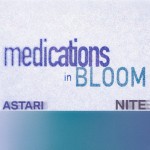
Artist: Astari Nite (@)
Title: Medications In Bloom
Format: CD + Download
Label: Kale Shelter Studios
Rated:


Title: Medications In Bloom
Format: CD + Download
Label: Kale Shelter Studios
Rated:
There is something almost suspiciously cheerful about "Medications In Bloom". The title sounds like a pharmaceutical company has finally discovered the benefits of flower arranging, while the songs themselves move through romance, vanity, loneliness, sexual confusion, disappointment and decay with the elegant disobedience of people who have decided that misery does not get to dictate the dress code. For Astari Nite, darkness has never been merely an aesthetic colour, but this six-track EP suggests that even the darkest wardrobe occasionally needs something violently pink.
Formed in Miami around vocalist Mychael Ghost and drummer Illia Tulloch, with Howard Melnick on guitar and Danny Ae on synthesizer and bass, Astari Nite have spent more than a decade negotiating the territory between alternative rock, post-punk, new wave and dark glam. Their history includes appearances alongside figures ranging from Peter Murphy and The Damned to Clan of Xymox, Peter Hook and the Psychedelic Furs, while their recent records have gradually loosened the band's relationship with conventional goth gloom. "Resolution Of Happiness" already pushed toward a brighter, more 1990s-inflected vocabulary, retaining the nocturnal atmosphere while allowing more colour and melodic eccentricity into the room. Contemporary reviews have noticed precisely that expansion, describing a band increasingly comfortable with glam, alternative rock, shoegaze and synth-driven textures rather than simply reproducing darkwave orthodoxy.
"Medications In Bloom" takes that development somewhere stranger and, importantly, more personal. Its title comes from Ghost's experience of accompanying his seriously ill mother through years of medical appointments and prescription refills, where flowers, medication alerts, childhood memories and the repetitive bureaucracy of care become tangled together. That background changes the way the EP's apparent frivolity reads. Glamour is not necessarily denial here. It can also be an act of maintenance: putting on the lipstick, making the joke, buying the flowers, continuing to participate in the world when circumstances would make retreat considerably easier.
The opening “Why Are You So Lame” establishes this attitude beautifully by refusing to choose between vulnerability and mockery. Its lyrics keep slipping between romantic disappointment, self-conscious posing and absurd little objects of desire, turning the language of seduction into something almost deliberately unstable. The song's central complaint is less “you hurt me” than “your performance is embarrassing,” which is a wonderfully petty distinction and therefore a very human one. Beneath the sarcasm, though, there is loneliness: the singer wants to be seen while simultaneously distrusting the theatrical machinery through which people attempt to see one another. Astari Nite understand that glamour is often just insecurity with better lighting.
Then comes “Dry Shampoo X”, perhaps the EP's most immediate demonstration of its preference for motion over solemnity. The song seems to take fragments of alternative-rock romance, disco imagery and slightly deranged pop language and shake them together until they become something brightly bruised. The emotional narrative repeatedly collapses into consumer spaces, bedrooms and strange little observations, as if heartbreak has been forced to shop for groceries. The contrast is important: rather than making romantic failure monumental, Astari Nite make it ridiculous, which can sometimes be a more accurate form of grief. A recent review similarly identified the track's more explosive rock character as a continuation of the band's move away from their earlier death-rock beginnings.
“Lennon Yellow Tangerine” shifts the temperature. Its title alone sounds like an object assembled from pop-cultural residue, colour, memory and a mildly unreliable dream. The song's repeated telephone imagery creates an intimate but unstable relationship between wanting contact and wanting escape. The request to call becomes almost immediately followed by the desire to be left alone, while the mysterious queen, nameless waitress and submarine tambourine inhabit a private mythology that makes very little effort to explain itself. This is one of the EP's strengths: Astari Nite can write lyrics that sound frivolous on first encounter but become increasingly suggestive when their images are allowed to remain unresolved. The darkness is there, but it has learned how to accessorise.
The two revamped pieces, “Unisex Games” and “Miss Rain On My Parade”, reveal another characteristic of the record: Astari Nite are not interested in treating their own back catalogue as sacred furniture. Both songs are revisited with the knowledge of a band that has changed since their earlier incarnations. “Unisex Games” is particularly unruly, turning desire, jealousy, friendship and sexual games into a collage of damaged memories and flamboyant self-incrimination. Its repeated accusation that guilt is petty sounds almost like a moral philosophy reduced to a nightclub chant. “Miss Rain On My Parade,” meanwhile, places the EP's central idea almost nakedly on the table: validation is wanted, rejected, demanded and mocked simultaneously. The song's imagery of makeup, pills, rain and ashtray residue makes self-presentation feel less like vanity than a survival technique.
That tension reaches its most tender form in “I Lack Nutrition”. Beneath its deliberately awkward title is a breakup song that gradually reveals a much more serious fear: what happens to affection when the relationship has already become part of your body's routine? The repeated desire to remain friends is surrounded by uncertainty, contradictory impulses and the fear of waking up to an absence that cannot be repaired. Even the familiar romantic sunshine metaphor becomes uncomfortable because the song keeps questioning whether the beloved is actually a source of nourishment or merely another dependency. The title therefore turns emotional hunger into physical comedy, and then quietly removes the joke.
Musically, the EP sits in the space Astari Nite have been cultivating over recent years: alternative rock with post-punk bones, new-wave colour, dark-glam theatricality and a conspicuous affection for the 1990s. Previous coverage of "Resolution Of Happiness" noted the band's tendency toward unusually dense guitars, forceful drums and a bass approach less rigid than traditional post-punk marching patterns, while other writing around the band has highlighted the combination of Bowie-like theatricality with darker alternative textures. On "Medications In Bloom", those ingredients feel less like a collection of influences and more like a wardrobe the band has finally stopped apologising for wearing.
What makes the EP interesting, however, is not simply that Astari Nite sound brighter. Plenty of dark bands eventually discover colour, usually somewhere around the point where someone in the studio says “perhaps we should try a major chord”. Here the brightness is psychologically connected to the subject matter. The record understands that positivity can be defensive, theatrical, even slightly ridiculous, and still be genuine. A person can be grieving and glamorous. Someone can be exhausted and flirtatious. You can spend years inside hospitals and still notice the flowers. You can be frightened and tell somebody to wear better lipstick.
That is where "Medications In Bloom" earns its title. Medication does not magically transform suffering into happiness, and flowers do not make illness disappear. The phrase instead joins two things that are usually kept apart: clinical repetition and sensual beauty, maintenance and decoration, vulnerability and performance. Astari Nite turn that collision into pop music without ironing out its contradictions.
There is something oddly reassuring in that. Not because the EP pretends everything will be fine, but because it refuses the rather exhausting cultural assumption that seriousness must always look miserable. Sometimes survival arrives wearing eyeliner. Sometimes it laughs at the wrong moment. Sometimes it writes a six-song record about desire, decay and pharmaceutical notifications and decides that the appropriate response to all of it is, somehow, to bloom.
Formed in Miami around vocalist Mychael Ghost and drummer Illia Tulloch, with Howard Melnick on guitar and Danny Ae on synthesizer and bass, Astari Nite have spent more than a decade negotiating the territory between alternative rock, post-punk, new wave and dark glam. Their history includes appearances alongside figures ranging from Peter Murphy and The Damned to Clan of Xymox, Peter Hook and the Psychedelic Furs, while their recent records have gradually loosened the band's relationship with conventional goth gloom. "Resolution Of Happiness" already pushed toward a brighter, more 1990s-inflected vocabulary, retaining the nocturnal atmosphere while allowing more colour and melodic eccentricity into the room. Contemporary reviews have noticed precisely that expansion, describing a band increasingly comfortable with glam, alternative rock, shoegaze and synth-driven textures rather than simply reproducing darkwave orthodoxy.
"Medications In Bloom" takes that development somewhere stranger and, importantly, more personal. Its title comes from Ghost's experience of accompanying his seriously ill mother through years of medical appointments and prescription refills, where flowers, medication alerts, childhood memories and the repetitive bureaucracy of care become tangled together. That background changes the way the EP's apparent frivolity reads. Glamour is not necessarily denial here. It can also be an act of maintenance: putting on the lipstick, making the joke, buying the flowers, continuing to participate in the world when circumstances would make retreat considerably easier.
The opening “Why Are You So Lame” establishes this attitude beautifully by refusing to choose between vulnerability and mockery. Its lyrics keep slipping between romantic disappointment, self-conscious posing and absurd little objects of desire, turning the language of seduction into something almost deliberately unstable. The song's central complaint is less “you hurt me” than “your performance is embarrassing,” which is a wonderfully petty distinction and therefore a very human one. Beneath the sarcasm, though, there is loneliness: the singer wants to be seen while simultaneously distrusting the theatrical machinery through which people attempt to see one another. Astari Nite understand that glamour is often just insecurity with better lighting.
Then comes “Dry Shampoo X”, perhaps the EP's most immediate demonstration of its preference for motion over solemnity. The song seems to take fragments of alternative-rock romance, disco imagery and slightly deranged pop language and shake them together until they become something brightly bruised. The emotional narrative repeatedly collapses into consumer spaces, bedrooms and strange little observations, as if heartbreak has been forced to shop for groceries. The contrast is important: rather than making romantic failure monumental, Astari Nite make it ridiculous, which can sometimes be a more accurate form of grief. A recent review similarly identified the track's more explosive rock character as a continuation of the band's move away from their earlier death-rock beginnings.
“Lennon Yellow Tangerine” shifts the temperature. Its title alone sounds like an object assembled from pop-cultural residue, colour, memory and a mildly unreliable dream. The song's repeated telephone imagery creates an intimate but unstable relationship between wanting contact and wanting escape. The request to call becomes almost immediately followed by the desire to be left alone, while the mysterious queen, nameless waitress and submarine tambourine inhabit a private mythology that makes very little effort to explain itself. This is one of the EP's strengths: Astari Nite can write lyrics that sound frivolous on first encounter but become increasingly suggestive when their images are allowed to remain unresolved. The darkness is there, but it has learned how to accessorise.
The two revamped pieces, “Unisex Games” and “Miss Rain On My Parade”, reveal another characteristic of the record: Astari Nite are not interested in treating their own back catalogue as sacred furniture. Both songs are revisited with the knowledge of a band that has changed since their earlier incarnations. “Unisex Games” is particularly unruly, turning desire, jealousy, friendship and sexual games into a collage of damaged memories and flamboyant self-incrimination. Its repeated accusation that guilt is petty sounds almost like a moral philosophy reduced to a nightclub chant. “Miss Rain On My Parade,” meanwhile, places the EP's central idea almost nakedly on the table: validation is wanted, rejected, demanded and mocked simultaneously. The song's imagery of makeup, pills, rain and ashtray residue makes self-presentation feel less like vanity than a survival technique.
That tension reaches its most tender form in “I Lack Nutrition”. Beneath its deliberately awkward title is a breakup song that gradually reveals a much more serious fear: what happens to affection when the relationship has already become part of your body's routine? The repeated desire to remain friends is surrounded by uncertainty, contradictory impulses and the fear of waking up to an absence that cannot be repaired. Even the familiar romantic sunshine metaphor becomes uncomfortable because the song keeps questioning whether the beloved is actually a source of nourishment or merely another dependency. The title therefore turns emotional hunger into physical comedy, and then quietly removes the joke.
Musically, the EP sits in the space Astari Nite have been cultivating over recent years: alternative rock with post-punk bones, new-wave colour, dark-glam theatricality and a conspicuous affection for the 1990s. Previous coverage of "Resolution Of Happiness" noted the band's tendency toward unusually dense guitars, forceful drums and a bass approach less rigid than traditional post-punk marching patterns, while other writing around the band has highlighted the combination of Bowie-like theatricality with darker alternative textures. On "Medications In Bloom", those ingredients feel less like a collection of influences and more like a wardrobe the band has finally stopped apologising for wearing.
What makes the EP interesting, however, is not simply that Astari Nite sound brighter. Plenty of dark bands eventually discover colour, usually somewhere around the point where someone in the studio says “perhaps we should try a major chord”. Here the brightness is psychologically connected to the subject matter. The record understands that positivity can be defensive, theatrical, even slightly ridiculous, and still be genuine. A person can be grieving and glamorous. Someone can be exhausted and flirtatious. You can spend years inside hospitals and still notice the flowers. You can be frightened and tell somebody to wear better lipstick.
That is where "Medications In Bloom" earns its title. Medication does not magically transform suffering into happiness, and flowers do not make illness disappear. The phrase instead joins two things that are usually kept apart: clinical repetition and sensual beauty, maintenance and decoration, vulnerability and performance. Astari Nite turn that collision into pop music without ironing out its contradictions.
There is something oddly reassuring in that. Not because the EP pretends everything will be fine, but because it refuses the rather exhausting cultural assumption that seriousness must always look miserable. Sometimes survival arrives wearing eyeliner. Sometimes it laughs at the wrong moment. Sometimes it writes a six-song record about desire, decay and pharmaceutical notifications and decides that the appropriate response to all of it is, somehow, to bloom.
Comments
Stream
Browse by Genre
Industrial Music / Industrial Metal / Aggro Industrial / Electro Metal
Industrial Noise / Power Noise / Harsh Noise
Synth Pop / Electro Pop / Synth-Electronica
Techno / Trance / Goa / Drum'n'Bass / Jungle / Tribal / Trip-Hop
Ambient / Electronica / Ethereal / Dub / Soundscapes / Abstract
Experimental / Avantgarde / Weird & Wired / Glitch / Noise / Field Recording
Dark / Gothic / Wave / New Wave / Dark Wave / Industrial Gothic
New Music / Downtown / Avantgarde Jazz / New Classical / World