
Damage Control & Leæther Strip: Master Of Silence EP
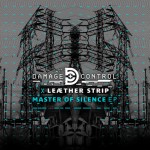
Artist: Damage Control & Leæther Strip
Title: Master Of Silence EP
Format: Download Only (MP3 + Lossless)
Label: Metropolis (@)
Rated:

Title: Master Of Silence EP
Format: Download Only (MP3 + Lossless)
Label: Metropolis (@)
Rated:
Industrial music has never suffered from a shortage of things being called "Rage", "Oblivion", "Obstacles" or "Crowned". It is practically a genre requirement, somewhere between distortion and a black-and-white photograph of a factory. The interesting question is what musicians actually do with such vocabulary once the familiar machinery is switched on. On "Master Of Silence", Damage Control and Leæther Strip approach the territory from a position of considerable experience, and the result is more nuanced than its titles might initially suggest.
Damage Control is an international electro-industrial collaboration centred on Australians Bill Barsby, Richard Thacker and Alex Wise, with Markus App from Germany among the wider creative network. Barsby and Thacker originally come from Birmingham, giving the project an interesting geographical collision between British industrial lineage and its later Australian incarnation. Their 2017 debut "Ultranoia" established a habit of working with outside musicians, and "Master Of Silence" extends that principle by placing Danish electro-industrial veteran Claus Larsen in the vocal foreground. Larsen has been operating as Leæther Strip since the late 1980s, becoming one of the defining figures in the development of European EBM and electro-industrial music, while also repeatedly bending that vocabulary toward darker, stranger or more melodic territory.
There is consequently no need here for anyone to prove their industrial credentials by hitting the distortion pedal with a large object. The production team already tells much of the story. Chris Peterson, whose résumé includes Front Line Assembly, Noise Unit and Unit:187, handles production, with Greg Reely, associated with Skinny Puppy, Front Line Assembly and Fear Factory, on engineering duties. Peterson also contributes synthesizer parts to “Obstacles”, while Josh Rombout of SIRUS adds programming to the same track. The result is suitably polished without becoming antiseptic, preserving the blunt physicality that electro-industrial music requires while allowing enough detail for the arrangements to breathe.
"Oblivion" opens the EP with an immediately recognisable combination of programmed momentum, hard-edged electronic textures and Larsen's unmistakable delivery. Yet the track is less interested in sheer punishment than in pressure. The rhythm has weight, but the arrangement leaves enough space around it for the synth layers to acquire shape. Larsen's voice provides the human element without softening anything. His performance carries the accumulated authority of somebody who has spent decades making electronic music sound confrontational, but there is no sense of him simply reenacting his own past.
That distinction matters. A guest appearance by an established industrial vocalist can easily become a karaoke version of the 1990s, with everybody politely agreeing that the old sounds were better before moving on to the next track. "Master Of Silence" avoids that trap because Larsen is incorporated into Damage Control's electronic framework rather than being treated as a historical artefact. His voice is part of the architecture, not a nostalgic sticker placed on top of it.
“Rage” makes this even clearer. The track's title is admirably economical, but the music does not behave like an instruction manual for anger. Its propulsion is controlled, with the rhythm section pushing forward while the synth programming gives the track a colder, more spacious contour. The aggression is therefore functional rather than theatrical. There is enough force to work on a dancefloor, but also enough restraint to keep the track from collapsing into the industrial equivalent of somebody repeatedly shouting at a printer.
Larsen is especially effective because his voice has always possessed an unusual combination of severity and personality. In the Leæther Strip catalogue, harsh electronics have frequently been balanced by melodic instincts, theatrical phrasing and an ability to make machine-driven music feel surprisingly personal. His long career has included everything from hard EBM to more experimental and symphonic approaches, and he has continued to release and perform well beyond the period in which the style was supposedly destined for the historical basement. On these four tracks, that history is useful without becoming a burden.
“Obstacles” is perhaps the most revealing piece because the production becomes more layered. Peterson's additional synth work and Rombout's programming give the track a denser electronic surface, while the rhythm remains sharply defined. The arrangement seems to operate through competing layers of insistence: one pattern establishes a direction, another interferes with it, and the vocal rides above the resulting friction. This is where Damage Control's collaborative nature becomes audible. Rather than simply adding another musician to a completed formula, the extra contributors alter the internal balance of the track.
There is also a useful irony in the title. Industrial music has been writing songs about obstacles for decades, usually while constructing an enormous rhythmic object specifically designed to run straight through them. Here the obstacle is less an external enemy than a structural principle. The track keeps introducing elements that make its own movement slightly more complicated, and therefore more interesting.
"Crowned" closes the EP with perhaps the most ceremonial atmosphere of the four. The title suggests triumph, authority and all the usual paraphernalia of industrial grandeur, but the music is more ambiguous. The synthesizers provide a darkly polished surface while the rhythm retains the physical insistence of EBM. Larsen's voice gives the track its sense of command, yet the production avoids turning that authority into bombast. It feels less like somebody being handed a crown than somebody wondering what, exactly, the crown is supposed to accomplish.
Taken together, the four tracks work because they occupy a useful middle ground between club functionality and studio detail. The rhythms are strong enough to give the music bodily momentum, but the production rewards attention away from the dancefloor too. This is partly due to the experience behind the controls. Peterson and Reely have been involved with Damage Control since "Ultranoia", and their continuing presence gives the project a sonic consistency even as its guest collaborations change.
The collaboration with Larsen also makes sense historically. Leæther Strip was founded as a solo project in 1988 and emerged during the period when EBM and electro-industrial music were developing their defining vocabulary in Europe. Larsen became particularly associated with the German Zoth Ommog scene and later maintained a remarkably durable career through label changes, stylistic shifts and periods of renewed activity. His participation therefore brings more than a familiar voice. It introduces a performer whose own history is embedded in the musical language Damage Control are using.
What makes "Master Of Silence" successful, however, is that it does not attempt to turn that history into a ceremonial reunion. There is no need for the tracks to sound as though they were retrieved from a forgotten warehouse containing obsolete drum machines and several extremely angry German club promoters. The production is contemporary, clean and deliberately muscular. At the same time, it understands that electro-industrial music does not need to disguise its physical origins. Bass frequencies still have to move the body. Percussion still has to hit somewhere below the intellect. A synth line can be both a compositional element and a piece of machinery with an attitude problem.
The EP's brevity helps enormously. Nineteen minutes is enough time to establish a world without requiring the listener to sign a long-term lease. Each track has a clear identity, but the four pieces also form a coherent sequence: darkness and pressure in “Oblivion”, more direct propulsion in “Rage”, increased textural complexity in “Obstacles”, and a slightly more imposing finale in “Crowned”. There is no unnecessary interlude, ambient corridor or five-minute passage in which somebody presumably adjusts the lighting.
Most importantly, Master Of Silence understands the difference between heaviness and density. Heavy music does not necessarily need to contain more sounds. Sometimes it is the spacing between them, the weight of a bass pulse, the dry impact of percussion or the contrast between a controlled electronic arrangement and a very human voice that creates the sensation of mass. Damage Control and Larsen use those contrasts effectively.
The EP also functions as a useful preview of Damage Control's developing Oblivion Grid cycle. The project has always relied on international collaboration, but this particular combination feels unusually coherent. Larsen does not merely lend his name to four tracks. His voice becomes a connecting element between the group's Australian electronic foundation and a lineage of European EBM that reaches back more than three decades.
There is nothing revolutionary about making electro-industrial music in 2026. That is precisely why doing it convincingly requires some care. The genre has accumulated so many established gestures that the danger is not failure but automatic competence: the correct kick drum, the correct vocal distortion, the correct ominous title, the correct photograph in which everyone looks as though they have recently been informed that joy is illegal. Master Of Silence works because its musicians understand those conventions well enough to manipulate them rather than merely obey them.
It is not an attempt to reinvent industrial music, nor does it need to be. Its achievement is more practical and arguably more valuable: four tightly constructed tracks that respect the genre's physical power while giving their collaborators enough room to remain recognisable. Damage Control provide the electronic framework; Claus Larsen supplies a voice with history, character and considerable bite; Peterson and Reely make sure the whole arrangement arrives with the necessary precision.
The result is a compact, disciplined EP that sounds neither trapped in its lineage nor embarrassed by it. Master Of Silence knows exactly what kind of music it is making, which in an age of increasingly complicated genre labels is almost an act of civil disobedience. The silence in the title may therefore be less about absence than about control: knowing when to let the machinery speak, when to pull something back, and when four people in different parts of the world can make an old musical language sound usefully alive again.
Damage Control is an international electro-industrial collaboration centred on Australians Bill Barsby, Richard Thacker and Alex Wise, with Markus App from Germany among the wider creative network. Barsby and Thacker originally come from Birmingham, giving the project an interesting geographical collision between British industrial lineage and its later Australian incarnation. Their 2017 debut "Ultranoia" established a habit of working with outside musicians, and "Master Of Silence" extends that principle by placing Danish electro-industrial veteran Claus Larsen in the vocal foreground. Larsen has been operating as Leæther Strip since the late 1980s, becoming one of the defining figures in the development of European EBM and electro-industrial music, while also repeatedly bending that vocabulary toward darker, stranger or more melodic territory.
There is consequently no need here for anyone to prove their industrial credentials by hitting the distortion pedal with a large object. The production team already tells much of the story. Chris Peterson, whose résumé includes Front Line Assembly, Noise Unit and Unit:187, handles production, with Greg Reely, associated with Skinny Puppy, Front Line Assembly and Fear Factory, on engineering duties. Peterson also contributes synthesizer parts to “Obstacles”, while Josh Rombout of SIRUS adds programming to the same track. The result is suitably polished without becoming antiseptic, preserving the blunt physicality that electro-industrial music requires while allowing enough detail for the arrangements to breathe.
"Oblivion" opens the EP with an immediately recognisable combination of programmed momentum, hard-edged electronic textures and Larsen's unmistakable delivery. Yet the track is less interested in sheer punishment than in pressure. The rhythm has weight, but the arrangement leaves enough space around it for the synth layers to acquire shape. Larsen's voice provides the human element without softening anything. His performance carries the accumulated authority of somebody who has spent decades making electronic music sound confrontational, but there is no sense of him simply reenacting his own past.
That distinction matters. A guest appearance by an established industrial vocalist can easily become a karaoke version of the 1990s, with everybody politely agreeing that the old sounds were better before moving on to the next track. "Master Of Silence" avoids that trap because Larsen is incorporated into Damage Control's electronic framework rather than being treated as a historical artefact. His voice is part of the architecture, not a nostalgic sticker placed on top of it.
“Rage” makes this even clearer. The track's title is admirably economical, but the music does not behave like an instruction manual for anger. Its propulsion is controlled, with the rhythm section pushing forward while the synth programming gives the track a colder, more spacious contour. The aggression is therefore functional rather than theatrical. There is enough force to work on a dancefloor, but also enough restraint to keep the track from collapsing into the industrial equivalent of somebody repeatedly shouting at a printer.
Larsen is especially effective because his voice has always possessed an unusual combination of severity and personality. In the Leæther Strip catalogue, harsh electronics have frequently been balanced by melodic instincts, theatrical phrasing and an ability to make machine-driven music feel surprisingly personal. His long career has included everything from hard EBM to more experimental and symphonic approaches, and he has continued to release and perform well beyond the period in which the style was supposedly destined for the historical basement. On these four tracks, that history is useful without becoming a burden.
“Obstacles” is perhaps the most revealing piece because the production becomes more layered. Peterson's additional synth work and Rombout's programming give the track a denser electronic surface, while the rhythm remains sharply defined. The arrangement seems to operate through competing layers of insistence: one pattern establishes a direction, another interferes with it, and the vocal rides above the resulting friction. This is where Damage Control's collaborative nature becomes audible. Rather than simply adding another musician to a completed formula, the extra contributors alter the internal balance of the track.
There is also a useful irony in the title. Industrial music has been writing songs about obstacles for decades, usually while constructing an enormous rhythmic object specifically designed to run straight through them. Here the obstacle is less an external enemy than a structural principle. The track keeps introducing elements that make its own movement slightly more complicated, and therefore more interesting.
"Crowned" closes the EP with perhaps the most ceremonial atmosphere of the four. The title suggests triumph, authority and all the usual paraphernalia of industrial grandeur, but the music is more ambiguous. The synthesizers provide a darkly polished surface while the rhythm retains the physical insistence of EBM. Larsen's voice gives the track its sense of command, yet the production avoids turning that authority into bombast. It feels less like somebody being handed a crown than somebody wondering what, exactly, the crown is supposed to accomplish.
Taken together, the four tracks work because they occupy a useful middle ground between club functionality and studio detail. The rhythms are strong enough to give the music bodily momentum, but the production rewards attention away from the dancefloor too. This is partly due to the experience behind the controls. Peterson and Reely have been involved with Damage Control since "Ultranoia", and their continuing presence gives the project a sonic consistency even as its guest collaborations change.
The collaboration with Larsen also makes sense historically. Leæther Strip was founded as a solo project in 1988 and emerged during the period when EBM and electro-industrial music were developing their defining vocabulary in Europe. Larsen became particularly associated with the German Zoth Ommog scene and later maintained a remarkably durable career through label changes, stylistic shifts and periods of renewed activity. His participation therefore brings more than a familiar voice. It introduces a performer whose own history is embedded in the musical language Damage Control are using.
What makes "Master Of Silence" successful, however, is that it does not attempt to turn that history into a ceremonial reunion. There is no need for the tracks to sound as though they were retrieved from a forgotten warehouse containing obsolete drum machines and several extremely angry German club promoters. The production is contemporary, clean and deliberately muscular. At the same time, it understands that electro-industrial music does not need to disguise its physical origins. Bass frequencies still have to move the body. Percussion still has to hit somewhere below the intellect. A synth line can be both a compositional element and a piece of machinery with an attitude problem.
The EP's brevity helps enormously. Nineteen minutes is enough time to establish a world without requiring the listener to sign a long-term lease. Each track has a clear identity, but the four pieces also form a coherent sequence: darkness and pressure in “Oblivion”, more direct propulsion in “Rage”, increased textural complexity in “Obstacles”, and a slightly more imposing finale in “Crowned”. There is no unnecessary interlude, ambient corridor or five-minute passage in which somebody presumably adjusts the lighting.
Most importantly, Master Of Silence understands the difference between heaviness and density. Heavy music does not necessarily need to contain more sounds. Sometimes it is the spacing between them, the weight of a bass pulse, the dry impact of percussion or the contrast between a controlled electronic arrangement and a very human voice that creates the sensation of mass. Damage Control and Larsen use those contrasts effectively.
The EP also functions as a useful preview of Damage Control's developing Oblivion Grid cycle. The project has always relied on international collaboration, but this particular combination feels unusually coherent. Larsen does not merely lend his name to four tracks. His voice becomes a connecting element between the group's Australian electronic foundation and a lineage of European EBM that reaches back more than three decades.
There is nothing revolutionary about making electro-industrial music in 2026. That is precisely why doing it convincingly requires some care. The genre has accumulated so many established gestures that the danger is not failure but automatic competence: the correct kick drum, the correct vocal distortion, the correct ominous title, the correct photograph in which everyone looks as though they have recently been informed that joy is illegal. Master Of Silence works because its musicians understand those conventions well enough to manipulate them rather than merely obey them.
It is not an attempt to reinvent industrial music, nor does it need to be. Its achievement is more practical and arguably more valuable: four tightly constructed tracks that respect the genre's physical power while giving their collaborators enough room to remain recognisable. Damage Control provide the electronic framework; Claus Larsen supplies a voice with history, character and considerable bite; Peterson and Reely make sure the whole arrangement arrives with the necessary precision.
The result is a compact, disciplined EP that sounds neither trapped in its lineage nor embarrassed by it. Master Of Silence knows exactly what kind of music it is making, which in an age of increasingly complicated genre labels is almost an act of civil disobedience. The silence in the title may therefore be less about absence than about control: knowing when to let the machinery speak, when to pull something back, and when four people in different parts of the world can make an old musical language sound usefully alive again.
Comments
Stream
Browse by Genre
Industrial Music / Industrial Metal / Aggro Industrial / Electro Metal
Industrial Noise / Power Noise / Harsh Noise
Synth Pop / Electro Pop / Synth-Electronica
Techno / Trance / Goa / Drum'n'Bass / Jungle / Tribal / Trip-Hop
Ambient / Electronica / Ethereal / Dub / Soundscapes / Abstract
Experimental / Avantgarde / Weird & Wired / Glitch / Noise / Field Recording
Dark / Gothic / Wave / New Wave / Dark Wave / Industrial Gothic
New Music / Downtown / Avantgarde Jazz / New Classical / World