
Sunday, November 15, 2026
Courant Zéro: Solari
Artist: Courant Zéro
Title: Solari
Format: CD & 12" + Download
Label: Constellation Records (@)
Rated:

Title: Solari
Format: CD & 12" + Download
Label: Constellation Records (@)
Rated:
There is a particular kind of ambition that involves putting several musical languages in the same room and trusting them not to start arguing before the first track is over. On "Solari", Maxime Corbeil-Perron seems quite comfortable with that risk. Under the new moniker Courant Zéro, the Montréal-based artist returns to recording-focused electronic music after several years devoted to experimental cinema, audiovisual performance and installation. His debut for Constellation gathers together ambient, IDM, electroacoustic composition, glitch, noise and modern composition, but the result is not an exercise in genre collecting. It is a densely constructed work whose strongest moments emerge from the friction between melodic clarity and electronic instability.
The opening title track establishes the album's more contemplative side. Cavernous drones and modular arpeggiations move through a thick electronic atmosphere, with small changes in timbre providing much of the movement. It is not exactly an invitation to relax, unless one's preferred relaxation technique involves spending time inside a malfunctioning observatory, but there is a curious sense of space within its darker textures. "En deçà du réel" gradually increases the emotional and compositional intensity, using interwoven melodic lines played on Buchla and other synthesizers. Dedicated to video artist Manon Labrecque, the piece was conceived partly through an image of her suspended between two frames of magnetic VHS tape. The influence of Andrei Tarkovsky's approach to cinematic pacing also informs its slow development. The result is a patient, carefully layered composition in which repetition becomes a means of altering perspective rather than simply filling time.
Corbeil-Perron's cinematic background is more than a convenient biographical detail. His work across experimental film, audiovisual performance and sound installation has clearly shaped his understanding of musical duration and detail. He is accustomed to working with images that resist straightforward narrative progression, and "Solari" carries a similar sensibility: events are allowed to develop at their own pace, while the listener is encouraged to notice how one texture changes the meaning of another. There is a visual intelligence to the arrangements, but the music never feels like an incidental soundtrack waiting for a film to arrive. It has its own internal drama, even when that drama is conducted at a speed that would make most action-film editors develop a nervous tic.
The third track, "Strange Aorta", introduces a more personal dimension. Its title refers to the pulsating rhythm surrounding the central melody, but also to the grief Corbeil-Perron experienced after his father's death and his confrontation with mortality. The emotional weight is not expressed through conventional elegiac gestures. Instead, wistful melodic fragments are surrounded by shifting low frequencies and sharp electronic interruptions, producing a tension between vulnerability and physical force. The title's anatomical reference is apt: the piece seems to draw its momentum from an internal mechanism, something that continues to function even when the surrounding system is under pressure. It is one of the album's most affecting passages precisely because it does not attempt to explain its sadness.
The next two tracks, "La peau des dents" and "Horizon n'arrête", demonstrate how far apart the album's compositional approaches can be. The former is more closely associated with electroacoustic and aleatoric systems, using colliding loops and unstable patterns that seem to resist settling into a fixed arrangement. The latter offers a striking change of temperature, with piano material transformed through digital processing. Its relative delicacy provides a necessary pause, though not a conventional moment of rest. The piano retains a recognisable expressive character, but its sound is subtly altered, as if the instrument were being recalled through an imperfect electronic memory. Corbeil-Perron understands that a piano does not need to be surrounded by an orchestra to sound emotionally substantial. Sometimes a few carefully handled notes can do more than an entire committee of cinematic strings.
Then comes "Unyeldd", the album's longest piece and arguably its most immediately engaging rhythmic statement. Over nine minutes, broken beats, skittering percussion and cascading melodic figures create a restless but remarkably coherent electronic structure. Its kinetic character distinguishes it from the more suspended passages elsewhere, while the recurring melodic details prevent the rhythmic activity from becoming an end in itself. Corbeil-Perron has cited the music of Do Make Say Think as an influence, particularly after rediscovering the group's records following a 2024 performance. That connection makes sense: there is a shared interest in the expressive possibilities of intricate rhythmic interplay, although "Unyeldd" translates that impulse into a more synthetic vocabulary. The piece has a certain mischievous energy, like a machine that has been programmed to perform a complicated task and has decided, halfway through, that dancing might be more interesting.
"Eroding Us", which follows, returns to the more abstract procedures heard earlier. Its unstable loops and shifting electronic patterns provide a less immediately accessible conclusion to the album's central sequence. The final piece, "Journée au bout de la nuit", then brings the record to a close without resorting to an emphatic resolution. Its title suggests a day at the far end of the night, a phrase that could easily belong to a particularly disorganised diary. Musically, it offers a final change of atmosphere, leaving the listener with the sense that the album's different tendencies have not been reconciled so much as allowed to coexist.
That is both the strength and the occasional weakness of "Solari". Its wealth of ideas gives it a distinctive character, but the transitions between its different compositional approaches are not always equally convincing. The more experimental passages sometimes seem content to explore their own sonic mechanisms without developing the kind of larger structural argument that makes the album's strongest pieces so compelling. One published assessment has similarly questioned whether the record's diverse materials always form a fully coherent whole, while another has praised its cinematic development and textural range. Both reactions point towards a genuine tension in the music: Corbeil-Perron is clearly interested in the expressive possibilities of complexity, but complexity alone does not guarantee that every musical idea will find its most persuasive form. The album is more successful when its intricate production serves a clear emotional or rhythmic purpose, as on "Strange Aorta", "Horizon n'arrête" and "Unyeldd".
The person behind Courant Zéro has accumulated plenty of experience to support such an ambitious undertaking. Based in Tiohtià:ke/Mooniyang/Montréal, Maxime Corbeil-Perron is a composer, filmmaker and multimedia artist whose practice spans electroacoustic music, improvisation, sound art, experimental cinema and installation. Originally trained as a pianist and jazz drummer, he has released more than fifteen albums under various projects and pseudonyms, including M.edium, DRESDEN and Le Poisson d'argent. He also co-founded Kohlenstoff Records, an independent Montréal label that has supported experimental electronic and electroacoustic music. His film and audiovisual work has received recognition at festivals including Ann Arbor, Festival Tous Courts, Dérapage and Vienna Shorts, while his compositional practice earned an Honorary Mention in Digital Music and Sound Art at Prix Ars Electronica in 2021.
This background helps explain why "Solari" feels less like a fresh start than a consolidation of several artistic interests. Corbeil-Perron's work has frequently explored the relationship between obsolete media and contemporary technology, a concern associated with media archaeology. His interest in the material qualities of image and sound is evident here, even without the visual component. The electronic textures have a physical presence, and the music often seems concerned with the behaviour of its own materials: how a melodic line can be interrupted, how a rhythmic pattern can mutate, how a familiar instrument can retain its identity after being digitally altered. His early musical experiences also remain relevant. The piano's expressive potential and the drummer's instinct for rhythmic displacement are both audible, even when the instruments themselves are transformed beyond conventional recognition.
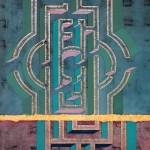
The album's artwork, "Cryptography I" by Yen-Chao Lin, provides an appropriate visual counterpart. Its intricate, maze-like circuitry combines sharply defined structures with a handmade quality, suggesting an object that is simultaneously engineered and organic. The image does not simply illustrate the music, but shares its fascination with systems whose apparent order contains plenty of room for uncertainty. The record was composed, performed, mixed and produced by Corbeil-Perron, with mastering by Jesse Osborne-Lanthier. Its recording and mixing took place across Montréal, Morelia, Mexico City and Stockholm, a geographical spread that seems fitting for an album whose identity is built through the accumulation of different artistic environments.
"Solari" is not a perfectly seamless statement, and its more exploratory passages occasionally expose the difficulty of bringing such varied materials into a single compositional framework. Yet its unevenness is also part of what makes it interesting. Corbeil-Perron is not trying to produce a neatly packaged demonstration of his technical abilities, nor does he seem particularly concerned with making every track equally accommodating. Instead, he allows the album to move between suspended electronic forms, intricate rhythmic constructions, abstract sound processing and moments of genuine melodic tenderness. The result is a debut that feels both assured and open-ended.
Courant Zéro is therefore a meaningful addition to Corbeil-Perron's already extensive body of work, not because it abandons his previous interests, but because it gives them a more concentrated musical setting. "Solari" contains enough detail to reward repeated listening, but also enough warmth to prevent its technical ambition from becoming an obstacle. Its most successful passages achieve something more interesting than mere sonic complexity: they make the machinery feel emotionally consequential. And that is no small achievement, particularly in electronic music, where occasionally even the machines seem to have more feelings than the people operating them.
Comments
Stream
Browse by Genre
Industrial Music / Industrial Metal / Aggro Industrial / Electro Metal
Industrial Noise / Power Noise / Harsh Noise
Synth Pop / Electro Pop / Synth-Electronica
Techno / Trance / Goa / Drum'n'Bass / Jungle / Tribal / Trip-Hop
Ambient / Electronica / Ethereal / Dub / Soundscapes / Abstract
Experimental / Avantgarde / Weird & Wired / Glitch / Noise / Field Recording
Dark / Gothic / Wave / New Wave / Dark Wave / Industrial Gothic
New Music / Downtown / Avantgarde Jazz / New Classical / World