
Tuesday, November 24, 2026
Martin Virgo: Ghost Piano
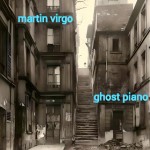


There is something quietly amusing about a musician who has spent decades working in the elaborate machinery of pop production deciding, eventually, that what he really needs is a piano and a little peace. Martin Virgo is hardly a newcomer to the business of shaping sound. His career includes work with Björk on "Debut", collaborations with Nellee Hooper and Massive Attack, and, most memorably, the creation of Mono, whose "Formica Blues" became one of the more distinctive records to emerge from the late-nineties fascination with trip-hop and cinematic pop. Yet "Ghost Piano", his first solo album, takes a considerable step away from that territory. There are no sampled orchestras, programmed beats or carefully assembled layers here, just Virgo at a Steinway Model B grand piano, with Nick Cooper's cello making a single appearance on the title track. It is a deliberately reduced setting, although reduction should not be mistaken for a lack of ambition.
Virgo's classical training at the Guildhall School of Music provides the obvious starting point, but the album is less an exercise in academic retrospection than an attempt to reconnect with a particular musical sensibility. Chopin, Debussy and Erik Satie are its most visible presences, with Philip Glass and Brian Eno also among the influences Virgo has acknowledged. The result is a collection of eleven short compositions that favour melodic clarity, carefully balanced harmonies and an almost old-fashioned sense of musical proportion. The title suggests something spectral, and the music does occasionally seem to arrive from another period, though not necessarily from another world. Its imagined geography is recognisably Parisian, with the late nineteenth century serving as an atmospheric reference rather than a historical reconstruction. One can almost picture the absinthe, the smoky cafés and the artists congratulating one another on having invented modernity, probably before the bill arrives.
The opening “Paris 1889” establishes the album's temperament through a gently melancholic piano figure, its Satie reference more than a decorative name-check. Virgo's two explicit homages, this piece and “Le Chat Noir”, frame the record with an affectionate awareness of the French composer's peculiar ability to make simplicity feel both elegant and faintly unsettling. “Ancient Modern” introduces a broader harmonic vocabulary, while “Nocturne” and “Hymn” explore more familiar territory, allowing the piano's natural resonance and Virgo's melodic instincts to do most of the work. The pieces are generally brief, often little more than two or three minutes, and their compactness gives the album the character of a sequence of finely drawn studies rather than a continuous, large-scale composition. That brevity is both an advantage and a limitation: ideas are presented with economy, but some disappear just as they begin to suggest a more substantial development.
The title track is the collection's most distinctive departure from its otherwise solitary arrangement. Cooper's cello adds a darker, more tactile counterweight to the piano, subtly altering the emotional temperature without turning the piece into a conventional chamber duet. Elsewhere, Virgo allows a few unexpected accents to disturb the prevailing refinement. “La Goulue” carries the suggestion of a more animated, theatrical Paris, while “Lagom” introduces a less predictable harmonic character, and “Strange Tango” brings a distinctly nostalgic, almost cinematic sway. The latter could easily accompany a scene in which two people meet after many years and discover that the past has become considerably more expensive than they remember. “Improvisation”, closing the album, loosens the formal approach a little, though it remains within the same restrained expressive language.
What makes "Ghost Piano" particularly interesting is the relationship between Virgo's earlier career and the music presented here. His work with Björk, Massive Attack and Shara Nelson, as well as his own compositions for Mono, involved a sophisticated understanding of arrangement, atmosphere and the emotional possibilities of production. The cinematic quality of "Formica Blues" was never simply a matter of borrowing vintage samples or dressing songs in retro clothing; its appeal depended on the precision with which Virgo balanced melody, texture and a certain European romanticism. Those qualities have not disappeared. They have simply been transferred to a different instrument and a much smaller vocabulary. Even without the elaborate production that helped define his earlier work, Virgo retains a strong instinct for memorable melodic shapes and harmonic colour. The apparent simplicity of the album therefore conceals a considerable amount of accumulated experience.
There is also something appealingly stubborn about the decision to record the pieces live on an acoustic grand piano, away from the conveniences of digital production. It is not a manifesto against technology, nor does the album need to pretend that acoustic music is inherently more authentic than anything involving a computer. Rather, Virgo seems interested in discovering how much expressive detail can be carried by the instrument itself, and by the compositional decisions made before the recording begins. The piano is allowed to sound like a piano, with its physical weight, its decay and its capacity to make a single melodic line feel unexpectedly spacious. In an era when even a modest keyboard passage can be subjected to enough processing to qualify for its own passport, this directness has a certain appeal.
Still, the album's consistency occasionally comes close to uniformity. Its reflective mood rarely changes dramatically, and the concise structures do not always leave enough room for the compositions to develop beyond their initial attraction. Listeners looking for the rhythmic invention and layered production of Mono will find little of that here. But expecting "Ghost Piano" to reproduce "Formica Blues" in miniature would miss the point. This is not an attempt to revisit a successful formula, but to approach a musical past that existed before the demands of a professional pop career began to shape it.
Ultimately, "Ghost Piano" is a modest, carefully considered record whose pleasures lie in its melodic intelligence rather than in any desire to impress through complexity. Its ghosts are not particularly frightening, and they seem perfectly content to occupy the piano bench without demanding royalties. Virgo has produced an album that feels personal without becoming confessional, nostalgic without being trapped by nostalgia, and classical in its references without behaving like an examination paper. The result is a graceful return to first principles, though the person returning is clearly not the same musician who left them behind.
Comments
Stream
Browse by Genre
Industrial Music / Industrial Metal / Aggro Industrial / Electro Metal
Industrial Noise / Power Noise / Harsh Noise
Synth Pop / Electro Pop / Synth-Electronica
Techno / Trance / Goa / Drum'n'Bass / Jungle / Tribal / Trip-Hop
Ambient / Electronica / Ethereal / Dub / Soundscapes / Abstract
Experimental / Avantgarde / Weird & Wired / Glitch / Noise / Field Recording
Dark / Gothic / Wave / New Wave / Dark Wave / Industrial Gothic
New Music / Downtown / Avantgarde Jazz / New Classical / World