
Candle Nine: The Muse in the Machine
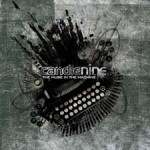
Artist: Candle Nine (@)
Title: The Muse in the Machine
Format: CD
Label: Tympanik Audio (@)
Distributor: Tympanik Audio
Rated:


Title: The Muse in the Machine
Format: CD
Label: Tympanik Audio (@)
Distributor: Tympanik Audio
Rated:
Out of Chicago comes Candle Nine, an apparently one-man electronic music project. On the website is a face, but no name we can put to it other than Candle Nine. He says he used to be an acoustic songwriter, but from his first experience in 2006 with a sequencer got hooked on electronic music. Influences claimed are such entities as Gridlock, Haujobb, Converter and Download. Candle Nine sounds like none of them though.
With the exception of vocal (dialogue) samples and maybe a slight vocal track, the music is mostly instrumental. There are Industrial leanings, with an emphasis on heavily programmed percussion, often in the glitch and IDM mode. In fact, the drum/percussion elements are so predominant most of the time that everything else takes a back seat. 'The Muse in the Machine' opens up with moody keyboard work and it's well over a minute before any significant percussion even enters the picture. Not a bad way of building atmosphere. When the drums do come in with a rolling sort of beat, they're strong and defined. Unfortunately, the underplayed keyboard work never swells into anything more defined, and just meanders along in its moody progression. This the way the tracks seem to continue throughout the album.
Track 2, 'Penumbra,' also starts with moody atmospherics (and those vocal samples, also present in track 1) before the drums and percussion hits with a barrage of chaotic and sonically twisted programming. For a time, its crazy and wild, then subsides and lets the synth string pads fill in the space'¦then it happens again. After the wild rhythm leaves for the second time, it returns in a more subdued and controlled form. This happens a couple of times, and then we're left with the synth pads again. I know this is a clinical description, but it's fitting; there isn't anything emotionally grabbing about this.
Candle Nine is good at moody atmospherics but seems lost as where to take them. One of the problems is the mix. The percussion is just so dominant that everything else seems to be the canvas the picture is painted on. One good example of this is 'Raison d'etre,' a track that has two simple synth melodies, a sparse repeating vocal line ('I can't find it on my own'), and a lot of heavy-duty percussion programming, which is the focus of the piece. There is even a time when one of the synth melodies comes to the foreground (with minimal percussion backing), but nothing is ever developed and taken further. It lacks vitality.
By this time I am noticing one element that is missing which could help out immensely ' BASS. There is not much bass, except as an occasional low end undertone. It was probably intentional to do things this way, but it could have been an important unifying factor to add some cohesion. What happens without the motion of bass is that there is often a lack of cohesion between the drifting and woozy keyboards and the percussion elements. What you end up with is a chillout juxtaposed with an Industrial/IDM hybrid percussion track. (And also, an overlay of dialogue samples.) The repetition of chordal progressions ad infinitum also gets old quick, and begins to sound New-Agey.
For me, the often raucous percussion and the gentle keyboard elements don't work well together. It often sounds like I'm listening to two different albums. It's unsettling, and not in a good way. There is no doubt there is some talent here, but it needs refining. Maybe the next album will be better if Candle Nine can find a way to fuse the elements he's using so they work with each other instead of against each other.
With the exception of vocal (dialogue) samples and maybe a slight vocal track, the music is mostly instrumental. There are Industrial leanings, with an emphasis on heavily programmed percussion, often in the glitch and IDM mode. In fact, the drum/percussion elements are so predominant most of the time that everything else takes a back seat. 'The Muse in the Machine' opens up with moody keyboard work and it's well over a minute before any significant percussion even enters the picture. Not a bad way of building atmosphere. When the drums do come in with a rolling sort of beat, they're strong and defined. Unfortunately, the underplayed keyboard work never swells into anything more defined, and just meanders along in its moody progression. This the way the tracks seem to continue throughout the album.
Track 2, 'Penumbra,' also starts with moody atmospherics (and those vocal samples, also present in track 1) before the drums and percussion hits with a barrage of chaotic and sonically twisted programming. For a time, its crazy and wild, then subsides and lets the synth string pads fill in the space'¦then it happens again. After the wild rhythm leaves for the second time, it returns in a more subdued and controlled form. This happens a couple of times, and then we're left with the synth pads again. I know this is a clinical description, but it's fitting; there isn't anything emotionally grabbing about this.
Candle Nine is good at moody atmospherics but seems lost as where to take them. One of the problems is the mix. The percussion is just so dominant that everything else seems to be the canvas the picture is painted on. One good example of this is 'Raison d'etre,' a track that has two simple synth melodies, a sparse repeating vocal line ('I can't find it on my own'), and a lot of heavy-duty percussion programming, which is the focus of the piece. There is even a time when one of the synth melodies comes to the foreground (with minimal percussion backing), but nothing is ever developed and taken further. It lacks vitality.
By this time I am noticing one element that is missing which could help out immensely ' BASS. There is not much bass, except as an occasional low end undertone. It was probably intentional to do things this way, but it could have been an important unifying factor to add some cohesion. What happens without the motion of bass is that there is often a lack of cohesion between the drifting and woozy keyboards and the percussion elements. What you end up with is a chillout juxtaposed with an Industrial/IDM hybrid percussion track. (And also, an overlay of dialogue samples.) The repetition of chordal progressions ad infinitum also gets old quick, and begins to sound New-Agey.
For me, the often raucous percussion and the gentle keyboard elements don't work well together. It often sounds like I'm listening to two different albums. It's unsettling, and not in a good way. There is no doubt there is some talent here, but it needs refining. Maybe the next album will be better if Candle Nine can find a way to fuse the elements he's using so they work with each other instead of against each other.
Comments
Browse by Genre
Industrial Music / Industrial Metal / Aggro Industrial / Electro Metal
Industrial Noise / Power Noise / Harsh Noise
Synth Pop / Electro Pop / Synth-Electronica
Techno / Trance / Goa / Drum'n'Bass / Jungle / Tribal / Trip-Hop
Ambient / Electronica / Ethereal / Dub / Soundscapes / Abstract
Experimental / Avantgarde / Weird & Wired / Glitch / Noise / Field Recording
Dark / Gothic / Wave / New Wave / Dark Wave / Industrial Gothic
New Music / Downtown / Avantgarde Jazz / New Classical / World