
Friday, October 16, 2026
Browse by Genre
Industrial Music / Industrial Metal / Aggro Industrial / Electro Metal
Industrial Noise / Power Noise / Harsh Noise
Synth Pop / Electro Pop / Synth-Electronica
Techno / Trance / Goa / Drum'n'Bass / Jungle / Tribal / Trip-Hop
Ambient / Electronica / Ethereal / Dub / Soundscapes / Abstract
Experimental / Avantgarde / Weird & Wired / Glitch / Noise / Field Recording
Dark / Gothic / Wave / New Wave / Dark Wave / Industrial Gothic
New Music / Downtown / Avantgarde Jazz / New Classical / World
Search Reviews
Music Reviews
Michael Meier & Christoph Franz: The Rhythm of Design
Artist: Michael Meier & Christoph Franz (@)
Title: The Rhythm of Design
Format: 12" + Download
Label: Präsens Editionen (@)
Rated:

Title: The Rhythm of Design
Format: 12" + Download
Label: Präsens Editionen (@)
Rated:
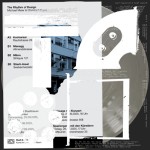
There is something almost perversely appropriate about turning the disappearance of music venues into a record, since vinyl is itself a rather good machine for preserving things that no longer exist. Michael Meier & Christoph Franz’s "The Rhythm of Design" takes this contradiction seriously, but without turning it into an exercise in cultural mourning. The Zürich-based artistic duo, whose research-driven practice repeatedly examines the social and historical layers embedded in built environments, began with six places connected to the city’s music scene: Club Zukunft, Giesshübel, Kochareal, Manegg, Mikro and Stierli-Areal. Some had already disappeared, others were threatened by redevelopment or changing urban priorities. Instead of simply photographing the remains and attaching a solemn text about gentrification, Meier & Franz removed pieces of the places themselves and had them transformed into six playable instruments with the help of specialist instrument builders. It is a beautifully literal idea: if the room is going to vanish, at least let it make some noise on the way out.
The conceptual elegance of "The Rhythm of Design" lies precisely in its refusal to separate architecture from music. The materials are not merely symbolic souvenirs of the venues; they become active components in a new musical process. Kalabrese, Tobibi Ferrari-Bienz, Rafal Skoczek, Lucien Badoux & Jeremy Sauter, Nicola Kazimir and Dualism were each asked to compose for one of these newly constructed instruments, resulting in six pieces whose stylistic coordinates stretch from experimental funk and punk towards kraut, noise and drone. The variety is important. A memorial made from a single aesthetic would risk turning a living musical culture into a tasteful museum exhibit, which is probably the last thing these places would have wanted. Instead, the record remains unruly enough to suggest that a scene is not defined by one sound but by the coexistence of incompatible ones.
The original performances made the idea even more radical. In September 2025, the six pieces were played simultaneously at their respective sites rather than presented as a conventional ensemble work. The audience had to move through the city, listening to isolated portions and constructing the larger composition through geography, memory and imagination. The city itself became the score, with distance functioning almost like another instrument. The LP inevitably changes that proposition. Six scattered events become six consecutive tracks; walking becomes sitting; architectural scale is reduced to a twelve-inch disc. Yet this apparent loss is actually where the album becomes fascinating. The record does not reproduce the original event so much as provide a second life for it. What was once spatial becomes temporal, and what depended upon physical movement can now be revisited through repetition.
That transformation also makes the individual pieces more revealing. “Club Zukunft” by Kalabrese carries the name of a place that belonged to Zürich’s nightlife but now survives here as a musical designation, while “Giesshübel” and “Kochareal” similarly convert addresses into titles that sound almost like coordinates on a map nobody needs to unfold anymore. The music consequently acquires a peculiar relationship with naming. These are not abstract compositions that happen to have urban titles attached to them; their identities are anchored to specific fragments of the city. Even when the listener has never stood in those places, the tracks retain the peculiar gravity of something made for a location rather than simply inspired by one.
The sequence becomes especially effective because the album does not insist on stylistic continuity. “Manegg”, credited to Lucien Badoux and Jeremy Sauter, gives way to Nicola Kazimir’s “Mikro” and finally Dualism’s “Stierli-Areal”, allowing the record to behave less like a unified genre statement than a collection of local dialects. That fragmentation is not a defect to be overcome. It is the point. Urban culture is messy because cities are messy, and the disappearance of a rehearsal room or club does not produce a neat hole in the cultural fabric. It redirects people, practices, friendships and sounds elsewhere, often in ways nobody can predict at the time.
The project also sits naturally within Meier & Franz’s wider artistic concerns. The duo, Michael Meier born in Wiener Neustadt in 1980 and Christoph Franz in Singen in 1982, both studied at the University of the Arts in Linz before completing Fine Arts degrees at Zurich University of the Arts. Their work repeatedly treats places not as neutral scenery but as accumulations of social, political and historical decisions. Earlier projects have dealt with urban transformation, construction, displacement and the strange ways in which apparently ordinary sites carry traces of larger systems. "The Rhythm of Design" extends that method into sound, but importantly does not treat music as an illustration of an architectural problem. Here music becomes evidence in its own right.
The title adds another layer. "The Rhythm of Design" echoes a song by the Zürich band Blue China, associated with the city’s youth and cultural protests of the 1980s. That historical reference prevents the project from presenting contemporary redevelopment as an entirely new phenomenon. Zürich has already had arguments about who gets to occupy the city, what kinds of culture deserve space, and whether urban development necessarily means cultural improvement. Apparently the city has been having this conversation for decades, which is reassuringly human in its inability to reach a final answer.
There is also something quietly political in the decision to preserve not only the memory of the venues but the materials associated with them. Photographs can document a demolished building, and an archive can catalogue its history, but an instrument made from its physical remains introduces another possibility: the past becomes capable of producing something new. The distinction matters. Nostalgia generally wants the vanished thing back exactly as it was. "The Rhythm of Design" accepts that this is impossible and asks a more useful question: what can be made from what remains?
The answer is neither purely musical nor purely architectural. These six pieces occupy the uncomfortable middle ground between document, composition and public artwork. Their real subject is therefore not simply the disappearance of Zürich’s music spaces, but the way culture survives spatial change by mutating. A venue closes; its wood or metal is repurposed; a musician writes for the resulting instrument; a performance takes place somewhere that has already ceased to be what it was; months later the performance becomes a record; eventually the record itself becomes another historical object. The process is almost absurdly elaborate for something as simple as remembering a room, but perhaps memory has always required unnecessary machinery.
That is what makes "The Rhythm of Design" more compelling than a straightforward commemorative release. It does not ask us to mourn six locations. It asks us to listen to what happens when their physical disappearance enters another form. The resulting album is fragmented because the city is fragmented, heterogeneous because scenes are heterogeneous, and slightly unstable because memory itself is a poor filing system. What survives here is not a replica of Zürich as it was, but a set of sonic residues capable of acquiring meanings beyond the places that generated them.
In that sense, the most important rhythm on "The Rhythm of Design" is not necessarily a beat. It is the rhythm of urban change itself: construction, occupation, displacement, adaptation, disappearance, recollection. Cities rarely stop moving long enough to notice what they have erased. This record does. It makes six vanished or endangered spaces audible again, not by pretending that they can be restored, but by giving their remains another function. A rather elegant form of resistance, and considerably more useful than another plaque nobody reads.
The conceptual elegance of "The Rhythm of Design" lies precisely in its refusal to separate architecture from music. The materials are not merely symbolic souvenirs of the venues; they become active components in a new musical process. Kalabrese, Tobibi Ferrari-Bienz, Rafal Skoczek, Lucien Badoux & Jeremy Sauter, Nicola Kazimir and Dualism were each asked to compose for one of these newly constructed instruments, resulting in six pieces whose stylistic coordinates stretch from experimental funk and punk towards kraut, noise and drone. The variety is important. A memorial made from a single aesthetic would risk turning a living musical culture into a tasteful museum exhibit, which is probably the last thing these places would have wanted. Instead, the record remains unruly enough to suggest that a scene is not defined by one sound but by the coexistence of incompatible ones.
The original performances made the idea even more radical. In September 2025, the six pieces were played simultaneously at their respective sites rather than presented as a conventional ensemble work. The audience had to move through the city, listening to isolated portions and constructing the larger composition through geography, memory and imagination. The city itself became the score, with distance functioning almost like another instrument. The LP inevitably changes that proposition. Six scattered events become six consecutive tracks; walking becomes sitting; architectural scale is reduced to a twelve-inch disc. Yet this apparent loss is actually where the album becomes fascinating. The record does not reproduce the original event so much as provide a second life for it. What was once spatial becomes temporal, and what depended upon physical movement can now be revisited through repetition.
That transformation also makes the individual pieces more revealing. “Club Zukunft” by Kalabrese carries the name of a place that belonged to Zürich’s nightlife but now survives here as a musical designation, while “Giesshübel” and “Kochareal” similarly convert addresses into titles that sound almost like coordinates on a map nobody needs to unfold anymore. The music consequently acquires a peculiar relationship with naming. These are not abstract compositions that happen to have urban titles attached to them; their identities are anchored to specific fragments of the city. Even when the listener has never stood in those places, the tracks retain the peculiar gravity of something made for a location rather than simply inspired by one.
The sequence becomes especially effective because the album does not insist on stylistic continuity. “Manegg”, credited to Lucien Badoux and Jeremy Sauter, gives way to Nicola Kazimir’s “Mikro” and finally Dualism’s “Stierli-Areal”, allowing the record to behave less like a unified genre statement than a collection of local dialects. That fragmentation is not a defect to be overcome. It is the point. Urban culture is messy because cities are messy, and the disappearance of a rehearsal room or club does not produce a neat hole in the cultural fabric. It redirects people, practices, friendships and sounds elsewhere, often in ways nobody can predict at the time.
The project also sits naturally within Meier & Franz’s wider artistic concerns. The duo, Michael Meier born in Wiener Neustadt in 1980 and Christoph Franz in Singen in 1982, both studied at the University of the Arts in Linz before completing Fine Arts degrees at Zurich University of the Arts. Their work repeatedly treats places not as neutral scenery but as accumulations of social, political and historical decisions. Earlier projects have dealt with urban transformation, construction, displacement and the strange ways in which apparently ordinary sites carry traces of larger systems. "The Rhythm of Design" extends that method into sound, but importantly does not treat music as an illustration of an architectural problem. Here music becomes evidence in its own right.
The title adds another layer. "The Rhythm of Design" echoes a song by the Zürich band Blue China, associated with the city’s youth and cultural protests of the 1980s. That historical reference prevents the project from presenting contemporary redevelopment as an entirely new phenomenon. Zürich has already had arguments about who gets to occupy the city, what kinds of culture deserve space, and whether urban development necessarily means cultural improvement. Apparently the city has been having this conversation for decades, which is reassuringly human in its inability to reach a final answer.
There is also something quietly political in the decision to preserve not only the memory of the venues but the materials associated with them. Photographs can document a demolished building, and an archive can catalogue its history, but an instrument made from its physical remains introduces another possibility: the past becomes capable of producing something new. The distinction matters. Nostalgia generally wants the vanished thing back exactly as it was. "The Rhythm of Design" accepts that this is impossible and asks a more useful question: what can be made from what remains?
The answer is neither purely musical nor purely architectural. These six pieces occupy the uncomfortable middle ground between document, composition and public artwork. Their real subject is therefore not simply the disappearance of Zürich’s music spaces, but the way culture survives spatial change by mutating. A venue closes; its wood or metal is repurposed; a musician writes for the resulting instrument; a performance takes place somewhere that has already ceased to be what it was; months later the performance becomes a record; eventually the record itself becomes another historical object. The process is almost absurdly elaborate for something as simple as remembering a room, but perhaps memory has always required unnecessary machinery.
That is what makes "The Rhythm of Design" more compelling than a straightforward commemorative release. It does not ask us to mourn six locations. It asks us to listen to what happens when their physical disappearance enters another form. The resulting album is fragmented because the city is fragmented, heterogeneous because scenes are heterogeneous, and slightly unstable because memory itself is a poor filing system. What survives here is not a replica of Zürich as it was, but a set of sonic residues capable of acquiring meanings beyond the places that generated them.
In that sense, the most important rhythm on "The Rhythm of Design" is not necessarily a beat. It is the rhythm of urban change itself: construction, occupation, displacement, adaptation, disappearance, recollection. Cities rarely stop moving long enough to notice what they have erased. This record does. It makes six vanished or endangered spaces audible again, not by pretending that they can be restored, but by giving their remains another function. A rather elegant form of resistance, and considerably more useful than another plaque nobody reads.
Tom Raworth Giancarlo Nino Locatelli, Pipeline: A Decent Run
Artist: Tom Raworth Giancarlo Nino Locatelli, Pipeline
Title: A Decent Run
Format: CD x 2 (double CD)
Label: We Insist! (@)
Rated:
Title: A Decent Run
Format: CD x 2 (double CD)
Label: We Insist! (@)
Rated:
There are easier ways of putting poetry to music. One can read the poem aloud over a tasteful piano chord, add some discreet strings, lower the lights and allow everyone present to feel culturally improved for approximately forty-five minutes. "A Decent Run" has considerably less interest in such civilised procedures. Its relationship with Tom Raworth's poetry is stranger, more physical and much more playful: words are spoken, sung, repeated, displaced, translated into instrumental gestures and sometimes treated almost as raw sound. The music does not accompany the poems so much as get into an argument with them, and, unusually, both parties appear to enjoy it.
The history behind the album makes that relationship particularly significant. Giancarlo Nino Locatelli first met Raworth in 1992, beginning a friendship and artistic collaboration that continued until the poet's death in 2017. The idea for this project dates back to 2000, but it finally took concrete form with recordings made in 2024. Ten pieces use Raworth's poetry, while two more draw on compositions by Steve Lacy, another crucial reference point in Locatelli's musical thinking. The resulting twelve tracks bring together the musicians of Pipeline with a remarkable group of guests, including Carla Kihlstedt, Sebi Tramontana, Alberto Braida, Luca Tilli, Andrea Grossi and Cristiano Calcagnile, alongside a collection of deliberately brief interventions from musicians gathered under the wonderfully suspicious name Clandestines.
Raworth's presence is therefore not simply literary. His recorded voice remains part of the album, making the project a posthumous collaboration rather than a retrospective tribute assembled at a safe distance. That distinction matters. Raworth was one of the central figures of the British Poetry Revival, a movement that challenged conventional poetic forms and embraced American influences from the Black Mountain and Beat traditions. His own writing often worked through rapid shifts of perception, compressed language, sudden associations and an almost gleeful distrust of grammatical stability. He also had a strong interest in visual art, publishing and the physical construction of books.
Such poetry already behaves a little like improvisation. Its syntax can turn before the reader has finished unpacking the previous image; its meanings are often provisional; its fragments seem to generate further fragments rather than obediently marching toward a conclusion. Locatelli understands this. Instead of trying to stabilise Raworth's language, he gives the musicians enough freedom to destabilise it further.
"Situations", which opens the album, immediately establishes the principle. A small music-box sound introduces the piece before Raworth's voice enters with language that refuses the reassuring distinction between sense and nonsense. The ensemble does not provide a conventional backdrop. Clarinet, strings, piano, trombone and percussion seem to examine the spoken words from different angles, sometimes reinforcing them, sometimes apparently ignoring them. The result feels less like an illustration than an alternative syntax running simultaneously alongside the poem.
This is where Locatelli's long experience with Pipeline becomes audible. The ensemble does not behave like a conventional jazz group in which a theme is stated, developed and eventually returned to with everybody congratulating themselves on having remembered it. The instruments retain individual personalities, but their roles remain unstable. A clarinet phrase may become a punctuation mark; a percussion sound may function almost like a consonant; a violin can extend a vowel that the voice has just abandoned. The distinction between musical accompaniment and linguistic structure begins to collapse.
"Poetry" takes the experiment further and, appropriately, does so with humour. Raworth's suspicion of categorisation meets a musical arrangement that refuses to behave categorically either. Carla Kihlstedt's voice shifts the material from speech toward song without turning the poem into a conventional art song, while the ensemble surrounds her with sounds that seem to have been selected partly because nobody informed them that they were supposed to behave like respectable instruments.
There is a mischievous intelligence in this. Raworth's poetry repeatedly questioned the mechanisms by which language acquires authority, while Locatelli questions the mechanisms by which music acquires coherence. Both approaches are interested in what happens when established relationships are nudged out of alignment. The album does not destroy meaning. It makes meaning work overtime.
"In Memoriam L. W." moves into more contemplative territory without becoming solemn in the conventional memorial sense. Raworth was capable of writing about absence, death and memory without allowing those subjects to dictate the emotional temperature of the work. Locatelli follows the same principle. The music leaves gaps rather than filling them, and the ensemble's restraint gives individual sounds considerable consequence.
Then comes "Vita Cortese Tara", where the album's relationship with voice becomes particularly intricate. The material exists in more than one state: spoken and sung, structured and improvised, recognisable and partially dissolved. The distinction is crucial because Raworth's poems are not being treated as fixed literary objects. They are being tested in different physical forms. What happens when the same words are spoken rather than sung? What happens when their semantic meaning becomes less important than their rhythm? What remains when a phrase becomes a sound before it becomes an idea? These are not academic questions dressed up as music. They are audible throughout the album.
"Sign of Time" and "Warm Autumn Problem" continue the process, but the album never settles into a single method. Sometimes the instruments seem to follow the contours of the language; elsewhere they appear to establish an independent conversation. This variation prevents the project from becoming a demonstration of one clever technique repeated twelve times. Locatelli has clearly resisted the temptation to invent a system and then spend an entire album proving that the system works.
That matters because Raworth's writing itself resists uniformity. His poetry could move rapidly between political observation, surreal imagery, mundane details, linguistic jokes and philosophical unease. He published more than forty collections and was also a publisher, editor, translator and visual artist, so the idea of language as something materially constructed was hardly incidental to his practice.
"Colonel Eternal", which appears on the second disc, revisits material related to the opening "Situations". But repetition here does not mean duplication. The return makes the earlier version look provisional, as though the same musical-poetic object has been picked up from another side. This is one of the album's recurring strategies: a piece can reappear without simply repeating itself, because the context has changed and therefore the listener's memory has changed with it.
"Radhopsin Blues" is especially revealing. Raworth's own voice comes forward, while the accompaniment initially seems almost skeletal before acquiring greater weight. There is a curious tension between the apparent looseness of the language and the careful control of the musical setting. The ensemble never tries to make the poem sound more comprehensible than it is. Instead, it gives its verbal movement somewhere to happen. That is probably the central virtue of "A Decent Run": it respects ambiguity without confusing ambiguity with vagueness.
"Translation" is perhaps the album's most mischievous episode. Its subject allows Locatelli to play with the instability of language itself, while the musicians turn the process of semantic distortion into a musical device. Trombone noises, electronic interventions and small instrumental gestures begin to resemble fragments of a conversation whose participants have all received slightly different versions of the dictionary.
It is difficult not to think about contemporary machine translation here, especially when language is stripped of context and rearranged according to rules that technically function while occasionally producing sentences that sound as if an exhausted extraterrestrial has been given access to an online phrasebook. Yet the piece does not merely mock linguistic failure. It suggests that translation is always a transformation, even when performed by humans who supposedly know exactly what they are doing.
"Oppio Inglese" shifts the atmosphere again. The music becomes comparatively spare, allowing the voice and instrumental textures to occupy separate but related spaces. There is something almost botanical in the way the sound grows and then retreats, although the album wisely avoids turning the poem into a soundtrack for a tasteful documentary about flowers. What matters is the fragility of the arrangement. A small change in density can radically alter the perceived weight of the words.
By the time the title track arrives, "A Decent Run" has accumulated enough different approaches that its apparent lack of stylistic uniformity becomes one of its strongest structural features. The project moves between free improvisation, composed material, song, spoken word, chamber-like textures, jazz, noise and electronics without treating genre as a border checkpoint.
This reflects Locatelli's own musical history. Pipeline has operated in different configurations, from trio to larger ensembles, and his approach has repeatedly involved combining written structures with improvisational freedom. Earlier Pipeline work has used compositions as frameworks around which musicians could construct networks of possible responses rather than simply reproducing a finished score.
That philosophy seems perfectly suited to Raworth. The poet's language does not need to be “set” because it already contains movement. Locatelli's role is to create circumstances in which that movement can interact with sound.
The final "Absence" is therefore appropriately unresolved. Its title might suggest a conventional elegy, but the music does something more interesting. Voice, instruments and small sounds occupy a space in which presence and disappearance constantly exchange places. The poem does not simply conclude, and neither does the music provide a grand emotional period at the end of the sentence. The album seems to understand that absence is not silence. It is the continuing effect of something that is no longer physically there.
That idea inevitably carries extra weight because Raworth died seven years before these recordings were made. Yet "A Decent Run" never turns his death into the organising principle of the music. This is not an album about a dead poet. It is an album made with a poet whose voice remains active inside it. That distinction saves the project from sentimentality.
The involvement of the Clandestines is another stroke of intelligence. John Corbett, Terry Kapsalis, Lou Mallozzi, Steve Beresford, Joëlle Léandre, Larry Ochs, Mazen Kerbaj, Gabriele Mitelli and others contribute brief gestures that are incorporated into the final structures. These interventions can be tiny, but their very brevity makes them significant. Instead of building a hierarchy in which the principal musicians produce the important material and guests decorate it, Locatelli treats the ensemble as a network of possible presences.
The album's title consequently acquires a slightly ironic dimension. A “decent run” sounds modest, almost dismissive, as though somebody has returned from an afternoon walk and reported that things went reasonably well. What actually sits behind the phrase is a quarter-century of friendship, correspondence, artistic exchange, a posthumous recording process and an ensemble large enough to make a tax accountant nervous.
But the modesty is appropriate. Raworth's poetry was never particularly interested in grand declarations when a sudden shift in language could do more damage with less effort. Locatelli's music follows a similar economy. Even when the ensemble becomes dense, the individual sounds remain legible. Nobody needs to demonstrate virtuosity by setting fire to the furniture.
The result is unusually generous music. It gives space to the voice without subordinating the instruments, allows improvisation without pretending that structure is unnecessary, and treats composition as something that can remain porous. The musicians listen not only to one another but to the internal rhythm of language.
That makes "A Decent Run" more than a meeting between literature and experimental jazz. It is an investigation into what happens when two different systems of thought are allowed to remain incomplete. Poetry does not become music, and music does not become poetry. Instead, each continually interferes with the other.
Raworth's language survives because it is not embalmed. Locatelli's arrangements survive because they are not overdetermined. Between them, Pipeline creates a music in which words can become rhythm, rhythm can become punctuation, noise can become syntax and silence can become part of the sentence.
There is something quietly moving about that. A project conceived in 2000, completed through recordings made in 2024 and released in 2026 might sound like an exercise in archival patience. Instead, "A Decent Run" feels remarkably alive. Its central idea is not preservation but continuation: the recognition that a friendship can outlast the people who began it, and that a poem can continue changing once its author is no longer available to change it himself.
Perhaps that is the most fitting tribute Raworth could receive. Not a monument, not a solemn anthology, and certainly not a tasteful recital. A set of musicians taking his words seriously enough to interfere with them.
That is what "A Decent Run" does. It listens to the poems, takes them apart, lets them collide with clarinets, trombone, strings, piano, percussion, electronics, voices and small mechanical noises, and then allows the resulting fragments to find their own relations. It is playful without being frivolous, intellectually demanding without becoming academic, and emotionally affecting without asking for the listener's sympathy.
A rare achievement, really. Twelve tracks, one absent poet, a large unruly ensemble, and somehow nobody has felt the need to explain what the music is supposed to mean. Human civilisation may yet have a little hope.
The history behind the album makes that relationship particularly significant. Giancarlo Nino Locatelli first met Raworth in 1992, beginning a friendship and artistic collaboration that continued until the poet's death in 2017. The idea for this project dates back to 2000, but it finally took concrete form with recordings made in 2024. Ten pieces use Raworth's poetry, while two more draw on compositions by Steve Lacy, another crucial reference point in Locatelli's musical thinking. The resulting twelve tracks bring together the musicians of Pipeline with a remarkable group of guests, including Carla Kihlstedt, Sebi Tramontana, Alberto Braida, Luca Tilli, Andrea Grossi and Cristiano Calcagnile, alongside a collection of deliberately brief interventions from musicians gathered under the wonderfully suspicious name Clandestines.
Raworth's presence is therefore not simply literary. His recorded voice remains part of the album, making the project a posthumous collaboration rather than a retrospective tribute assembled at a safe distance. That distinction matters. Raworth was one of the central figures of the British Poetry Revival, a movement that challenged conventional poetic forms and embraced American influences from the Black Mountain and Beat traditions. His own writing often worked through rapid shifts of perception, compressed language, sudden associations and an almost gleeful distrust of grammatical stability. He also had a strong interest in visual art, publishing and the physical construction of books.
Such poetry already behaves a little like improvisation. Its syntax can turn before the reader has finished unpacking the previous image; its meanings are often provisional; its fragments seem to generate further fragments rather than obediently marching toward a conclusion. Locatelli understands this. Instead of trying to stabilise Raworth's language, he gives the musicians enough freedom to destabilise it further.
"Situations", which opens the album, immediately establishes the principle. A small music-box sound introduces the piece before Raworth's voice enters with language that refuses the reassuring distinction between sense and nonsense. The ensemble does not provide a conventional backdrop. Clarinet, strings, piano, trombone and percussion seem to examine the spoken words from different angles, sometimes reinforcing them, sometimes apparently ignoring them. The result feels less like an illustration than an alternative syntax running simultaneously alongside the poem.
This is where Locatelli's long experience with Pipeline becomes audible. The ensemble does not behave like a conventional jazz group in which a theme is stated, developed and eventually returned to with everybody congratulating themselves on having remembered it. The instruments retain individual personalities, but their roles remain unstable. A clarinet phrase may become a punctuation mark; a percussion sound may function almost like a consonant; a violin can extend a vowel that the voice has just abandoned. The distinction between musical accompaniment and linguistic structure begins to collapse.
"Poetry" takes the experiment further and, appropriately, does so with humour. Raworth's suspicion of categorisation meets a musical arrangement that refuses to behave categorically either. Carla Kihlstedt's voice shifts the material from speech toward song without turning the poem into a conventional art song, while the ensemble surrounds her with sounds that seem to have been selected partly because nobody informed them that they were supposed to behave like respectable instruments.
There is a mischievous intelligence in this. Raworth's poetry repeatedly questioned the mechanisms by which language acquires authority, while Locatelli questions the mechanisms by which music acquires coherence. Both approaches are interested in what happens when established relationships are nudged out of alignment. The album does not destroy meaning. It makes meaning work overtime.
"In Memoriam L. W." moves into more contemplative territory without becoming solemn in the conventional memorial sense. Raworth was capable of writing about absence, death and memory without allowing those subjects to dictate the emotional temperature of the work. Locatelli follows the same principle. The music leaves gaps rather than filling them, and the ensemble's restraint gives individual sounds considerable consequence.
Then comes "Vita Cortese Tara", where the album's relationship with voice becomes particularly intricate. The material exists in more than one state: spoken and sung, structured and improvised, recognisable and partially dissolved. The distinction is crucial because Raworth's poems are not being treated as fixed literary objects. They are being tested in different physical forms. What happens when the same words are spoken rather than sung? What happens when their semantic meaning becomes less important than their rhythm? What remains when a phrase becomes a sound before it becomes an idea? These are not academic questions dressed up as music. They are audible throughout the album.
"Sign of Time" and "Warm Autumn Problem" continue the process, but the album never settles into a single method. Sometimes the instruments seem to follow the contours of the language; elsewhere they appear to establish an independent conversation. This variation prevents the project from becoming a demonstration of one clever technique repeated twelve times. Locatelli has clearly resisted the temptation to invent a system and then spend an entire album proving that the system works.
That matters because Raworth's writing itself resists uniformity. His poetry could move rapidly between political observation, surreal imagery, mundane details, linguistic jokes and philosophical unease. He published more than forty collections and was also a publisher, editor, translator and visual artist, so the idea of language as something materially constructed was hardly incidental to his practice.
"Colonel Eternal", which appears on the second disc, revisits material related to the opening "Situations". But repetition here does not mean duplication. The return makes the earlier version look provisional, as though the same musical-poetic object has been picked up from another side. This is one of the album's recurring strategies: a piece can reappear without simply repeating itself, because the context has changed and therefore the listener's memory has changed with it.
"Radhopsin Blues" is especially revealing. Raworth's own voice comes forward, while the accompaniment initially seems almost skeletal before acquiring greater weight. There is a curious tension between the apparent looseness of the language and the careful control of the musical setting. The ensemble never tries to make the poem sound more comprehensible than it is. Instead, it gives its verbal movement somewhere to happen. That is probably the central virtue of "A Decent Run": it respects ambiguity without confusing ambiguity with vagueness.
"Translation" is perhaps the album's most mischievous episode. Its subject allows Locatelli to play with the instability of language itself, while the musicians turn the process of semantic distortion into a musical device. Trombone noises, electronic interventions and small instrumental gestures begin to resemble fragments of a conversation whose participants have all received slightly different versions of the dictionary.
It is difficult not to think about contemporary machine translation here, especially when language is stripped of context and rearranged according to rules that technically function while occasionally producing sentences that sound as if an exhausted extraterrestrial has been given access to an online phrasebook. Yet the piece does not merely mock linguistic failure. It suggests that translation is always a transformation, even when performed by humans who supposedly know exactly what they are doing.
"Oppio Inglese" shifts the atmosphere again. The music becomes comparatively spare, allowing the voice and instrumental textures to occupy separate but related spaces. There is something almost botanical in the way the sound grows and then retreats, although the album wisely avoids turning the poem into a soundtrack for a tasteful documentary about flowers. What matters is the fragility of the arrangement. A small change in density can radically alter the perceived weight of the words.
By the time the title track arrives, "A Decent Run" has accumulated enough different approaches that its apparent lack of stylistic uniformity becomes one of its strongest structural features. The project moves between free improvisation, composed material, song, spoken word, chamber-like textures, jazz, noise and electronics without treating genre as a border checkpoint.
This reflects Locatelli's own musical history. Pipeline has operated in different configurations, from trio to larger ensembles, and his approach has repeatedly involved combining written structures with improvisational freedom. Earlier Pipeline work has used compositions as frameworks around which musicians could construct networks of possible responses rather than simply reproducing a finished score.
That philosophy seems perfectly suited to Raworth. The poet's language does not need to be “set” because it already contains movement. Locatelli's role is to create circumstances in which that movement can interact with sound.
The final "Absence" is therefore appropriately unresolved. Its title might suggest a conventional elegy, but the music does something more interesting. Voice, instruments and small sounds occupy a space in which presence and disappearance constantly exchange places. The poem does not simply conclude, and neither does the music provide a grand emotional period at the end of the sentence. The album seems to understand that absence is not silence. It is the continuing effect of something that is no longer physically there.
That idea inevitably carries extra weight because Raworth died seven years before these recordings were made. Yet "A Decent Run" never turns his death into the organising principle of the music. This is not an album about a dead poet. It is an album made with a poet whose voice remains active inside it. That distinction saves the project from sentimentality.
The involvement of the Clandestines is another stroke of intelligence. John Corbett, Terry Kapsalis, Lou Mallozzi, Steve Beresford, Joëlle Léandre, Larry Ochs, Mazen Kerbaj, Gabriele Mitelli and others contribute brief gestures that are incorporated into the final structures. These interventions can be tiny, but their very brevity makes them significant. Instead of building a hierarchy in which the principal musicians produce the important material and guests decorate it, Locatelli treats the ensemble as a network of possible presences.
The album's title consequently acquires a slightly ironic dimension. A “decent run” sounds modest, almost dismissive, as though somebody has returned from an afternoon walk and reported that things went reasonably well. What actually sits behind the phrase is a quarter-century of friendship, correspondence, artistic exchange, a posthumous recording process and an ensemble large enough to make a tax accountant nervous.
But the modesty is appropriate. Raworth's poetry was never particularly interested in grand declarations when a sudden shift in language could do more damage with less effort. Locatelli's music follows a similar economy. Even when the ensemble becomes dense, the individual sounds remain legible. Nobody needs to demonstrate virtuosity by setting fire to the furniture.
The result is unusually generous music. It gives space to the voice without subordinating the instruments, allows improvisation without pretending that structure is unnecessary, and treats composition as something that can remain porous. The musicians listen not only to one another but to the internal rhythm of language.
That makes "A Decent Run" more than a meeting between literature and experimental jazz. It is an investigation into what happens when two different systems of thought are allowed to remain incomplete. Poetry does not become music, and music does not become poetry. Instead, each continually interferes with the other.
Raworth's language survives because it is not embalmed. Locatelli's arrangements survive because they are not overdetermined. Between them, Pipeline creates a music in which words can become rhythm, rhythm can become punctuation, noise can become syntax and silence can become part of the sentence.
There is something quietly moving about that. A project conceived in 2000, completed through recordings made in 2024 and released in 2026 might sound like an exercise in archival patience. Instead, "A Decent Run" feels remarkably alive. Its central idea is not preservation but continuation: the recognition that a friendship can outlast the people who began it, and that a poem can continue changing once its author is no longer available to change it himself.
Perhaps that is the most fitting tribute Raworth could receive. Not a monument, not a solemn anthology, and certainly not a tasteful recital. A set of musicians taking his words seriously enough to interfere with them.
That is what "A Decent Run" does. It listens to the poems, takes them apart, lets them collide with clarinets, trombone, strings, piano, percussion, electronics, voices and small mechanical noises, and then allows the resulting fragments to find their own relations. It is playful without being frivolous, intellectually demanding without becoming academic, and emotionally affecting without asking for the listener's sympathy.
A rare achievement, really. Twelve tracks, one absent poet, a large unruly ensemble, and somehow nobody has felt the need to explain what the music is supposed to mean. Human civilisation may yet have a little hope.
Magic Wands: Remixes EP

Artist: Magic Wands (@)
Title: Remixes EP
Format: Download Only (MP3 + Lossless)
Label: Metropolis (@)
Rated:

Title: Remixes EP
Format: Download Only (MP3 + Lossless)
Label: Metropolis (@)
Rated:
A remix EP is normally where songs go when their parents have decided they need to meet other people. Sometimes the result is illuminating; sometimes it is merely the original wearing somebody else's jacket. "Remixes EP", however, makes a reasonably strong case for the former. Across six reinterpretations, Magic Wands hand material from their recent catalogue to Lost Signal, Lars Deutsch, Delerium, Principe Valiente and Glass Chapel, and the resulting record behaves less like a collection of decorative alternatives than a set of parallel readings of the same peculiar musical language.
That language has been developing since Dexy and Chris Valentine began Magic Wands in Nashville in the late 2000s before eventually relocating to Los Angeles. Their music has gradually moved between dream-pop, shoegaze, post-punk and goth, with heavily treated guitars, synths and vocals creating a tension between sweetness and darkness. The early "Aloha Moon" already suggested that the duo was interested in atmosphere as much as conventional indie-rock mechanics; subsequent records have made the sound more synthetic, nocturnal and spacious. "Cascades", released in 2025, pushed further into gothic romance, myth and literary imagery, while 2026's "Wishing Well" suggested a somewhat lighter direction.
The "Remixes EP" consequently arrives at an interesting moment. It looks backwards at "Cascades" and 2023's "Switch", while also including “Sacred Mirrors”, the new collaboration with John Ashton of The Psychedelic Furs. That song is itself already a kind of exchange: Ashton supplied the initial instrumental, after which Magic Wands added guitars, keyboards, percussion and vocals. The remix therefore transforms a song that was already born from collaboration, which is rather like asking one conversation to explain itself through another conversation.
Lost Signal gets two opportunities to interfere with the Magic Wands formula, beginning with “Armour”. The original belongs to the darker side of "Cascades", where the band's shimmering guitars and romantic gloom lean toward the post-punk tradition. Lost Signal pushes that material toward greater electronic definition. The guitar haze becomes more sharply organised, the rhythmic component assumes greater importance, and the song acquires a harder silhouette without losing its underlying melancholy. It is less a matter of making "Armour" heavier than of revealing the electronic skeleton that was already hiding beneath its soft surfaces.
That distinction becomes important throughout the EP. The best remixes here do not seem determined to demonstrate how radically somebody can alter a track. They identify something latent and enlarge it. Magic Wands already operate somewhere between songcraft and atmosphere, so the remixers have plenty of loose material to work with. There are melodies that can become motifs, guitar textures that can become drones, and vocal lines that can be pushed forward or allowed to recede.
“Albatross”, reworked by Lars Deutsch, takes a different route. The original "Cascades" track draws on the ominous literary associations of its title, recalling Coleridge's doomed bird without needing to turn the thing into an undergraduate poetry seminar. Its original form combines propulsion with thick layers of synth and reverberation. Deutsch, an Emmy-winning composer as well as a musician, makes the electronic dimension more prominent, creating a treatment in which atmosphere and arrangement become unusually close companions.
The effect is subtly cinematic. Instead of simply making the song larger, Deutsch seems to widen the spaces between its components. The vocal acquires more room around it, while the electronic layers suggest movement beneath the surface. There is still a recognisable Magic Wands song underneath, but its emotional centre has shifted. The darkness feels less like a room decorated in black and more like an expanse in which the listener has temporarily misplaced the exit.
Lost Signal returns for “Sacred Mirrors”, and this is perhaps the EP's most conceptually satisfying transformation. The original song was already unusual within the Magic Wands catalogue because it emerged from John Ashton's instrumental contribution. Ashton, best known as guitarist of The Psychedelic Furs, had independently become interested in the duo and sent them the piece; Magic Wands subsequently added their own instrumental and vocal material. The song's atmosphere was correspondingly lighter and more reflective than much of "Cascades".
Lost Signal does not destroy that luminosity. Instead, the remix places it under a cooler electronic light. The vocal becomes part of a larger synthetic environment, while the rhythmic details give the track a more nocturnal momentum. The result is interesting precisely because the song's emotional centre survives the transformation. Its sense of openness remains, but the route toward it has become more circuitous.
This is where "Remixes EP" becomes more than a catalogue maintenance exercise. A successful remix can reveal that a song contains several possible identities, only one of which happened to be selected for the original recording. Magic Wands' material is particularly susceptible to this because their songs are built from layers that do not always belong to the same musical tradition. A guitar can suggest shoegaze while a synth points toward darkwave; a vocal can sound romantic while the rhythm section behaves like electronic pop. The remixers simply choose which of these competing impulses gets to sit in the front row.
Delerium's treatment of “Moonshadow” makes that choice especially apparent. Delerium have been refining the meeting point between electronic music, atmosphere and vocal melodicism for decades, so their involvement is less a collision than a conversation between adjacent dialects. Their remix extends the track into a more spacious electronic landscape, allowing its melodic qualities to become more pronounced while maintaining the dusky emotional tone associated with Magic Wands.
The six-and-a-half-minute duration helps. Delerium are given enough time to let the arrangement breathe rather than compressing everything into the usual three-minute requirement for people who apparently consider silence a personal insult. The track develops gradually, with textures appearing and receding around the vocal. It feels less like a remix designed for a club than a reconsideration of the song's atmospheric possibilities.
Principe Valiente's “Candle Sea” takes yet another route. Their own relationship with darkwave and post-punk makes the connection almost suspiciously logical, but the treatment avoids merely adding darkness to an already dark band. Instead, the remix sharpens the contrast between the song's melodic core and its surrounding textures. The emotional temperature becomes cooler, and the arrangement acquires a more distinctly European gothic character.
This is one of the recurring pleasures of the EP: the collaborators do not have to teach Magic Wands how to be gloomy. They are already perfectly capable of that, having spent much of "Cascades" exploring melancholy, romanticism and nocturnal imagery. The remixers are more interesting when they alter the proportions. One brings rhythm forward, another enlarges the electronic space, another makes the guitars feel more architectural, another foregrounds melody.
Glass Chapel's “Time To Dream” closes the collection and perhaps offers the most fitting ending. The title itself could describe much of Magic Wands' aesthetic, but the remix does not simply dissolve into soft-focus dreaminess. Instead, the track retains a defined melodic centre while the surrounding production becomes more spacious and suspended. The effect is intimate without becoming delicate, which is not quite the same thing.
The sequence as a whole is revealing. “Armour” establishes the harder electronic potential; “Albatross” expands the cinematic dimension; “Sacred Mirrors” moves through a cooler and more synthetic atmosphere; “Moonshadow” stretches toward spacious electronic pop; “Candle Sea” deepens the gothic side; and “Time To Dream” brings the collection toward something more weightless. The EP therefore works almost like a prism. The songs remain recognisable, but the colours change according to who holds them up to the light.
That is also why the record benefits from being heard after "Cascades". The original album was already praised for its mixture of goth, shoegaze, post-punk and dream-pop, with reviewers noting both its strong 1980s references and its more literary or mythological tendencies. The remixes expose the seams between those influences rather than smoothing them over. What initially sounded like one coherent style turns out to contain several possible arrangements waiting to be separated.
There is a slight paradox at the heart of Magic Wands' music. Their aesthetic depends heavily on atmosphere, but atmosphere is normally the thing least likely to survive rearrangement. Change the drums, move the guitars, alter the vocal treatment and suddenly the supposed essence of a song has vanished. Here, however, the songs prove sturdier than their surface suggests. The melodies and vocal phrasing remain sufficiently distinctive to survive considerable changes in emphasis.
“Sacred Mirrors” is the clearest example because its collaborative origins are already embedded in the composition. The song was conceived around Ashton's instrumental piece and then developed collectively by Ashton and the Valentines. Its subsequent remix turns that history into another layer of authorship. The track has effectively passed through three stages: Ashton’s initial composition, Magic Wands' transformation of it into a song, and Lost Signal's transformation of that song into something else. At some point the notion of an “original version” becomes almost bureaucratic.
That is perhaps the most interesting thing about remix culture when it works properly. A song stops being a fixed object and becomes a set of possibilities. Magic Wands seem comfortable with that idea. Their own catalogue has already included remixes and reworkings, and "Remixes EP" continues the process rather than treating the original recordings as sacred property.
The record is also careful not to confuse difference with quality. Some remixes are more radical than others, but the collection does not require every contributor to perform a spectacular act of sonic vandalism. In several cases, the pleasure comes precisely from hearing how little needs to be changed for the emotional balance of a song to shift.
That restraint suits Magic Wands. Their music has always depended on blurred boundaries: between softness and distortion, romance and melancholy, organic guitar textures and synthetic surfaces, darkness and a surprisingly persistent sense of wonder. The remixers do not resolve those contradictions. They simply rearrange them.
"Remixes EP" is therefore a useful second look at a band whose music can initially appear deceptively consistent. Six versions later, the consistency starts looking more like flexibility. The songs survive because their identity is not located in any single guitar tone, drum pattern or production trick. It lies somewhere less tangible, in the combination of melody, voice and emotional atmosphere that remains recognisable even after the furniture has been rearranged.
Human beings have always had difficulty leaving a perfectly serviceable song alone, which is probably why remix culture exists. In this case, the interference proves worthwhile. "Remixes EP" does not replace "Cascades" or "Switch", and it does not pretend to improve them by decree. It simply opens several side doors into material that already had more than one way of being heard.
For Magic Wands, that may be the most appropriate form of continuation: not another definitive statement, but six alternate perspectives on songs that were never quite as settled as they first appeared.
That language has been developing since Dexy and Chris Valentine began Magic Wands in Nashville in the late 2000s before eventually relocating to Los Angeles. Their music has gradually moved between dream-pop, shoegaze, post-punk and goth, with heavily treated guitars, synths and vocals creating a tension between sweetness and darkness. The early "Aloha Moon" already suggested that the duo was interested in atmosphere as much as conventional indie-rock mechanics; subsequent records have made the sound more synthetic, nocturnal and spacious. "Cascades", released in 2025, pushed further into gothic romance, myth and literary imagery, while 2026's "Wishing Well" suggested a somewhat lighter direction.
The "Remixes EP" consequently arrives at an interesting moment. It looks backwards at "Cascades" and 2023's "Switch", while also including “Sacred Mirrors”, the new collaboration with John Ashton of The Psychedelic Furs. That song is itself already a kind of exchange: Ashton supplied the initial instrumental, after which Magic Wands added guitars, keyboards, percussion and vocals. The remix therefore transforms a song that was already born from collaboration, which is rather like asking one conversation to explain itself through another conversation.
Lost Signal gets two opportunities to interfere with the Magic Wands formula, beginning with “Armour”. The original belongs to the darker side of "Cascades", where the band's shimmering guitars and romantic gloom lean toward the post-punk tradition. Lost Signal pushes that material toward greater electronic definition. The guitar haze becomes more sharply organised, the rhythmic component assumes greater importance, and the song acquires a harder silhouette without losing its underlying melancholy. It is less a matter of making "Armour" heavier than of revealing the electronic skeleton that was already hiding beneath its soft surfaces.
That distinction becomes important throughout the EP. The best remixes here do not seem determined to demonstrate how radically somebody can alter a track. They identify something latent and enlarge it. Magic Wands already operate somewhere between songcraft and atmosphere, so the remixers have plenty of loose material to work with. There are melodies that can become motifs, guitar textures that can become drones, and vocal lines that can be pushed forward or allowed to recede.
“Albatross”, reworked by Lars Deutsch, takes a different route. The original "Cascades" track draws on the ominous literary associations of its title, recalling Coleridge's doomed bird without needing to turn the thing into an undergraduate poetry seminar. Its original form combines propulsion with thick layers of synth and reverberation. Deutsch, an Emmy-winning composer as well as a musician, makes the electronic dimension more prominent, creating a treatment in which atmosphere and arrangement become unusually close companions.
The effect is subtly cinematic. Instead of simply making the song larger, Deutsch seems to widen the spaces between its components. The vocal acquires more room around it, while the electronic layers suggest movement beneath the surface. There is still a recognisable Magic Wands song underneath, but its emotional centre has shifted. The darkness feels less like a room decorated in black and more like an expanse in which the listener has temporarily misplaced the exit.
Lost Signal returns for “Sacred Mirrors”, and this is perhaps the EP's most conceptually satisfying transformation. The original song was already unusual within the Magic Wands catalogue because it emerged from John Ashton's instrumental contribution. Ashton, best known as guitarist of The Psychedelic Furs, had independently become interested in the duo and sent them the piece; Magic Wands subsequently added their own instrumental and vocal material. The song's atmosphere was correspondingly lighter and more reflective than much of "Cascades".
Lost Signal does not destroy that luminosity. Instead, the remix places it under a cooler electronic light. The vocal becomes part of a larger synthetic environment, while the rhythmic details give the track a more nocturnal momentum. The result is interesting precisely because the song's emotional centre survives the transformation. Its sense of openness remains, but the route toward it has become more circuitous.
This is where "Remixes EP" becomes more than a catalogue maintenance exercise. A successful remix can reveal that a song contains several possible identities, only one of which happened to be selected for the original recording. Magic Wands' material is particularly susceptible to this because their songs are built from layers that do not always belong to the same musical tradition. A guitar can suggest shoegaze while a synth points toward darkwave; a vocal can sound romantic while the rhythm section behaves like electronic pop. The remixers simply choose which of these competing impulses gets to sit in the front row.
Delerium's treatment of “Moonshadow” makes that choice especially apparent. Delerium have been refining the meeting point between electronic music, atmosphere and vocal melodicism for decades, so their involvement is less a collision than a conversation between adjacent dialects. Their remix extends the track into a more spacious electronic landscape, allowing its melodic qualities to become more pronounced while maintaining the dusky emotional tone associated with Magic Wands.
The six-and-a-half-minute duration helps. Delerium are given enough time to let the arrangement breathe rather than compressing everything into the usual three-minute requirement for people who apparently consider silence a personal insult. The track develops gradually, with textures appearing and receding around the vocal. It feels less like a remix designed for a club than a reconsideration of the song's atmospheric possibilities.
Principe Valiente's “Candle Sea” takes yet another route. Their own relationship with darkwave and post-punk makes the connection almost suspiciously logical, but the treatment avoids merely adding darkness to an already dark band. Instead, the remix sharpens the contrast between the song's melodic core and its surrounding textures. The emotional temperature becomes cooler, and the arrangement acquires a more distinctly European gothic character.
This is one of the recurring pleasures of the EP: the collaborators do not have to teach Magic Wands how to be gloomy. They are already perfectly capable of that, having spent much of "Cascades" exploring melancholy, romanticism and nocturnal imagery. The remixers are more interesting when they alter the proportions. One brings rhythm forward, another enlarges the electronic space, another makes the guitars feel more architectural, another foregrounds melody.
Glass Chapel's “Time To Dream” closes the collection and perhaps offers the most fitting ending. The title itself could describe much of Magic Wands' aesthetic, but the remix does not simply dissolve into soft-focus dreaminess. Instead, the track retains a defined melodic centre while the surrounding production becomes more spacious and suspended. The effect is intimate without becoming delicate, which is not quite the same thing.
The sequence as a whole is revealing. “Armour” establishes the harder electronic potential; “Albatross” expands the cinematic dimension; “Sacred Mirrors” moves through a cooler and more synthetic atmosphere; “Moonshadow” stretches toward spacious electronic pop; “Candle Sea” deepens the gothic side; and “Time To Dream” brings the collection toward something more weightless. The EP therefore works almost like a prism. The songs remain recognisable, but the colours change according to who holds them up to the light.
That is also why the record benefits from being heard after "Cascades". The original album was already praised for its mixture of goth, shoegaze, post-punk and dream-pop, with reviewers noting both its strong 1980s references and its more literary or mythological tendencies. The remixes expose the seams between those influences rather than smoothing them over. What initially sounded like one coherent style turns out to contain several possible arrangements waiting to be separated.
There is a slight paradox at the heart of Magic Wands' music. Their aesthetic depends heavily on atmosphere, but atmosphere is normally the thing least likely to survive rearrangement. Change the drums, move the guitars, alter the vocal treatment and suddenly the supposed essence of a song has vanished. Here, however, the songs prove sturdier than their surface suggests. The melodies and vocal phrasing remain sufficiently distinctive to survive considerable changes in emphasis.
“Sacred Mirrors” is the clearest example because its collaborative origins are already embedded in the composition. The song was conceived around Ashton's instrumental piece and then developed collectively by Ashton and the Valentines. Its subsequent remix turns that history into another layer of authorship. The track has effectively passed through three stages: Ashton’s initial composition, Magic Wands' transformation of it into a song, and Lost Signal's transformation of that song into something else. At some point the notion of an “original version” becomes almost bureaucratic.
That is perhaps the most interesting thing about remix culture when it works properly. A song stops being a fixed object and becomes a set of possibilities. Magic Wands seem comfortable with that idea. Their own catalogue has already included remixes and reworkings, and "Remixes EP" continues the process rather than treating the original recordings as sacred property.
The record is also careful not to confuse difference with quality. Some remixes are more radical than others, but the collection does not require every contributor to perform a spectacular act of sonic vandalism. In several cases, the pleasure comes precisely from hearing how little needs to be changed for the emotional balance of a song to shift.
That restraint suits Magic Wands. Their music has always depended on blurred boundaries: between softness and distortion, romance and melancholy, organic guitar textures and synthetic surfaces, darkness and a surprisingly persistent sense of wonder. The remixers do not resolve those contradictions. They simply rearrange them.
"Remixes EP" is therefore a useful second look at a band whose music can initially appear deceptively consistent. Six versions later, the consistency starts looking more like flexibility. The songs survive because their identity is not located in any single guitar tone, drum pattern or production trick. It lies somewhere less tangible, in the combination of melody, voice and emotional atmosphere that remains recognisable even after the furniture has been rearranged.
Human beings have always had difficulty leaving a perfectly serviceable song alone, which is probably why remix culture exists. In this case, the interference proves worthwhile. "Remixes EP" does not replace "Cascades" or "Switch", and it does not pretend to improve them by decree. It simply opens several side doors into material that already had more than one way of being heard.
For Magic Wands, that may be the most appropriate form of continuation: not another definitive statement, but six alternate perspectives on songs that were never quite as settled as they first appeared.
Damage Control & Leæther Strip: Master Of Silence EP

Artist: Damage Control & Leæther Strip
Title: Master Of Silence EP
Format: Download Only (MP3 + Lossless)
Label: Metropolis (@)
Rated:
Title: Master Of Silence EP
Format: Download Only (MP3 + Lossless)
Label: Metropolis (@)
Rated:
Industrial music has never suffered from a shortage of things being called "Rage", "Oblivion", "Obstacles" or "Crowned". It is practically a genre requirement, somewhere between distortion and a black-and-white photograph of a factory. The interesting question is what musicians actually do with such vocabulary once the familiar machinery is switched on. On "Master Of Silence", Damage Control and Leæther Strip approach the territory from a position of considerable experience, and the result is more nuanced than its titles might initially suggest.
Damage Control is an international electro-industrial collaboration centred on Australians Bill Barsby, Richard Thacker and Alex Wise, with Markus App from Germany among the wider creative network. Barsby and Thacker originally come from Birmingham, giving the project an interesting geographical collision between British industrial lineage and its later Australian incarnation. Their 2017 debut "Ultranoia" established a habit of working with outside musicians, and "Master Of Silence" extends that principle by placing Danish electro-industrial veteran Claus Larsen in the vocal foreground. Larsen has been operating as Leæther Strip since the late 1980s, becoming one of the defining figures in the development of European EBM and electro-industrial music, while also repeatedly bending that vocabulary toward darker, stranger or more melodic territory.
There is consequently no need here for anyone to prove their industrial credentials by hitting the distortion pedal with a large object. The production team already tells much of the story. Chris Peterson, whose résumé includes Front Line Assembly, Noise Unit and Unit:187, handles production, with Greg Reely, associated with Skinny Puppy, Front Line Assembly and Fear Factory, on engineering duties. Peterson also contributes synthesizer parts to “Obstacles”, while Josh Rombout of SIRUS adds programming to the same track. The result is suitably polished without becoming antiseptic, preserving the blunt physicality that electro-industrial music requires while allowing enough detail for the arrangements to breathe.
"Oblivion" opens the EP with an immediately recognisable combination of programmed momentum, hard-edged electronic textures and Larsen's unmistakable delivery. Yet the track is less interested in sheer punishment than in pressure. The rhythm has weight, but the arrangement leaves enough space around it for the synth layers to acquire shape. Larsen's voice provides the human element without softening anything. His performance carries the accumulated authority of somebody who has spent decades making electronic music sound confrontational, but there is no sense of him simply reenacting his own past.
That distinction matters. A guest appearance by an established industrial vocalist can easily become a karaoke version of the 1990s, with everybody politely agreeing that the old sounds were better before moving on to the next track. "Master Of Silence" avoids that trap because Larsen is incorporated into Damage Control's electronic framework rather than being treated as a historical artefact. His voice is part of the architecture, not a nostalgic sticker placed on top of it.
“Rage” makes this even clearer. The track's title is admirably economical, but the music does not behave like an instruction manual for anger. Its propulsion is controlled, with the rhythm section pushing forward while the synth programming gives the track a colder, more spacious contour. The aggression is therefore functional rather than theatrical. There is enough force to work on a dancefloor, but also enough restraint to keep the track from collapsing into the industrial equivalent of somebody repeatedly shouting at a printer.
Larsen is especially effective because his voice has always possessed an unusual combination of severity and personality. In the Leæther Strip catalogue, harsh electronics have frequently been balanced by melodic instincts, theatrical phrasing and an ability to make machine-driven music feel surprisingly personal. His long career has included everything from hard EBM to more experimental and symphonic approaches, and he has continued to release and perform well beyond the period in which the style was supposedly destined for the historical basement. On these four tracks, that history is useful without becoming a burden.
“Obstacles” is perhaps the most revealing piece because the production becomes more layered. Peterson's additional synth work and Rombout's programming give the track a denser electronic surface, while the rhythm remains sharply defined. The arrangement seems to operate through competing layers of insistence: one pattern establishes a direction, another interferes with it, and the vocal rides above the resulting friction. This is where Damage Control's collaborative nature becomes audible. Rather than simply adding another musician to a completed formula, the extra contributors alter the internal balance of the track.
There is also a useful irony in the title. Industrial music has been writing songs about obstacles for decades, usually while constructing an enormous rhythmic object specifically designed to run straight through them. Here the obstacle is less an external enemy than a structural principle. The track keeps introducing elements that make its own movement slightly more complicated, and therefore more interesting.
"Crowned" closes the EP with perhaps the most ceremonial atmosphere of the four. The title suggests triumph, authority and all the usual paraphernalia of industrial grandeur, but the music is more ambiguous. The synthesizers provide a darkly polished surface while the rhythm retains the physical insistence of EBM. Larsen's voice gives the track its sense of command, yet the production avoids turning that authority into bombast. It feels less like somebody being handed a crown than somebody wondering what, exactly, the crown is supposed to accomplish.
Taken together, the four tracks work because they occupy a useful middle ground between club functionality and studio detail. The rhythms are strong enough to give the music bodily momentum, but the production rewards attention away from the dancefloor too. This is partly due to the experience behind the controls. Peterson and Reely have been involved with Damage Control since "Ultranoia", and their continuing presence gives the project a sonic consistency even as its guest collaborations change.
The collaboration with Larsen also makes sense historically. Leæther Strip was founded as a solo project in 1988 and emerged during the period when EBM and electro-industrial music were developing their defining vocabulary in Europe. Larsen became particularly associated with the German Zoth Ommog scene and later maintained a remarkably durable career through label changes, stylistic shifts and periods of renewed activity. His participation therefore brings more than a familiar voice. It introduces a performer whose own history is embedded in the musical language Damage Control are using.
What makes "Master Of Silence" successful, however, is that it does not attempt to turn that history into a ceremonial reunion. There is no need for the tracks to sound as though they were retrieved from a forgotten warehouse containing obsolete drum machines and several extremely angry German club promoters. The production is contemporary, clean and deliberately muscular. At the same time, it understands that electro-industrial music does not need to disguise its physical origins. Bass frequencies still have to move the body. Percussion still has to hit somewhere below the intellect. A synth line can be both a compositional element and a piece of machinery with an attitude problem.
The EP's brevity helps enormously. Nineteen minutes is enough time to establish a world without requiring the listener to sign a long-term lease. Each track has a clear identity, but the four pieces also form a coherent sequence: darkness and pressure in “Oblivion”, more direct propulsion in “Rage”, increased textural complexity in “Obstacles”, and a slightly more imposing finale in “Crowned”. There is no unnecessary interlude, ambient corridor or five-minute passage in which somebody presumably adjusts the lighting.
Most importantly, Master Of Silence understands the difference between heaviness and density. Heavy music does not necessarily need to contain more sounds. Sometimes it is the spacing between them, the weight of a bass pulse, the dry impact of percussion or the contrast between a controlled electronic arrangement and a very human voice that creates the sensation of mass. Damage Control and Larsen use those contrasts effectively.
The EP also functions as a useful preview of Damage Control's developing Oblivion Grid cycle. The project has always relied on international collaboration, but this particular combination feels unusually coherent. Larsen does not merely lend his name to four tracks. His voice becomes a connecting element between the group's Australian electronic foundation and a lineage of European EBM that reaches back more than three decades.
There is nothing revolutionary about making electro-industrial music in 2026. That is precisely why doing it convincingly requires some care. The genre has accumulated so many established gestures that the danger is not failure but automatic competence: the correct kick drum, the correct vocal distortion, the correct ominous title, the correct photograph in which everyone looks as though they have recently been informed that joy is illegal. Master Of Silence works because its musicians understand those conventions well enough to manipulate them rather than merely obey them.
It is not an attempt to reinvent industrial music, nor does it need to be. Its achievement is more practical and arguably more valuable: four tightly constructed tracks that respect the genre's physical power while giving their collaborators enough room to remain recognisable. Damage Control provide the electronic framework; Claus Larsen supplies a voice with history, character and considerable bite; Peterson and Reely make sure the whole arrangement arrives with the necessary precision.
The result is a compact, disciplined EP that sounds neither trapped in its lineage nor embarrassed by it. Master Of Silence knows exactly what kind of music it is making, which in an age of increasingly complicated genre labels is almost an act of civil disobedience. The silence in the title may therefore be less about absence than about control: knowing when to let the machinery speak, when to pull something back, and when four people in different parts of the world can make an old musical language sound usefully alive again.
Damage Control is an international electro-industrial collaboration centred on Australians Bill Barsby, Richard Thacker and Alex Wise, with Markus App from Germany among the wider creative network. Barsby and Thacker originally come from Birmingham, giving the project an interesting geographical collision between British industrial lineage and its later Australian incarnation. Their 2017 debut "Ultranoia" established a habit of working with outside musicians, and "Master Of Silence" extends that principle by placing Danish electro-industrial veteran Claus Larsen in the vocal foreground. Larsen has been operating as Leæther Strip since the late 1980s, becoming one of the defining figures in the development of European EBM and electro-industrial music, while also repeatedly bending that vocabulary toward darker, stranger or more melodic territory.
There is consequently no need here for anyone to prove their industrial credentials by hitting the distortion pedal with a large object. The production team already tells much of the story. Chris Peterson, whose résumé includes Front Line Assembly, Noise Unit and Unit:187, handles production, with Greg Reely, associated with Skinny Puppy, Front Line Assembly and Fear Factory, on engineering duties. Peterson also contributes synthesizer parts to “Obstacles”, while Josh Rombout of SIRUS adds programming to the same track. The result is suitably polished without becoming antiseptic, preserving the blunt physicality that electro-industrial music requires while allowing enough detail for the arrangements to breathe.
"Oblivion" opens the EP with an immediately recognisable combination of programmed momentum, hard-edged electronic textures and Larsen's unmistakable delivery. Yet the track is less interested in sheer punishment than in pressure. The rhythm has weight, but the arrangement leaves enough space around it for the synth layers to acquire shape. Larsen's voice provides the human element without softening anything. His performance carries the accumulated authority of somebody who has spent decades making electronic music sound confrontational, but there is no sense of him simply reenacting his own past.
That distinction matters. A guest appearance by an established industrial vocalist can easily become a karaoke version of the 1990s, with everybody politely agreeing that the old sounds were better before moving on to the next track. "Master Of Silence" avoids that trap because Larsen is incorporated into Damage Control's electronic framework rather than being treated as a historical artefact. His voice is part of the architecture, not a nostalgic sticker placed on top of it.
“Rage” makes this even clearer. The track's title is admirably economical, but the music does not behave like an instruction manual for anger. Its propulsion is controlled, with the rhythm section pushing forward while the synth programming gives the track a colder, more spacious contour. The aggression is therefore functional rather than theatrical. There is enough force to work on a dancefloor, but also enough restraint to keep the track from collapsing into the industrial equivalent of somebody repeatedly shouting at a printer.
Larsen is especially effective because his voice has always possessed an unusual combination of severity and personality. In the Leæther Strip catalogue, harsh electronics have frequently been balanced by melodic instincts, theatrical phrasing and an ability to make machine-driven music feel surprisingly personal. His long career has included everything from hard EBM to more experimental and symphonic approaches, and he has continued to release and perform well beyond the period in which the style was supposedly destined for the historical basement. On these four tracks, that history is useful without becoming a burden.
“Obstacles” is perhaps the most revealing piece because the production becomes more layered. Peterson's additional synth work and Rombout's programming give the track a denser electronic surface, while the rhythm remains sharply defined. The arrangement seems to operate through competing layers of insistence: one pattern establishes a direction, another interferes with it, and the vocal rides above the resulting friction. This is where Damage Control's collaborative nature becomes audible. Rather than simply adding another musician to a completed formula, the extra contributors alter the internal balance of the track.
There is also a useful irony in the title. Industrial music has been writing songs about obstacles for decades, usually while constructing an enormous rhythmic object specifically designed to run straight through them. Here the obstacle is less an external enemy than a structural principle. The track keeps introducing elements that make its own movement slightly more complicated, and therefore more interesting.
"Crowned" closes the EP with perhaps the most ceremonial atmosphere of the four. The title suggests triumph, authority and all the usual paraphernalia of industrial grandeur, but the music is more ambiguous. The synthesizers provide a darkly polished surface while the rhythm retains the physical insistence of EBM. Larsen's voice gives the track its sense of command, yet the production avoids turning that authority into bombast. It feels less like somebody being handed a crown than somebody wondering what, exactly, the crown is supposed to accomplish.
Taken together, the four tracks work because they occupy a useful middle ground between club functionality and studio detail. The rhythms are strong enough to give the music bodily momentum, but the production rewards attention away from the dancefloor too. This is partly due to the experience behind the controls. Peterson and Reely have been involved with Damage Control since "Ultranoia", and their continuing presence gives the project a sonic consistency even as its guest collaborations change.
The collaboration with Larsen also makes sense historically. Leæther Strip was founded as a solo project in 1988 and emerged during the period when EBM and electro-industrial music were developing their defining vocabulary in Europe. Larsen became particularly associated with the German Zoth Ommog scene and later maintained a remarkably durable career through label changes, stylistic shifts and periods of renewed activity. His participation therefore brings more than a familiar voice. It introduces a performer whose own history is embedded in the musical language Damage Control are using.
What makes "Master Of Silence" successful, however, is that it does not attempt to turn that history into a ceremonial reunion. There is no need for the tracks to sound as though they were retrieved from a forgotten warehouse containing obsolete drum machines and several extremely angry German club promoters. The production is contemporary, clean and deliberately muscular. At the same time, it understands that electro-industrial music does not need to disguise its physical origins. Bass frequencies still have to move the body. Percussion still has to hit somewhere below the intellect. A synth line can be both a compositional element and a piece of machinery with an attitude problem.
The EP's brevity helps enormously. Nineteen minutes is enough time to establish a world without requiring the listener to sign a long-term lease. Each track has a clear identity, but the four pieces also form a coherent sequence: darkness and pressure in “Oblivion”, more direct propulsion in “Rage”, increased textural complexity in “Obstacles”, and a slightly more imposing finale in “Crowned”. There is no unnecessary interlude, ambient corridor or five-minute passage in which somebody presumably adjusts the lighting.
Most importantly, Master Of Silence understands the difference between heaviness and density. Heavy music does not necessarily need to contain more sounds. Sometimes it is the spacing between them, the weight of a bass pulse, the dry impact of percussion or the contrast between a controlled electronic arrangement and a very human voice that creates the sensation of mass. Damage Control and Larsen use those contrasts effectively.
The EP also functions as a useful preview of Damage Control's developing Oblivion Grid cycle. The project has always relied on international collaboration, but this particular combination feels unusually coherent. Larsen does not merely lend his name to four tracks. His voice becomes a connecting element between the group's Australian electronic foundation and a lineage of European EBM that reaches back more than three decades.
There is nothing revolutionary about making electro-industrial music in 2026. That is precisely why doing it convincingly requires some care. The genre has accumulated so many established gestures that the danger is not failure but automatic competence: the correct kick drum, the correct vocal distortion, the correct ominous title, the correct photograph in which everyone looks as though they have recently been informed that joy is illegal. Master Of Silence works because its musicians understand those conventions well enough to manipulate them rather than merely obey them.
It is not an attempt to reinvent industrial music, nor does it need to be. Its achievement is more practical and arguably more valuable: four tightly constructed tracks that respect the genre's physical power while giving their collaborators enough room to remain recognisable. Damage Control provide the electronic framework; Claus Larsen supplies a voice with history, character and considerable bite; Peterson and Reely make sure the whole arrangement arrives with the necessary precision.
The result is a compact, disciplined EP that sounds neither trapped in its lineage nor embarrassed by it. Master Of Silence knows exactly what kind of music it is making, which in an age of increasingly complicated genre labels is almost an act of civil disobedience. The silence in the title may therefore be less about absence than about control: knowing when to let the machinery speak, when to pull something back, and when four people in different parts of the world can make an old musical language sound usefully alive again.
Raphael Loher: Figuren
There is a peculiar kind of musical archaeology involved in "Figuren". Raphael Loher does not excavate old recordings merely to preserve their remains, nor does he treat them as convenient material for the usual ambient makeover. He takes performances that already existed, separates them into melodic fragments, isolated tones and resonances, subjects some of them to tape manipulation, changes their pitch and then rebuilds the results into something that no longer behaves like its source. The past is not remembered here. It is repeatedly disassembled until it starts behaving differently.
This is particularly significant because Loher is a pianist. His previous work has often begun with the physical presence of the instrument, whether through preparation, altered tuning, pedals or unusually concentrated playing. His 2022 debut "Keemuun" reduced the piano's enormous possibilities to a remarkably restricted field, while "Hug of Gravity" subsequently took recordings of those performances and stretched their relationships across much longer durations. Loher is also active in the Swiss improvisation scene through Baumschule, with Manuel Troller and Julian Sartorius, and KALI Trio, alongside Urs Müller and Nicolas Stocker. His musical personality therefore makes the apparent retreat from the piano in "Figuren" rather more interesting than a simple change of equipment. He is not abandoning his instrument so much as questioning how much of an instrument needs to remain audible for its musical identity to survive.
The source material consists of ten intimate performances of "Keemuun", recorded during the pandemic for audiences of only one or two people. During a residency in the Blenio Valley, Loher pulled those recordings apart and generated around thirty preliminary pieces from their constituent material. Some of that process informed "Hug of Gravity"; "Figuren" pushes the same family of ideas further, passing selected fragments through a Revox B77 before digitising and reshaping them again. The resulting album is consequently less like a set of compositions than a series of carefully engineered mutations. There is something almost perversely patient about making music this way. Most people edit because they want to finish. Loher edits because apparently finishing was not complicated enough.
"Figuren I" opens with a few hesitant melodic shapes whose edges seem slightly softened by repetition. The notes do not arrive with the authority of piano statements anymore. They have become objects whose previous identity can still be sensed, but not entirely recovered. Their recurrence is important: each return places the same material in a subtly different context, so that memory itself becomes part of the arrangement. A tiny alteration in decay or pitch can make a familiar figure appear less familiar without actually changing its basic outline.
That tension between recognition and estrangement runs through the record. "Figuren II" is more rhythmically articulate, built from small gestures that seem to overlap imperfectly. The music has a pulse, but not one generous enough to qualify as a beat. Instead, rhythmic information emerges from repetition, interruption and slight displacement. It is a wonderfully economical trick. Loher does not need to create a complex rhythm when he can allow two simple patterns to disagree politely.
The pieces remain short enough to resist the grand architectural gestures of "Hug of Gravity". "Figuren III" and "Figuren IV" pass through sparse melodic configurations in which silence and decay are as consequential as the notes themselves. The effect is not empty space but a heightened awareness of what remains after a sound has stopped. Loher's fascination with reduction becomes particularly clear here: he keeps taking information away until the remaining material starts carrying disproportionate weight.
There is also a quiet strangeness to the tape process. A Revox B77 is not merely a nostalgic prop in this context. Its ability to alter speed and therefore pitch introduces a physical instability into material that could otherwise have been manipulated entirely within a computer. That matters because the slight imperfections of analogue treatment give the fragments a history. Even when the final pieces sound extremely clean, there is a sense that the tones have travelled somewhere before arriving in their present form.
"Figuren V" is among the album's more finely balanced constructions, with fragments appearing to orbit one another without settling into a conventional progression. The result is deceptively simple. One hears a small amount of material, but the relationships between its repetitions keep changing. This is where the comparison with Morton Feldman becomes useful, not because Loher imitates Feldman's language, but because both composers understand that duration can make apparently modest events acquire enormous perceptual significance.
The connection with William Basinski is equally tempting, particularly because both artists have discovered how much expressive information can be extracted from repetition and deterioration. Yet Loher's method is more interventionist. He is not simply allowing old material to decay. He actively rearranges it, alters its pitch and changes the scale at which its components operate. The music therefore feels less like a tape loop gradually losing its original shape and more like an image being photocopied, cut apart and reconstructed by someone who keeps becoming interested in a different detail.
"Figuren VI" introduces a darker tension, with a low recurring presence set against more fragmented harmonic material. The simplicity of the components makes their collision unusually effective. There is no need for a dramatic crescendo because the friction is already embedded in the patterns themselves. One begins to hear the record's “figures” not as melodies in the conventional sense but as small behavioural units: they repeat, hesitate, collide, drift apart and occasionally seem to anticipate one another.
"Figuren VII" is perhaps the most delicate of the shorter pieces, while the concluding "Figuren VIII" allows the material more time to accumulate. Its slightly awkward repetitions and unstable harmonic relations give the ending an intriguing ambiguity. It does not provide closure in the conventional sense. Instead, the final piece feels as though the album has arrived at another arrangement of the same unresolved materials. The circle is not completed so much as redrawn with a slightly different radius.
This makes the title "Figuren" particularly apt. The German word can suggest figures, forms, characters or shapes, and Loher's pieces occupy all those meanings without settling on one. A figure can be a melody, a rhythmic cell, a recurring sonic object, or simply a pattern that becomes recognisable through repetition. Here, each one is provisional. Its identity depends upon where it appears and what surrounds it.
The record's greatest strength is therefore not its resemblance to ambient music, minimalism or experimental electronics, although it comfortably touches all three. It is the unusual precision with which Loher manages the threshold between composition and transformation. The original performances are not merely quoted, but neither are they completely erased. Their physical memory survives in altered form. What began as piano playing has become a collection of traces that no longer need the piano to make sense.
That is a surprisingly rich proposition for a record so restrained. "Figuren" does not demand attention through volume, density or dramatic development. It operates by making small discrepancies matter. A repeated note shifts slightly; a loop seems to lose its balance; two fragments briefly occupy the same rhythmic space; a resonance lasts just long enough to change the meaning of the next sound. The listener is gradually trained to notice distinctions that would be almost invisible in a more crowded piece of music.
There is something almost comic about how much technological labour has gone into producing music that can sound so modest. Ten performances, a residency, around thirty preliminary pieces, tape processing, pitch alterations, digitisation, recombination and further editing have ultimately produced eight compact compositions. Humanity has invented computers, tape machines and digital audio workstations, only to use them to make a three-minute fragment wait very patiently before becoming interesting. Fortunately, in Loher's case, the patience pays off.
Figuren is less concerned with making new sounds than with discovering how differently an existing sound can behave once its context has been dismantled. That gives the album an unusually intimate quality. The music feels close to its source material without ever becoming nostalgic for it. What survives is not the performance itself but its potential for another life.
In that sense, Loher's deliberate distance from the piano is not really a departure from his earlier work. It is its logical consequence. Having reduced the instrument, altered it, recorded it and reconsidered it, he now treats its sounds as raw material rather than as evidence of pianistic performance. The instrument has become less visible precisely because Loher has learned how much can be done with what it leaves behind.
Figuren ultimately succeeds through this modest act of refusal: it refuses the piano its traditional authority, refuses repetition its usual predictability, and refuses ambient music the obligation to be merely soothing. Its eight pieces are small, but they are not slight. They behave like fragments of something larger whose original outline may no longer matter. What matters is the strange new coherence they acquire after being taken apart.
This is particularly significant because Loher is a pianist. His previous work has often begun with the physical presence of the instrument, whether through preparation, altered tuning, pedals or unusually concentrated playing. His 2022 debut "Keemuun" reduced the piano's enormous possibilities to a remarkably restricted field, while "Hug of Gravity" subsequently took recordings of those performances and stretched their relationships across much longer durations. Loher is also active in the Swiss improvisation scene through Baumschule, with Manuel Troller and Julian Sartorius, and KALI Trio, alongside Urs Müller and Nicolas Stocker. His musical personality therefore makes the apparent retreat from the piano in "Figuren" rather more interesting than a simple change of equipment. He is not abandoning his instrument so much as questioning how much of an instrument needs to remain audible for its musical identity to survive.
The source material consists of ten intimate performances of "Keemuun", recorded during the pandemic for audiences of only one or two people. During a residency in the Blenio Valley, Loher pulled those recordings apart and generated around thirty preliminary pieces from their constituent material. Some of that process informed "Hug of Gravity"; "Figuren" pushes the same family of ideas further, passing selected fragments through a Revox B77 before digitising and reshaping them again. The resulting album is consequently less like a set of compositions than a series of carefully engineered mutations. There is something almost perversely patient about making music this way. Most people edit because they want to finish. Loher edits because apparently finishing was not complicated enough.
"Figuren I" opens with a few hesitant melodic shapes whose edges seem slightly softened by repetition. The notes do not arrive with the authority of piano statements anymore. They have become objects whose previous identity can still be sensed, but not entirely recovered. Their recurrence is important: each return places the same material in a subtly different context, so that memory itself becomes part of the arrangement. A tiny alteration in decay or pitch can make a familiar figure appear less familiar without actually changing its basic outline.
That tension between recognition and estrangement runs through the record. "Figuren II" is more rhythmically articulate, built from small gestures that seem to overlap imperfectly. The music has a pulse, but not one generous enough to qualify as a beat. Instead, rhythmic information emerges from repetition, interruption and slight displacement. It is a wonderfully economical trick. Loher does not need to create a complex rhythm when he can allow two simple patterns to disagree politely.
The pieces remain short enough to resist the grand architectural gestures of "Hug of Gravity". "Figuren III" and "Figuren IV" pass through sparse melodic configurations in which silence and decay are as consequential as the notes themselves. The effect is not empty space but a heightened awareness of what remains after a sound has stopped. Loher's fascination with reduction becomes particularly clear here: he keeps taking information away until the remaining material starts carrying disproportionate weight.
There is also a quiet strangeness to the tape process. A Revox B77 is not merely a nostalgic prop in this context. Its ability to alter speed and therefore pitch introduces a physical instability into material that could otherwise have been manipulated entirely within a computer. That matters because the slight imperfections of analogue treatment give the fragments a history. Even when the final pieces sound extremely clean, there is a sense that the tones have travelled somewhere before arriving in their present form.
"Figuren V" is among the album's more finely balanced constructions, with fragments appearing to orbit one another without settling into a conventional progression. The result is deceptively simple. One hears a small amount of material, but the relationships between its repetitions keep changing. This is where the comparison with Morton Feldman becomes useful, not because Loher imitates Feldman's language, but because both composers understand that duration can make apparently modest events acquire enormous perceptual significance.
The connection with William Basinski is equally tempting, particularly because both artists have discovered how much expressive information can be extracted from repetition and deterioration. Yet Loher's method is more interventionist. He is not simply allowing old material to decay. He actively rearranges it, alters its pitch and changes the scale at which its components operate. The music therefore feels less like a tape loop gradually losing its original shape and more like an image being photocopied, cut apart and reconstructed by someone who keeps becoming interested in a different detail.
"Figuren VI" introduces a darker tension, with a low recurring presence set against more fragmented harmonic material. The simplicity of the components makes their collision unusually effective. There is no need for a dramatic crescendo because the friction is already embedded in the patterns themselves. One begins to hear the record's “figures” not as melodies in the conventional sense but as small behavioural units: they repeat, hesitate, collide, drift apart and occasionally seem to anticipate one another.
"Figuren VII" is perhaps the most delicate of the shorter pieces, while the concluding "Figuren VIII" allows the material more time to accumulate. Its slightly awkward repetitions and unstable harmonic relations give the ending an intriguing ambiguity. It does not provide closure in the conventional sense. Instead, the final piece feels as though the album has arrived at another arrangement of the same unresolved materials. The circle is not completed so much as redrawn with a slightly different radius.
This makes the title "Figuren" particularly apt. The German word can suggest figures, forms, characters or shapes, and Loher's pieces occupy all those meanings without settling on one. A figure can be a melody, a rhythmic cell, a recurring sonic object, or simply a pattern that becomes recognisable through repetition. Here, each one is provisional. Its identity depends upon where it appears and what surrounds it.
The record's greatest strength is therefore not its resemblance to ambient music, minimalism or experimental electronics, although it comfortably touches all three. It is the unusual precision with which Loher manages the threshold between composition and transformation. The original performances are not merely quoted, but neither are they completely erased. Their physical memory survives in altered form. What began as piano playing has become a collection of traces that no longer need the piano to make sense.
That is a surprisingly rich proposition for a record so restrained. "Figuren" does not demand attention through volume, density or dramatic development. It operates by making small discrepancies matter. A repeated note shifts slightly; a loop seems to lose its balance; two fragments briefly occupy the same rhythmic space; a resonance lasts just long enough to change the meaning of the next sound. The listener is gradually trained to notice distinctions that would be almost invisible in a more crowded piece of music.
There is something almost comic about how much technological labour has gone into producing music that can sound so modest. Ten performances, a residency, around thirty preliminary pieces, tape processing, pitch alterations, digitisation, recombination and further editing have ultimately produced eight compact compositions. Humanity has invented computers, tape machines and digital audio workstations, only to use them to make a three-minute fragment wait very patiently before becoming interesting. Fortunately, in Loher's case, the patience pays off.
Figuren is less concerned with making new sounds than with discovering how differently an existing sound can behave once its context has been dismantled. That gives the album an unusually intimate quality. The music feels close to its source material without ever becoming nostalgic for it. What survives is not the performance itself but its potential for another life.
In that sense, Loher's deliberate distance from the piano is not really a departure from his earlier work. It is its logical consequence. Having reduced the instrument, altered it, recorded it and reconsidered it, he now treats its sounds as raw material rather than as evidence of pianistic performance. The instrument has become less visible precisely because Loher has learned how much can be done with what it leaves behind.
Figuren ultimately succeeds through this modest act of refusal: it refuses the piano its traditional authority, refuses repetition its usual predictability, and refuses ambient music the obligation to be merely soothing. Its eight pieces are small, but they are not slight. They behave like fragments of something larger whose original outline may no longer matter. What matters is the strange new coherence they acquire after being taken apart.