
Browse by Genre
Industrial Music / Industrial Metal / Aggro Industrial / Electro Metal
Industrial Noise / Power Noise / Harsh Noise
Synth Pop / Electro Pop / Synth-Electronica
Techno / Trance / Goa / Drum'n'Bass / Jungle / Tribal / Trip-Hop
Ambient / Electronica / Ethereal / Dub / Soundscapes / Abstract
Experimental / Avantgarde / Weird & Wired / Glitch / Noise / Field Recording
Dark / Gothic / Wave / New Wave / Dark Wave / Industrial Gothic
New Music / Downtown / Avantgarde Jazz / New Classical / World
Search Reviews
Music Reviews
Monocube & Troum: Contemplation Caeli

Artist: Monocube & Troum
Title: Contemplation Caeli
Format: CD + Download
Label: Zoharum (http://zoharum.com/) (@)
Rated:

Title: Contemplation Caeli
Format: CD + Download
Label: Zoharum (http://zoharum.com/) (@)
Rated:
There are records that ask for attention, records that ask for patience, and then there are records like "Contemplator Caeli", which seem to ask something altogether stranger: that the listener temporarily abandon the comforting illusion of being at the center of things. Not an easy request in an age where every device insists that we are the protagonist of every story. Monocube and Troum, thankfully, have other priorities.
The collaboration between these two respected names in the drone and dark ambient underground always seemed less like a meeting of musicians and more like the convergence of two weather systems. On one side stands Monocube, the long-running project of Ukrainian artist Oleg Kolyada, whose work has often explored themes of spirituality, memory, and metaphysical inquiry through vast sonic landscapes. On the other is Troum, the German duo formed by Stefan Knappe and Martin Gitschel following the dissolution of the influential industrial-ambient project Maeror Tri, a group whose shadow still stretches across much of contemporary drone music. Together, they create something that feels both monumental and elusive.
Originally released only on vinyl, "Contemplator Caeli" now receives a deserved wider edition on CD and cassette, complete with remastering by James Plotkin and a previously unreleased bonus composition. The title itself, roughly translating as "Observer of the Heavens," offers an important clue. This is not an album concerned with earthly narratives or emotional confession. It gazes upward, outward, and inward simultaneously, tracing invisible geometries between stars, silence, and consciousness.
The opening piece, "Circularis Et Perpetua", unfolds with the patience of celestial mechanics. Layers of drone emerge slowly from the darkness, not as melodies but as gravitational fields. Sounds drift, intersect, and recede according to a logic that feels older than composition itself. One is reminded that the universe conducts its affairs without consulting our schedules.
Throughout the album, Monocube and Troum demonstrate a remarkable command of scale. "Precessio Aequinoctiorum", named after the gradual shift of Earth's rotational axis, mirrors its subject matter through subtle, almost imperceptible transformations. Nothing dramatic happens, yet everything changes. It is a composition that rewards surrender rather than analysis, though naturally critics will attempt analysis anyway. Humans have an admirable inability to leave mysteries alone.
What distinguishes "Contemplator Caeli" from many contemporary drone releases is its sense of depth. Too often, drone music becomes a contest of endurance, where sustained tones are mistaken for profundity. Here, however, every layer appears carefully positioned within a three-dimensional space. Sounds seem to arrive from impossible distances, as though transmitted from forgotten observatories orbiting abandoned planets. The result is immersive without becoming overwhelming, expansive without collapsing into formlessness.
"Stellae Errantis" perhaps best captures the album's peculiar beauty. The title refers to wandering stars, an ancient term for planets, and the music itself feels similarly nomadic. Textures drift through one another with a quiet elegance, generating a sense of movement without destination. This is not music about arrival. It is music about the act of travelling through uncertainty.
The influence of both projects remains audible throughout. Monocube contributes a contemplative, almost mystical dimension, while Troum's long experience with drone architectures provides structural weight and textural richness. Yet neither dominates. Instead, the collaboration achieves something increasingly rare: genuine synthesis. The individual identities dissolve into a shared language.
The remastering by James Plotkin serves the material exceptionally well. Known for his ability to preserve detail within immense sonic masses, Plotkin enhances the album's spatial qualities without sacrificing its organic character. The music breathes more deeply, revealing subtle harmonics and hidden currents that might otherwise remain unnoticed.
The bonus track, "Via Astorum", proves more than a mere archival appendage. Rather than feeling tacked on, it functions as a final chapter, extending the album's cosmological meditation with understated grace. It leaves the listener not with closure but with continuation, as if the journey extends beyond the final audible frequencies.
I particularly appreciated the fat that "Contemplator Caeli" doesn't dramatize transcendence. There are no grand crescendos announcing revelation, no cinematic gestures insisting upon significance. Instead, Monocube and Troum understand something fundamental: genuine wonder rarely shouts. It whispers. It lingers. It emerges in the spaces between certainty and doubt.
Listening to this album feels less like hearing music and more like standing beneath a clear night sky far from artificial light, confronted by the uncomfortable realization that the cosmos is simultaneously indifferent to your existence and unimaginably beautiful. Curiously, these two facts do not cancel each other out.
Years after its original appearance, "Contemplator Caeli" remains a remarkable achievement within the drone and dark ambient canon. Not because it seeks to overwhelm the listener, but because it invites them into a state of attentive stillness. Few records ask so little and offer so much in return.
Some albums fill a room. This one expands it.
The collaboration between these two respected names in the drone and dark ambient underground always seemed less like a meeting of musicians and more like the convergence of two weather systems. On one side stands Monocube, the long-running project of Ukrainian artist Oleg Kolyada, whose work has often explored themes of spirituality, memory, and metaphysical inquiry through vast sonic landscapes. On the other is Troum, the German duo formed by Stefan Knappe and Martin Gitschel following the dissolution of the influential industrial-ambient project Maeror Tri, a group whose shadow still stretches across much of contemporary drone music. Together, they create something that feels both monumental and elusive.
Originally released only on vinyl, "Contemplator Caeli" now receives a deserved wider edition on CD and cassette, complete with remastering by James Plotkin and a previously unreleased bonus composition. The title itself, roughly translating as "Observer of the Heavens," offers an important clue. This is not an album concerned with earthly narratives or emotional confession. It gazes upward, outward, and inward simultaneously, tracing invisible geometries between stars, silence, and consciousness.
The opening piece, "Circularis Et Perpetua", unfolds with the patience of celestial mechanics. Layers of drone emerge slowly from the darkness, not as melodies but as gravitational fields. Sounds drift, intersect, and recede according to a logic that feels older than composition itself. One is reminded that the universe conducts its affairs without consulting our schedules.
Throughout the album, Monocube and Troum demonstrate a remarkable command of scale. "Precessio Aequinoctiorum", named after the gradual shift of Earth's rotational axis, mirrors its subject matter through subtle, almost imperceptible transformations. Nothing dramatic happens, yet everything changes. It is a composition that rewards surrender rather than analysis, though naturally critics will attempt analysis anyway. Humans have an admirable inability to leave mysteries alone.
What distinguishes "Contemplator Caeli" from many contemporary drone releases is its sense of depth. Too often, drone music becomes a contest of endurance, where sustained tones are mistaken for profundity. Here, however, every layer appears carefully positioned within a three-dimensional space. Sounds seem to arrive from impossible distances, as though transmitted from forgotten observatories orbiting abandoned planets. The result is immersive without becoming overwhelming, expansive without collapsing into formlessness.
"Stellae Errantis" perhaps best captures the album's peculiar beauty. The title refers to wandering stars, an ancient term for planets, and the music itself feels similarly nomadic. Textures drift through one another with a quiet elegance, generating a sense of movement without destination. This is not music about arrival. It is music about the act of travelling through uncertainty.
The influence of both projects remains audible throughout. Monocube contributes a contemplative, almost mystical dimension, while Troum's long experience with drone architectures provides structural weight and textural richness. Yet neither dominates. Instead, the collaboration achieves something increasingly rare: genuine synthesis. The individual identities dissolve into a shared language.
The remastering by James Plotkin serves the material exceptionally well. Known for his ability to preserve detail within immense sonic masses, Plotkin enhances the album's spatial qualities without sacrificing its organic character. The music breathes more deeply, revealing subtle harmonics and hidden currents that might otherwise remain unnoticed.
The bonus track, "Via Astorum", proves more than a mere archival appendage. Rather than feeling tacked on, it functions as a final chapter, extending the album's cosmological meditation with understated grace. It leaves the listener not with closure but with continuation, as if the journey extends beyond the final audible frequencies.
I particularly appreciated the fat that "Contemplator Caeli" doesn't dramatize transcendence. There are no grand crescendos announcing revelation, no cinematic gestures insisting upon significance. Instead, Monocube and Troum understand something fundamental: genuine wonder rarely shouts. It whispers. It lingers. It emerges in the spaces between certainty and doubt.
Listening to this album feels less like hearing music and more like standing beneath a clear night sky far from artificial light, confronted by the uncomfortable realization that the cosmos is simultaneously indifferent to your existence and unimaginably beautiful. Curiously, these two facts do not cancel each other out.
Years after its original appearance, "Contemplator Caeli" remains a remarkable achievement within the drone and dark ambient canon. Not because it seeks to overwhelm the listener, but because it invites them into a state of attentive stillness. Few records ask so little and offer so much in return.
Some albums fill a room. This one expands it.
Vidna Obmana: Twilight of Perception Redux: Volume Three 1996-2006
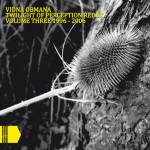
Artist: Vidna Obmana
Title: Twilight of Perception Redux: Volume Three 1996-2006
Format: CD x 3 (triple CD)
Label: Zoharum (http://zoharum.com/) (@)
Rated:
Title: Twilight of Perception Redux: Volume Three 1996-2006
Format: CD x 3 (triple CD)
Label: Zoharum (http://zoharum.com/) (@)
Rated:
Some artists release archives because history demands organization. Others release archives because there are still treasures hidden in the attic. Dirk Serries, operating under the enduring banner of Vidna Obmana, belongs firmly to the latter category. Listening to "Twilight of Perception Redux: Volume Three 1996-2006" feels less like opening a box of leftovers and more like discovering an entire wing of a museum that somehow escaped public attention for two decades.
For those familiar with ambient music's deeper currents, Serries requires little introduction. Since the 1980s, the Belgian composer has occupied a singular position within experimental music, moving effortlessly between dark ambient, drone, electro-acoustic improvisation, minimalist abstraction, and countless collaborative ventures. While many artists spend a career refining a recognizable signature, Serries has often behaved more like an explorer mapping unknown territories, abandoning established routes as soon as they become comfortable.
This third volume in the "Twilight of Perception Redux" series gathers material created between 1996 and 2006, a particularly fertile period in the Vidna Obmana chronology. Eighteen tracks spread across three discs offer not merely a collection of rarities but an alternative history of an artist constantly refining his relationship with atmosphere, texture, and sonic architecture. Thirteen of these pieces were previously unreleased, while the remaining works originally appeared on obscure compilations or limited releases long since absorbed into the collector's marketplace, that peculiar ecosystem where CDs occasionally become more expensive than the equipment needed to play them.
What immediately emerges is the remarkable coherence of the material. Collections of archival recordings often reveal why certain tracks remained unreleased. Here, the opposite occurs. One repeatedly wonders how pieces of this quality managed to remain hidden for so long.
The opening sequence establishes many of the characteristics that made Vidna Obmana such a distinctive voice within ambient music. "Majestic Trip" unfolds with patient grandeur, while "Mechanical Blow" introduces subtle tensions between organic resonance and technological presence. Throughout the compilation, Serries demonstrates an uncommon ability to create environments that feel simultaneously earthly and extraterrestrial. These are not simply ambient backdrops. They are inhabited spaces, alive with movement, memory, and suggestion.
What distinguished Vidna Obmana from many of his contemporaries was his refusal to rely exclusively on synthesizers. Across these recordings, one encounters overtone flutes, fujara, percussion, processed voices, rhythmic fragments, and countless abstract mutations woven into the fabric of the compositions. The result often resembles an imagined anthropology of impossible civilizations. One can almost picture archaeologists from another galaxy carefully excavating evidence of rituals humanity never actually performed.
Long-form pieces such as "Intersection" and "Threshold Of Obstruction" demonstrate Serries' mastery of duration. Rather than moving toward obvious climaxes, these works evolve through gradual transformations, allowing tiny shifts in timbre and density to become meaningful events. Time behaves differently inside these compositions. Minutes cease functioning as measurements and instead become landscapes through which the listener slowly travels.
The period covered by this compilation was also one during which ambient music was undergoing significant transformation. The genre was expanding beyond its early definitions, absorbing influences from industrial music, world music, field recordings, and experimental electronics. Vidna Obmana stood at the crossroads of these developments without ever appearing eager to join any particular movement. There is an independence to these recordings that remains striking today. They neither chase trends nor react against them. They simply exist according to their own internal logic.
Tracks such as "Travelworld", "Totems", and "Temple" reveal another dimension of Serries' artistry: his ability to evoke spiritual resonance without resorting to easy mysticism. These compositions possess a ceremonial quality, yet they avoid the clichés that often plague music attempting to sound transcendent. Nothing here feels decorative. The atmosphere emerges naturally from the interaction of sound, space, and silence.
Perhaps the most fascinating aspect of "Twilight of Perception Redux: Volume Three" is how contemporary it feels. Despite originating from recordings made between 1996 and 2006, the material remains astonishingly fresh. Modern drone, ambient, and sound-art practitioners continue exploring territories that Serries was already navigating decades ago. Listening to these tracks today is a reminder that innovation often occurs quietly, without demanding attention, patiently waiting for future generations to catch up.
The remastering undertaken by Serries himself enhances the collection without sacrificing its original character. The sound remains immersive, detailed, and spacious, allowing the subtle complexities of the recordings to fully emerge. Combined with the extensive commentary and elegant presentation from Zoharum, this release functions both as an archival document and as a rewarding standalone experience.
Ultimately, "Twilight of Perception Redux: Volume Three 1996-2006" succeeds because it transcends the limitations often associated with retrospective collections. Rather than merely preserving the past, it reactivates it. These recordings do not feel like historical artifacts sealed behind glass. They breathe. They wander. They continue asking questions.
And perhaps that is the enduring achievement of Vidna Obmana. While much ambient music seeks to calm the mind, Serries has always seemed more interested in expanding it, opening small doorways into unfamiliar territories and inviting us to step through. Some doors lead to beautiful places. Others lead somewhere stranger. The wisest response is probably the same in either case: keep listening.
For those familiar with ambient music's deeper currents, Serries requires little introduction. Since the 1980s, the Belgian composer has occupied a singular position within experimental music, moving effortlessly between dark ambient, drone, electro-acoustic improvisation, minimalist abstraction, and countless collaborative ventures. While many artists spend a career refining a recognizable signature, Serries has often behaved more like an explorer mapping unknown territories, abandoning established routes as soon as they become comfortable.
This third volume in the "Twilight of Perception Redux" series gathers material created between 1996 and 2006, a particularly fertile period in the Vidna Obmana chronology. Eighteen tracks spread across three discs offer not merely a collection of rarities but an alternative history of an artist constantly refining his relationship with atmosphere, texture, and sonic architecture. Thirteen of these pieces were previously unreleased, while the remaining works originally appeared on obscure compilations or limited releases long since absorbed into the collector's marketplace, that peculiar ecosystem where CDs occasionally become more expensive than the equipment needed to play them.
What immediately emerges is the remarkable coherence of the material. Collections of archival recordings often reveal why certain tracks remained unreleased. Here, the opposite occurs. One repeatedly wonders how pieces of this quality managed to remain hidden for so long.
The opening sequence establishes many of the characteristics that made Vidna Obmana such a distinctive voice within ambient music. "Majestic Trip" unfolds with patient grandeur, while "Mechanical Blow" introduces subtle tensions between organic resonance and technological presence. Throughout the compilation, Serries demonstrates an uncommon ability to create environments that feel simultaneously earthly and extraterrestrial. These are not simply ambient backdrops. They are inhabited spaces, alive with movement, memory, and suggestion.
What distinguished Vidna Obmana from many of his contemporaries was his refusal to rely exclusively on synthesizers. Across these recordings, one encounters overtone flutes, fujara, percussion, processed voices, rhythmic fragments, and countless abstract mutations woven into the fabric of the compositions. The result often resembles an imagined anthropology of impossible civilizations. One can almost picture archaeologists from another galaxy carefully excavating evidence of rituals humanity never actually performed.
Long-form pieces such as "Intersection" and "Threshold Of Obstruction" demonstrate Serries' mastery of duration. Rather than moving toward obvious climaxes, these works evolve through gradual transformations, allowing tiny shifts in timbre and density to become meaningful events. Time behaves differently inside these compositions. Minutes cease functioning as measurements and instead become landscapes through which the listener slowly travels.
The period covered by this compilation was also one during which ambient music was undergoing significant transformation. The genre was expanding beyond its early definitions, absorbing influences from industrial music, world music, field recordings, and experimental electronics. Vidna Obmana stood at the crossroads of these developments without ever appearing eager to join any particular movement. There is an independence to these recordings that remains striking today. They neither chase trends nor react against them. They simply exist according to their own internal logic.
Tracks such as "Travelworld", "Totems", and "Temple" reveal another dimension of Serries' artistry: his ability to evoke spiritual resonance without resorting to easy mysticism. These compositions possess a ceremonial quality, yet they avoid the clichés that often plague music attempting to sound transcendent. Nothing here feels decorative. The atmosphere emerges naturally from the interaction of sound, space, and silence.
Perhaps the most fascinating aspect of "Twilight of Perception Redux: Volume Three" is how contemporary it feels. Despite originating from recordings made between 1996 and 2006, the material remains astonishingly fresh. Modern drone, ambient, and sound-art practitioners continue exploring territories that Serries was already navigating decades ago. Listening to these tracks today is a reminder that innovation often occurs quietly, without demanding attention, patiently waiting for future generations to catch up.
The remastering undertaken by Serries himself enhances the collection without sacrificing its original character. The sound remains immersive, detailed, and spacious, allowing the subtle complexities of the recordings to fully emerge. Combined with the extensive commentary and elegant presentation from Zoharum, this release functions both as an archival document and as a rewarding standalone experience.
Ultimately, "Twilight of Perception Redux: Volume Three 1996-2006" succeeds because it transcends the limitations often associated with retrospective collections. Rather than merely preserving the past, it reactivates it. These recordings do not feel like historical artifacts sealed behind glass. They breathe. They wander. They continue asking questions.
And perhaps that is the enduring achievement of Vidna Obmana. While much ambient music seeks to calm the mind, Serries has always seemed more interested in expanding it, opening small doorways into unfamiliar territories and inviting us to step through. Some doors lead to beautiful places. Others lead somewhere stranger. The wisest response is probably the same in either case: keep listening.
Jude: Zakaz

There are albums that politely invite the listener inside. "Zakaz" is not one of them. It kicks the door open, drags a concrete block across the floor, and then stares at you as if you are somehow responsible for the state of the world.
For more than two decades, the Polish collective JUDE has occupied a peculiar and stubborn corner of underground culture, operating as much as a multimedia organism as a band. Their work has long resisted neat classification, drawing from industrial, hardcore, post-punk, sludge, noise, and experimental art practices while maintaining a fierce independence from both commercial expectations and underground orthodoxies. JUDE's history is littered with records, visual works, films, activism, controversies, and the sort of legends that tend to accumulate around artists who seem fundamentally uninterested in behaving themselves.
"Zakaz" ("Prohibition" in Polish) feels like the culmination of that attitude. Not because it abandons the group's past, but because it sharpens it. The seven tracks gathered here sound less like songs than pressure systems colliding. The production by Kamil azikowski deserves particular mention: every element arrives with startling physicality. The guitars grind and scrape like industrial machinery operating beyond safety regulations, the drums hit with the certainty of demolition equipment, and Wiktor Skok's vocals emerge from the turbulence like urgent transmissions from a collapsing communications network. The result is an album whose aggression is not chaotic but meticulously engineered.
What makes "Zakaz" compelling is that its heaviness never feels ornamental. Many contemporary industrial and noise-adjacent releases mistake volume for intensity, as if distortion alone could substitute for conviction. JUDE understand a more difficult truth: genuine force comes from tension. Throughout the album, moments of suffocating density coexist with carefully constructed spaces, allowing the listener to feel the weight of each impact rather than merely endure an endless barrage.
Tracks such as "Ignition. Szron" and "Misery Within" establish a landscape of friction and resistance, while the title piece stands like a monument built from rusted steel and unresolved anxieties. Elsewhere, the sprawling "Beton Blok. Methodology" unfolds with the grim patience of urban decay itself, transforming repetition into a kind of architectural statement. The music often feels less composed than excavated, as though JUDE have uncovered these sounds buried beneath layers of concrete and social debris.
There is also something distinctly physical about this record. Listening to "Zakaz" evokes textures rather than melodies: cold metal, cracked asphalt, damp walls, electrical interference. One is reminded that industrial music, at its best, is not merely about machines. It is about what machines do to people, how environments shape emotions, and how modern life leaves its marks on both bodies and landscapes.
Yet beneath the abrasion lurks an unexpected humanity. For all its hostility, "Zakaz" is not nihilistic. The album carries the emotional charge of individuals still wrestling with the world rather than surrendering to it. Anger remains present because disappointment remains present; disappointment remains present because some part of the artist still believes things could be otherwise. That fragile thread of hope, hidden beneath layers of noise and distortion, gives the record much of its emotional weight.
The decision by Zoharum to finally issue the album on vinyl feels particularly appropriate. This is music that benefits from physical presence. A limited 180-gram pressing, accompanied by the band's characteristic visual aesthetic, transforms "Zakaz" from a collection of tracks into an object with mass, texture, and permanence. In an age where songs often pass through our lives with the lifespan of a social media post, there is something quietly defiant about a record that insists on occupying actual space.
"Zakaz" does not seek comfort, accessibility, or fashionable relevance. It seeks impact. And it achieves it with remarkable precision. If this is indeed the strongest entry in JUDE's discography, as some have suggested, it is because the band has learned how to transform raw aggression into something larger: a language of resistance, frustration, endurance, and dark beauty.
Like a factory chimney silhouetted against a winter sky, "Zakaz" is harsh, imposing, and strangely magnificent.
For more than two decades, the Polish collective JUDE has occupied a peculiar and stubborn corner of underground culture, operating as much as a multimedia organism as a band. Their work has long resisted neat classification, drawing from industrial, hardcore, post-punk, sludge, noise, and experimental art practices while maintaining a fierce independence from both commercial expectations and underground orthodoxies. JUDE's history is littered with records, visual works, films, activism, controversies, and the sort of legends that tend to accumulate around artists who seem fundamentally uninterested in behaving themselves.
"Zakaz" ("Prohibition" in Polish) feels like the culmination of that attitude. Not because it abandons the group's past, but because it sharpens it. The seven tracks gathered here sound less like songs than pressure systems colliding. The production by Kamil azikowski deserves particular mention: every element arrives with startling physicality. The guitars grind and scrape like industrial machinery operating beyond safety regulations, the drums hit with the certainty of demolition equipment, and Wiktor Skok's vocals emerge from the turbulence like urgent transmissions from a collapsing communications network. The result is an album whose aggression is not chaotic but meticulously engineered.
What makes "Zakaz" compelling is that its heaviness never feels ornamental. Many contemporary industrial and noise-adjacent releases mistake volume for intensity, as if distortion alone could substitute for conviction. JUDE understand a more difficult truth: genuine force comes from tension. Throughout the album, moments of suffocating density coexist with carefully constructed spaces, allowing the listener to feel the weight of each impact rather than merely endure an endless barrage.
Tracks such as "Ignition. Szron" and "Misery Within" establish a landscape of friction and resistance, while the title piece stands like a monument built from rusted steel and unresolved anxieties. Elsewhere, the sprawling "Beton Blok. Methodology" unfolds with the grim patience of urban decay itself, transforming repetition into a kind of architectural statement. The music often feels less composed than excavated, as though JUDE have uncovered these sounds buried beneath layers of concrete and social debris.
There is also something distinctly physical about this record. Listening to "Zakaz" evokes textures rather than melodies: cold metal, cracked asphalt, damp walls, electrical interference. One is reminded that industrial music, at its best, is not merely about machines. It is about what machines do to people, how environments shape emotions, and how modern life leaves its marks on both bodies and landscapes.
Yet beneath the abrasion lurks an unexpected humanity. For all its hostility, "Zakaz" is not nihilistic. The album carries the emotional charge of individuals still wrestling with the world rather than surrendering to it. Anger remains present because disappointment remains present; disappointment remains present because some part of the artist still believes things could be otherwise. That fragile thread of hope, hidden beneath layers of noise and distortion, gives the record much of its emotional weight.
The decision by Zoharum to finally issue the album on vinyl feels particularly appropriate. This is music that benefits from physical presence. A limited 180-gram pressing, accompanied by the band's characteristic visual aesthetic, transforms "Zakaz" from a collection of tracks into an object with mass, texture, and permanence. In an age where songs often pass through our lives with the lifespan of a social media post, there is something quietly defiant about a record that insists on occupying actual space.
"Zakaz" does not seek comfort, accessibility, or fashionable relevance. It seeks impact. And it achieves it with remarkable precision. If this is indeed the strongest entry in JUDE's discography, as some have suggested, it is because the band has learned how to transform raw aggression into something larger: a language of resistance, frustration, endurance, and dark beauty.
Like a factory chimney silhouetted against a winter sky, "Zakaz" is harsh, imposing, and strangely magnificent.
Chessie + Contriva: Black Jacket

Some collaborations are born from commercial strategy, some from convenience, and some from the increasingly rare phenomenon of people genuinely liking each other's music. "Black Jacket" belongs emphatically to the latter category. It is the sound of two bands maintaining a creative correspondence for more than two decades, eventually discovering that admiration, patience, and geography can produce something more durable than novelty.
The story begins in 2001, when Washington D.C.'s Chessie and Berlin's Contriva shared a stage and recognized a common language beneath their different accents. Twenty-five years later, that conversation finally arrives in completed form. The result is neither a Chessie record featuring Contriva nor a Contriva record featuring Chessie. Instead, "Black Jacket" occupies a fascinating third space where individual identities gradually blur into a collective sensibility.
That may sound suspiciously harmonious. Human collaborations usually involve at least some degree of artistic territorial dispute, passive-aggressive email exchanges, or debates over whether a track is finished. Yet "Black Jacket" carries remarkably little friction. The album feels less like negotiation than convergence.
Both groups arrive with distinct histories. Chessie, founded by Stephen Gardner and Ben Bailes, emerged from the fertile American post-rock underground of the 1990s, exploring the intersection of abstract electronics, ambient textures, and a peculiar fascination with railways. Their work often transformed transportation infrastructure into emotional geography, proving that train travel can inspire surprisingly profound reflection once one stops worrying about delays.
Contriva, meanwhile, assembled a remarkable cast of musicians including Masha Qrella, Max Punktezahl, Hannes Lehmann, and Rike Schuberty. Associated with labels such as Morr Music and Monika Enterprise, the group developed a distinctive approach that balanced experimental textures with melodic sophistication. Their music never treated atmosphere and songcraft as opposing forces.
On "Black Jacket", those sensibilities intertwine beautifully.
The album's track titles immediately suggest a world built around color, movement, and place. "Take Me To Hiddensee" opens like a departure rather than an arrival. Gentle instrumental motifs unfold with an unforced elegance, establishing the record's preference for suggestion over declaration. Throughout the album, melody functions less as destination than as horizon.
Pieces such as "Magenta", "Hellblau", and "Brunswick Green" reinforce the impression that the music is painting rather than narrating. Colors become emotional coordinates. Textures overlap like translucent layers of watercolor, revealing subtle relationships beneath the surface. The arrangements remain remarkably detailed without becoming crowded, allowing each instrument to retain its own breathing space.
One of the album's most appealing qualities is its refusal to embrace the dramatic tendencies often associated with post-rock. There are no towering crescendos demanding applause for their architectural achievements. No guitars attempting to impersonate weather systems. Instead, "Black Jacket" favors accumulation over explosion. The emotional impact emerges gradually, through repetition, nuance, and careful interplay.
"Cabina A" and "Point No Point" showcase this approach particularly well. Rhythms drift in and out of focus while guitars, electronics, and percussion establish shifting relationships that never fully settle. The presence of drummer Robert Kretzschmar on the latter track adds momentum without disturbing the album's contemplative atmosphere.
Elsewhere, "Lunar White" introduces saxophone contributions from Peter Ehwald, adding another shade to the palette. The instrument appears almost like a distant voice remembered rather than heard directly, reinforcing the record's fascination with memory and distance.
What makes "Black Jacket" especially compelling is the sense of elapsed time embedded within it. Recorded intermittently between 2008 and 2025, the album spans nearly two decades of artistic evolution. Yet it never feels fragmented. If anything, the long gestation period contributes to its coherence. The music carries the quiet confidence of ideas allowed to mature at their own pace.
There is also something deeply refreshing about an album that understands the expressive power of restraint. In an era where musicians are often encouraged to maximize every emotional gesture, Chessie and Contriva seem content to leave certain things unresolved. Their compositions invite the listener to inhabit them rather than decode them.
The cover photograph, depicting an evening view toward train tracks in Pennsylvania, feels entirely appropriate. Much like railways themselves, these pieces are defined by connection. Not direct routes from point A to point B, but networks of relationships stretching across distance and time.
By the closing moments of "Fugitive", "Black Jacket" reveals itself as more than a collaboration. It becomes a meditation on artistic friendship itself: on what happens when musicians continue listening to one another over decades, across continents, through changing circumstances and evolving aesthetics.
The album never announces this achievement. It simply embodies it. Quietly, patiently, and with the kind of grace that only emerges when nobody is trying too hard to impress anyone. Sometimes the most remarkable journeys are not the ones that race toward a destination. Sometimes they are the ones that keep finding reasons to continue travelling together.
The story begins in 2001, when Washington D.C.'s Chessie and Berlin's Contriva shared a stage and recognized a common language beneath their different accents. Twenty-five years later, that conversation finally arrives in completed form. The result is neither a Chessie record featuring Contriva nor a Contriva record featuring Chessie. Instead, "Black Jacket" occupies a fascinating third space where individual identities gradually blur into a collective sensibility.
That may sound suspiciously harmonious. Human collaborations usually involve at least some degree of artistic territorial dispute, passive-aggressive email exchanges, or debates over whether a track is finished. Yet "Black Jacket" carries remarkably little friction. The album feels less like negotiation than convergence.
Both groups arrive with distinct histories. Chessie, founded by Stephen Gardner and Ben Bailes, emerged from the fertile American post-rock underground of the 1990s, exploring the intersection of abstract electronics, ambient textures, and a peculiar fascination with railways. Their work often transformed transportation infrastructure into emotional geography, proving that train travel can inspire surprisingly profound reflection once one stops worrying about delays.
Contriva, meanwhile, assembled a remarkable cast of musicians including Masha Qrella, Max Punktezahl, Hannes Lehmann, and Rike Schuberty. Associated with labels such as Morr Music and Monika Enterprise, the group developed a distinctive approach that balanced experimental textures with melodic sophistication. Their music never treated atmosphere and songcraft as opposing forces.
On "Black Jacket", those sensibilities intertwine beautifully.
The album's track titles immediately suggest a world built around color, movement, and place. "Take Me To Hiddensee" opens like a departure rather than an arrival. Gentle instrumental motifs unfold with an unforced elegance, establishing the record's preference for suggestion over declaration. Throughout the album, melody functions less as destination than as horizon.
Pieces such as "Magenta", "Hellblau", and "Brunswick Green" reinforce the impression that the music is painting rather than narrating. Colors become emotional coordinates. Textures overlap like translucent layers of watercolor, revealing subtle relationships beneath the surface. The arrangements remain remarkably detailed without becoming crowded, allowing each instrument to retain its own breathing space.
One of the album's most appealing qualities is its refusal to embrace the dramatic tendencies often associated with post-rock. There are no towering crescendos demanding applause for their architectural achievements. No guitars attempting to impersonate weather systems. Instead, "Black Jacket" favors accumulation over explosion. The emotional impact emerges gradually, through repetition, nuance, and careful interplay.
"Cabina A" and "Point No Point" showcase this approach particularly well. Rhythms drift in and out of focus while guitars, electronics, and percussion establish shifting relationships that never fully settle. The presence of drummer Robert Kretzschmar on the latter track adds momentum without disturbing the album's contemplative atmosphere.
Elsewhere, "Lunar White" introduces saxophone contributions from Peter Ehwald, adding another shade to the palette. The instrument appears almost like a distant voice remembered rather than heard directly, reinforcing the record's fascination with memory and distance.
What makes "Black Jacket" especially compelling is the sense of elapsed time embedded within it. Recorded intermittently between 2008 and 2025, the album spans nearly two decades of artistic evolution. Yet it never feels fragmented. If anything, the long gestation period contributes to its coherence. The music carries the quiet confidence of ideas allowed to mature at their own pace.
There is also something deeply refreshing about an album that understands the expressive power of restraint. In an era where musicians are often encouraged to maximize every emotional gesture, Chessie and Contriva seem content to leave certain things unresolved. Their compositions invite the listener to inhabit them rather than decode them.
The cover photograph, depicting an evening view toward train tracks in Pennsylvania, feels entirely appropriate. Much like railways themselves, these pieces are defined by connection. Not direct routes from point A to point B, but networks of relationships stretching across distance and time.
By the closing moments of "Fugitive", "Black Jacket" reveals itself as more than a collaboration. It becomes a meditation on artistic friendship itself: on what happens when musicians continue listening to one another over decades, across continents, through changing circumstances and evolving aesthetics.
The album never announces this achievement. It simply embodies it. Quietly, patiently, and with the kind of grace that only emerges when nobody is trying too hard to impress anyone. Sometimes the most remarkable journeys are not the ones that race toward a destination. Sometimes they are the ones that keep finding reasons to continue travelling together.
Yann Novak: Meadowsweet (redux)

Artist: Yann Novak (@)
Title: Meadowsweet (redux)
Format: Download Only (MP3 + Lossless)
Label: Dragon's Eye Recordings (@)
Rated:

Title: Meadowsweet (redux)
Format: Download Only (MP3 + Lossless)
Label: Dragon's Eye Recordings (@)
Rated:
Some albums are revisited because technology improves. Others are revisited because markets rediscover them. "Meadowsweet (redux)" exists for a far more human reason: time has passed, grief has changed shape, and the person who made the original recording is no longer standing in quite the same place.
Twenty years after its initial creation, Yann Novak returns to one of the most intimate works in his catalog, not to correct it but to listen to it again. That distinction matters. "Meadowsweet (redux)" is less a remaster than a conversation between two versions of the same artist, separated by decades of experience and by the slow, uneven work of mourning.
Los Angeles-based artist, composer, and technologist Yann Novak has built a career exploring questions of presence, perception, and the increasingly blurred boundary between physical and virtual experience. Through installations, performances, recordings, and multimedia works presented at institutions ranging from the Hammer Museum to Mutek Festival, Novak has consistently investigated how intangible phenomena can be transformed into embodied experiences. Yet for all the conceptual sophistication of his broader practice, "Meadowsweet" remains strikingly personal.
The original album emerged in the aftermath of his mother's death. Rather than approaching loss through narrative or confession, Novak turned toward field recordings, layering and processing them until they became something suspended between documentation and dream. The sounds retain traces of real places, yet their origins become increasingly difficult to identify. Memory operates in much the same way: specific details dissolve while emotional contours remain stubbornly intact.
Listening to "Meadowsweet (redux)" feels like wandering through a house where every room has been subtly altered by time. Familiar objects remain, but their meanings have shifted. The opening pieces, "A Hard Drive (redux)" and "Before the Storm (redux)", establish this atmosphere immediately. Delicate drones emerge from processed environmental recordings, hovering at the threshold between presence and disappearance. Nothing dramatic occurs, yet everything feels consequential.
One of the album's most fascinating dimensions lies in its treatment of imperfection. The original recording famously contained a technical malfunction caused by a hard drive struggling to retrieve source material quickly enough. Rather than removing or disguising the error, Novak embraced it. The resulting rupture became part of the composition itself. There is something profoundly moving in this decision. Human beings spend enormous amounts of energy trying to eliminate flaws from both art and life, only to discover that the flaws are often where meaning accumulates.
The inclusion of an astrology reading introduces another layer of complexity. Novak has openly acknowledged that he does not subscribe to astrology, yet he recognized the sincerity of a friend's attempt to offer comfort through symbolic systems. That tension becomes one of the album's central insights. Grief often pushes people toward explanations they might otherwise dismiss. Not because those explanations solve anything, but because loss creates a vacuum that demands some form of response. We reach for rituals, stories, philosophies, lucky objects, old photographs, or occasionally the advice of celestial bodies apparently preoccupied with our emotional well-being.
"A Long Goodbye pt.1" and "pt.2" form the emotional core of the record. Their gradual unfolding avoids sentimentality while remaining deeply affecting. The sounds seem to drift through one another like memories surfacing unexpectedly during ordinary moments. There is no attempt to impose resolution. Instead, Novak allows uncertainty to remain visible.
The shorter pieces that follow continue this process of dissolution. "Miller Garden", "Swarming Starlings", and "Release" each explore different relationships between environment and emotion, between external landscapes and internal states. Throughout, the mastering by Lawrence English reveals remarkable depth within the material, preserving its fragility while enhancing its spatial richness.
The centerpiece, the fifty-three-minute "Meadowsweet (redux)", functions almost as a parallel work rather than a mere extension. Here Novak's patient manipulation of texture reaches its fullest expression. Layers accumulate slowly, creating a vast sonic environment that seems simultaneously intimate and immense. The piece does not progress in any conventional sense. Instead, it breathes. It expands and contracts like recollection itself, moving through states of clarity, ambiguity, tenderness, and distance.
What ultimately distinguishes "Meadowsweet (redux)" is its refusal to offer conclusions. Many works about grief attempt to chart a path toward acceptance, closure, or healing. Novak understands that loss rarely behaves so neatly. Twenty years later, the questions remain unresolved. The absence remains present. The sounds continue to hover between arrival and departure.
In that sense, "Meadowsweet (redux)" becomes less a memorial than a demonstration of listening as an act of care. Not listening for answers, but listening for traces. Listening for what remains after certainty has vanished. Listening long enough to recognize that memory is not a fixed archive but an ongoing process of reconstruction.
The album's greatest achievement is that it transforms this deeply personal experience into something quietly universal. It reminds us that grief is not a puzzle to solve but a landscape to inhabit. Some paths fade. Others reappear unexpectedly years later. And sometimes, amid the static, the glitches, and the half-remembered sounds, we discover that what endures is not understanding, but attention itself.
Twenty years after its initial creation, Yann Novak returns to one of the most intimate works in his catalog, not to correct it but to listen to it again. That distinction matters. "Meadowsweet (redux)" is less a remaster than a conversation between two versions of the same artist, separated by decades of experience and by the slow, uneven work of mourning.
Los Angeles-based artist, composer, and technologist Yann Novak has built a career exploring questions of presence, perception, and the increasingly blurred boundary between physical and virtual experience. Through installations, performances, recordings, and multimedia works presented at institutions ranging from the Hammer Museum to Mutek Festival, Novak has consistently investigated how intangible phenomena can be transformed into embodied experiences. Yet for all the conceptual sophistication of his broader practice, "Meadowsweet" remains strikingly personal.
The original album emerged in the aftermath of his mother's death. Rather than approaching loss through narrative or confession, Novak turned toward field recordings, layering and processing them until they became something suspended between documentation and dream. The sounds retain traces of real places, yet their origins become increasingly difficult to identify. Memory operates in much the same way: specific details dissolve while emotional contours remain stubbornly intact.
Listening to "Meadowsweet (redux)" feels like wandering through a house where every room has been subtly altered by time. Familiar objects remain, but their meanings have shifted. The opening pieces, "A Hard Drive (redux)" and "Before the Storm (redux)", establish this atmosphere immediately. Delicate drones emerge from processed environmental recordings, hovering at the threshold between presence and disappearance. Nothing dramatic occurs, yet everything feels consequential.
One of the album's most fascinating dimensions lies in its treatment of imperfection. The original recording famously contained a technical malfunction caused by a hard drive struggling to retrieve source material quickly enough. Rather than removing or disguising the error, Novak embraced it. The resulting rupture became part of the composition itself. There is something profoundly moving in this decision. Human beings spend enormous amounts of energy trying to eliminate flaws from both art and life, only to discover that the flaws are often where meaning accumulates.
The inclusion of an astrology reading introduces another layer of complexity. Novak has openly acknowledged that he does not subscribe to astrology, yet he recognized the sincerity of a friend's attempt to offer comfort through symbolic systems. That tension becomes one of the album's central insights. Grief often pushes people toward explanations they might otherwise dismiss. Not because those explanations solve anything, but because loss creates a vacuum that demands some form of response. We reach for rituals, stories, philosophies, lucky objects, old photographs, or occasionally the advice of celestial bodies apparently preoccupied with our emotional well-being.
"A Long Goodbye pt.1" and "pt.2" form the emotional core of the record. Their gradual unfolding avoids sentimentality while remaining deeply affecting. The sounds seem to drift through one another like memories surfacing unexpectedly during ordinary moments. There is no attempt to impose resolution. Instead, Novak allows uncertainty to remain visible.
The shorter pieces that follow continue this process of dissolution. "Miller Garden", "Swarming Starlings", and "Release" each explore different relationships between environment and emotion, between external landscapes and internal states. Throughout, the mastering by Lawrence English reveals remarkable depth within the material, preserving its fragility while enhancing its spatial richness.
The centerpiece, the fifty-three-minute "Meadowsweet (redux)", functions almost as a parallel work rather than a mere extension. Here Novak's patient manipulation of texture reaches its fullest expression. Layers accumulate slowly, creating a vast sonic environment that seems simultaneously intimate and immense. The piece does not progress in any conventional sense. Instead, it breathes. It expands and contracts like recollection itself, moving through states of clarity, ambiguity, tenderness, and distance.
What ultimately distinguishes "Meadowsweet (redux)" is its refusal to offer conclusions. Many works about grief attempt to chart a path toward acceptance, closure, or healing. Novak understands that loss rarely behaves so neatly. Twenty years later, the questions remain unresolved. The absence remains present. The sounds continue to hover between arrival and departure.
In that sense, "Meadowsweet (redux)" becomes less a memorial than a demonstration of listening as an act of care. Not listening for answers, but listening for traces. Listening for what remains after certainty has vanished. Listening long enough to recognize that memory is not a fixed archive but an ongoing process of reconstruction.
The album's greatest achievement is that it transforms this deeply personal experience into something quietly universal. It reminds us that grief is not a puzzle to solve but a landscape to inhabit. Some paths fade. Others reappear unexpectedly years later. And sometimes, amid the static, the glitches, and the half-remembered sounds, we discover that what endures is not understanding, but attention itself.