
Browse by Genre
Industrial Music / Industrial Metal / Aggro Industrial / Electro Metal
Industrial Noise / Power Noise / Harsh Noise
Synth Pop / Electro Pop / Synth-Electronica
Techno / Trance / Goa / Drum'n'Bass / Jungle / Tribal / Trip-Hop
Ambient / Electronica / Ethereal / Dub / Soundscapes / Abstract
Experimental / Avantgarde / Weird & Wired / Glitch / Noise / Field Recording
Dark / Gothic / Wave / New Wave / Dark Wave / Industrial Gothic
New Music / Downtown / Avantgarde Jazz / New Classical / World
Search Reviews
Music Reviews
Christoph Gallio: Stone Is A Rose Is A Stone Is A Stone / Yet Dish
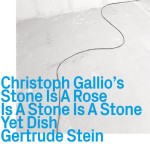
Artist: Christoph Gallio (@)
Title: Stone Is A Rose Is A Stone Is A Stone / Yet Dish
Format: CD + Download
Label: Hat Hut Records
Rated:

Title: Stone Is A Rose Is A Stone Is A Stone / Yet Dish
Format: CD + Download
Label: Hat Hut Records
Rated:
There’s a particular kind of courage in setting Gertrude Stein to music. Not the heroic, trumpet-blazing kind. More the quiet, slightly unhinged confidence of someone who looks at repetition, fragmentation, semantic loops and thinks: yes, this should sing.
Christoph Gallio has been circling the outer edges of jazz and composition for decades, often where structure begins to loosen but never quite dissolves. With "Stone Is A Rose Is A Stone Is A Stone / Yet Dish", he doesn’t just approach Stein’s text, he inhabits its peculiar logic. Or perhaps he lets it inhabit him, which sounds more accurate and slightly more concerning.
The ensemble - Sonia Loenne on voice, Gallio on soprano and alto sax, Vito Cadonau on double bass, and Flo Hufschmid on drums and percussion - operates with the kind of restraint that suggests everyone is acutely aware they are dealing with unstable material. Stein’s language doesn’t progress, it circles, accumulates, erodes meaning through insistence. The music mirrors this, but without becoming a mere illustration. That would be too easy, and also quite boring.
Instead, the six-part structure unfolds like a series of rooms where the same objects are rearranged with minor, disorienting differences. The voice doesn’t interpret Stein in any theatrical sense. Sonia Loenne treats the text almost as a physical substance, something to be weighed, stretched, tested for resonance. Words land, repeat, shift emphasis, lose their footing. Meaning becomes provisional, negotiated in real time.
Gallio’s saxophones rarely dominate. They hover, insinuate, sometimes cut through with a line that feels less like a melody and more like a question asked at the wrong moment. There’s a dryness to his tone that resists lyricism, as if he’s deliberately avoiding the temptation to beautify what is already structurally strange. It’s a smart move. Stein doesn’t need decoration; she needs space.
The rhythm section is where things get quietly subversive. Cadonau’s bass and Hufschmid’s percussion don’t anchor the music so much as unsettle it from below. They introduce pulses that almost cohere into grooves, then withdraw them before anything comfortable can form. It’s like watching someone build a staircase and then casually remove a few steps just to see what happens.
The subtitle might promise “unique and rare beauty”, which is a bold claim in a field where beauty is often treated with suspicion. What "Stone Is A Rose Is A Stone Is A Stone / Yet Dish" offers instead is something more elusive: a shifting surface where language and sound keep misaligning just enough to stay alive.
Christoph Gallio has been circling the outer edges of jazz and composition for decades, often where structure begins to loosen but never quite dissolves. With "Stone Is A Rose Is A Stone Is A Stone / Yet Dish", he doesn’t just approach Stein’s text, he inhabits its peculiar logic. Or perhaps he lets it inhabit him, which sounds more accurate and slightly more concerning.
The ensemble - Sonia Loenne on voice, Gallio on soprano and alto sax, Vito Cadonau on double bass, and Flo Hufschmid on drums and percussion - operates with the kind of restraint that suggests everyone is acutely aware they are dealing with unstable material. Stein’s language doesn’t progress, it circles, accumulates, erodes meaning through insistence. The music mirrors this, but without becoming a mere illustration. That would be too easy, and also quite boring.
Instead, the six-part structure unfolds like a series of rooms where the same objects are rearranged with minor, disorienting differences. The voice doesn’t interpret Stein in any theatrical sense. Sonia Loenne treats the text almost as a physical substance, something to be weighed, stretched, tested for resonance. Words land, repeat, shift emphasis, lose their footing. Meaning becomes provisional, negotiated in real time.
Gallio’s saxophones rarely dominate. They hover, insinuate, sometimes cut through with a line that feels less like a melody and more like a question asked at the wrong moment. There’s a dryness to his tone that resists lyricism, as if he’s deliberately avoiding the temptation to beautify what is already structurally strange. It’s a smart move. Stein doesn’t need decoration; she needs space.
The rhythm section is where things get quietly subversive. Cadonau’s bass and Hufschmid’s percussion don’t anchor the music so much as unsettle it from below. They introduce pulses that almost cohere into grooves, then withdraw them before anything comfortable can form. It’s like watching someone build a staircase and then casually remove a few steps just to see what happens.
The subtitle might promise “unique and rare beauty”, which is a bold claim in a field where beauty is often treated with suspicion. What "Stone Is A Rose Is A Stone Is A Stone / Yet Dish" offers instead is something more elusive: a shifting surface where language and sound keep misaligning just enough to stay alive.
Timo Kaukolampi: Strive – Original Music & Outtakes

Artist: Timo Kaukolampi (@)
Title: Strive – Original Music & Outtakes
Format: CD + Download
Label: Öm Sound
Rated:
Title: Strive – Original Music & Outtakes
Format: CD + Download
Label: Öm Sound
Rated:
Soundtracks often pretend to guide you through a story. "Strive – Original Music & Outtakes" does something less polite: it drops you into a malfunctioning system and lets you figure out where the exits used to be.
Timo Kaukolampi has spent years navigating the intersection between kosmische drift, industrial pulse and something colder, more clinical. With K-X-P and Op:l Bastards, he built a reputation for music that feels engineered rather than composed, as if circuitry had developed a taste for rhythm. This first solo soundtrack doesn’t mark a departure. It sharpens the edges.
The premise behind "Strive" - a near-future world where technological obsession has quietly replaced human connection - could easily collapse into familiar dystopian aesthetics. Kaukolampi avoids that trap by refusing to aestheticize the future. Instead, he degrades it. The sound palette is fractured, corroded, intentionally incomplete. Minimalism here isn’t elegant reduction; it’s damage control.
Tracks like “Beginning” and “Max Speaks” sketch out a sonic architecture built from pulses that feel slightly misaligned, like a machine running just off calibration. There’s tension, but not the cinematic kind that resolves into release. It accumulates, compresses, lingers. Even the shortest pieces - “Corpse”, “Overpass” - function less as transitions and more as interruptions, abrupt reminders that continuity is optional.
What makes this release particularly revealing is the inclusion of outtakes and discarded sketches. Normally, these function as archival curiosities, polite extras for completists. Here, they feel essential. The discarded versions - “First Drive”, “End Titles”, “Drive Movement” - don’t just show alternative ideas; they expose the process of erosion, the gradual stripping away of anything too stable, too resolved. You hear decisions being made, or more accurately, unmade.
There’s a lineage here that stretches from the Berlin school’s expansive electronics to the austere patience of Éliane Radigue, but Kaukolampi compresses those influences into something more volatile. His sound doesn’t expand outward. It folds in on itself, creating dense, pressurized environments rather than open sonic landscapes.
Released by Öm Sound, "Strive - Original Music & Outtakes" feels less like a finished statement and more like a controlled exposure of a working mind. Not everything here is complete, and that’s precisely the point. Completion would imply stability, and this music has no interest in reassuring you that things hold together.
Listening to it without the film is a slightly disorienting experience, like reading fragments of a technical manual for a machine you’ve never seen. But the emotional logic still leaks through: obsession, distance, the faint, stubborn trace of connection trying to survive in hostile circuitry.
It’s not immersive in the usual sense. It doesn’t surround you. It encloses you. And once you’re inside, it becomes clear that the system isn’t broken. It’s functioning exactly as designed. Which is, admittedly, worse.
Timo Kaukolampi has spent years navigating the intersection between kosmische drift, industrial pulse and something colder, more clinical. With K-X-P and Op:l Bastards, he built a reputation for music that feels engineered rather than composed, as if circuitry had developed a taste for rhythm. This first solo soundtrack doesn’t mark a departure. It sharpens the edges.
The premise behind "Strive" - a near-future world where technological obsession has quietly replaced human connection - could easily collapse into familiar dystopian aesthetics. Kaukolampi avoids that trap by refusing to aestheticize the future. Instead, he degrades it. The sound palette is fractured, corroded, intentionally incomplete. Minimalism here isn’t elegant reduction; it’s damage control.
Tracks like “Beginning” and “Max Speaks” sketch out a sonic architecture built from pulses that feel slightly misaligned, like a machine running just off calibration. There’s tension, but not the cinematic kind that resolves into release. It accumulates, compresses, lingers. Even the shortest pieces - “Corpse”, “Overpass” - function less as transitions and more as interruptions, abrupt reminders that continuity is optional.
What makes this release particularly revealing is the inclusion of outtakes and discarded sketches. Normally, these function as archival curiosities, polite extras for completists. Here, they feel essential. The discarded versions - “First Drive”, “End Titles”, “Drive Movement” - don’t just show alternative ideas; they expose the process of erosion, the gradual stripping away of anything too stable, too resolved. You hear decisions being made, or more accurately, unmade.
There’s a lineage here that stretches from the Berlin school’s expansive electronics to the austere patience of Éliane Radigue, but Kaukolampi compresses those influences into something more volatile. His sound doesn’t expand outward. It folds in on itself, creating dense, pressurized environments rather than open sonic landscapes.
Released by Öm Sound, "Strive - Original Music & Outtakes" feels less like a finished statement and more like a controlled exposure of a working mind. Not everything here is complete, and that’s precisely the point. Completion would imply stability, and this music has no interest in reassuring you that things hold together.
Listening to it without the film is a slightly disorienting experience, like reading fragments of a technical manual for a machine you’ve never seen. But the emotional logic still leaks through: obsession, distance, the faint, stubborn trace of connection trying to survive in hostile circuitry.
It’s not immersive in the usual sense. It doesn’t surround you. It encloses you. And once you’re inside, it becomes clear that the system isn’t broken. It’s functioning exactly as designed. Which is, admittedly, worse.
Danny McCarthy: Haunted By Silence
Artist: Danny McCarthy (@)
Title: Haunted By Silence
Format: CD + Download
Label: Farpoint Recordings (@)
Rated:

Title: Haunted By Silence
Format: CD + Download
Label: Farpoint Recordings (@)
Rated:
Silence, as it turns out, is rarely silent. It creaks, exhales, contracts, remembers. And if you sit still long enough - longer than most people are willing to - you start to notice that it has a temperament. "Haunted By Silence" by Danny McCarthy is built precisely on that uncomfortable realization: that absence is never empty, only unattended.
McCarthy has been working in the field of sound art and deep listening for decades, often orbiting installations, environments, and site-specific works rather than conventional “albums”. This piece, though released as a single 47-minute composition, carries that spatial DNA with it. It doesn’t behave like a recording. It behaves like a place you’re temporarily allowed to occupy, assuming you don’t start making noise and ruin everything.
The origin story matters here, and not just as a romantic backdrop. St. Mary’s Abbey in Glencairn - home to a Cistercian community where silence is not aesthetic but structural - provides both the conceptual and acoustic seed. McCarthy listens to the building the way some people listen to music: heating systems switching off, wood contracting, tiny fractures of sound appearing without warning. No rhythm, no pattern, no intention. Just events. And between them, something far more demanding than sound: attention.
The piece unfolds with a kind of severe patience. Field recordings and manipulated objects are arranged so sparingly that each gesture feels consequential, almost intrusive. Some sounds hover at the edge of perception, others cut through with surgical precision. There’s no narrative, no progression in the traditional sense. Instead, there’s a shifting field of presence and withdrawal, as if the work is constantly negotiating how much it should reveal.
At times, it borders on the perverse. You find yourself leaning in, waiting for something to happen, and when it does, it’s barely there. A click, a distant resonance, a texture that dissolves before you can name it. It’s the kind of listening experience that exposes how conditioned we are to expect reward, payoff, meaning neatly delivered. "Haunted By Silence" offers none of that. It offers proximity.
The influence of deep listening practices is evident, though never didactic. McCarthy doesn’t instruct you to listen differently. He simply removes the usual scaffolding and leaves you alone with your own perceptual habits. The result is mildly disorienting, occasionally frustrating, and, if you persist, unexpectedly absorbing.
There’s also a quiet dialogue with the accompanying texts - particularly the presence of David Toop, whose reflections on silence have long occupied a similar terrain. But the album doesn’t rely on theory to justify itself. It stands, or rather barely stands, on its own fragile acoustics.
Released by Farpoint Recordings, a label that has consistently documented work at the edges of audibility and intention, this album fits comfortably within a catalog that values attention over spectacle. The limited CD edition, with essays and photographic documentation, reinforces the sense that this is as much an object of contemplation as a piece of sound.
What "Haunted By Silence" ultimately does is strip listening down to something almost primitive. No hooks, no gestures toward accessibility, no concern for your patience threshold. It asks you to sit, to wait, to notice. Which, in a world engineered to prevent exactly that, feels less like an artistic choice and more like a quiet act of resistance.
It won’t fill a room. It will, however, change how the room feels once it’s gone.
McCarthy has been working in the field of sound art and deep listening for decades, often orbiting installations, environments, and site-specific works rather than conventional “albums”. This piece, though released as a single 47-minute composition, carries that spatial DNA with it. It doesn’t behave like a recording. It behaves like a place you’re temporarily allowed to occupy, assuming you don’t start making noise and ruin everything.
The origin story matters here, and not just as a romantic backdrop. St. Mary’s Abbey in Glencairn - home to a Cistercian community where silence is not aesthetic but structural - provides both the conceptual and acoustic seed. McCarthy listens to the building the way some people listen to music: heating systems switching off, wood contracting, tiny fractures of sound appearing without warning. No rhythm, no pattern, no intention. Just events. And between them, something far more demanding than sound: attention.
The piece unfolds with a kind of severe patience. Field recordings and manipulated objects are arranged so sparingly that each gesture feels consequential, almost intrusive. Some sounds hover at the edge of perception, others cut through with surgical precision. There’s no narrative, no progression in the traditional sense. Instead, there’s a shifting field of presence and withdrawal, as if the work is constantly negotiating how much it should reveal.
At times, it borders on the perverse. You find yourself leaning in, waiting for something to happen, and when it does, it’s barely there. A click, a distant resonance, a texture that dissolves before you can name it. It’s the kind of listening experience that exposes how conditioned we are to expect reward, payoff, meaning neatly delivered. "Haunted By Silence" offers none of that. It offers proximity.
The influence of deep listening practices is evident, though never didactic. McCarthy doesn’t instruct you to listen differently. He simply removes the usual scaffolding and leaves you alone with your own perceptual habits. The result is mildly disorienting, occasionally frustrating, and, if you persist, unexpectedly absorbing.
There’s also a quiet dialogue with the accompanying texts - particularly the presence of David Toop, whose reflections on silence have long occupied a similar terrain. But the album doesn’t rely on theory to justify itself. It stands, or rather barely stands, on its own fragile acoustics.
Released by Farpoint Recordings, a label that has consistently documented work at the edges of audibility and intention, this album fits comfortably within a catalog that values attention over spectacle. The limited CD edition, with essays and photographic documentation, reinforces the sense that this is as much an object of contemplation as a piece of sound.
What "Haunted By Silence" ultimately does is strip listening down to something almost primitive. No hooks, no gestures toward accessibility, no concern for your patience threshold. It asks you to sit, to wait, to notice. Which, in a world engineered to prevent exactly that, feels less like an artistic choice and more like a quiet act of resistance.
It won’t fill a room. It will, however, change how the room feels once it’s gone.
Roman Leykam: Enticing
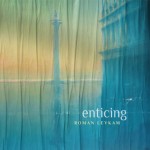
There’s a certain type of album that promises contemplation and then delivers a politely blurred background for your next existential crisis. "Enticing" by Roman Leykam gets dangerously close to that territory, then quietly sidesteps it, as if aware that true stillness is less about comfort and more about what starts surfacing when nothing distracts you.
Leykam works in that porous space where guitar stops behaving like a guitar. Through analog and digital synth treatments, field recordings, and a patient dismantling of instrumental identity, he builds something that feels less composed than slowly exhaled. The fact that much of the material dates back to 2022 recordings gives the album a faint temporal dislocation, like memories processed long after the events themselves have lost their urgency.
“A Tireless Choir of Waves” opens with exactly the kind of title that dares you to roll your eyes. Resist the urge. The piece unfolds with a restrained insistence, layering tones that never quite resolve into harmony, more like parallel currents brushing against each other. It’s not oceanic in the clichéd ambient sense. It’s more like standing near water and realizing you’ve been listening to it for longer than you intended.
Across the record, Leykam avoids dramatic gestures with almost stubborn discipline. “A Touch of Bleakness” and “Fleeing Shadows” drift through minor tonalities that never collapse into despair, instead hovering in that ambiguous emotional register where melancholy feels observational rather than confessional. There’s no catharsis here, which is either a flaw or the entire point, depending on how much emotional closure you require from your music.
“Elation” briefly suggests a shift, but even here the brightness feels filtered, as if viewed through frosted glass. Any sense of uplift is tempered by a lingering hesitation, like someone who has learned not to trust sudden happiness. It’s a small, almost cruel detail, and it works.
Field recordings - subtly integrated, occasionally sourced by Jacqueline Leykam - appear less as documentary elements and more as spatial interruptions. They don’t locate you in a place so much as remind you that place is always slipping. “Myriads of Black Angels” and “Grey Unlimited Water Area” extend this ambiguity, stretching time until it becomes difficult to tell whether the music is evolving or simply persisting.
“Ponte Pantalon” introduces a faint architectural echo, a suggestion of Venice not as postcard but as acoustic residue: footsteps, water, stone, absence. It’s one of the few moments where the outside world feels momentarily legible before dissolving again into abstraction.
By the time “Environmental Sounds” and “The Leisure of a Dream” arrive, the album has thinned out into something almost transparent. The closing stretch - “Silent Beauty” and “City of Masks” - doesn’t conclude so much as fade into a state of suspended attention, as if ending would be too definitive a gesture for a record so invested in ambiguity.
Released by Frank Mark Arts, "Enticing" aligns itself with a lineage of ambient and electroacoustic work that treats sound less as narrative and more as environment. But unlike more decorative entries in the genre, it resists becoming purely ornamental. There’s a quiet insistence here, a refusal to be reduced to atmosphere alone.
It’s not an album that reaches out. It waits. And if you meet it halfway, it does something mildly inconvenient: it removes the illusion that stillness is empty. Instead, it reveals it as crowded, layered, and slightly unsettling.
Which, frankly, is a more honest kind of calm.
Leykam works in that porous space where guitar stops behaving like a guitar. Through analog and digital synth treatments, field recordings, and a patient dismantling of instrumental identity, he builds something that feels less composed than slowly exhaled. The fact that much of the material dates back to 2022 recordings gives the album a faint temporal dislocation, like memories processed long after the events themselves have lost their urgency.
“A Tireless Choir of Waves” opens with exactly the kind of title that dares you to roll your eyes. Resist the urge. The piece unfolds with a restrained insistence, layering tones that never quite resolve into harmony, more like parallel currents brushing against each other. It’s not oceanic in the clichéd ambient sense. It’s more like standing near water and realizing you’ve been listening to it for longer than you intended.
Across the record, Leykam avoids dramatic gestures with almost stubborn discipline. “A Touch of Bleakness” and “Fleeing Shadows” drift through minor tonalities that never collapse into despair, instead hovering in that ambiguous emotional register where melancholy feels observational rather than confessional. There’s no catharsis here, which is either a flaw or the entire point, depending on how much emotional closure you require from your music.
“Elation” briefly suggests a shift, but even here the brightness feels filtered, as if viewed through frosted glass. Any sense of uplift is tempered by a lingering hesitation, like someone who has learned not to trust sudden happiness. It’s a small, almost cruel detail, and it works.
Field recordings - subtly integrated, occasionally sourced by Jacqueline Leykam - appear less as documentary elements and more as spatial interruptions. They don’t locate you in a place so much as remind you that place is always slipping. “Myriads of Black Angels” and “Grey Unlimited Water Area” extend this ambiguity, stretching time until it becomes difficult to tell whether the music is evolving or simply persisting.
“Ponte Pantalon” introduces a faint architectural echo, a suggestion of Venice not as postcard but as acoustic residue: footsteps, water, stone, absence. It’s one of the few moments where the outside world feels momentarily legible before dissolving again into abstraction.
By the time “Environmental Sounds” and “The Leisure of a Dream” arrive, the album has thinned out into something almost transparent. The closing stretch - “Silent Beauty” and “City of Masks” - doesn’t conclude so much as fade into a state of suspended attention, as if ending would be too definitive a gesture for a record so invested in ambiguity.
Released by Frank Mark Arts, "Enticing" aligns itself with a lineage of ambient and electroacoustic work that treats sound less as narrative and more as environment. But unlike more decorative entries in the genre, it resists becoming purely ornamental. There’s a quiet insistence here, a refusal to be reduced to atmosphere alone.
It’s not an album that reaches out. It waits. And if you meet it halfway, it does something mildly inconvenient: it removes the illusion that stillness is empty. Instead, it reveals it as crowded, layered, and slightly unsettling.
Which, frankly, is a more honest kind of calm.
Bad Groupy & Pink Twins: Hallitusvastane Puhastus
Artist: Bad Groupy & Pink Twins (@)
Title: Hallitusvastane Puhastus
Format: CD + Download
Label: I Shall Sing Until My Land Is Free (@)
Rated:
Title: Hallitusvastane Puhastus
Format: CD + Download
Label: I Shall Sing Until My Land Is Free (@)
Rated:
Some records arrive with a concept. Others arrive like a dent in the wall and dare you to explain how it got there. "Hallitusvastane Puhastus" - the meeting point between Bad Groupy and Pink Twins - belongs firmly to the second category. A single 37-minute piece, recorded until the computer gave up, which is either a romantic anecdote or a subtle warning.
The title alone does half the work: anti-government activity in Finnish, bathroom mold cleaner in Estonian. It’s difficult to decide whether this is conceptual brilliance or a perfectly calibrated joke at the listener’s expense. Either way, it sets the tone. Expect ambiguity. Expect friction. Expect to question your life choices somewhere around minute twelve.
The four minds involved - Kris Kuldkepp, Jeff Surak, Juha VehvilÄinen and Vesa VehvilÄinen - approach sound not as composition but as accumulation. Synthesizers, tapes, pedals, field recordings, and whatever else happened to be within arm’s reach are fed into a process that feels less like collaboration and more like a controlled landslide.
The result is a monolith, but not a static one. It shifts, corrodes, regenerates. Early on, there’s a sense of spatial exploration: fragments flicker in and out, textures scrape against each other, as if the piece is testing its own boundaries. Then, gradually, density takes over. Layers stack, distort, and begin to obscure their own origins. You stop identifying sources and start perceiving mass.
There’s a peculiar psychedelic quality here, though not the comforting, kaleidoscopic kind. This is closer to sensory overload filtered through industrial fatigue. At times, it hints at rhythm, then immediately undermines it. At others, it flirts with drone, only to inject enough instability to prevent any meditative drift. If this is “rock ’n’ roll”, it’s been dismantled, catalogued, and reassembled without instructions.
What makes the piece unexpectedly compelling is its refusal to resolve into a single identity. It doesn’t settle into noise, though it frequently approaches it. It doesn’t commit to structure, though patterns occasionally emerge like temporary scaffolding. The question “is it art or noise?” lingers, but the record seems largely indifferent to the outcome. It exists regardless, which is both admirable and mildly irritating.
There’s also a quiet sense of humor embedded in the excess. Playing until the recording system crashes is the kind of gesture that flirts with cliché in experimental circles, yet here it feels oddly appropriate. The music carries that same threshold energy, as if constantly approaching its own limit without quite collapsing.
Released by I Shall Sing Until My Land Is Free, a label whose name already suggests a certain ideological stubbornness, "Hallitusvastane Puhastus" fits neatly into a lineage of works that treat sound as both material and provocation. It doesn’t guide, it confronts. Not aggressively, but persistently.
For the sake of clarity, this review remains strictly focused on the artistic content of the release and does not endorse or oppose any political stance or campaign associated with the label.
Listening to it is less like following a narrative and more like inhabiting a space that keeps rearranging itself while you’re inside. Doors appear, disappear, lead nowhere. Eventually, you stop looking for an exit and start paying attention to the walls.
Whether it’s a tool for dismantling systems or cleaning imaginary mold is, ultimately, beside the point. It does something more basic and more inconvenient: it forces you to confront how much meaning you expect from sound - and how uneasy it feels when that expectation isn’t met.
The title alone does half the work: anti-government activity in Finnish, bathroom mold cleaner in Estonian. It’s difficult to decide whether this is conceptual brilliance or a perfectly calibrated joke at the listener’s expense. Either way, it sets the tone. Expect ambiguity. Expect friction. Expect to question your life choices somewhere around minute twelve.
The four minds involved - Kris Kuldkepp, Jeff Surak, Juha VehvilÄinen and Vesa VehvilÄinen - approach sound not as composition but as accumulation. Synthesizers, tapes, pedals, field recordings, and whatever else happened to be within arm’s reach are fed into a process that feels less like collaboration and more like a controlled landslide.
The result is a monolith, but not a static one. It shifts, corrodes, regenerates. Early on, there’s a sense of spatial exploration: fragments flicker in and out, textures scrape against each other, as if the piece is testing its own boundaries. Then, gradually, density takes over. Layers stack, distort, and begin to obscure their own origins. You stop identifying sources and start perceiving mass.
There’s a peculiar psychedelic quality here, though not the comforting, kaleidoscopic kind. This is closer to sensory overload filtered through industrial fatigue. At times, it hints at rhythm, then immediately undermines it. At others, it flirts with drone, only to inject enough instability to prevent any meditative drift. If this is “rock ’n’ roll”, it’s been dismantled, catalogued, and reassembled without instructions.
What makes the piece unexpectedly compelling is its refusal to resolve into a single identity. It doesn’t settle into noise, though it frequently approaches it. It doesn’t commit to structure, though patterns occasionally emerge like temporary scaffolding. The question “is it art or noise?” lingers, but the record seems largely indifferent to the outcome. It exists regardless, which is both admirable and mildly irritating.
There’s also a quiet sense of humor embedded in the excess. Playing until the recording system crashes is the kind of gesture that flirts with cliché in experimental circles, yet here it feels oddly appropriate. The music carries that same threshold energy, as if constantly approaching its own limit without quite collapsing.
Released by I Shall Sing Until My Land Is Free, a label whose name already suggests a certain ideological stubbornness, "Hallitusvastane Puhastus" fits neatly into a lineage of works that treat sound as both material and provocation. It doesn’t guide, it confronts. Not aggressively, but persistently.
For the sake of clarity, this review remains strictly focused on the artistic content of the release and does not endorse or oppose any political stance or campaign associated with the label.
Listening to it is less like following a narrative and more like inhabiting a space that keeps rearranging itself while you’re inside. Doors appear, disappear, lead nowhere. Eventually, you stop looking for an exit and start paying attention to the walls.
Whether it’s a tool for dismantling systems or cleaning imaginary mold is, ultimately, beside the point. It does something more basic and more inconvenient: it forces you to confront how much meaning you expect from sound - and how uneasy it feels when that expectation isn’t met.