
Browse by Genre
Industrial Music / Industrial Metal / Aggro Industrial / Electro Metal
Industrial Noise / Power Noise / Harsh Noise
Synth Pop / Electro Pop / Synth-Electronica
Techno / Trance / Goa / Drum'n'Bass / Jungle / Tribal / Trip-Hop
Ambient / Electronica / Ethereal / Dub / Soundscapes / Abstract
Experimental / Avantgarde / Weird & Wired / Glitch / Noise / Field Recording
Dark / Gothic / Wave / New Wave / Dark Wave / Industrial Gothic
New Music / Downtown / Avantgarde Jazz / New Classical / World
Search Reviews
Music Reviews
VV.AA.: eavesdrop festival 2024

Artist: VV.AA.
Title: eavesdrop festival 2024
Format: Tape + Download
Label: Karlrecords (http://www.karlrecords.net/) (@)
Rated:

Title: eavesdrop festival 2024
Format: Tape + Download
Label: Karlrecords (http://www.karlrecords.net/) (@)
Rated:
Festivals like to describe themselves as “platforms”. Which is a polite way of saying: a temporary ecosystem where musicians, machines, cables and philosophical anxieties gather in one architectural container and see what noises emerge. The Eavesdrop Festival, held inside the cavernous concrete geometry of Silent Green Kulturquartier in Berlin, takes that idea unusually seriously. Even its name suggests a listening posture that is slightly sideways. Not passive, not passive-aggressive either. Just attentive. Curious. Nose pressed against the sonic keyhole.
The compilation "eavesdrop festival 2024", released by Karlrecords as a hand-numbered cassette in the modest quantity of one hundred copies, functions less like a souvenir and more like an archaeological sample. Two nights of performances are distilled into nine tracks, most of them raw excerpts from live sets, plus a couple of stereo reductions of installations that originally occupied physical space in multichannel form. In other words, what you hear is already a translation. A shadow of a spatial event flattened into tape hiss and magnetic particles.
That might sound like a loss. It is not. If anything, the reduction intensifies the listening.
The opening fragment by Rashad Becker behaves like a laboratory demonstration of synthesis gone slightly feral. Becker, a composer whose biography reads like a list of philosophical resignations, sculpts tones that feel both clinical and oddly humorous, as if oscillators had developed personalities and were arguing quietly in the corner.
Then Mariam Rezaei enters with a turntable performance that dismantles the polite expectations of DJ culture. Her approach to vinyl is closer to sculptural violence than nostalgic reverence. Scratches explode, rhythms disintegrate, fragments collide at absurd velocities. Somewhere between free improvisation and sonic surrealism, the record player stops pretending it was ever meant merely to reproduce sound.
The collaboration between Audrey Chen and Hugo Esquinca pushes things further into bodily territory. Chen’s voice stretches into impossible shapes while Esquinca floods the acoustic space with extreme amplification. The result is less a duet than a temporary organism: lungs, circuits and architecture vibrating together in uneasy sympathy.
A moment of structural contrast arrives with Nima Aghiani, whose work balances synthesis, field recordings and instrumental gestures with the compositional patience of someone who enjoys juxtaposing incompatible sonic colors. His excerpt behaves like a collage assembled with microscopic care.
On the more conceptual end of the spectrum sits Lottie Sebes’ "Mouthpiece", a stereo version of a multichannel installation involving AI-mediated voice synthesis. The piece hovers somewhere between machine confession and algorithmic séance, quietly probing the power dynamics embedded in technologies that speak with borrowed human timbres.
Side B brings an entirely different set of physical energies. Nina Garcia treats the electric guitar as an object to interrogate rather than a tool to perform with. Scrapes, resonances and unstable feedback loops accumulate until the instrument resembles a metal animal discovering its own nervous system.
Festival curator Jasmine Guffond contributes "Approaching Chaos", another installation-derived piece where generative structures blur the boundary between system and improvisation. It sounds like infrastructure thinking aloud.
The longest track belongs to Ilpo Vaisanen, formerly of Pan Sonic, whose legacy in minimalist electronic brutality remains intimidating. His live excerpt is a slow tectonic drift of analogue tones, dub-inflected pressure and industrial residue. Few artists can produce such density with such stubbornly simple tools.
Finally Mat Pogo closes the tape with "Special Occasion", which sounds exactly like what might happen if a noise performance, a punk monologue and a surrealist radio play collided after midnight. Screams, narrative fragments and absurd vocal gestures swirl together with a theatrical sense of chaos. You could call it nonsense. You could also call it a reminder that experimental music occasionally benefits from a sense of humor.
Beyond the music itself, the release carries a weight that refuses to remain abstract. All revenues from the compilation go to Medical Aid for Palestinians and Thamra, supporting medical assistance and food sovereignty initiatives in Gaza. It is a quiet but deliberate gesture: listening as a political act, not merely an aesthetic pastime.
So the tape ends up performing two functions at once. On one level, it documents a particular moment in Berlin’s ever-shifting ecosystem of experimental sound practices. On another, it reminds listeners that curiosity and attention are not neutral habits. They can also be forms of solidarity.
Strange little object, this cassette. Limited, fragile, probably destined to live on a shelf next to other obscure artefacts of contemporary sonic culture. Yet inside those seventy-eight minutes you hear something stubbornly alive: artists testing the limits of machines, bodies and rooms, while the audience leans in and listens a bit closer than usual.
Which, come to think of it, is exactly what eavesdropping was supposed to be about.
The compilation "eavesdrop festival 2024", released by Karlrecords as a hand-numbered cassette in the modest quantity of one hundred copies, functions less like a souvenir and more like an archaeological sample. Two nights of performances are distilled into nine tracks, most of them raw excerpts from live sets, plus a couple of stereo reductions of installations that originally occupied physical space in multichannel form. In other words, what you hear is already a translation. A shadow of a spatial event flattened into tape hiss and magnetic particles.
That might sound like a loss. It is not. If anything, the reduction intensifies the listening.
The opening fragment by Rashad Becker behaves like a laboratory demonstration of synthesis gone slightly feral. Becker, a composer whose biography reads like a list of philosophical resignations, sculpts tones that feel both clinical and oddly humorous, as if oscillators had developed personalities and were arguing quietly in the corner.
Then Mariam Rezaei enters with a turntable performance that dismantles the polite expectations of DJ culture. Her approach to vinyl is closer to sculptural violence than nostalgic reverence. Scratches explode, rhythms disintegrate, fragments collide at absurd velocities. Somewhere between free improvisation and sonic surrealism, the record player stops pretending it was ever meant merely to reproduce sound.
The collaboration between Audrey Chen and Hugo Esquinca pushes things further into bodily territory. Chen’s voice stretches into impossible shapes while Esquinca floods the acoustic space with extreme amplification. The result is less a duet than a temporary organism: lungs, circuits and architecture vibrating together in uneasy sympathy.
A moment of structural contrast arrives with Nima Aghiani, whose work balances synthesis, field recordings and instrumental gestures with the compositional patience of someone who enjoys juxtaposing incompatible sonic colors. His excerpt behaves like a collage assembled with microscopic care.
On the more conceptual end of the spectrum sits Lottie Sebes’ "Mouthpiece", a stereo version of a multichannel installation involving AI-mediated voice synthesis. The piece hovers somewhere between machine confession and algorithmic séance, quietly probing the power dynamics embedded in technologies that speak with borrowed human timbres.
Side B brings an entirely different set of physical energies. Nina Garcia treats the electric guitar as an object to interrogate rather than a tool to perform with. Scrapes, resonances and unstable feedback loops accumulate until the instrument resembles a metal animal discovering its own nervous system.
Festival curator Jasmine Guffond contributes "Approaching Chaos", another installation-derived piece where generative structures blur the boundary between system and improvisation. It sounds like infrastructure thinking aloud.
The longest track belongs to Ilpo Vaisanen, formerly of Pan Sonic, whose legacy in minimalist electronic brutality remains intimidating. His live excerpt is a slow tectonic drift of analogue tones, dub-inflected pressure and industrial residue. Few artists can produce such density with such stubbornly simple tools.
Finally Mat Pogo closes the tape with "Special Occasion", which sounds exactly like what might happen if a noise performance, a punk monologue and a surrealist radio play collided after midnight. Screams, narrative fragments and absurd vocal gestures swirl together with a theatrical sense of chaos. You could call it nonsense. You could also call it a reminder that experimental music occasionally benefits from a sense of humor.
Beyond the music itself, the release carries a weight that refuses to remain abstract. All revenues from the compilation go to Medical Aid for Palestinians and Thamra, supporting medical assistance and food sovereignty initiatives in Gaza. It is a quiet but deliberate gesture: listening as a political act, not merely an aesthetic pastime.
So the tape ends up performing two functions at once. On one level, it documents a particular moment in Berlin’s ever-shifting ecosystem of experimental sound practices. On another, it reminds listeners that curiosity and attention are not neutral habits. They can also be forms of solidarity.
Strange little object, this cassette. Limited, fragile, probably destined to live on a shelf next to other obscure artefacts of contemporary sonic culture. Yet inside those seventy-eight minutes you hear something stubbornly alive: artists testing the limits of machines, bodies and rooms, while the audience leans in and listens a bit closer than usual.
Which, come to think of it, is exactly what eavesdropping was supposed to be about.
Juan J. G. Escudero: Ice Door

I had previously reviewed Escudero’s album “Shapes of Inner Timespaces,” and found it to be a pleasant listen, so I was interested to see what his next album would sound like. Escudero hails from Madrid, Spain and his day job seems to be mathematics researcher (if my Google Scholar search is bringing back the right person, topology seems to be his forte). The label describes the album thus: “To the bemusement of the rest of us, mathematicians often describe certain equations, processes, and proofs as ‘elegant,’ ‘beautiful,’ or even ‘sensuous.’ Artworks based on algorithms, conversely, might seem less predisposed to such descriptions. But what if those complex calculations actually produced perceptibly emotional qualities?” Well, let’s run the program and see what the numbers give us.
“Páginas de Mar” is chaotic and whimsical right out of the gate. This would be right at home on a Looney tunes cartoon soundtrack. Heavy piano runs, wood blocks, staccato plucked strings and xylophone really make this work well. Seriously, this would be perfect on a cartoon soundtrack. “Sur la Pente du Talus” changes things up significantly. On this one tension is the name of the game, with low bass that is punctuated by the occasional bass stab and other incidental sounds. This would be right at home as the soundtrack to your haunted house next Halloween. “Das Wort als Horizont” moves in a slightly different direction. It's a noisy, scraping, clattering soundscape with an undercurrent that sounds like you're being digested by a large animal. It's noisy, but subdued. “Underland A20” shifts gears again, and this track is a lot of fun. Imagine letting a group of energetic children into a room with assorted orchestra instruments. They start plucking the strings, messing with them, running a bow over them in various places. Some of the children are pushing them around with the bow, dropping them on the floor, playing sword fight with the bows . . . and then they discover the basses. This is where sudden drops of heavy bass happen at times. All over a cacophony of strings. It's a good time, but I'm sure there are some violin players out there that are wincing at this description. “Ice Door” is like sitting in a ship that's been sunk to the bottom of the ocean. The clanks and heavy bass and rattling metal remind you that it hasn't quite settled just yet. The overall feel is kind of dream-like, but it's an unsettling dream. Much like being stuck at the bottom of the ocean. “Coincidence Threshold” is a bit more composed than the previous few tracks. It seems to have a bit more in common with “Páginas de Mar” in the sense that it seems more intentionally put together, but where the prior track is more whimsical in feeling, this track takes a more sinister turn. Heavy bass opens up the track and piano stabs interrupt the drone. The track tacks between animated, as the piano comes in, and sounding like Escudero has run the entire track backwards through a tape deck. I'm generally not a huge fan of piano-based pieces, but this piano player really makes it work.
The judicious use of dissonance is what gives these tracks their charm. Overall if you're looking for experimental classical music this is definitely one to find to check out. If there is a criticism to be had it's that some of the tracks started to sound a little too similar in feel. That said, this is well worth checking out if you're looking for something that pushes the envelope of classical music.
“Páginas de Mar” is chaotic and whimsical right out of the gate. This would be right at home on a Looney tunes cartoon soundtrack. Heavy piano runs, wood blocks, staccato plucked strings and xylophone really make this work well. Seriously, this would be perfect on a cartoon soundtrack. “Sur la Pente du Talus” changes things up significantly. On this one tension is the name of the game, with low bass that is punctuated by the occasional bass stab and other incidental sounds. This would be right at home as the soundtrack to your haunted house next Halloween. “Das Wort als Horizont” moves in a slightly different direction. It's a noisy, scraping, clattering soundscape with an undercurrent that sounds like you're being digested by a large animal. It's noisy, but subdued. “Underland A20” shifts gears again, and this track is a lot of fun. Imagine letting a group of energetic children into a room with assorted orchestra instruments. They start plucking the strings, messing with them, running a bow over them in various places. Some of the children are pushing them around with the bow, dropping them on the floor, playing sword fight with the bows . . . and then they discover the basses. This is where sudden drops of heavy bass happen at times. All over a cacophony of strings. It's a good time, but I'm sure there are some violin players out there that are wincing at this description. “Ice Door” is like sitting in a ship that's been sunk to the bottom of the ocean. The clanks and heavy bass and rattling metal remind you that it hasn't quite settled just yet. The overall feel is kind of dream-like, but it's an unsettling dream. Much like being stuck at the bottom of the ocean. “Coincidence Threshold” is a bit more composed than the previous few tracks. It seems to have a bit more in common with “Páginas de Mar” in the sense that it seems more intentionally put together, but where the prior track is more whimsical in feeling, this track takes a more sinister turn. Heavy bass opens up the track and piano stabs interrupt the drone. The track tacks between animated, as the piano comes in, and sounding like Escudero has run the entire track backwards through a tape deck. I'm generally not a huge fan of piano-based pieces, but this piano player really makes it work.
The judicious use of dissonance is what gives these tracks their charm. Overall if you're looking for experimental classical music this is definitely one to find to check out. If there is a criticism to be had it's that some of the tracks started to sound a little too similar in feel. That said, this is well worth checking out if you're looking for something that pushes the envelope of classical music.
Daniele Brusaschetto: Bruise a Shadow
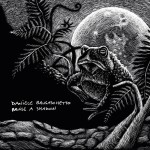
I was not familiar with this artist and the frog artwork did not give much indication of what I was in for, so I put the disc in and hit play. I like hearing the music on its own terms without any preconceived notions. Afterwards, I read the press sheet. Daniele Brusaschetto hails from Turin Italy and the press sheet states that “The new album ties and expands the tropes of the former Flying Stag, hammering even more along the lines of the incandescent lineage of Voivod, Godflesh and early Mastodon. Tracks built in the last 5 years, existentialism, melancholy, daily apocalypse, on-sense, delirium and irony. Granite enriched by the mist of new / no wave, from which the echo of sudden melody emerges, a sort of emotional industry, to uncover beyond the wall of guitars.”
Like most people with a Y and an X chromosome that grew up in the '80s, I too had my metal phase. As such, this album was kind of nostalgic in that it seems to evoke that kind of feel. Brusachetto plays it pretty straight, and by that I mean there's not a lot of distortion or effects, and the voice is relatively unprocessed and non-screaming. Generally, Chain D.L.K. does not review straight metal or hard rock, and more often than not when I am reviewing something with a guitar, drills and other power tools are also involved. This isn't industrial metal like Ministry, or even coldwave stuff like Chemlab. Rather, this is pretty straightforward hard rock. The only inkling of experimentalism is found in “Petra,” which serves more as an interlude. Still, they sent it so I'm going to give my thoughts on it. To me the standout track on here is “Coal Woods,” which is a lovely piece that really showcases the compositional skill of this artist. You could almost think of it as several movements within the same track. The other tracks are quite nice as well and for those of you who speak Italian, you have a couple of tracks just for you. The music is well done and manages to avoid many of the cliches of hard rock and metal. The lyrics have a poetic feel to them which is sometimes lacking in hard rock music. In short, if you're looking for some hard rock with a little bit of a prog feel to it this is certainly worth checking out.
Like most people with a Y and an X chromosome that grew up in the '80s, I too had my metal phase. As such, this album was kind of nostalgic in that it seems to evoke that kind of feel. Brusachetto plays it pretty straight, and by that I mean there's not a lot of distortion or effects, and the voice is relatively unprocessed and non-screaming. Generally, Chain D.L.K. does not review straight metal or hard rock, and more often than not when I am reviewing something with a guitar, drills and other power tools are also involved. This isn't industrial metal like Ministry, or even coldwave stuff like Chemlab. Rather, this is pretty straightforward hard rock. The only inkling of experimentalism is found in “Petra,” which serves more as an interlude. Still, they sent it so I'm going to give my thoughts on it. To me the standout track on here is “Coal Woods,” which is a lovely piece that really showcases the compositional skill of this artist. You could almost think of it as several movements within the same track. The other tracks are quite nice as well and for those of you who speak Italian, you have a couple of tracks just for you. The music is well done and manages to avoid many of the cliches of hard rock and metal. The lyrics have a poetic feel to them which is sometimes lacking in hard rock music. In short, if you're looking for some hard rock with a little bit of a prog feel to it this is certainly worth checking out.
Eternal Cynic: Eat, Drink And Be Merry For Tomorrow We Snuff It

Artist: Eternal Cynic
Title: Eat, Drink And Be Merry For Tomorrow We Snuff It
Format: 3" Mini CD
Label: Inner Demons Records
Rated:

Title: Eat, Drink And Be Merry For Tomorrow We Snuff It
Format: 3" Mini CD
Label: Inner Demons Records
Rated:
I had previously reviewed an album from this artist, so I was interested to see where the cynic takes us this time. The answer, of course, is the grave. It is rare that an artist shows their work, but The Eternal Cynic has, in this case, provided commentary on all of the tracks and describes the album as "an avant-garde auditory journey through the ephemeral whispers of existence, captured and distorted in the raw, unfiltered essence of harsh noise wall. This album serves as a profound, albeit jarringly cacophonous, meditation on the fleeting nature of human life. The titles of our compositions—Ephemeral, Memento Mori, Perchance To Dream, and Totentanz—each evoke a different aspect of our inevitable march towards oblivion." And on that note, let's dive right into the void.
"Ephemeral" kicks everything off with static that ebbs and flows throughout the track over slow droning tones. The artist explains that "the static symbolises the relentless passage of time, while the underlying drone serves as a reminder of our inevitable demise." "Perchance to Dream" is where we get the heavy harsh noise wall that Inner Demons is known for. This is constantly shifting rumbling noise. Around 9 minutes in, it shifts to drone in the foreground, overpowering the noise that remains in the background. The artist explains that "This track explores the fragile boundary between our waking nightmares and our sleeping reveries. The interwoven layers of sound mimic the erratic and unpredictable nature of dreams, providing a stark contrast to the harsh reality we escape from nightly." The noise and the drone make for an interesting juxtaposition, but if I were to play this for my wife, I suspect that she would not get it. Still, I appreciate the sentiment.
On to the second disc as we dance with death. The notes for "Memento Mori" read: "Remember, dear listener, that you must die. . . . The relentless wall of noise here represents the ever-present shadow of death that lurks behind our every action, a humbling reminder that we are but temporary residents on this spinning rock." There is sparse, crackling static and voice that I can't really make out (although it sounds like an old phonograph recording). I expected a full blast of noise, but it was just the static and the voices. But that was enough. It worked, and the voices being just outside of comprehension only enhanced the track. Finally, we close it off with "Totentanz," which opens with heavily distorted voices that quickly give way to rumbling noise wall overlaying the sounds of howling winds. This continues, constantly shifting, until it sputters to a conclusion. There is enough movement to keep it interesting, and the ending reinforces the idea that it will all come crashing down in the end because all of us will eventually have our own dance with death. As the artist explains, "It’s a celebration, a lament, and a conclusion all in one."
Noise is a difficult medium to use for a philosophical argument, but musically it works well, so all is good. If you like your noise with a bit of melancholy and existential dread, this is well worth checking out. This album weighs in at around 42 minutes and is limited to 42 copies, which is the meaning of life, the universe, and everything. I will leave the last word to the Eternal Cynic: “So, dear connoisseurs of the avant-garde, grab your finest beverage, indulge in your most decadent pleasures, and let the walls of noise remind you: eat, drink, and be merry, for tomorrow we snuff it.”
"Ephemeral" kicks everything off with static that ebbs and flows throughout the track over slow droning tones. The artist explains that "the static symbolises the relentless passage of time, while the underlying drone serves as a reminder of our inevitable demise." "Perchance to Dream" is where we get the heavy harsh noise wall that Inner Demons is known for. This is constantly shifting rumbling noise. Around 9 minutes in, it shifts to drone in the foreground, overpowering the noise that remains in the background. The artist explains that "This track explores the fragile boundary between our waking nightmares and our sleeping reveries. The interwoven layers of sound mimic the erratic and unpredictable nature of dreams, providing a stark contrast to the harsh reality we escape from nightly." The noise and the drone make for an interesting juxtaposition, but if I were to play this for my wife, I suspect that she would not get it. Still, I appreciate the sentiment.
On to the second disc as we dance with death. The notes for "Memento Mori" read: "Remember, dear listener, that you must die. . . . The relentless wall of noise here represents the ever-present shadow of death that lurks behind our every action, a humbling reminder that we are but temporary residents on this spinning rock." There is sparse, crackling static and voice that I can't really make out (although it sounds like an old phonograph recording). I expected a full blast of noise, but it was just the static and the voices. But that was enough. It worked, and the voices being just outside of comprehension only enhanced the track. Finally, we close it off with "Totentanz," which opens with heavily distorted voices that quickly give way to rumbling noise wall overlaying the sounds of howling winds. This continues, constantly shifting, until it sputters to a conclusion. There is enough movement to keep it interesting, and the ending reinforces the idea that it will all come crashing down in the end because all of us will eventually have our own dance with death. As the artist explains, "It’s a celebration, a lament, and a conclusion all in one."
Noise is a difficult medium to use for a philosophical argument, but musically it works well, so all is good. If you like your noise with a bit of melancholy and existential dread, this is well worth checking out. This album weighs in at around 42 minutes and is limited to 42 copies, which is the meaning of life, the universe, and everything. I will leave the last word to the Eternal Cynic: “So, dear connoisseurs of the avant-garde, grab your finest beverage, indulge in your most decadent pleasures, and let the walls of noise remind you: eat, drink, and be merry, for tomorrow we snuff it.”
echözoo: Regression & Deviation

Artist: echözoo (@)
Title: Regression & Deviation
Format: Download Only (MP3 + Lossless)
Label: Inner Demons Records
Title: Regression & Deviation
Format: Download Only (MP3 + Lossless)
Label: Inner Demons Records
I was unfamiliar with this Japanese artist, but the release notes calls this “A sacred whisper from a world slowly closing. A hymn for the last light before silence.” This release consists of one track that weighs in at just under 3 minutes, so let’s get to it.
This track consists of hardcore techno beats, some sampled voices, some synth that then shifts into synth washes that slowly fade in, along with sounds reminiscent of sirens makes for an interesting track. 80’s rave techno was not on my Inner Demons bingo card, but here we are, and that is one of the things that I like about the label. As a single it is a fun track, and I would be interested to hear a full release from this artist
This track consists of hardcore techno beats, some sampled voices, some synth that then shifts into synth washes that slowly fade in, along with sounds reminiscent of sirens makes for an interesting track. 80’s rave techno was not on my Inner Demons bingo card, but here we are, and that is one of the things that I like about the label. As a single it is a fun track, and I would be interested to hear a full release from this artist