
Browse by Genre
Industrial Music / Industrial Metal / Aggro Industrial / Electro Metal
Industrial Noise / Power Noise / Harsh Noise
Synth Pop / Electro Pop / Synth-Electronica
Techno / Trance / Goa / Drum'n'Bass / Jungle / Tribal / Trip-Hop
Ambient / Electronica / Ethereal / Dub / Soundscapes / Abstract
Experimental / Avantgarde / Weird & Wired / Glitch / Noise / Field Recording
Dark / Gothic / Wave / New Wave / Dark Wave / Industrial Gothic
New Music / Downtown / Avantgarde Jazz / New Classical / World
Search Reviews
Music Reviews
The Sephardics: Sephardic Dialogues I-III

Artist: The Sephardics (@)
Title: Sephardic Dialogues I-III
Format: CD x 3 (triple CD)
Label: Umland Records (@)
Rated:

Title: Sephardic Dialogues I-III
Format: CD x 3 (triple CD)
Label: Umland Records (@)
Rated:
Tradition is usually treated like a fragile object: handle with care, don’t touch too much, definitely don’t plug it into an amplifier. "Sephardic Dialogues I–III" takes that idea, folds it neatly, and puts it somewhere out of sight.
The Sephardics approach centuries-old Sephardic material not as a museum artifact but as something unfinished, still arguing with the present. This three-part release - spread across collaborations with Biensüre, Oren Ambarchi & Ramesh Shotham, and Elliott Sharp - doesn’t so much “reinterpret” tradition as place it under pressure and observe what survives.
The premise sounds dangerously worthy: three years, three programs, heritage meeting experimentation. The result, fortunately, is far less polite.
The first disc, with Biensüre, is the most immediately disorienting. Sephardic melodies slip into anatolian-tinged psychedelia, disco fragments, and electro-funk textures that feel slightly unstable, like a dance floor built on uneven ground. Vocals drift between intimacy and incantation, while the rhythmic framework keeps shifting just enough to prevent comfort. It’s the closest the project comes to something resembling groove - and even that is handled with suspicion.
The second chapter, featuring Ambarchi and Shotham, withdraws from that outward energy and turns inward. Here, space becomes the primary material. Ambarchi’s extended guitar work stretches tones into long, patient lines, while Shotham’s percussion introduces a kind of organic complexity that never settles into pattern. The Sephardic themes appear almost as echoes, emerging and dissolving within a broader field of sound. It’s less about dialogue in the conversational sense and more about cohabitation - multiple musical languages sharing the same air without fully merging.
By the time Elliott Sharp enters on the third disc, any remaining sense of stylistic stability is quietly dismantled. Sharp, being Sharp, doesn’t “adapt” to the material so much as interrogate it. The result is the most fragmented and unpredictable section of the trilogy, where avant-garde gestures, sudden shifts, and textural collisions push the source material to its limits. Tracks expand and contract unpredictably, as if testing how far a melody can be stretched before it ceases to be itself.
Across all three discs, what holds the project together is not a consistent sound but a consistent attitude: refusal. Refusal to fix the material in a single identity, refusal to resolve tensions between past and present, refusal to treat tradition as either sacred or disposable.
The core ensemble - Patrick Hengst, Ludger Schmidt, Martin Verborg, and Manuela Weichenrieder - operates less like a backing band and more like a flexible organism. Their role shifts constantly, sometimes leading, sometimes dissolving into the texture, sometimes acting as a hinge between radically different approaches. Weichenrieder’s voice, in particular, functions as a kind of thread, not anchoring the music but keeping it from dispersing entirely.
What’s striking is how little nostalgia there is. Despite drawing from songs that date back to the 16th century, "Sephardic Dialogues" avoids the usual reverence. Instead, it treats history as something active, unstable, occasionally contradictory. The past isn’t reconstructed; it’s re-experienced under altered conditions.
Of course, this approach comes with risks. Not every transition feels seamless, and at times the sheer variety of methods can border on fragmentation. But smoothness was never the goal. The project gains more from its friction than it would from coherence.
Released by Umland Records, this three-disc set feels less like a definitive statement and more like an open process - one that happens to have been documented with unusual care.
If there’s a unifying idea, it’s hidden in plain sight: dialogue implies difference. And difference, here, is not something to be resolved. It’s something to be sustained.
Three discs, multiple voices, no final agreement. Which, considering the subject matter, might be the most faithful outcome imaginable.
The Sephardics approach centuries-old Sephardic material not as a museum artifact but as something unfinished, still arguing with the present. This three-part release - spread across collaborations with Biensüre, Oren Ambarchi & Ramesh Shotham, and Elliott Sharp - doesn’t so much “reinterpret” tradition as place it under pressure and observe what survives.
The premise sounds dangerously worthy: three years, three programs, heritage meeting experimentation. The result, fortunately, is far less polite.
The first disc, with Biensüre, is the most immediately disorienting. Sephardic melodies slip into anatolian-tinged psychedelia, disco fragments, and electro-funk textures that feel slightly unstable, like a dance floor built on uneven ground. Vocals drift between intimacy and incantation, while the rhythmic framework keeps shifting just enough to prevent comfort. It’s the closest the project comes to something resembling groove - and even that is handled with suspicion.
The second chapter, featuring Ambarchi and Shotham, withdraws from that outward energy and turns inward. Here, space becomes the primary material. Ambarchi’s extended guitar work stretches tones into long, patient lines, while Shotham’s percussion introduces a kind of organic complexity that never settles into pattern. The Sephardic themes appear almost as echoes, emerging and dissolving within a broader field of sound. It’s less about dialogue in the conversational sense and more about cohabitation - multiple musical languages sharing the same air without fully merging.
By the time Elliott Sharp enters on the third disc, any remaining sense of stylistic stability is quietly dismantled. Sharp, being Sharp, doesn’t “adapt” to the material so much as interrogate it. The result is the most fragmented and unpredictable section of the trilogy, where avant-garde gestures, sudden shifts, and textural collisions push the source material to its limits. Tracks expand and contract unpredictably, as if testing how far a melody can be stretched before it ceases to be itself.
Across all three discs, what holds the project together is not a consistent sound but a consistent attitude: refusal. Refusal to fix the material in a single identity, refusal to resolve tensions between past and present, refusal to treat tradition as either sacred or disposable.
The core ensemble - Patrick Hengst, Ludger Schmidt, Martin Verborg, and Manuela Weichenrieder - operates less like a backing band and more like a flexible organism. Their role shifts constantly, sometimes leading, sometimes dissolving into the texture, sometimes acting as a hinge between radically different approaches. Weichenrieder’s voice, in particular, functions as a kind of thread, not anchoring the music but keeping it from dispersing entirely.
What’s striking is how little nostalgia there is. Despite drawing from songs that date back to the 16th century, "Sephardic Dialogues" avoids the usual reverence. Instead, it treats history as something active, unstable, occasionally contradictory. The past isn’t reconstructed; it’s re-experienced under altered conditions.
Of course, this approach comes with risks. Not every transition feels seamless, and at times the sheer variety of methods can border on fragmentation. But smoothness was never the goal. The project gains more from its friction than it would from coherence.
Released by Umland Records, this three-disc set feels less like a definitive statement and more like an open process - one that happens to have been documented with unusual care.
If there’s a unifying idea, it’s hidden in plain sight: dialogue implies difference. And difference, here, is not something to be resolved. It’s something to be sustained.
Three discs, multiple voices, no final agreement. Which, considering the subject matter, might be the most faithful outcome imaginable.
Kodax Strophes / Martyn Bates: Christ In The House Of Martha & Mary

Artist: Kodax Strophes / Martyn Bates (@)
Title: Christ In The House Of Martha & Mary
Format: CD + Download
Label: Hive-Arc Records
Rated:

Title: Christ In The House Of Martha & Mary
Format: CD + Download
Label: Hive-Arc Records
Rated:
Some records try to tell you what they are about. This one behaves more like a late-night radio that refuses to stay on one station, drifting between memory, theology, childhood static, and the faint suspicion that all of it is somehow connected.
Kodax Strophes - that wonderfully unstable alias of Martyn Bates - has always worked in this liminal space between song and transmission. With "Christ In The House Of Martha & Mary", he leans fully into the metaphor he himself proposes: music as signal, as residue, as something received rather than constructed.
And like most signals worth listening to, it’s not clean.
The album is framed as a life-journey, sliding across time rather than moving through it. You can hear that immediately in the opening fragments: short bursts, test tones, half-formed melodies that feel less like introductions and more like tuning attempts. “Signal”, “Test Transmission”, “Call Sign” - these aren’t just titles, they’re instructions. You are not entering a narrative. You are scanning.
What emerges from that scan is a collage of songs that oscillate between the intimate and the cosmic, often within the same breath. In “Prescient”, the language is almost devotional - waiting, calling, reaching across loss - yet it never settles into religious certainty. It hovers. Bates’ voice, fragile and insistent, carries that tension beautifully: always on the edge of revelation, never quite arriving.
Then there’s “The Good Luck Book”, where memory becomes something sensory and overwhelming - “perfumes rich like bibles”, “seven senses soaring”. It reads like a childhood myth rewritten from inside the body, where perception itself is a kind of blessing. The phrasing is simple, almost naive, but the accumulation of images creates a strange density, as if the past were pressing too close to the present.
Of course, Bates being Bates, the album doesn’t stay in that register for long. “Skulls” introduces a darker procession - dancers, roses, repetition turning into something ritualistic, almost obsessive. The word itself - "skulls" - loses meaning through insistence and becomes pure sound, a percussive mantra. Language here is not stable. It erodes, loops, reconstitutes.
And then he does something quietly audacious: he inserts echoes of existing cultural memory without fully claiming them. “Flowers”, with its ghost of a familiar anti-war lament, doesn’t quote so much as haunt. The effect is unsettling. You recognize the shape, but it arrives distorted, as if carried through decades of interference.
The title track is perhaps the closest thing to a center, though calling anything here a “center” feels optimistic. It draws on the biblical scene - Martha busy, Mary contemplative - but reframes it as an interior state. “You are the room”, Bates sings, collapsing space, presence, and memory into a single point. The spiritual question isn’t staged as doctrine, but as proximity: how close can you get to something before it dissolves into you?
Throughout, the instrumentation remains deliberately porous. Guitar, piano, tape fragments, radio noise - they don’t form a stable arrangement so much as a shifting backdrop, like stations fading in and out. Even the additional tracks, presented almost as a second, tangential broadcast, reinforce this sense of overflow. The album doesn’t end; it trails off into other possible versions of itself.
What ties all of this together is the idea of transmission - not just in the electromagnetic sense Bates fixates on, but in the broader human one. Songs, memories, cultural fragments, spiritual anxieties: all of them traveling across time, degraded, reshaped, reinterpreted. Like starlight, to borrow his own metaphor - arriving long after the source has vanished.
Released on Hive-Arc Records, the album feels less like a finished statement and more like a living archive. Messy, inconsistent, occasionally frustrating. Also, inconveniently, quite moving.
There’s a question running underneath it all: how do you resist, how do you serve, how do you remain yourself within this constant flow of signals? Bates doesn’t answer. He tunes the dial, lets the noise through, and leaves you to decide which fragments matter.
Not the most comforting approach. But then again, clarity was never really part of the broadcast.
Kodax Strophes - that wonderfully unstable alias of Martyn Bates - has always worked in this liminal space between song and transmission. With "Christ In The House Of Martha & Mary", he leans fully into the metaphor he himself proposes: music as signal, as residue, as something received rather than constructed.
And like most signals worth listening to, it’s not clean.
The album is framed as a life-journey, sliding across time rather than moving through it. You can hear that immediately in the opening fragments: short bursts, test tones, half-formed melodies that feel less like introductions and more like tuning attempts. “Signal”, “Test Transmission”, “Call Sign” - these aren’t just titles, they’re instructions. You are not entering a narrative. You are scanning.
What emerges from that scan is a collage of songs that oscillate between the intimate and the cosmic, often within the same breath. In “Prescient”, the language is almost devotional - waiting, calling, reaching across loss - yet it never settles into religious certainty. It hovers. Bates’ voice, fragile and insistent, carries that tension beautifully: always on the edge of revelation, never quite arriving.
Then there’s “The Good Luck Book”, where memory becomes something sensory and overwhelming - “perfumes rich like bibles”, “seven senses soaring”. It reads like a childhood myth rewritten from inside the body, where perception itself is a kind of blessing. The phrasing is simple, almost naive, but the accumulation of images creates a strange density, as if the past were pressing too close to the present.
Of course, Bates being Bates, the album doesn’t stay in that register for long. “Skulls” introduces a darker procession - dancers, roses, repetition turning into something ritualistic, almost obsessive. The word itself - "skulls" - loses meaning through insistence and becomes pure sound, a percussive mantra. Language here is not stable. It erodes, loops, reconstitutes.
And then he does something quietly audacious: he inserts echoes of existing cultural memory without fully claiming them. “Flowers”, with its ghost of a familiar anti-war lament, doesn’t quote so much as haunt. The effect is unsettling. You recognize the shape, but it arrives distorted, as if carried through decades of interference.
The title track is perhaps the closest thing to a center, though calling anything here a “center” feels optimistic. It draws on the biblical scene - Martha busy, Mary contemplative - but reframes it as an interior state. “You are the room”, Bates sings, collapsing space, presence, and memory into a single point. The spiritual question isn’t staged as doctrine, but as proximity: how close can you get to something before it dissolves into you?
Throughout, the instrumentation remains deliberately porous. Guitar, piano, tape fragments, radio noise - they don’t form a stable arrangement so much as a shifting backdrop, like stations fading in and out. Even the additional tracks, presented almost as a second, tangential broadcast, reinforce this sense of overflow. The album doesn’t end; it trails off into other possible versions of itself.
What ties all of this together is the idea of transmission - not just in the electromagnetic sense Bates fixates on, but in the broader human one. Songs, memories, cultural fragments, spiritual anxieties: all of them traveling across time, degraded, reshaped, reinterpreted. Like starlight, to borrow his own metaphor - arriving long after the source has vanished.
Released on Hive-Arc Records, the album feels less like a finished statement and more like a living archive. Messy, inconsistent, occasionally frustrating. Also, inconveniently, quite moving.
There’s a question running underneath it all: how do you resist, how do you serve, how do you remain yourself within this constant flow of signals? Bates doesn’t answer. He tunes the dial, lets the noise through, and leaves you to decide which fragments matter.
Not the most comforting approach. But then again, clarity was never really part of the broadcast.
Pharoah Chromium: Chronicles from the Arab Cold War

Artist: Pharoah Chromium
Title: Chronicles from the Arab Cold War
Format: 12" + Download
Label: Discrepant (@)
Rated:
Title: Chronicles from the Arab Cold War
Format: 12" + Download
Label: Discrepant (@)
Rated:
Some records try to address history, which usually means polishing it into something digestible. "Chronicles from the Arab Cold War" refuses that courtesy. It doesn’t interpret events so much as stand uncomfortably close to them, like a witness who isn’t sure whether speaking will clarify anything or just make the silence heavier.
Behind Pharoah Chromium is Ghazi Barakat, a figure who has long treated sound as both archive and intervention. His earlier works already circled themes of displacement and memory, but here the approach tightens: fewer gestures, sharper edges, less distance between material and implication.
The album’s construction is deceptively simple. Flutes, EWI, rhythmic patterns that echo belly dance traditions, and - crucially - voices sourced from a 1970s Omani revolutionary record. That last element could easily slip into the realm of aestheticized politics, the kind that borrows history as texture. Barakat avoids that trap by letting the voices remain stubbornly themselves. They don’t blend seamlessly. They insist.
Side A opens with a strange, almost disarming clarity. The children’s voices - light, collective, carrying something that resembles hope without announcing it - interact with the instrumental layers in a way that feels suspended between eras. There’s a temporal dislocation at play: 1970s revolutionary chants reframed within a present marked by ongoing violence. The dedication to the children of Gaza is not expressed through documentary realism, but through a kind of fragile projection. Not what is, but what could still be imagined. It’s a risky move, bordering on naïve, and precisely for that reason it works.
Then the record turns.
Side B doesn’t escalate theatrically. It darkens. The tonal palette thickens, the rhythms feel heavier, less fluid. The voices shift from children to adults, and with them comes rhetoric, urgency, anger that no longer needs translation. The presence of Philipp Selalmazidis adds a metallic tension, lines that don’t so much accompany as press against the existing material, amplifying its unease.
What’s striking is how the album refuses resolution. There is no synthesis between innocence and anger, no comforting narrative arc. Instead, the two states coexist, uneasily, like parallel realities forced into the same acoustic space. The listener is left to navigate that tension without guidance, which is either a profound gesture of respect or a quiet abdication of responsibility. Possibly both.
There’s also an ethical precision in Barakat’s decision not to use direct recordings from current atrocities. In a cultural landscape increasingly comfortable with turning suffering into raw material, this restraint feels deliberate. The record doesn’t document. It resonates. It creates a space where listening becomes less about consuming information and more about acknowledging presence - past, present, unresolved.
Released by Discrepant, a label known for its interest in displaced sounds and fractured histories, "Chronicles from the Arab Cold War" fits into a catalog that often questions how music travels through time and context. Not everything lands cleanly. At times, the layering feels almost too careful, as if aware of its own weight. But perhaps that hesitation is part of the work. This is not music that wants to convince you. It wants you to remain aware of what cannot be resolved, what cannot be neatly framed.
Between innocence and anger, the record doesn’t choose. It holds both, and lets them interfere with each other.
It’s not comfortable listening. It shouldn’t be.
Behind Pharoah Chromium is Ghazi Barakat, a figure who has long treated sound as both archive and intervention. His earlier works already circled themes of displacement and memory, but here the approach tightens: fewer gestures, sharper edges, less distance between material and implication.
The album’s construction is deceptively simple. Flutes, EWI, rhythmic patterns that echo belly dance traditions, and - crucially - voices sourced from a 1970s Omani revolutionary record. That last element could easily slip into the realm of aestheticized politics, the kind that borrows history as texture. Barakat avoids that trap by letting the voices remain stubbornly themselves. They don’t blend seamlessly. They insist.
Side A opens with a strange, almost disarming clarity. The children’s voices - light, collective, carrying something that resembles hope without announcing it - interact with the instrumental layers in a way that feels suspended between eras. There’s a temporal dislocation at play: 1970s revolutionary chants reframed within a present marked by ongoing violence. The dedication to the children of Gaza is not expressed through documentary realism, but through a kind of fragile projection. Not what is, but what could still be imagined. It’s a risky move, bordering on naïve, and precisely for that reason it works.
Then the record turns.
Side B doesn’t escalate theatrically. It darkens. The tonal palette thickens, the rhythms feel heavier, less fluid. The voices shift from children to adults, and with them comes rhetoric, urgency, anger that no longer needs translation. The presence of Philipp Selalmazidis adds a metallic tension, lines that don’t so much accompany as press against the existing material, amplifying its unease.
What’s striking is how the album refuses resolution. There is no synthesis between innocence and anger, no comforting narrative arc. Instead, the two states coexist, uneasily, like parallel realities forced into the same acoustic space. The listener is left to navigate that tension without guidance, which is either a profound gesture of respect or a quiet abdication of responsibility. Possibly both.
There’s also an ethical precision in Barakat’s decision not to use direct recordings from current atrocities. In a cultural landscape increasingly comfortable with turning suffering into raw material, this restraint feels deliberate. The record doesn’t document. It resonates. It creates a space where listening becomes less about consuming information and more about acknowledging presence - past, present, unresolved.
Released by Discrepant, a label known for its interest in displaced sounds and fractured histories, "Chronicles from the Arab Cold War" fits into a catalog that often questions how music travels through time and context. Not everything lands cleanly. At times, the layering feels almost too careful, as if aware of its own weight. But perhaps that hesitation is part of the work. This is not music that wants to convince you. It wants you to remain aware of what cannot be resolved, what cannot be neatly framed.
Between innocence and anger, the record doesn’t choose. It holds both, and lets them interfere with each other.
It’s not comfortable listening. It shouldn’t be.
Austin Williamson + Blanket Swimming: Horizons

Artist: Austin Williamson + Blanket Swimming
Title: Horizons
Format: Download Only (MP3 + Lossless)
Label: Dragon's Eye Recordings (@)
Rated:
Title: Horizons
Format: Download Only (MP3 + Lossless)
Label: Dragon's Eye Recordings (@)
Rated:
There’s a long tradition of artists “returning to nature”, usually by recording it, processing it, and quietly rebranding it as something more profound than wind doing its job. "Horizons", the collaboration between Austin Williamson and Thea Maloney, risks falling into that well-worn gesture. Then it does something more interesting: it lets the environment push back.
The record begins with coordinates - “39°02'38.7"N 95°12’21.5"W” - which sounds clinical until you realize it’s a way of refusing metaphor. This is not “a prairie”. This is "that" prairie: Rockefeller Prairie, Kansas. You don’t get pastoral nostalgia here. You get grass, wind, friction, distance. The field recordings aren’t decorative; they’re stubbornly literal.
What follows is less a transformation than a negotiation. Williamson’s background in programming and improvisation meets Maloney’s (under the Blanket Swimming moniker) interest in affective and spiritual landscapes, and neither fully yields. Synth lines stretch across the surface like tentative hypotheses, processed guitar tones hover without committing to melody, and beneath it all the field recordings continue their indifferent activity. Birds don’t care about your compositional arc. The album wisely doesn’t try to convince them otherwise.
“Viewing Ourselves As Strangers”, the central and longest piece, unfolds with a patience that borders on confrontational. Layers accumulate, but not in a way that suggests progress. Instead, they thicken the air. Listening becomes less about following a trajectory and more about adjusting your sensitivity, like your ears are being recalibrated in real time. There’s a subtle tension here between immersion and distance, as if the music is inviting you in while simultaneously reminding you that you don’t belong.
“Temporary Utopias” hints at structure, almost offering a shape you could hold onto, then quietly dissolves it. The title feels less aspirational than diagnostic. Any sense of coherence is provisional, contingent on how long you’re willing to stay with it before your attention fractures.
By the time the closing track “Horizons” arrives, the album has settled into a kind of expanded stillness. Not silence, not quite. More like a field of low-level activity where everything is in motion but nothing demands focus. It’s here that the collaboration feels most resolved, not because it reaches a conclusion, but because it stops pretending one is necessary.
Maloney’s broader practice - spanning sound, photography, and intermedia work - leaks into the music in subtle ways. There’s a visual sensibility at play, a sense of framing and depth that makes the listening experience feel spatial rather than purely sonic. Williamson, meanwhile, maintains a compositional restraint that prevents the material from drifting into pure abstraction. Together, they create something that feels less like a statement and more like a condition.
Released by Dragon's Eye Recordings, a label well-versed in these liminal territories, "Horizons" sits comfortably within a lineage of works that treat environment as collaborator rather than subject. But it avoids the more predictable traps of the genre. It doesn’t romanticize. It doesn’t explain. It doesn’t resolve.
It just stays there, wide and patient, while you decide how much of yourself you’re willing to leave in it.
The record begins with coordinates - “39°02'38.7"N 95°12’21.5"W” - which sounds clinical until you realize it’s a way of refusing metaphor. This is not “a prairie”. This is "that" prairie: Rockefeller Prairie, Kansas. You don’t get pastoral nostalgia here. You get grass, wind, friction, distance. The field recordings aren’t decorative; they’re stubbornly literal.
What follows is less a transformation than a negotiation. Williamson’s background in programming and improvisation meets Maloney’s (under the Blanket Swimming moniker) interest in affective and spiritual landscapes, and neither fully yields. Synth lines stretch across the surface like tentative hypotheses, processed guitar tones hover without committing to melody, and beneath it all the field recordings continue their indifferent activity. Birds don’t care about your compositional arc. The album wisely doesn’t try to convince them otherwise.
“Viewing Ourselves As Strangers”, the central and longest piece, unfolds with a patience that borders on confrontational. Layers accumulate, but not in a way that suggests progress. Instead, they thicken the air. Listening becomes less about following a trajectory and more about adjusting your sensitivity, like your ears are being recalibrated in real time. There’s a subtle tension here between immersion and distance, as if the music is inviting you in while simultaneously reminding you that you don’t belong.
“Temporary Utopias” hints at structure, almost offering a shape you could hold onto, then quietly dissolves it. The title feels less aspirational than diagnostic. Any sense of coherence is provisional, contingent on how long you’re willing to stay with it before your attention fractures.
By the time the closing track “Horizons” arrives, the album has settled into a kind of expanded stillness. Not silence, not quite. More like a field of low-level activity where everything is in motion but nothing demands focus. It’s here that the collaboration feels most resolved, not because it reaches a conclusion, but because it stops pretending one is necessary.
Maloney’s broader practice - spanning sound, photography, and intermedia work - leaks into the music in subtle ways. There’s a visual sensibility at play, a sense of framing and depth that makes the listening experience feel spatial rather than purely sonic. Williamson, meanwhile, maintains a compositional restraint that prevents the material from drifting into pure abstraction. Together, they create something that feels less like a statement and more like a condition.
Released by Dragon's Eye Recordings, a label well-versed in these liminal territories, "Horizons" sits comfortably within a lineage of works that treat environment as collaborator rather than subject. But it avoids the more predictable traps of the genre. It doesn’t romanticize. It doesn’t explain. It doesn’t resolve.
It just stays there, wide and patient, while you decide how much of yourself you’re willing to leave in it.
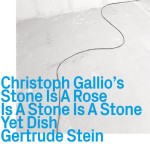
Christoph Gallio: Stone Is A Rose Is A Stone Is A Stone / Yet Dish
Artist: Christoph Gallio (@)
Title: Stone Is A Rose Is A Stone Is A Stone / Yet Dish
Format: CD + Download
Label: Hat Hut Records
Rated:
Title: Stone Is A Rose Is A Stone Is A Stone / Yet Dish
Format: CD + Download
Label: Hat Hut Records
Rated:
There’s a particular kind of courage in setting Gertrude Stein to music. Not the heroic, trumpet-blazing kind. More the quiet, slightly unhinged confidence of someone who looks at repetition, fragmentation, semantic loops and thinks: yes, this should sing.
Christoph Gallio has been circling the outer edges of jazz and composition for decades, often where structure begins to loosen but never quite dissolves. With "Stone Is A Rose Is A Stone Is A Stone / Yet Dish", he doesn’t just approach Stein’s text, he inhabits its peculiar logic. Or perhaps he lets it inhabit him, which sounds more accurate and slightly more concerning.
The ensemble - Sonia Loenne on voice, Gallio on soprano and alto sax, Vito Cadonau on double bass, and Flo Hufschmid on drums and percussion - operates with the kind of restraint that suggests everyone is acutely aware they are dealing with unstable material. Stein’s language doesn’t progress, it circles, accumulates, erodes meaning through insistence. The music mirrors this, but without becoming a mere illustration. That would be too easy, and also quite boring.
Instead, the six-part structure unfolds like a series of rooms where the same objects are rearranged with minor, disorienting differences. The voice doesn’t interpret Stein in any theatrical sense. Sonia Loenne treats the text almost as a physical substance, something to be weighed, stretched, tested for resonance. Words land, repeat, shift emphasis, lose their footing. Meaning becomes provisional, negotiated in real time.
Gallio’s saxophones rarely dominate. They hover, insinuate, sometimes cut through with a line that feels less like a melody and more like a question asked at the wrong moment. There’s a dryness to his tone that resists lyricism, as if he’s deliberately avoiding the temptation to beautify what is already structurally strange. It’s a smart move. Stein doesn’t need decoration; she needs space.
The rhythm section is where things get quietly subversive. Cadonau’s bass and Hufschmid’s percussion don’t anchor the music so much as unsettle it from below. They introduce pulses that almost cohere into grooves, then withdraw them before anything comfortable can form. It’s like watching someone build a staircase and then casually remove a few steps just to see what happens.
The subtitle might promise “unique and rare beauty”, which is a bold claim in a field where beauty is often treated with suspicion. What "Stone Is A Rose Is A Stone Is A Stone / Yet Dish" offers instead is something more elusive: a shifting surface where language and sound keep misaligning just enough to stay alive.
Christoph Gallio has been circling the outer edges of jazz and composition for decades, often where structure begins to loosen but never quite dissolves. With "Stone Is A Rose Is A Stone Is A Stone / Yet Dish", he doesn’t just approach Stein’s text, he inhabits its peculiar logic. Or perhaps he lets it inhabit him, which sounds more accurate and slightly more concerning.
The ensemble - Sonia Loenne on voice, Gallio on soprano and alto sax, Vito Cadonau on double bass, and Flo Hufschmid on drums and percussion - operates with the kind of restraint that suggests everyone is acutely aware they are dealing with unstable material. Stein’s language doesn’t progress, it circles, accumulates, erodes meaning through insistence. The music mirrors this, but without becoming a mere illustration. That would be too easy, and also quite boring.
Instead, the six-part structure unfolds like a series of rooms where the same objects are rearranged with minor, disorienting differences. The voice doesn’t interpret Stein in any theatrical sense. Sonia Loenne treats the text almost as a physical substance, something to be weighed, stretched, tested for resonance. Words land, repeat, shift emphasis, lose their footing. Meaning becomes provisional, negotiated in real time.
Gallio’s saxophones rarely dominate. They hover, insinuate, sometimes cut through with a line that feels less like a melody and more like a question asked at the wrong moment. There’s a dryness to his tone that resists lyricism, as if he’s deliberately avoiding the temptation to beautify what is already structurally strange. It’s a smart move. Stein doesn’t need decoration; she needs space.
The rhythm section is where things get quietly subversive. Cadonau’s bass and Hufschmid’s percussion don’t anchor the music so much as unsettle it from below. They introduce pulses that almost cohere into grooves, then withdraw them before anything comfortable can form. It’s like watching someone build a staircase and then casually remove a few steps just to see what happens.
The subtitle might promise “unique and rare beauty”, which is a bold claim in a field where beauty is often treated with suspicion. What "Stone Is A Rose Is A Stone Is A Stone / Yet Dish" offers instead is something more elusive: a shifting surface where language and sound keep misaligning just enough to stay alive.