
Browse by Genre
Industrial Music / Industrial Metal / Aggro Industrial / Electro Metal
Industrial Noise / Power Noise / Harsh Noise
Synth Pop / Electro Pop / Synth-Electronica
Techno / Trance / Goa / Drum'n'Bass / Jungle / Tribal / Trip-Hop
Ambient / Electronica / Ethereal / Dub / Soundscapes / Abstract
Experimental / Avantgarde / Weird & Wired / Glitch / Noise / Field Recording
Dark / Gothic / Wave / New Wave / Dark Wave / Industrial Gothic
New Music / Downtown / Avantgarde Jazz / New Classical / World
Search Reviews
Music Reviews
Tangent Mek: Immutable Traveler

Artist: Tangent Mek (@)
Title: Immutable Traveler
Format: CD + Download
Label: Carton Records (@)
Rated:

Title: Immutable Traveler
Format: CD + Download
Label: Carton Records (@)
Rated:
There’s always a moment, when reading phrases like “recorded in a Benedictine Abbey” and “improvised without any material”, where you brace yourself for either transcendence or an hour of politely arranged fog. "Immutable Traveler" manages the irritating trick of being both elusive and oddly precise, like a memory you don’t trust but can’t quite dismiss.
Tangent Mek operate here as cartographers of absence. Their instrumentation - violin (Anouck Genthon), viola da gamba (Anna-Kaisa Meklin), and flutes/voice (Marina Tantanozi) - suggests something rooted in early music or folk traditions, but what emerges is closer to a slow dismantling of those expectations. The trio doesn’t quote the past; they let it echo faintly, as if heard through thick stone walls and unreliable recollection.
The Abbey of Sorèze is not just a setting here, it’s an accomplice. Two rooms - the “blue” and the “white” - act less like studios and more like resonant bodies, stretching tones into long, trembling threads. Sound doesn’t sit still; it seeps, lingers, mutates. You begin to suspect that what you’re hearing is less performance than negotiation: between air and wood, between intention and accident, between what is played and what the room decides to keep.
Improvisation is often sold as freedom, but "Immutable Traveler" treats it more like archaeology. These pieces feel excavated rather than invented. Fragments surface, are turned over, partially erased, then reassembled into something that resists narrative closure. The title track, drawing from Etel Adnan, carries this particularly well: a voice that is neither fully present nor entirely gone, suspended between declaration and disappearance. It doesn’t “sing” so much as haunt the idea of singing.
Elsewhere, tracks like “say it clear, say it loud” do the opposite of what they promise, dissolving clarity into grainy textures and hesitant gestures. “drizzle” and “in the air” feel like studies in near-absence, while “byzantine abolition” briefly thickens the atmosphere into something ritualistic, almost severe, before letting it dissipate again. Even the shortest piece, “virgule”, behaves like a comma in a language that refuses to form a sentence.
There’s a quiet stubbornness to this album. It refuses to perform for the listener, refuses to resolve its tensions, refuses even to fully declare what it is. And yet, it’s not hostile. If anything, it’s strangely generous in its restraint. It allows space - actual, acoustic, psychological space - for the listener to wander, to project, to get lost without the safety net of structure.
In a world where music is often engineered to grab, hook, and retain, "Immutable Traveler" does the opposite: it drifts, withdraws, and occasionally pretends you’re not even there. Which, irritatingly, makes you lean in closer.
What Tangent Mek ultimately propose is not a journey with a destination, but a condition of perpetual transit. Memory as landscape, sound as residue, identity as something that erodes and reforms in the act of being heard. An “immutable traveler”, it turns out, is not someone who stays the same, but someone who keeps moving through change without ever quite arriving.
Tangent Mek operate here as cartographers of absence. Their instrumentation - violin (Anouck Genthon), viola da gamba (Anna-Kaisa Meklin), and flutes/voice (Marina Tantanozi) - suggests something rooted in early music or folk traditions, but what emerges is closer to a slow dismantling of those expectations. The trio doesn’t quote the past; they let it echo faintly, as if heard through thick stone walls and unreliable recollection.
The Abbey of Sorèze is not just a setting here, it’s an accomplice. Two rooms - the “blue” and the “white” - act less like studios and more like resonant bodies, stretching tones into long, trembling threads. Sound doesn’t sit still; it seeps, lingers, mutates. You begin to suspect that what you’re hearing is less performance than negotiation: between air and wood, between intention and accident, between what is played and what the room decides to keep.
Improvisation is often sold as freedom, but "Immutable Traveler" treats it more like archaeology. These pieces feel excavated rather than invented. Fragments surface, are turned over, partially erased, then reassembled into something that resists narrative closure. The title track, drawing from Etel Adnan, carries this particularly well: a voice that is neither fully present nor entirely gone, suspended between declaration and disappearance. It doesn’t “sing” so much as haunt the idea of singing.
Elsewhere, tracks like “say it clear, say it loud” do the opposite of what they promise, dissolving clarity into grainy textures and hesitant gestures. “drizzle” and “in the air” feel like studies in near-absence, while “byzantine abolition” briefly thickens the atmosphere into something ritualistic, almost severe, before letting it dissipate again. Even the shortest piece, “virgule”, behaves like a comma in a language that refuses to form a sentence.
There’s a quiet stubbornness to this album. It refuses to perform for the listener, refuses to resolve its tensions, refuses even to fully declare what it is. And yet, it’s not hostile. If anything, it’s strangely generous in its restraint. It allows space - actual, acoustic, psychological space - for the listener to wander, to project, to get lost without the safety net of structure.
In a world where music is often engineered to grab, hook, and retain, "Immutable Traveler" does the opposite: it drifts, withdraws, and occasionally pretends you’re not even there. Which, irritatingly, makes you lean in closer.
What Tangent Mek ultimately propose is not a journey with a destination, but a condition of perpetual transit. Memory as landscape, sound as residue, identity as something that erodes and reforms in the act of being heard. An “immutable traveler”, it turns out, is not someone who stays the same, but someone who keeps moving through change without ever quite arriving.
Pita: Get Out [2025 edition]

Some records age like wine. Others age like exposed wiring: still dangerous, still humming, possibly more relevant now than when they first shocked a room into silence. Peter Rehberg’s "Get Out" belongs firmly to the second category, and this 2025 edition feels less like a reissue than a quiet reminder that the future already happened, and it wasn’t particularly polite.
Originally released in 1999 under the Pita moniker, "Get Out" arrived at a moment when experimental electronics were flirting with austerity, sometimes mistaking emptiness for depth. Rehberg, never one for minimal gestures masquerading as philosophy, did something more unsettling: he injected emotion into noise. Not the comforting, cinematic kind, but a bruised, flickering melancholy buried under layers of digital abrasion.
Listening now, the album still feels like navigating a system that is constantly on the verge of collapse, yet stubbornly refuses to crash. Glitches don’t decorate the surface, they "are" the structure. Distortion isn’t aggression for its own sake, it’s a kind of language. And somewhere inside that fractured syntax, melodies try to form, fail, and try again. It’s almost touching, in a slightly tragic way.
What made "Get Out" quietly revolutionary was this tension between violence and vulnerability. While many contemporaries leaned into either pure noise or pristine abstraction, Rehberg occupied the uncomfortable middle ground. Tracks stretch, stutter, and disintegrate, but they never lose a strange sense of direction, like a machine that has developed doubts about its own function.
The expanded vinyl edition doesn’t just add archival weight; it sharpens the perspective. The Detroit live recording, in particular, exposes the physicality behind the digital facade. This wasn’t laptop music as passive gesture. It was confrontation. Sound pushed to the point where listening becomes an active decision rather than a background habit.
There’s also something almost ironic in how contemporary it still sounds. In an era obsessed with “glitch aesthetics” and curated imperfection, "Get Out" reminds us what actual risk sounds like. No safety nets, no tasteful restraint, no algorithm-friendly arcs. Just a stubborn exploration of how far sound can be stretched before it breaks, and what might emerge from that fracture.
Rehberg, who later became a central figure through Editions Mego, didn’t just release music, he helped define a space where discomfort could be meaningful. "Get Out" is one of those early fault lines. You can trace a lot of subsequent experimental electronic music back to these cracks, whether artists admit it or not.
Revisiting it now feels less like nostalgia and more like standing in front of an old machine that still works perfectly, while everything built after it quietly malfunctions in more elegant ways. Not bad for something that was never supposed to be comfortable in the first place.
Originally released in 1999 under the Pita moniker, "Get Out" arrived at a moment when experimental electronics were flirting with austerity, sometimes mistaking emptiness for depth. Rehberg, never one for minimal gestures masquerading as philosophy, did something more unsettling: he injected emotion into noise. Not the comforting, cinematic kind, but a bruised, flickering melancholy buried under layers of digital abrasion.
Listening now, the album still feels like navigating a system that is constantly on the verge of collapse, yet stubbornly refuses to crash. Glitches don’t decorate the surface, they "are" the structure. Distortion isn’t aggression for its own sake, it’s a kind of language. And somewhere inside that fractured syntax, melodies try to form, fail, and try again. It’s almost touching, in a slightly tragic way.
What made "Get Out" quietly revolutionary was this tension between violence and vulnerability. While many contemporaries leaned into either pure noise or pristine abstraction, Rehberg occupied the uncomfortable middle ground. Tracks stretch, stutter, and disintegrate, but they never lose a strange sense of direction, like a machine that has developed doubts about its own function.
The expanded vinyl edition doesn’t just add archival weight; it sharpens the perspective. The Detroit live recording, in particular, exposes the physicality behind the digital facade. This wasn’t laptop music as passive gesture. It was confrontation. Sound pushed to the point where listening becomes an active decision rather than a background habit.
There’s also something almost ironic in how contemporary it still sounds. In an era obsessed with “glitch aesthetics” and curated imperfection, "Get Out" reminds us what actual risk sounds like. No safety nets, no tasteful restraint, no algorithm-friendly arcs. Just a stubborn exploration of how far sound can be stretched before it breaks, and what might emerge from that fracture.
Rehberg, who later became a central figure through Editions Mego, didn’t just release music, he helped define a space where discomfort could be meaningful. "Get Out" is one of those early fault lines. You can trace a lot of subsequent experimental electronic music back to these cracks, whether artists admit it or not.
Revisiting it now feels less like nostalgia and more like standing in front of an old machine that still works perfectly, while everything built after it quietly malfunctions in more elegant ways. Not bad for something that was never supposed to be comfortable in the first place.
WIELORYB: God's Final Breath

There’s a certain kind of music that doesn’t ask for interpretation. It issues instructions. Move. Resist. Obey. Repeat. Wieloryb has been operating in that territory for a while now, and "God’s Final Breath" doesn’t exactly change the rules. It just tightens the screws until you notice them.
Released via Zoharum, the album sits squarely within the coordinates of rhythmic noise, where industrial percussion meets club functionality and both pretend they’re not enjoying it. Twelve tracks, each built on heavy, machine-like beats, form a continuous pressure system. Subtlety is not the point. Persistence is.
From the opening "System Failure!" - a title that feels less like metaphor and more like diagnosis - the album establishes its method: dense layers, relentless pacing, and a refusal to leave space unoccupied. The kicks land with mechanical certainty, loops grind forward, textures stack until they threaten to collapse under their own weight. Somehow, they don’t. Or at least not completely.
Compared to earlier work, there’s an increased sense of mass here. Everything feels slightly more compressed, more forceful, as if the sound itself had been subjected to the same industrial processes it imitates. Tracks like "Mind Control" and "Obey!" don’t just reference control systems, they enact them. Repetition becomes a tool, not just a structure. You don’t drift through these pieces; you’re held in place by them.
And yet, buried under the blunt-force rhythms, there are moments where something almost playful emerges. "Kaos_1" and "Kaos_2" flirt with fragmentation, introducing small disruptions that keep the machine from becoming entirely predictable. It’s not chaos, despite the name. More like controlled instability. The system hiccups, then keeps going.
There’s also a curious relationship with club culture throughout the album. On one level, these tracks could function on a dancefloor, provided the dancefloor is located somewhere between a bunker and a data center. On another level, they seem to critique that very environment, amplifying its repetitive logic until it becomes slightly absurd. Endless loops chasing endless peaks. A kind of sonic treadmill.
Titles like "No Escape", "Machine World", and "Game Over" don’t exactly aim for nuance, but that’s part of the appeal. Wieloryb operates in a symbolic language that’s closer to signage than poetry. Direct, almost blunt. The trick is that, over time, the repetition drains these phrases of their obvious meaning and replaces it with something more ambiguous. Is this resistance, or simulation? Control, or performance?
What keeps "God’s Final Breath" from becoming monotonous is its attention to texture. Small shifts in timbre, subtle distortions, variations in density. The details are easy to miss if you treat the album as background. Which would be a mistake, though an understandable one given how often this kind of music gets relegated to functional listening.
In the end, Wieloryb isn’t offering transcendence or escape. Just a mirror, slightly distorted, of the systems we already inhabit. Loud, repetitive, efficient, and strangely difficult to turn off.
Released via Zoharum, the album sits squarely within the coordinates of rhythmic noise, where industrial percussion meets club functionality and both pretend they’re not enjoying it. Twelve tracks, each built on heavy, machine-like beats, form a continuous pressure system. Subtlety is not the point. Persistence is.
From the opening "System Failure!" - a title that feels less like metaphor and more like diagnosis - the album establishes its method: dense layers, relentless pacing, and a refusal to leave space unoccupied. The kicks land with mechanical certainty, loops grind forward, textures stack until they threaten to collapse under their own weight. Somehow, they don’t. Or at least not completely.
Compared to earlier work, there’s an increased sense of mass here. Everything feels slightly more compressed, more forceful, as if the sound itself had been subjected to the same industrial processes it imitates. Tracks like "Mind Control" and "Obey!" don’t just reference control systems, they enact them. Repetition becomes a tool, not just a structure. You don’t drift through these pieces; you’re held in place by them.
And yet, buried under the blunt-force rhythms, there are moments where something almost playful emerges. "Kaos_1" and "Kaos_2" flirt with fragmentation, introducing small disruptions that keep the machine from becoming entirely predictable. It’s not chaos, despite the name. More like controlled instability. The system hiccups, then keeps going.
There’s also a curious relationship with club culture throughout the album. On one level, these tracks could function on a dancefloor, provided the dancefloor is located somewhere between a bunker and a data center. On another level, they seem to critique that very environment, amplifying its repetitive logic until it becomes slightly absurd. Endless loops chasing endless peaks. A kind of sonic treadmill.
Titles like "No Escape", "Machine World", and "Game Over" don’t exactly aim for nuance, but that’s part of the appeal. Wieloryb operates in a symbolic language that’s closer to signage than poetry. Direct, almost blunt. The trick is that, over time, the repetition drains these phrases of their obvious meaning and replaces it with something more ambiguous. Is this resistance, or simulation? Control, or performance?
What keeps "God’s Final Breath" from becoming monotonous is its attention to texture. Small shifts in timbre, subtle distortions, variations in density. The details are easy to miss if you treat the album as background. Which would be a mistake, though an understandable one given how often this kind of music gets relegated to functional listening.
In the end, Wieloryb isn’t offering transcendence or escape. Just a mirror, slightly distorted, of the systems we already inhabit. Loud, repetitive, efficient, and strangely difficult to turn off.
VV.AA.: Salò, or The 120 Days Of Sodom
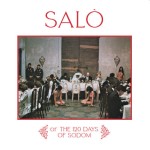
Artist: VV.AA.
Title: Salò, or The 120 Days Of Sodom
Format: CD + Download
Label: Cold Spring (@)
Rated:
Title: Salò, or The 120 Days Of Sodom
Format: CD + Download
Label: Cold Spring (@)
Rated:
Some releases arrive politely, asking for your attention. Others walk in carrying a historical crime scene and expect you to sit with it. This first official issue of the soundtrack to Salò, or the 120 Days of Sodom falls firmly into the second category, and it’s not remotely interested in being an easy listen. What a surprise!
Curated under the shadow of Pier Paolo Pasolini’s final, brutal statement, the music assembled here operates on a principle that still feels quietly perverse: beauty as indictment. The refined, often delicate compositions - drawn from the likes of Johann Sebastian Bach and Frédéric Chopin - don’t soften the violence of the film they accompany. They sharpen it. Civility becomes complicity.
At the center of this uneasy architecture sits Ennio Morricone, whose contributions here are deceptively restrained. “Son Tanto Triste” opens the sequence with a kind of mournful elegance that feels almost inappropriate given what follows. And that’s precisely the point. Morricone understood that horror rarely needs help being loud; it benefits more from contrast, from the quiet suggestion that something is fundamentally wrong beneath the surface.
The inclusion of “Addio a Pier Paolo Pasolini”, composed after the director’s murder, adds a layer that no amount of curatorial framing could invent. It’s not just a tribute; it’s an intrusion of reality into an already unbearable fiction. The boundary between artwork and aftermath collapses, and you’re left wondering whether the soundtrack documents a film, a worldview, or a rupture in history.
What makes this release particularly unsettling in isolation - detached from the film - is how incomplete it feels by design. The untitled fragments, the abrupt transitions, the occasional intrusion of voices from the cast: it all resists coherence. You’re not meant to follow this music. You’re meant to endure it, to notice how quickly refinement curdles into something else when placed in the wrong context.
Cold Spring’s decision to present this material now, decades later, inevitably raises the question of timing. Why revisit Salò in 2026, when the world has already perfected more subtle forms of cruelty? The uncomfortable answer is that Pasolini’s thesis - that power, when unchecked, aestheticizes its own violence - hasn’t aged at all. If anything, it’s become more efficient.
There is, admittedly, something almost darkly funny in the way the album’s structure mirrors its subject. Short, neatly contained pieces. Elegant, even. As if brutality could be archived, catalogued, and presented in digestible segments. A playlist of moral collapse.
And yet, despite everything - or because of it - the music retains a strange autonomy. Removed from the images, it reveals its own internal tensions: between sacred and profane, order and disintegration, composition and contamination. It doesn’t redeem the film, nor does it need to. It simply exposes the mechanisms by which beauty can be made to serve something far less beautiful.
Listening to this soundtrack is less about appreciation and more about recognition. Not of specific scenes, but of a pattern: the way culture dresses up its worst instincts in impeccable taste and calls it civilization. You can admire the craftsmanship, certainly. Just don’t pretend it’s neutral.
Curated under the shadow of Pier Paolo Pasolini’s final, brutal statement, the music assembled here operates on a principle that still feels quietly perverse: beauty as indictment. The refined, often delicate compositions - drawn from the likes of Johann Sebastian Bach and Frédéric Chopin - don’t soften the violence of the film they accompany. They sharpen it. Civility becomes complicity.
At the center of this uneasy architecture sits Ennio Morricone, whose contributions here are deceptively restrained. “Son Tanto Triste” opens the sequence with a kind of mournful elegance that feels almost inappropriate given what follows. And that’s precisely the point. Morricone understood that horror rarely needs help being loud; it benefits more from contrast, from the quiet suggestion that something is fundamentally wrong beneath the surface.
The inclusion of “Addio a Pier Paolo Pasolini”, composed after the director’s murder, adds a layer that no amount of curatorial framing could invent. It’s not just a tribute; it’s an intrusion of reality into an already unbearable fiction. The boundary between artwork and aftermath collapses, and you’re left wondering whether the soundtrack documents a film, a worldview, or a rupture in history.
What makes this release particularly unsettling in isolation - detached from the film - is how incomplete it feels by design. The untitled fragments, the abrupt transitions, the occasional intrusion of voices from the cast: it all resists coherence. You’re not meant to follow this music. You’re meant to endure it, to notice how quickly refinement curdles into something else when placed in the wrong context.
Cold Spring’s decision to present this material now, decades later, inevitably raises the question of timing. Why revisit Salò in 2026, when the world has already perfected more subtle forms of cruelty? The uncomfortable answer is that Pasolini’s thesis - that power, when unchecked, aestheticizes its own violence - hasn’t aged at all. If anything, it’s become more efficient.
There is, admittedly, something almost darkly funny in the way the album’s structure mirrors its subject. Short, neatly contained pieces. Elegant, even. As if brutality could be archived, catalogued, and presented in digestible segments. A playlist of moral collapse.
And yet, despite everything - or because of it - the music retains a strange autonomy. Removed from the images, it reveals its own internal tensions: between sacred and profane, order and disintegration, composition and contamination. It doesn’t redeem the film, nor does it need to. It simply exposes the mechanisms by which beauty can be made to serve something far less beautiful.
Listening to this soundtrack is less about appreciation and more about recognition. Not of specific scenes, but of a pattern: the way culture dresses up its worst instincts in impeccable taste and calls it civilization. You can admire the craftsmanship, certainly. Just don’t pretend it’s neutral.
Siren Section: Separation Team

Artist: Siren Section (@)
Title: Separation Team
Format: Download Only (MP3 + Lossless)
Label: self-released
Rated:

Title: Separation Team
Format: Download Only (MP3 + Lossless)
Label: self-released
Rated:
There’s something faintly suspicious about albums that arrive after a long silence claiming urgency. Most of the time, it’s just backlog dressed up as revelation. "Separation Team" by Siren Section almost falls into that trap - until it doesn’t, and instead pulls you into something far less tidy: a record that sounds like it had no choice but to exist.
The backstory matters, unfortunately. A decade of unfinished material, a band on pause, and then a near-death experience forcing things into alignment. You’d expect catharsis. What you get instead is something colder, more ambiguous. Recovery here is not redemption; it’s just continuation, slightly warped.
Musically, Siren Section operate in that crowded intersection where post-punk gloom meets industrial abrasion and shoegaze residue. The difference is that they don’t seem particularly interested in curating their influences into something fashionable. The album feels stitched together from impulses rather than references, which gives it a strange internal logic. Tracks like “Bullet Train” and “Medicine” move with mechanical insistence, while others fracture into quieter, almost dissociative passages that feel less like transitions and more like gaps in memory.
There’s a recurring sense that the songs are circling something they can’t quite articulate without collapsing it. The titular “Separation Team” is a perfect example: it suggests unity, but only through erosion. A partnership that stabilizes by dissolving its own boundaries. Romantic, if your idea of romance includes mutual disappearance.
Lyrically, the album leans into mythic imagery - phoenixes, labyrinths, cycles devouring themselves - but it never fully commits to symbolism as explanation. These are not metaphors to decode; they’re recurring symptoms. The ouroboros isn’t there to be clever, it’s there because the record genuinely doesn’t know how to stop eating its own tail.
At times, the theatricality threatens to tip into excess. You can almost hear the band daring themselves to go further into the abyss. But just as things risk becoming overwrought, a track will pull back, reduce itself to a skeletal rhythm or a half-erased vocal line, and remind you that restraint is still part of the vocabulary. Not a common trait in records this emotionally invested in their own collapse.
The length - eighty minutes, because subtlety is apparently illegal - is both a strength and a test of patience. There are moments where the album could have benefited from less devotion to its own internal mythology. Then again, trimming it might have broken the spell. This is not a collection of songs; it’s a closed system. You either enter it or you don’t.
What lingers is not any single track, but a kind of emotional afterimage: the sense of having witnessed a process rather than a statement. "Separation Team" doesn’t resolve its tensions, it sustains them. Survival is framed not as triumph, but as an ongoing negotiation with whatever nearly erased you in the first place.
In a landscape full of carefully engineered vulnerability, Siren Section offer something less flattering: vulnerability that doesn’t clean up after itself. It sprawls, contradicts, repeats, insists. Like someone trying to explain what happened and realizing, halfway through, that the explanation is just another version of the problem.
The backstory matters, unfortunately. A decade of unfinished material, a band on pause, and then a near-death experience forcing things into alignment. You’d expect catharsis. What you get instead is something colder, more ambiguous. Recovery here is not redemption; it’s just continuation, slightly warped.
Musically, Siren Section operate in that crowded intersection where post-punk gloom meets industrial abrasion and shoegaze residue. The difference is that they don’t seem particularly interested in curating their influences into something fashionable. The album feels stitched together from impulses rather than references, which gives it a strange internal logic. Tracks like “Bullet Train” and “Medicine” move with mechanical insistence, while others fracture into quieter, almost dissociative passages that feel less like transitions and more like gaps in memory.
There’s a recurring sense that the songs are circling something they can’t quite articulate without collapsing it. The titular “Separation Team” is a perfect example: it suggests unity, but only through erosion. A partnership that stabilizes by dissolving its own boundaries. Romantic, if your idea of romance includes mutual disappearance.
Lyrically, the album leans into mythic imagery - phoenixes, labyrinths, cycles devouring themselves - but it never fully commits to symbolism as explanation. These are not metaphors to decode; they’re recurring symptoms. The ouroboros isn’t there to be clever, it’s there because the record genuinely doesn’t know how to stop eating its own tail.
At times, the theatricality threatens to tip into excess. You can almost hear the band daring themselves to go further into the abyss. But just as things risk becoming overwrought, a track will pull back, reduce itself to a skeletal rhythm or a half-erased vocal line, and remind you that restraint is still part of the vocabulary. Not a common trait in records this emotionally invested in their own collapse.
The length - eighty minutes, because subtlety is apparently illegal - is both a strength and a test of patience. There are moments where the album could have benefited from less devotion to its own internal mythology. Then again, trimming it might have broken the spell. This is not a collection of songs; it’s a closed system. You either enter it or you don’t.
What lingers is not any single track, but a kind of emotional afterimage: the sense of having witnessed a process rather than a statement. "Separation Team" doesn’t resolve its tensions, it sustains them. Survival is framed not as triumph, but as an ongoing negotiation with whatever nearly erased you in the first place.
In a landscape full of carefully engineered vulnerability, Siren Section offer something less flattering: vulnerability that doesn’t clean up after itself. It sprawls, contradicts, repeats, insists. Like someone trying to explain what happened and realizing, halfway through, that the explanation is just another version of the problem.