
Browse by Genre
Industrial Music / Industrial Metal / Aggro Industrial / Electro Metal
Industrial Noise / Power Noise / Harsh Noise
Synth Pop / Electro Pop / Synth-Electronica
Techno / Trance / Goa / Drum'n'Bass / Jungle / Tribal / Trip-Hop
Ambient / Electronica / Ethereal / Dub / Soundscapes / Abstract
Experimental / Avantgarde / Weird & Wired / Glitch / Noise / Field Recording
Dark / Gothic / Wave / New Wave / Dark Wave / Industrial Gothic
New Music / Downtown / Avantgarde Jazz / New Classical / World
Search Reviews
Music Reviews
Matilde Meireles: Four Tales

Cities are usually described through their skylines, traffic, or architectural bravado. Rarely through their rivers actually speaking. Which is unfortunate, because water has been patiently composing the soundtrack of urban life long before humans decided to build bridges over it.
With "Four Tales", Matilde Meireles approaches the city from precisely that overlooked perspective: listening downward, toward the currents, the metal infrastructures touching them, and the fragile ecosystems vibrating along their edges. The album, released by Crónica, grows out of DRIFT Belfast floating pavilion project, a collaborative architectural and sonic experiment that temporarily anchored itself along the River Lagan during the Belfast 2024 cultural programme. The pavilion itself functioned as a kind of “floating instrument”, inviting visitors to pause, listen, and reconsider the relationship between city and river.
Translating such a spatial and communal experience into a record is not exactly a trivial exercise. Sound installations often resist documentation the way clouds resist photography. Yet "Four Tales" manages to retain something essential from the original project: the sense that listening is not just a sensory act but a form of attention, perhaps even care.
The album unfolds in four long pieces, each acting less like a track and more like a chapter in a slowly drifting narrative.
“One” begins with water itself. Field recordings collected across multiple geographies ripple through the piece: the gentle currents of the Lagan, distant rivers in Portugal, Spain and England, the calm sea in Greece, even a storm in Mozambique. The composition behaves like a hydrological map drawn with sound rather than ink. Metallic resonances from the pavilion’s scaffolding and the tactile friction of cotton ropes enter the texture, creating a dialogue between natural movement and human-built structures. The result is quietly immersive, like standing beside a river long enough that the landscape begins to reveal its smaller rhythms.
“Two” shifts the perspective slightly, tracing an imagined sonic journey between two points along the Lagan. Micro and macro events coexist: underwater murmurs, atmospheric disturbances, electromagnetic interference humming through urban infrastructure. Meireles arranges these layers with a patient sense of pacing, allowing them to breathe rather than forcing them into tidy narrative arcs. The piece feels less composed than cultivated, as if the composer were tending a garden of vibrations rather than arranging a score.
With “Three”, the album takes an unexpectedly reflective turn. Raw biodiversity recordings made around Stranmillis Weir are assembled alongside a spoken narration cataloguing species both present and absent. The device is deceptively simple yet conceptually sharp: a reminder that field recording is always partial, always incomplete. Technology captures fragments, but the ecosystem remains larger than the microphone’s reach. It is a subtle meditation on presence and absence, observation and imagination.
Finally “Four” offers an excerpt from a live performance that took place on the pavilion itself, where improvisers interacted with the surrounding environment. Percussion, amplified objects, field recordings and the unusual resonance of the tromba marina intertwine with the acoustic properties of the floating structure. The piece carries a gentle unpredictability, the feeling that the river and the performers are negotiating the music together in real time.
Meireles has long worked at the intersection of sound art, environmental awareness and social engagement, and "Four Tales" neatly condenses these concerns into a single project. Her background in interdisciplinary sonic research, including years spent working in SARC: Centre for Interdisciplinary Research in Sound and Music at Queen’s University Belfast, clearly informs the methodical yet poetic way she approaches listening.
What keeps the album from drifting into academic dryness is its quiet sense of wonder. The compositions never lecture the listener about ecology or urban infrastructure. Instead, they invite a slower pace of perception. Spend enough time with these sounds and the city begins to feel less like a static grid of buildings and more like a living mesh of currents, animals, machines and human footsteps.
In a world obsessed with louder signals and faster rhythms, "Four Tales" proposes something mildly radical: stop, lean closer, and listen to the river.
It has been telling stories the whole time.
With "Four Tales", Matilde Meireles approaches the city from precisely that overlooked perspective: listening downward, toward the currents, the metal infrastructures touching them, and the fragile ecosystems vibrating along their edges. The album, released by Crónica, grows out of DRIFT Belfast floating pavilion project, a collaborative architectural and sonic experiment that temporarily anchored itself along the River Lagan during the Belfast 2024 cultural programme. The pavilion itself functioned as a kind of “floating instrument”, inviting visitors to pause, listen, and reconsider the relationship between city and river.
Translating such a spatial and communal experience into a record is not exactly a trivial exercise. Sound installations often resist documentation the way clouds resist photography. Yet "Four Tales" manages to retain something essential from the original project: the sense that listening is not just a sensory act but a form of attention, perhaps even care.
The album unfolds in four long pieces, each acting less like a track and more like a chapter in a slowly drifting narrative.
“One” begins with water itself. Field recordings collected across multiple geographies ripple through the piece: the gentle currents of the Lagan, distant rivers in Portugal, Spain and England, the calm sea in Greece, even a storm in Mozambique. The composition behaves like a hydrological map drawn with sound rather than ink. Metallic resonances from the pavilion’s scaffolding and the tactile friction of cotton ropes enter the texture, creating a dialogue between natural movement and human-built structures. The result is quietly immersive, like standing beside a river long enough that the landscape begins to reveal its smaller rhythms.
“Two” shifts the perspective slightly, tracing an imagined sonic journey between two points along the Lagan. Micro and macro events coexist: underwater murmurs, atmospheric disturbances, electromagnetic interference humming through urban infrastructure. Meireles arranges these layers with a patient sense of pacing, allowing them to breathe rather than forcing them into tidy narrative arcs. The piece feels less composed than cultivated, as if the composer were tending a garden of vibrations rather than arranging a score.
With “Three”, the album takes an unexpectedly reflective turn. Raw biodiversity recordings made around Stranmillis Weir are assembled alongside a spoken narration cataloguing species both present and absent. The device is deceptively simple yet conceptually sharp: a reminder that field recording is always partial, always incomplete. Technology captures fragments, but the ecosystem remains larger than the microphone’s reach. It is a subtle meditation on presence and absence, observation and imagination.
Finally “Four” offers an excerpt from a live performance that took place on the pavilion itself, where improvisers interacted with the surrounding environment. Percussion, amplified objects, field recordings and the unusual resonance of the tromba marina intertwine with the acoustic properties of the floating structure. The piece carries a gentle unpredictability, the feeling that the river and the performers are negotiating the music together in real time.
Meireles has long worked at the intersection of sound art, environmental awareness and social engagement, and "Four Tales" neatly condenses these concerns into a single project. Her background in interdisciplinary sonic research, including years spent working in SARC: Centre for Interdisciplinary Research in Sound and Music at Queen’s University Belfast, clearly informs the methodical yet poetic way she approaches listening.
What keeps the album from drifting into academic dryness is its quiet sense of wonder. The compositions never lecture the listener about ecology or urban infrastructure. Instead, they invite a slower pace of perception. Spend enough time with these sounds and the city begins to feel less like a static grid of buildings and more like a living mesh of currents, animals, machines and human footsteps.
In a world obsessed with louder signals and faster rhythms, "Four Tales" proposes something mildly radical: stop, lean closer, and listen to the river.
It has been telling stories the whole time.
It Dockumer Lokaeltsje: Loop of Sloop
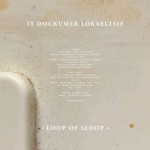
Forty years is a long time in music. Entire genres are born, flourish, collapse, and get rediscovered by people wearing carefully distressed denim jackets. Yet some bands manage to move through those decades without ever quite learning how to behave. It Dockumer Lokaeltsje clearly belongs to that category.
Their new record, "Loop of Sloop", released by Makkum Records, arrives with the sort of mischievous conceptual logic that only veteran punk groups seem capable of inventing. Back in the early eighties the Frisian trio reportedly wrote their debut album "WIL MET U NEUKEN" in a single afternoon, a gesture of chaotic spontaneity that became part of their legend. This time the process apparently ran in reverse: first they recorded an album, and only afterward did they extract ten songs from it. Which is either an avant-garde compositional method or a wonderfully elaborate joke. Possibly both.
The band itself, formed in Friesland and still proudly operating in the Frisian language, has always occupied a peculiar corner of European underground music. Punk, yes, but with the slightly crooked humor and stubborn independence that often characterize scenes from smaller linguistic cultures. When a band sings in Frisian, they are automatically liberated from many of the clichés of global rock. The language itself becomes part of the attitude.
Listening to "Loop of Sloop" feels a bit like opening an old toolbox and discovering that all the instruments inside are still functional but slightly rusted in interesting ways. The songs are short, impatient, and gloriously unstable. Most hover around two minutes or less, delivered with the kind of ragged urgency that suggests the band is simultaneously performing and trying to outrun its own momentum.
The opening tracks rattle forward with a nervous, skeletal energy. Guitars scrape and jab rather than form polite chords, while the rhythm section behaves like a machine that was assembled correctly but refuses to run smoothly. The spirit of confrontational post-punk lurks in the background; fleeting echoes of bands such as Shellac, DNA, Teenage Jesus and the Jerks and The Ex flicker through the arrangements. But these influences appear only briefly before the band swerves somewhere else, as if unwilling to linger too long in anyone else’s territory.
What keeps the album engaging is its sense of barely controlled collapse. The songs feel as though they might disintegrate at any moment. “Foarjanker”, for instance, barely crosses the one-minute mark before vanishing like a small explosion. “Helskip” expands slightly into a heavier groove, while “De klok tebek” moves with the twitchy logic of a band rewinding time and tripping over the tape.
The second side continues the controlled chaos. “Nim de Huawei” adds a faintly satirical tone to the proceedings, while “Twa flikers” and “Wekker wurde dingen dwaan” push the group’s minimalist punk mechanics into even tighter bursts of nervous energy. By the time the title track arrives, the record feels less like a sequence of songs and more like a compact manifesto: fast, crooked, stubbornly alive.
There is also something quietly touching about the album’s self-declared “posthumous” status. The band jokes that since they now have more past than future, they have decided to exist in a kind of living afterlife. In practice this means playing shows and releasing records as if the project were already a ghost of itself. It is a darkly comic concept, but also oddly liberating. If you are technically already posthumous, expectations become irrelevant.
That attitude permeates "Loop of Sloop". The music does not attempt to modernize itself or compete with contemporary punk trends. Instead it doubles down on the raw spirit that defined the band’s earliest days. The result is a record that sounds both nostalgic and strangely fresh, like a radio transmission from a parallel timeline where punk never bothered growing up.
Perhaps that is the real charm of this album. It reminds us that underground music has always thrived on a certain kind of cheerful stubbornness. Styles evolve, technologies change, scenes come and go, but somewhere there are still musicians who pick up battered instruments and produce two-minute bursts of noise simply because it feels necessary.
After forty years, It Dockumer Lokaeltsje clearly still feels that necessity. Which is impressive. Many bands spend decades polishing their legacy into something respectable. These Frisian troublemakers seem far more interested in rattling it until the screws come loose.
Their new record, "Loop of Sloop", released by Makkum Records, arrives with the sort of mischievous conceptual logic that only veteran punk groups seem capable of inventing. Back in the early eighties the Frisian trio reportedly wrote their debut album "WIL MET U NEUKEN" in a single afternoon, a gesture of chaotic spontaneity that became part of their legend. This time the process apparently ran in reverse: first they recorded an album, and only afterward did they extract ten songs from it. Which is either an avant-garde compositional method or a wonderfully elaborate joke. Possibly both.
The band itself, formed in Friesland and still proudly operating in the Frisian language, has always occupied a peculiar corner of European underground music. Punk, yes, but with the slightly crooked humor and stubborn independence that often characterize scenes from smaller linguistic cultures. When a band sings in Frisian, they are automatically liberated from many of the clichés of global rock. The language itself becomes part of the attitude.
Listening to "Loop of Sloop" feels a bit like opening an old toolbox and discovering that all the instruments inside are still functional but slightly rusted in interesting ways. The songs are short, impatient, and gloriously unstable. Most hover around two minutes or less, delivered with the kind of ragged urgency that suggests the band is simultaneously performing and trying to outrun its own momentum.
The opening tracks rattle forward with a nervous, skeletal energy. Guitars scrape and jab rather than form polite chords, while the rhythm section behaves like a machine that was assembled correctly but refuses to run smoothly. The spirit of confrontational post-punk lurks in the background; fleeting echoes of bands such as Shellac, DNA, Teenage Jesus and the Jerks and The Ex flicker through the arrangements. But these influences appear only briefly before the band swerves somewhere else, as if unwilling to linger too long in anyone else’s territory.
What keeps the album engaging is its sense of barely controlled collapse. The songs feel as though they might disintegrate at any moment. “Foarjanker”, for instance, barely crosses the one-minute mark before vanishing like a small explosion. “Helskip” expands slightly into a heavier groove, while “De klok tebek” moves with the twitchy logic of a band rewinding time and tripping over the tape.
The second side continues the controlled chaos. “Nim de Huawei” adds a faintly satirical tone to the proceedings, while “Twa flikers” and “Wekker wurde dingen dwaan” push the group’s minimalist punk mechanics into even tighter bursts of nervous energy. By the time the title track arrives, the record feels less like a sequence of songs and more like a compact manifesto: fast, crooked, stubbornly alive.
There is also something quietly touching about the album’s self-declared “posthumous” status. The band jokes that since they now have more past than future, they have decided to exist in a kind of living afterlife. In practice this means playing shows and releasing records as if the project were already a ghost of itself. It is a darkly comic concept, but also oddly liberating. If you are technically already posthumous, expectations become irrelevant.
That attitude permeates "Loop of Sloop". The music does not attempt to modernize itself or compete with contemporary punk trends. Instead it doubles down on the raw spirit that defined the band’s earliest days. The result is a record that sounds both nostalgic and strangely fresh, like a radio transmission from a parallel timeline where punk never bothered growing up.
Perhaps that is the real charm of this album. It reminds us that underground music has always thrived on a certain kind of cheerful stubbornness. Styles evolve, technologies change, scenes come and go, but somewhere there are still musicians who pick up battered instruments and produce two-minute bursts of noise simply because it feels necessary.
After forty years, It Dockumer Lokaeltsje clearly still feels that necessity. Which is impressive. Many bands spend decades polishing their legacy into something respectable. These Frisian troublemakers seem far more interested in rattling it until the screws come loose.
VV.AA.: eavesdrop festival 2024

Artist: VV.AA.
Title: eavesdrop festival 2024
Format: Tape + Download
Label: Karlrecords (http://www.karlrecords.net/) (@)
Rated:

Title: eavesdrop festival 2024
Format: Tape + Download
Label: Karlrecords (http://www.karlrecords.net/) (@)
Rated:
Festivals like to describe themselves as “platforms”. Which is a polite way of saying: a temporary ecosystem where musicians, machines, cables and philosophical anxieties gather in one architectural container and see what noises emerge. The Eavesdrop Festival, held inside the cavernous concrete geometry of Silent Green Kulturquartier in Berlin, takes that idea unusually seriously. Even its name suggests a listening posture that is slightly sideways. Not passive, not passive-aggressive either. Just attentive. Curious. Nose pressed against the sonic keyhole.
The compilation "eavesdrop festival 2024", released by Karlrecords as a hand-numbered cassette in the modest quantity of one hundred copies, functions less like a souvenir and more like an archaeological sample. Two nights of performances are distilled into nine tracks, most of them raw excerpts from live sets, plus a couple of stereo reductions of installations that originally occupied physical space in multichannel form. In other words, what you hear is already a translation. A shadow of a spatial event flattened into tape hiss and magnetic particles.
That might sound like a loss. It is not. If anything, the reduction intensifies the listening.
The opening fragment by Rashad Becker behaves like a laboratory demonstration of synthesis gone slightly feral. Becker, a composer whose biography reads like a list of philosophical resignations, sculpts tones that feel both clinical and oddly humorous, as if oscillators had developed personalities and were arguing quietly in the corner.
Then Mariam Rezaei enters with a turntable performance that dismantles the polite expectations of DJ culture. Her approach to vinyl is closer to sculptural violence than nostalgic reverence. Scratches explode, rhythms disintegrate, fragments collide at absurd velocities. Somewhere between free improvisation and sonic surrealism, the record player stops pretending it was ever meant merely to reproduce sound.
The collaboration between Audrey Chen and Hugo Esquinca pushes things further into bodily territory. Chen’s voice stretches into impossible shapes while Esquinca floods the acoustic space with extreme amplification. The result is less a duet than a temporary organism: lungs, circuits and architecture vibrating together in uneasy sympathy.
A moment of structural contrast arrives with Nima Aghiani, whose work balances synthesis, field recordings and instrumental gestures with the compositional patience of someone who enjoys juxtaposing incompatible sonic colors. His excerpt behaves like a collage assembled with microscopic care.
On the more conceptual end of the spectrum sits Lottie Sebes’ "Mouthpiece", a stereo version of a multichannel installation involving AI-mediated voice synthesis. The piece hovers somewhere between machine confession and algorithmic séance, quietly probing the power dynamics embedded in technologies that speak with borrowed human timbres.
Side B brings an entirely different set of physical energies. Nina Garcia treats the electric guitar as an object to interrogate rather than a tool to perform with. Scrapes, resonances and unstable feedback loops accumulate until the instrument resembles a metal animal discovering its own nervous system.
Festival curator Jasmine Guffond contributes "Approaching Chaos", another installation-derived piece where generative structures blur the boundary between system and improvisation. It sounds like infrastructure thinking aloud.
The longest track belongs to Ilpo Vaisanen, formerly of Pan Sonic, whose legacy in minimalist electronic brutality remains intimidating. His live excerpt is a slow tectonic drift of analogue tones, dub-inflected pressure and industrial residue. Few artists can produce such density with such stubbornly simple tools.
Finally Mat Pogo closes the tape with "Special Occasion", which sounds exactly like what might happen if a noise performance, a punk monologue and a surrealist radio play collided after midnight. Screams, narrative fragments and absurd vocal gestures swirl together with a theatrical sense of chaos. You could call it nonsense. You could also call it a reminder that experimental music occasionally benefits from a sense of humor.
Beyond the music itself, the release carries a weight that refuses to remain abstract. All revenues from the compilation go to Medical Aid for Palestinians and Thamra, supporting medical assistance and food sovereignty initiatives in Gaza. It is a quiet but deliberate gesture: listening as a political act, not merely an aesthetic pastime.
So the tape ends up performing two functions at once. On one level, it documents a particular moment in Berlin’s ever-shifting ecosystem of experimental sound practices. On another, it reminds listeners that curiosity and attention are not neutral habits. They can also be forms of solidarity.
Strange little object, this cassette. Limited, fragile, probably destined to live on a shelf next to other obscure artefacts of contemporary sonic culture. Yet inside those seventy-eight minutes you hear something stubbornly alive: artists testing the limits of machines, bodies and rooms, while the audience leans in and listens a bit closer than usual.
Which, come to think of it, is exactly what eavesdropping was supposed to be about.
The compilation "eavesdrop festival 2024", released by Karlrecords as a hand-numbered cassette in the modest quantity of one hundred copies, functions less like a souvenir and more like an archaeological sample. Two nights of performances are distilled into nine tracks, most of them raw excerpts from live sets, plus a couple of stereo reductions of installations that originally occupied physical space in multichannel form. In other words, what you hear is already a translation. A shadow of a spatial event flattened into tape hiss and magnetic particles.
That might sound like a loss. It is not. If anything, the reduction intensifies the listening.
The opening fragment by Rashad Becker behaves like a laboratory demonstration of synthesis gone slightly feral. Becker, a composer whose biography reads like a list of philosophical resignations, sculpts tones that feel both clinical and oddly humorous, as if oscillators had developed personalities and were arguing quietly in the corner.
Then Mariam Rezaei enters with a turntable performance that dismantles the polite expectations of DJ culture. Her approach to vinyl is closer to sculptural violence than nostalgic reverence. Scratches explode, rhythms disintegrate, fragments collide at absurd velocities. Somewhere between free improvisation and sonic surrealism, the record player stops pretending it was ever meant merely to reproduce sound.
The collaboration between Audrey Chen and Hugo Esquinca pushes things further into bodily territory. Chen’s voice stretches into impossible shapes while Esquinca floods the acoustic space with extreme amplification. The result is less a duet than a temporary organism: lungs, circuits and architecture vibrating together in uneasy sympathy.
A moment of structural contrast arrives with Nima Aghiani, whose work balances synthesis, field recordings and instrumental gestures with the compositional patience of someone who enjoys juxtaposing incompatible sonic colors. His excerpt behaves like a collage assembled with microscopic care.
On the more conceptual end of the spectrum sits Lottie Sebes’ "Mouthpiece", a stereo version of a multichannel installation involving AI-mediated voice synthesis. The piece hovers somewhere between machine confession and algorithmic séance, quietly probing the power dynamics embedded in technologies that speak with borrowed human timbres.
Side B brings an entirely different set of physical energies. Nina Garcia treats the electric guitar as an object to interrogate rather than a tool to perform with. Scrapes, resonances and unstable feedback loops accumulate until the instrument resembles a metal animal discovering its own nervous system.
Festival curator Jasmine Guffond contributes "Approaching Chaos", another installation-derived piece where generative structures blur the boundary between system and improvisation. It sounds like infrastructure thinking aloud.
The longest track belongs to Ilpo Vaisanen, formerly of Pan Sonic, whose legacy in minimalist electronic brutality remains intimidating. His live excerpt is a slow tectonic drift of analogue tones, dub-inflected pressure and industrial residue. Few artists can produce such density with such stubbornly simple tools.
Finally Mat Pogo closes the tape with "Special Occasion", which sounds exactly like what might happen if a noise performance, a punk monologue and a surrealist radio play collided after midnight. Screams, narrative fragments and absurd vocal gestures swirl together with a theatrical sense of chaos. You could call it nonsense. You could also call it a reminder that experimental music occasionally benefits from a sense of humor.
Beyond the music itself, the release carries a weight that refuses to remain abstract. All revenues from the compilation go to Medical Aid for Palestinians and Thamra, supporting medical assistance and food sovereignty initiatives in Gaza. It is a quiet but deliberate gesture: listening as a political act, not merely an aesthetic pastime.
So the tape ends up performing two functions at once. On one level, it documents a particular moment in Berlin’s ever-shifting ecosystem of experimental sound practices. On another, it reminds listeners that curiosity and attention are not neutral habits. They can also be forms of solidarity.
Strange little object, this cassette. Limited, fragile, probably destined to live on a shelf next to other obscure artefacts of contemporary sonic culture. Yet inside those seventy-eight minutes you hear something stubbornly alive: artists testing the limits of machines, bodies and rooms, while the audience leans in and listens a bit closer than usual.
Which, come to think of it, is exactly what eavesdropping was supposed to be about.
Juan J. G. Escudero: Ice Door
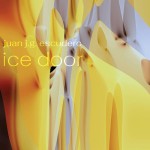

I had previously reviewed Escudero’s album “Shapes of Inner Timespaces,” and found it to be a pleasant listen, so I was interested to see what his next album would sound like. Escudero hails from Madrid, Spain and his day job seems to be mathematics researcher (if my Google Scholar search is bringing back the right person, topology seems to be his forte). The label describes the album thus: “To the bemusement of the rest of us, mathematicians often describe certain equations, processes, and proofs as ‘elegant,’ ‘beautiful,’ or even ‘sensuous.’ Artworks based on algorithms, conversely, might seem less predisposed to such descriptions. But what if those complex calculations actually produced perceptibly emotional qualities?” Well, let’s run the program and see what the numbers give us.
“Páginas de Mar” is chaotic and whimsical right out of the gate. This would be right at home on a Looney tunes cartoon soundtrack. Heavy piano runs, wood blocks, staccato plucked strings and xylophone really make this work well. Seriously, this would be perfect on a cartoon soundtrack. “Sur la Pente du Talus” changes things up significantly. On this one tension is the name of the game, with low bass that is punctuated by the occasional bass stab and other incidental sounds. This would be right at home as the soundtrack to your haunted house next Halloween. “Das Wort als Horizont” moves in a slightly different direction. It's a noisy, scraping, clattering soundscape with an undercurrent that sounds like you're being digested by a large animal. It's noisy, but subdued. “Underland A20” shifts gears again, and this track is a lot of fun. Imagine letting a group of energetic children into a room with assorted orchestra instruments. They start plucking the strings, messing with them, running a bow over them in various places. Some of the children are pushing them around with the bow, dropping them on the floor, playing sword fight with the bows . . . and then they discover the basses. This is where sudden drops of heavy bass happen at times. All over a cacophony of strings. It's a good time, but I'm sure there are some violin players out there that are wincing at this description. “Ice Door” is like sitting in a ship that's been sunk to the bottom of the ocean. The clanks and heavy bass and rattling metal remind you that it hasn't quite settled just yet. The overall feel is kind of dream-like, but it's an unsettling dream. Much like being stuck at the bottom of the ocean. “Coincidence Threshold” is a bit more composed than the previous few tracks. It seems to have a bit more in common with “Páginas de Mar” in the sense that it seems more intentionally put together, but where the prior track is more whimsical in feeling, this track takes a more sinister turn. Heavy bass opens up the track and piano stabs interrupt the drone. The track tacks between animated, as the piano comes in, and sounding like Escudero has run the entire track backwards through a tape deck. I'm generally not a huge fan of piano-based pieces, but this piano player really makes it work.
The judicious use of dissonance is what gives these tracks their charm. Overall if you're looking for experimental classical music this is definitely one to find to check out. If there is a criticism to be had it's that some of the tracks started to sound a little too similar in feel. That said, this is well worth checking out if you're looking for something that pushes the envelope of classical music.
“Páginas de Mar” is chaotic and whimsical right out of the gate. This would be right at home on a Looney tunes cartoon soundtrack. Heavy piano runs, wood blocks, staccato plucked strings and xylophone really make this work well. Seriously, this would be perfect on a cartoon soundtrack. “Sur la Pente du Talus” changes things up significantly. On this one tension is the name of the game, with low bass that is punctuated by the occasional bass stab and other incidental sounds. This would be right at home as the soundtrack to your haunted house next Halloween. “Das Wort als Horizont” moves in a slightly different direction. It's a noisy, scraping, clattering soundscape with an undercurrent that sounds like you're being digested by a large animal. It's noisy, but subdued. “Underland A20” shifts gears again, and this track is a lot of fun. Imagine letting a group of energetic children into a room with assorted orchestra instruments. They start plucking the strings, messing with them, running a bow over them in various places. Some of the children are pushing them around with the bow, dropping them on the floor, playing sword fight with the bows . . . and then they discover the basses. This is where sudden drops of heavy bass happen at times. All over a cacophony of strings. It's a good time, but I'm sure there are some violin players out there that are wincing at this description. “Ice Door” is like sitting in a ship that's been sunk to the bottom of the ocean. The clanks and heavy bass and rattling metal remind you that it hasn't quite settled just yet. The overall feel is kind of dream-like, but it's an unsettling dream. Much like being stuck at the bottom of the ocean. “Coincidence Threshold” is a bit more composed than the previous few tracks. It seems to have a bit more in common with “Páginas de Mar” in the sense that it seems more intentionally put together, but where the prior track is more whimsical in feeling, this track takes a more sinister turn. Heavy bass opens up the track and piano stabs interrupt the drone. The track tacks between animated, as the piano comes in, and sounding like Escudero has run the entire track backwards through a tape deck. I'm generally not a huge fan of piano-based pieces, but this piano player really makes it work.
The judicious use of dissonance is what gives these tracks their charm. Overall if you're looking for experimental classical music this is definitely one to find to check out. If there is a criticism to be had it's that some of the tracks started to sound a little too similar in feel. That said, this is well worth checking out if you're looking for something that pushes the envelope of classical music.
Daniele Brusaschetto: Bruise a Shadow
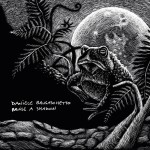
I was not familiar with this artist and the frog artwork did not give much indication of what I was in for, so I put the disc in and hit play. I like hearing the music on its own terms without any preconceived notions. Afterwards, I read the press sheet. Daniele Brusaschetto hails from Turin Italy and the press sheet states that “The new album ties and expands the tropes of the former Flying Stag, hammering even more along the lines of the incandescent lineage of Voivod, Godflesh and early Mastodon. Tracks built in the last 5 years, existentialism, melancholy, daily apocalypse, on-sense, delirium and irony. Granite enriched by the mist of new / no wave, from which the echo of sudden melody emerges, a sort of emotional industry, to uncover beyond the wall of guitars.”
Like most people with a Y and an X chromosome that grew up in the '80s, I too had my metal phase. As such, this album was kind of nostalgic in that it seems to evoke that kind of feel. Brusachetto plays it pretty straight, and by that I mean there's not a lot of distortion or effects, and the voice is relatively unprocessed and non-screaming. Generally, Chain D.L.K. does not review straight metal or hard rock, and more often than not when I am reviewing something with a guitar, drills and other power tools are also involved. This isn't industrial metal like Ministry, or even coldwave stuff like Chemlab. Rather, this is pretty straightforward hard rock. The only inkling of experimentalism is found in “Petra,” which serves more as an interlude. Still, they sent it so I'm going to give my thoughts on it. To me the standout track on here is “Coal Woods,” which is a lovely piece that really showcases the compositional skill of this artist. You could almost think of it as several movements within the same track. The other tracks are quite nice as well and for those of you who speak Italian, you have a couple of tracks just for you. The music is well done and manages to avoid many of the cliches of hard rock and metal. The lyrics have a poetic feel to them which is sometimes lacking in hard rock music. In short, if you're looking for some hard rock with a little bit of a prog feel to it this is certainly worth checking out.
Like most people with a Y and an X chromosome that grew up in the '80s, I too had my metal phase. As such, this album was kind of nostalgic in that it seems to evoke that kind of feel. Brusachetto plays it pretty straight, and by that I mean there's not a lot of distortion or effects, and the voice is relatively unprocessed and non-screaming. Generally, Chain D.L.K. does not review straight metal or hard rock, and more often than not when I am reviewing something with a guitar, drills and other power tools are also involved. This isn't industrial metal like Ministry, or even coldwave stuff like Chemlab. Rather, this is pretty straightforward hard rock. The only inkling of experimentalism is found in “Petra,” which serves more as an interlude. Still, they sent it so I'm going to give my thoughts on it. To me the standout track on here is “Coal Woods,” which is a lovely piece that really showcases the compositional skill of this artist. You could almost think of it as several movements within the same track. The other tracks are quite nice as well and for those of you who speak Italian, you have a couple of tracks just for you. The music is well done and manages to avoid many of the cliches of hard rock and metal. The lyrics have a poetic feel to them which is sometimes lacking in hard rock music. In short, if you're looking for some hard rock with a little bit of a prog feel to it this is certainly worth checking out.