
Browse by Genre
Industrial Music / Industrial Metal / Aggro Industrial / Electro Metal
Industrial Noise / Power Noise / Harsh Noise
Synth Pop / Electro Pop / Synth-Electronica
Techno / Trance / Goa / Drum'n'Bass / Jungle / Tribal / Trip-Hop
Ambient / Electronica / Ethereal / Dub / Soundscapes / Abstract
Experimental / Avantgarde / Weird & Wired / Glitch / Noise / Field Recording
Dark / Gothic / Wave / New Wave / Dark Wave / Industrial Gothic
New Music / Downtown / Avantgarde Jazz / New Classical / World
Search Reviews
Music Reviews
Stilluppsteypa: Schokolino Choco Loco
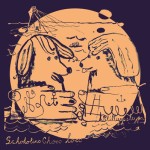
Artist: Stilluppsteypa
Title: Schokolino Choco Loco
Format: 12" + Download
Label: Futura Resistenza (@)
Rated:

Title: Schokolino Choco Loco
Format: 12" + Download
Label: Futura Resistenza (@)
Rated:
Stilluppsteypa have always been the kind of band that makes you wonder if they’re secretly feeding on static, schnapps, and dada poetry rather than air and food. With "Schokolino Choco Loco", their new LP on Futura Resistenza, the Icelandic duo - Sigtryggur Berg Sigmarsson and Helgi Thorsson - continue to prove that absurdity, when treated with care, can be one of the most tender forms of art.
Formed in the early ’90s as a larger punk-infected unit before trimming down and dissolving into abstraction, Stilluppsteypa have made a career out of turning non-sequiturs into full-blown universes. Their catalogue reads like a parallel history of electronic music: a playful detour where Mille Plateaux austerity was swapped for pranks, stories, and sonic collages that feel like dreams narrated by your weird uncle after two glasses of brennivín. Collaborations with Benny Nilsen or Melt-Banana only added fuel to the fire, creating an oeuvre where experimentalism was always laced with humour and a strangely gentle kind of humanity.
On "Schokolino Choco Loco", that ethos remains intact, even sharpened. Recorded over several years and lovingly assembled, the album feels like eavesdropping on pirate radio run by friendly aliens who learned English by mishearing pop songs in a Reykjavík laundromat. Titles like "hot and steamy sweatpants" or "farmer had a farm song (crazy dog lady)" point toward comedy, but the sounds themselves are often delicate, even moving. It’s this tension between silliness and sensitivity that makes the album so compelling: you chuckle, then suddenly you’re blindsided by a wave of melancholy.
Side A begins with fractured sketches ("downtown club owner", "no need to thank meme"), pieces that feel like found tape experiments spliced with private jokes. Yet amid the dada collage, "look what the dog bought in" stretches out to eight minutes of woozy drift, somewhere between hypnosis and lullaby, as if the dog in question dragged home not a bone but a whole philosophy of sound.
Side B, meanwhile, leans even more into surreal whimsy. "shakin cat stevens" is as deranged as its title suggests, while "ukulele house of worship aka casino place" manages to fuse devotion and kitsch in a way that feels both irreverent and oddly sincere. The closing "unexpected money transfer" is pure Stilluppsteypa: part joke, part atmosphere, part moment of real emotional resonance. It’s as though they’re reminding us that accidents - musical or financial - can sometimes be gifts.
What sets Stilluppsteypa apart, and what "Schokolino Choco Loco" reaffirms, is their refusal to treat experimental music as a grim, serious task. For them, abstraction is a playground, chaos a kind of natural law to be embraced, and humour a way of keeping the heart open. In a musical world that often mistakes severity for depth, they offer a different model: that laughter and warmth can be just as radical as noise and theory.
So yes, this record is loco. It’s also choco - sweet in its absurdity, melting into your ears with a richness that is both ridiculous and disarmingly sincere. Drop the needle, and let the Icelanders guide you through their cracked funhouse. You may not understand everything, but you’ll come out smiling, a little dizzy, and maybe - just maybe - a kinder human being.
Formed in the early ’90s as a larger punk-infected unit before trimming down and dissolving into abstraction, Stilluppsteypa have made a career out of turning non-sequiturs into full-blown universes. Their catalogue reads like a parallel history of electronic music: a playful detour where Mille Plateaux austerity was swapped for pranks, stories, and sonic collages that feel like dreams narrated by your weird uncle after two glasses of brennivín. Collaborations with Benny Nilsen or Melt-Banana only added fuel to the fire, creating an oeuvre where experimentalism was always laced with humour and a strangely gentle kind of humanity.
On "Schokolino Choco Loco", that ethos remains intact, even sharpened. Recorded over several years and lovingly assembled, the album feels like eavesdropping on pirate radio run by friendly aliens who learned English by mishearing pop songs in a Reykjavík laundromat. Titles like "hot and steamy sweatpants" or "farmer had a farm song (crazy dog lady)" point toward comedy, but the sounds themselves are often delicate, even moving. It’s this tension between silliness and sensitivity that makes the album so compelling: you chuckle, then suddenly you’re blindsided by a wave of melancholy.
Side A begins with fractured sketches ("downtown club owner", "no need to thank meme"), pieces that feel like found tape experiments spliced with private jokes. Yet amid the dada collage, "look what the dog bought in" stretches out to eight minutes of woozy drift, somewhere between hypnosis and lullaby, as if the dog in question dragged home not a bone but a whole philosophy of sound.
Side B, meanwhile, leans even more into surreal whimsy. "shakin cat stevens" is as deranged as its title suggests, while "ukulele house of worship aka casino place" manages to fuse devotion and kitsch in a way that feels both irreverent and oddly sincere. The closing "unexpected money transfer" is pure Stilluppsteypa: part joke, part atmosphere, part moment of real emotional resonance. It’s as though they’re reminding us that accidents - musical or financial - can sometimes be gifts.
What sets Stilluppsteypa apart, and what "Schokolino Choco Loco" reaffirms, is their refusal to treat experimental music as a grim, serious task. For them, abstraction is a playground, chaos a kind of natural law to be embraced, and humour a way of keeping the heart open. In a musical world that often mistakes severity for depth, they offer a different model: that laughter and warmth can be just as radical as noise and theory.
So yes, this record is loco. It’s also choco - sweet in its absurdity, melting into your ears with a richness that is both ridiculous and disarmingly sincere. Drop the needle, and let the Icelanders guide you through their cracked funhouse. You may not understand everything, but you’ll come out smiling, a little dizzy, and maybe - just maybe - a kinder human being.
Gonçalo F. Cardoso: Impressões de Várias Ilhas

Artist: Gonçalo F. Cardoso
Title: Impressões de Várias Ilhas
Format: LP
Label: Discrepant (@)
Rated:
Title: Impressões de Várias Ilhas
Format: LP
Label: Discrepant (@)
Rated:
There’s a particular magic in the way Gonçalo F. Cardoso keeps turning the humble act of listening into a passport. With "Impressões de Várias Ilhas", the Discrepant mastermind continues his sonic travelogue into island life, after previous detours to Unguja and Borneo. This time, his ears, and microphones roam Macaronesia - those scattered archipelagos of the Azores, Cape Verde, and the Canaries, places that seem to exist halfway between postcards and geological fables.
But if you expect lush sound panoramas ready for a National Geographic special, think again. Cardoso doesn’t make sonic tourism; he makes sonic hauntings. His “impressions” are less about documenting reality than about filtering it through memory, dreams, and a certain sly mischief. A frog chorus in Santo Antão becomes musique concrète in disguise ("Rãs em Xoxo"), while the hiss of waves in "Bufadeiros de São Vicente" carries the weirdly soothing irregularity of something alive and disinterested in human schedules. It’s as if the sea is saying: “You may record me, but you’ll never own me”.
Pieces like "La Cueva Scuba Livre" dive beneath the surface (literally), surrounding us with subaquatic pads and reverberant emptiness, a scuba-dream bordering on cosmic. Others, like "Noite em Rabo de Peixe", evoke night’s low-level anxieties: detuned chords scraping in the dark, the sound of shadows leaning too close. Then there’s the culinary oddity of "Cozido na Caldeira Velha", a field-recorded memory of food bubbling away in volcanic steam, but rendered like a Boards of Canada miniature that slipped into a cooking pot. You can almost smell the sulphur in your headphones.
What makes the record compelling is Cardoso’s refusal to choose between the real and the unreal. His recordings are at once intimate and estranged: the natural sounds are so specific they feel tactile, but the processing and juxtaposition push them into surreal territory. Take "Salinas de Pedra Lume" - a piece that shuffles between crackling ambience, ghostly synths, and what could be flutes or wolves or both. It plays like a saltpan remembering its past lives, or perhaps foretelling yours.
Cardoso’s role here is less composer than medium, a guide who knows how to stand back and let places whisper through him. The album’s diary-like form, with its short sketches and sudden shifts, resists any neat narrative. It mirrors island life itself: fragmented, cyclical, full of small details that refuse to coalesce into a single picture. And yet, listening across its 14 vignettes, you do feel a unity - an archipelago of impressions that together form a map of the in-between: between land and sea, between memory and invention, between postcard prettiness and something stranger, more enduring.
At its core, "Impressões de Várias Ilhas" is a reminder that islands are not isolated dots on a map but dense nodes of memory, myth, and sound. Cardoso approaches them not as a tourist, but as a conspirator with their echoes. The result is an album that is playful, uncanny, and quietly profound - an archipelago of listening exercises that invites us to hear not just the islands, but the way they continue to reverberate in us long after the waves recede.
But if you expect lush sound panoramas ready for a National Geographic special, think again. Cardoso doesn’t make sonic tourism; he makes sonic hauntings. His “impressions” are less about documenting reality than about filtering it through memory, dreams, and a certain sly mischief. A frog chorus in Santo Antão becomes musique concrète in disguise ("Rãs em Xoxo"), while the hiss of waves in "Bufadeiros de São Vicente" carries the weirdly soothing irregularity of something alive and disinterested in human schedules. It’s as if the sea is saying: “You may record me, but you’ll never own me”.
Pieces like "La Cueva Scuba Livre" dive beneath the surface (literally), surrounding us with subaquatic pads and reverberant emptiness, a scuba-dream bordering on cosmic. Others, like "Noite em Rabo de Peixe", evoke night’s low-level anxieties: detuned chords scraping in the dark, the sound of shadows leaning too close. Then there’s the culinary oddity of "Cozido na Caldeira Velha", a field-recorded memory of food bubbling away in volcanic steam, but rendered like a Boards of Canada miniature that slipped into a cooking pot. You can almost smell the sulphur in your headphones.
What makes the record compelling is Cardoso’s refusal to choose between the real and the unreal. His recordings are at once intimate and estranged: the natural sounds are so specific they feel tactile, but the processing and juxtaposition push them into surreal territory. Take "Salinas de Pedra Lume" - a piece that shuffles between crackling ambience, ghostly synths, and what could be flutes or wolves or both. It plays like a saltpan remembering its past lives, or perhaps foretelling yours.
Cardoso’s role here is less composer than medium, a guide who knows how to stand back and let places whisper through him. The album’s diary-like form, with its short sketches and sudden shifts, resists any neat narrative. It mirrors island life itself: fragmented, cyclical, full of small details that refuse to coalesce into a single picture. And yet, listening across its 14 vignettes, you do feel a unity - an archipelago of impressions that together form a map of the in-between: between land and sea, between memory and invention, between postcard prettiness and something stranger, more enduring.
At its core, "Impressões de Várias Ilhas" is a reminder that islands are not isolated dots on a map but dense nodes of memory, myth, and sound. Cardoso approaches them not as a tourist, but as a conspirator with their echoes. The result is an album that is playful, uncanny, and quietly profound - an archipelago of listening exercises that invites us to hear not just the islands, but the way they continue to reverberate in us long after the waves recede.
PETRU KSS: Mirage EP

Artist: PETRU KSS (@)
Title: Mirage EP
Format: Download Only (MP3 + Lossless)
Label: City Wall Records (@)
Rated:

Title: Mirage EP
Format: Download Only (MP3 + Lossless)
Label: City Wall Records (@)
Rated:
There’s a reason PETRU KSS calls his new EP "Mirage" - this is techno as fata morgana, a flickering image in the heat of a desert rave, just out of reach, seductive precisely because you can’t pin it down. Released on City Wall, the record comes as both a declaration and an invitation: step into the shimmer, sweat out your doubts, and let repetition blur into vision.
PETRU (aka Petru Kss, Romanian-born, London-based, and steadily carving a name in the European underground) has been orbiting between moody deep techno and more melodic, emotionally charged structures. Here, he embraces the in-between: the title track is a rolling groove that refuses to settle, its melodic line both earworm and shadow, something you chase without ever quite catching. It’s high-energy but strangely mysterious, like a banger with a secret life. The irony, of course, is that the “illusion” is the hook itself: you keep following it deeper into the mirage, knowing it will vanish, but addicted to the chase.
The remixes cleverly refract this mirage into different climates. Developer - the LA techno titan known for brutal precision - delivers exactly what you’d expect and what you secretly wanted: a pounding, unrelenting machine march. No tricks, no flourishes, just a straight line into the heart of the void. If PETRU’s original is about seduction, Developer’s version is about discipline: a mirage turned into a treadmill you can’t step off.
Ross Harper, meanwhile, does the opposite - his rework lightens the texture, injects playfulness, makes the mirage sparkle. It’s a kind of sonic sleight of hand, reframing the same material as a dancefloor tease: crisp, energetic, and cheeky where the others are brooding. In Harper’s hands, the desert turns into a carnival.
And then comes "Prelude to Mirage", PETRU’s own epilogue (or maybe prologue, depending on how you listen). It slows down the pulse, widens the horizon, and lets the emotional content rise to the surface. Here, the mirage is not just a dancefloor trick but a metaphor for longing itself: the thing we chase, the image we project, the shimmer that keeps us moving even when we know it’s “not really there.” It’s almost symphonic in scope, atmospheric and grand, as though PETRU wanted to remind us that techno can be both heatstroke and hallucination, both body and myth.
What holds the EP together is contrast: pressure versus release, playfulness versus relentlessness, seduction versus brute force. PETRU understands that techno thrives on paradox - that you need the mirage as much as you need the ground beneath your feet. In this sense, the record is more than a collection of tracks; it’s a miniature philosophy of club music, one that says: illusion isn’t a bug, it’s the point.
And perhaps that’s why "Mirage" lingers after the last beat fades. You remember it the way you remember heat waves on asphalt: shimmering, elusive, not entirely real, but impossible to forget.
PETRU (aka Petru Kss, Romanian-born, London-based, and steadily carving a name in the European underground) has been orbiting between moody deep techno and more melodic, emotionally charged structures. Here, he embraces the in-between: the title track is a rolling groove that refuses to settle, its melodic line both earworm and shadow, something you chase without ever quite catching. It’s high-energy but strangely mysterious, like a banger with a secret life. The irony, of course, is that the “illusion” is the hook itself: you keep following it deeper into the mirage, knowing it will vanish, but addicted to the chase.
The remixes cleverly refract this mirage into different climates. Developer - the LA techno titan known for brutal precision - delivers exactly what you’d expect and what you secretly wanted: a pounding, unrelenting machine march. No tricks, no flourishes, just a straight line into the heart of the void. If PETRU’s original is about seduction, Developer’s version is about discipline: a mirage turned into a treadmill you can’t step off.
Ross Harper, meanwhile, does the opposite - his rework lightens the texture, injects playfulness, makes the mirage sparkle. It’s a kind of sonic sleight of hand, reframing the same material as a dancefloor tease: crisp, energetic, and cheeky where the others are brooding. In Harper’s hands, the desert turns into a carnival.
And then comes "Prelude to Mirage", PETRU’s own epilogue (or maybe prologue, depending on how you listen). It slows down the pulse, widens the horizon, and lets the emotional content rise to the surface. Here, the mirage is not just a dancefloor trick but a metaphor for longing itself: the thing we chase, the image we project, the shimmer that keeps us moving even when we know it’s “not really there.” It’s almost symphonic in scope, atmospheric and grand, as though PETRU wanted to remind us that techno can be both heatstroke and hallucination, both body and myth.
What holds the EP together is contrast: pressure versus release, playfulness versus relentlessness, seduction versus brute force. PETRU understands that techno thrives on paradox - that you need the mirage as much as you need the ground beneath your feet. In this sense, the record is more than a collection of tracks; it’s a miniature philosophy of club music, one that says: illusion isn’t a bug, it’s the point.
And perhaps that’s why "Mirage" lingers after the last beat fades. You remember it the way you remember heat waves on asphalt: shimmering, elusive, not entirely real, but impossible to forget.
Bob Semp: Retroflect EP
Techno, in its best incarnations, is not merely about propulsion - it’s about architecture, about sculpting pressure and release into something that leaves both body and mind slightly altered. Bob Semp, a rising Dutch producer who’s already carved out a small but distinctive niche, understands this instinctively. With "Retroflect", his second outing on Barcelona’s ever-adventurous TUTU label, he turns the dancefloor into a hall of mirrors: every beat reflects another, every layer refracts the one beneath, until the listener is caught in a kaleidoscope of rhythm and resonance. And yes, it dropped back in April 2024 - better reviewing it late than never, especially when the music still feels this sharp and relevant.
The title is telling. To "retroflect" is to look backward while still projecting forward, to take stock of what has been while spinning it into what could be. This duality - past and future, reflection and propulsion - runs through the five tracks here. Bob Semp isn’t content to bang out four-on-the-floor formulas; instead, he teases the listener with an unusual sense of detail, where tiny filigrees of sound cut through muscular patterns like glimmers on a stormy sea.
“Nightshade” opens the set with a slinky menace, nocturnal but not oppressive, its pulse both seductive and slightly toxic, like a flower you’re tempted to touch but know you probably shouldn’t. “Outer Realm” pushes deeper into cosmic terrain, a track that feels weightless and pressurized at the same time, as though gravity were constantly shifting beneath your feet. The title track, “Retroflect”, is the axis of the record: sharp, hypnotic, designed like a Möbius strip of rhythm where forward momentum feels inseparable from déjà vu.
On “Unseen Quest”, Semp edges toward narrative - a track that doesn’t just drive but unfolds, each loop a stepping stone across a river of sound. And finally, “Soul Linkage” closes the EP with a more human pulse, almost tender by techno standards, as if after all the circuitry and night drives, there’s still a heartbeat at the center of the machine.
What makes Bob Semp stand out isn’t just his technical precision - plenty of producers can throw layers on layers - but his ability to maintain intensity without falling into monotony. His tracks invite attention to detail, rewarding close listening while still providing enough kinetic energy to move a floor. They’re intelligent without being pretentious, physical without being brutish.
In the larger story of techno, Semp may be relatively young, but "Retroflect" shows an artist already grappling with the genre’s paradoxes: the machine that feels human, the repetition that creates transcendence, the forward thrust that’s haunted by echoes of the past. It’s techno as both mirror and engine, reflecting us even as it drives us somewhere new.
The title is telling. To "retroflect" is to look backward while still projecting forward, to take stock of what has been while spinning it into what could be. This duality - past and future, reflection and propulsion - runs through the five tracks here. Bob Semp isn’t content to bang out four-on-the-floor formulas; instead, he teases the listener with an unusual sense of detail, where tiny filigrees of sound cut through muscular patterns like glimmers on a stormy sea.
“Nightshade” opens the set with a slinky menace, nocturnal but not oppressive, its pulse both seductive and slightly toxic, like a flower you’re tempted to touch but know you probably shouldn’t. “Outer Realm” pushes deeper into cosmic terrain, a track that feels weightless and pressurized at the same time, as though gravity were constantly shifting beneath your feet. The title track, “Retroflect”, is the axis of the record: sharp, hypnotic, designed like a Möbius strip of rhythm where forward momentum feels inseparable from déjà vu.
On “Unseen Quest”, Semp edges toward narrative - a track that doesn’t just drive but unfolds, each loop a stepping stone across a river of sound. And finally, “Soul Linkage” closes the EP with a more human pulse, almost tender by techno standards, as if after all the circuitry and night drives, there’s still a heartbeat at the center of the machine.
What makes Bob Semp stand out isn’t just his technical precision - plenty of producers can throw layers on layers - but his ability to maintain intensity without falling into monotony. His tracks invite attention to detail, rewarding close listening while still providing enough kinetic energy to move a floor. They’re intelligent without being pretentious, physical without being brutish.
In the larger story of techno, Semp may be relatively young, but "Retroflect" shows an artist already grappling with the genre’s paradoxes: the machine that feels human, the repetition that creates transcendence, the forward thrust that’s haunted by echoes of the past. It’s techno as both mirror and engine, reflecting us even as it drives us somewhere new.
Wil Bolton: Stari Grad

Artist: Wil Bolton
Title: Stari Grad
Format: CD + Download
Label: Sound In Silence Records (@)
Rated:
Title: Stari Grad
Format: CD + Download
Label: Sound In Silence Records (@)
Rated:
Haven't heard anything by UK ambient artist Will Bolton since his 'Surface Reflections' album in 2019. 'Stari Grad' features two long-form tracks recorded during Wil Bolton’s residency at Radio Belgrade’s Electronic Studio in June 2024. Named after the Serbian capital city’s old town area where the studio is located, it features environmental sounds recorded in nearby streets during the sweltering heat of early summer alongside thick, buzzing tones patched on the studio’s massive 1970s EMS Synthi 100 synthesizer. Additional reverb was added back at the artist’s studio in East London and the final mixes were carefully mastered by George Mastrokostas (Absent Without Leave) in Athens.
The first piece, "Skadarlija" (21:00) features harmonium-like sustained chordal drone with measured bass tones at intervals amidst birds and other quiet-side city ambience (footsteps on the pavement, a rumbling cart), and later, filtered synth drone. With that, you can kind of sense the heat rising off the sidewalk. Fans of minimal environmental ambient might like this one, as that is surely exactly what this is. "Venizeloslova" (also 21:00) is the second piece, with an ambiance more reflective of the seashore with the ebb and flow of noise with an overlay of of synth drones. This could also be highway traffic at a distance, perhaps in the rain, a wet roadway? I'd rather be at the seashore though, especially in the summer heat. Interestingly, there is a feeling of loneliness and isolation. Definitely of the Brian Eno school of minimal ambient music, meant to be passive and innocuous; wallpaper music for places without walls.
For more than twenty years Wil Bolton has been making predominantly sound-based artworks for both music releases and installations, often enhanced with video or photography. His work has been shown in many exhibitions and festivals and has also worked on projects with video artists, choreographers and dancers. He is co-owner of the electronic label Boltfish Recordings and has also released several albums and EPs under the moniker of Cheju. From time to time he has also collaborated with other sound-like musicians on projects like Ashlar, Le Moors, Anzio Green, The Ashes Of Piemonte, Wil & Tarl, Biotron Shelf and others. Under his own name he has offered many releases, which gained high worldwide praises, on labels such as Home Normal, Hibernate Recordings, Eilean Rec., Dronarivm, Dauw, Fluid Audio, Time Released Sound and many others.
The first piece, "Skadarlija" (21:00) features harmonium-like sustained chordal drone with measured bass tones at intervals amidst birds and other quiet-side city ambience (footsteps on the pavement, a rumbling cart), and later, filtered synth drone. With that, you can kind of sense the heat rising off the sidewalk. Fans of minimal environmental ambient might like this one, as that is surely exactly what this is. "Venizeloslova" (also 21:00) is the second piece, with an ambiance more reflective of the seashore with the ebb and flow of noise with an overlay of of synth drones. This could also be highway traffic at a distance, perhaps in the rain, a wet roadway? I'd rather be at the seashore though, especially in the summer heat. Interestingly, there is a feeling of loneliness and isolation. Definitely of the Brian Eno school of minimal ambient music, meant to be passive and innocuous; wallpaper music for places without walls.
For more than twenty years Wil Bolton has been making predominantly sound-based artworks for both music releases and installations, often enhanced with video or photography. His work has been shown in many exhibitions and festivals and has also worked on projects with video artists, choreographers and dancers. He is co-owner of the electronic label Boltfish Recordings and has also released several albums and EPs under the moniker of Cheju. From time to time he has also collaborated with other sound-like musicians on projects like Ashlar, Le Moors, Anzio Green, The Ashes Of Piemonte, Wil & Tarl, Biotron Shelf and others. Under his own name he has offered many releases, which gained high worldwide praises, on labels such as Home Normal, Hibernate Recordings, Eilean Rec., Dronarivm, Dauw, Fluid Audio, Time Released Sound and many others.